
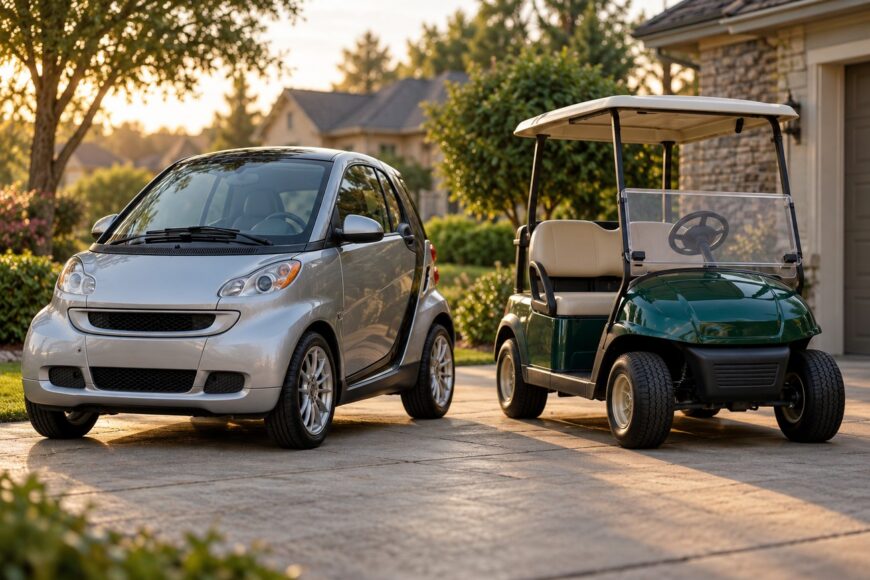
The Smart Fortwo is unusually light and compact for a passenger car, yet an ordinary golf cart is still generally unsuitable as its tow vehicle. Vehicle weight alone does not determine whether a towing combination is safe. The cart also needs sufficient traction, braking capacity, hitch strength, stability, and legal approval for the job.
This question involves two different tasks. Towing a Smart with a golf cart means the golf cart is the powered tow vehicle; transporting a golf cart on a trailer is an entirely different use. A short, controlled relocation on private property may be possible with suitable equipment, but it should not be treated as road towing. The Smart’s exact transmission and powertrain create another limitation because wheels-down movement is not approved for every Fortwo.
- Can a Golf Cart Tow a Smart Fortwo?
- Golf Cart Capability vs. Smart Fortwo Weight
- Why a Light Smart Still Needs a Real Tow Vehicle
- Smart Fortwo Transmission Rules: Flat-Towing Is Not Universal
- Legal and Safety Checks Before Moving the Car
- Safer Ways to Move a Smart Fortwo
- Frequently asked questions
- How much does a Smart Fortwo weigh?
Can a Golf Cart Tow a Smart Fortwo?
An ordinary golf cart should not be treated as a tow vehicle for a Smart Fortwo. Most golf carts are low-speed vehicles that are not designed or approved to tow a passenger car such as a Smart Fortwo. Their ability to move a light load around a course or residential area does not establish that they can control a car during acceleration, braking, turning, or downhill travel.
The Fortwo is unusually light and compact compared with typical passenger cars, which explains why it can appear easy to push or move. That observation concerns static effort only. Once the Smart is connected to a moving cart, its rolling resistance, momentum, and movement over uneven ground create forces that the cart must transmit through its hitch, frame, tires, and brakes.
Traction is another weak point. A golf cart may move adequately on a level, firm surface but lose grip when starting on a slope or pulling over loose ground. During braking, the towed Smart can push the cart forward, especially downhill. A cart that can pull the vehicle slowly for a few feet may still lack the reserve needed to stop and remain directional.
For normal road transport, the practical answer is no. A properly rated trailer, flatbed, tow truck, or professional recovery vehicle provides a more predictable connection and braking arrangement. A private-property maneuver should still be limited to a controlled area, with compatible equipment and no assumption that a successful short roll proves the setup is safe.
Golf Cart Capability vs. Smart Fortwo Weight
The comparison below separates features that allow a golf cart to use certain roads from features required to tow a passenger car. The Smart’s exact weight varies by model year, body style, and powertrain, so no single figure applies to every Fortwo.
| Requirement | What a typical golf cart provides | What Smart towing requires |
|---|---|---|
| Propulsion | Low-speed movement for the cart and its intended occupants or load | Enough sustained traction to start, climb, and control a separate passenger car |
| Braking | Braking sized for the cart’s own mass and approved use | Reserve capacity to stop the combined moving load, including on slopes |
| Hitch and frame | Often no passenger-car-rated hitch or tow structure | A rated attachment point and frame capable of handling pull, shock, and turning loads |
| Stability | Designed around the cart’s own wheelbase and load distribution | Stable control while the Smart follows, pushes, or shifts across bumps and turns |
| Road speed | Some street-legal versions operate in a low-speed range, commonly cited as 20–25 mph | Road-legal towing equipment, lighting, braking, and a lawful towing speed for the jurisdiction |
| Legal status | May meet local requirements for low-speed road use | Separate authorization to tow another vehicle, which may be restricted or prohibited |
References to FMVSS 500 or a 20–25 mph operating range concern low-speed vehicle equipment and road access. They do not establish towing capacity, hitch suitability, braking reserve, or permission to tow a Smart Fortwo. A street-legal golf cart can therefore remain technically and legally unsuitable for this task.
Why a Light Smart Still Needs a Real Tow Vehicle
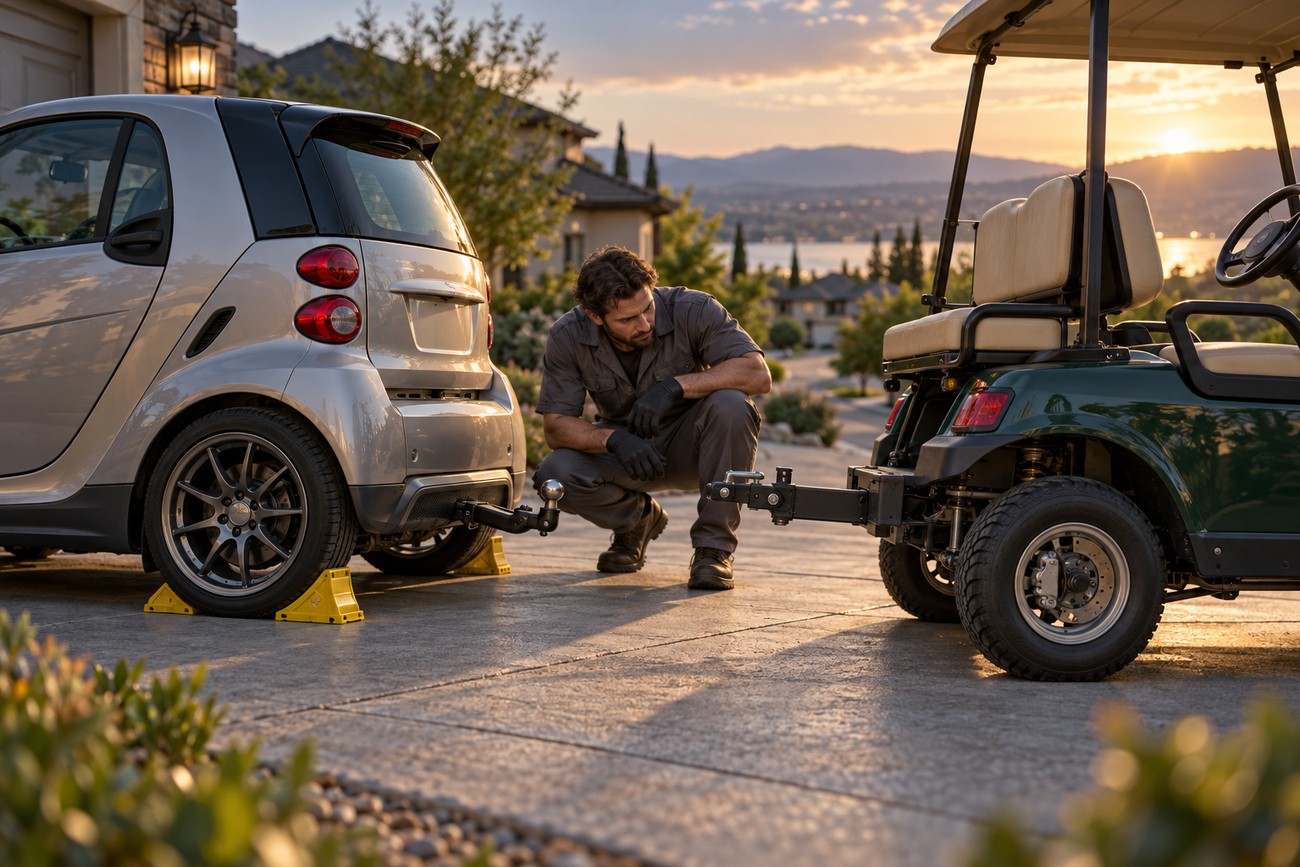
The difficult part is controlling the combined vehicles rather than merely getting them moving. On a slope, the cart must overcome the Smart’s rolling resistance while maintaining tire grip. When the cart slows or stops, the Smart’s momentum acts through the tow connection and can push the cart, overload its brakes, or disturb its direction.
Hitch loads also change as the combination turns, crosses a dip, or moves over a bump. An improvised attachment point may carry a straight pull yet fail under a sideways or shock load. Load distribution matters as well: the cart’s driven tires may be lightly loaded while the connected Smart adds force behind them, reducing the grip available for acceleration and steering.
Many golf carts do not have the traction, braking, stability, or hitch design expected for towing a passenger car. Their brakes are commonly intended to stop the cart itself. Adding a rolling vehicle changes the stopping distance and the behavior of the whole combination, even when the towed vehicle seems small.
The Fortwo’s small size does not eliminate the effects of bumps and uneven surfaces. Poor pavement can increase tow-bar movement, steering disturbance, and suspension loads. A Smart that can be pushed by hand on level ground may still create dangerous dynamic forces when connected to a moving cart.
Smart Fortwo Transmission Rules: Flat-Towing Is Not Universal
Flat-towing means moving the Smart with its wheels on the ground behind another vehicle. Whether that is permitted depends on the exact transmission and powertrain, as well as the manufacturer’s instructions. It is a separate question from whether the golf cart has enough capacity or legal authority to act as the tow vehicle.
The cited confirmation applies to MY2016–MY2017 ICE coupe and cabrio models equipped with the twinamic DCT. In that same information, manual-transmission and electric versions are identified as not approved for flat-towing. This limited exception should not be generalized to every Fortwo, including other model years or configurations.
Verify the exact transmission and powertrain before moving the car; a neutral selector position or a short successful roll is not evidence of flat-tow approval.
Owners should check the relevant owner’s manual and vehicle specifications before allowing the driven wheels to roll. Parking, neutral, steering, and restraint procedures can differ by transmission. A car that appears to be in neutral may still be unsuitable for extended wheels-down movement.
Even confirmed flat-tow approval only describes how an approved tow vehicle may move the Smart. It does not approve an ordinary golf cart, create a rated hitch, or solve the cart’s braking and stability limitations. Both vehicles must be suitable for the complete combination.
Legal and Safety Checks Before Moving the Car
Physical attachment does not make a towing arrangement legal. Rules vary by state, country, road type, and private-property context. Some jurisdictions restrict or prohibit towing a vehicle with its wheels on the ground, while others impose requirements for brakes, lighting, tow bars, safety connections, and the vehicle doing the towing.
Check the local rules for golf-cart road use and for towing another vehicle before entering a public road. Also confirm whether the road has a minimum-speed rule, whether the cart may operate there, and whether the attachment method is approved. Street-legal registration for the golf cart does not automatically give it legal or technical authority to tow a Smart Fortwo.
Private property may be governed differently, but it does not remove mechanical risk. A short movement across a firm, level surface still requires a secure rated connection, sufficient braking, clear steering, and people kept away from the gap between the vehicles. A tow strap or improvised hitch can fail without warning and is difficult to control if the cart loses traction.
For public-road movement, a trailer, flatbed, or properly equipped professional recovery vehicle is generally more predictable. It keeps the load supported by equipment designed for transport and avoids many wheels-down transmission and legal complications. Local requirements still apply to the trailer and recovery vehicle.
Safer Ways to Move a Smart Fortwo
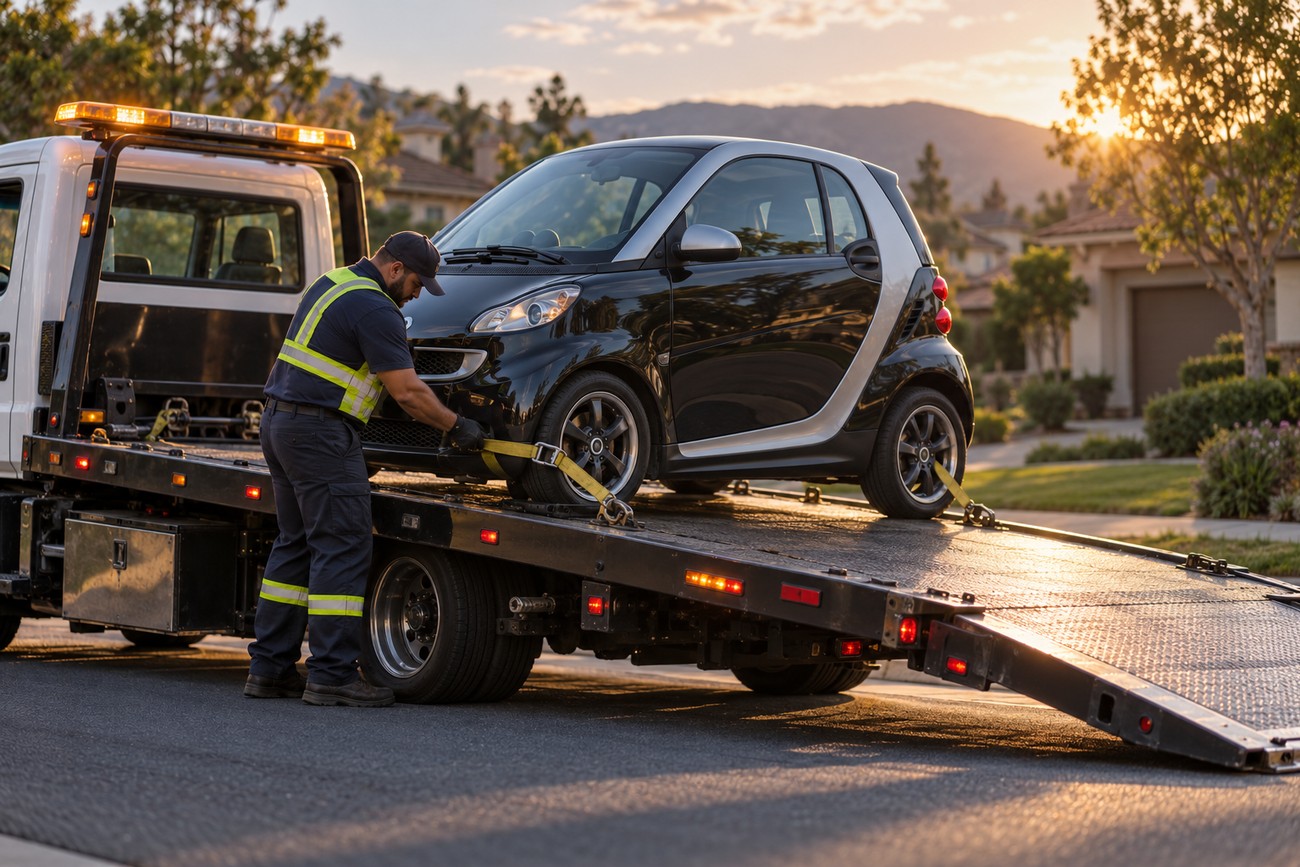
The preferred solution is a properly rated tow truck, flatbed, or trailer rather than an ordinary golf cart. Before any wheels-down movement, verify the Smart’s model year, body style, transmission, and powertrain. Do not rely on a generic statement that all Smart cars are light or can be towed.
A trailer or flatbed must match the vehicle’s dimensions, attachment points, loading method, and weight rating. A tow dolly is not automatically suitable for every Fortwo because its wheel position and the Smart’s approved transport method must be compatible. The owner’s manual and equipment instructions should be checked together.
If the car only needs to be relocated on private property, keep the maneuver slow, short, and controlled. Use a rated connection attached to suitable structural points, confirm that the cart can brake the combined load, and choose a firm surface without steep grades or sharp bumps. Do not allow bystanders near the connection or inside the path of either vehicle.
The Smart’s small dimensions do not replace proper towing equipment. For normal road transport, the safest practical conclusion is that an ordinary golf cart is not an appropriate tow vehicle for a Smart Fortwo.
Frequently asked questions
How much does a Smart Fortwo weigh?
There is no single weight that applies to every Smart Fortwo. The figure varies by model year, body style, and powertrain, including whether the vehicle uses an internal-combustion engine or an electric system.
Use the exact specification in the vehicle documentation rather than a generic internet figure. Even an unusually light Fortwo still requires a tow vehicle with adequate traction, braking, stability, and a rated connection. Weight is one input in the assessment, not proof that a golf cart can tow it safely.







