
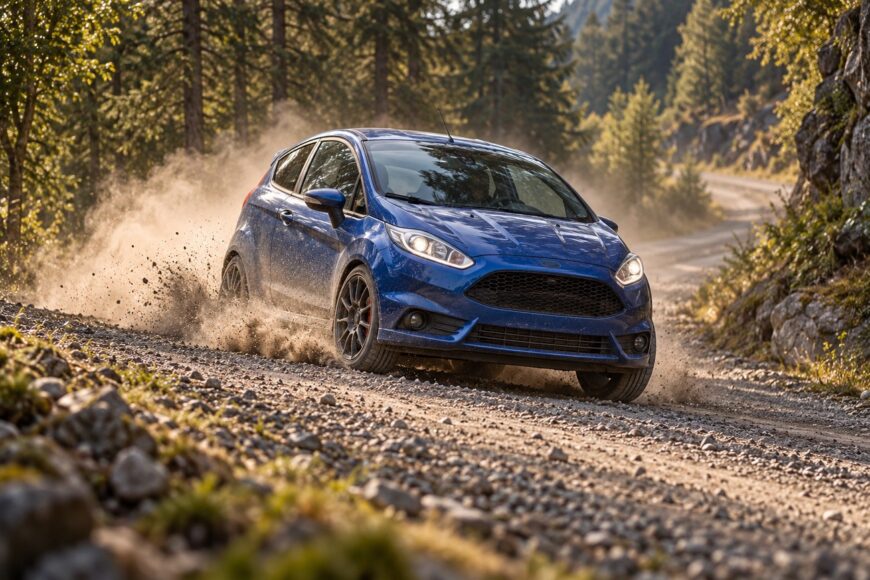
Yes, a Ford Fiesta ST can handle a gravel rally stage, but only after substantial preparation. A stock car is built for paved roads and track days, with front-wheel drive, low clearance, firm short-travel suspension, and no rally-grade protection. Those choices make it sharp on tarmac and vulnerable on rough, rocky stages.
The important distinction is between a showroom Fiesta ST and a prepared Fiesta R2, Rally, Cup, or similar competition car. Prepared versions use a safety cage, rally suspension, gravel tires, underbody protection, and competition brakes. That is why Fiesta-based cars have succeeded in rallying; the marketing reputation does not mean an ordinary road car is ready for a gravel special stage.
- The Short Answer: Yes, but Not in Stock Form
- Why the Stock Fiesta ST Struggles on Gravel
- What a Safe Gravel Conversion Requires
- Can a Prepared Fiesta ST Be Competitive?
- Frequently asked questions
- How much horsepower can a Ford Fiesta ST handle?
- What should be checked after a Fiesta ST gravel stage?
- What car went from 0 to 60 mph in 2.5 seconds on gravel?
- What Ford Fiesta is used for rally?
- What car was banned from rally?
The Short Answer: Yes, but Not in Stock Form
The production Fiesta ST has useful traits for gravel: a light body, responsive controls, and front-wheel drive that can be exploited with clean weight transfer and careful throttle work. A lower-powered car can also be easier to manage on loose surfaces than a powerful all-wheel-drive machine. Its basic chassis is a reasonable starting point.
That starting point needs extensive work. A Fiesta R2 or Rally car has a reinforced body, safety cage, rally dampers and springs, increased usable suspension travel, underbody protection, and competition brakes. It is a purpose-built competition configuration, not a standard trim level with a different driving mode.
Some local amateur events may accept lightly modified Fiesta STs under simplified rules. Eligibility depends on the organizer, the route, and the required safety equipment. Acceptance in such an event does not make the car compliant with full FIA-level gravel rally regulations.
Why the Stock Fiesta ST Struggles on Gravel
The first problem is traction. On loose gravel, the front tires must steer and transmit drive at the same time, so the car can develop pronounced understeer, especially without a factory limited-slip differential. An asphalt alignment and road tires make that response worse: the car pushes wide while the driver is still asking for acceleration.
Road suspension is the next failure point. Production clearance is approximately 120–140 mm, and the firm, short-travel setup is designed for smooth pavement. On corrugations, ruts, and landings, the dampers can run into their stops, sending sharp loads through the body, wheels, and suspension mounts.
There is also little margin underneath. A stock Fiesta ST lacks full protection for the sump, transmission, fuel lines, brake lines, and other vulnerable components. One misplaced rock can turn a manageable slide into a mechanical retirement, even when the driver is traveling at a moderate pace.
Road UHP and semi-track tires are another false economy. Gravel stones can cut their casings, bend wheels, or cause loss of sealing after an impact. Long stages can also overheat road brake pads and fluid. Track or Sport mode may alter throttle response, electronic control, or the driver interface, but it cannot add suspension travel, protection, rally tires, or a limited-slip differential.
What a Safe Gravel Conversion Requires
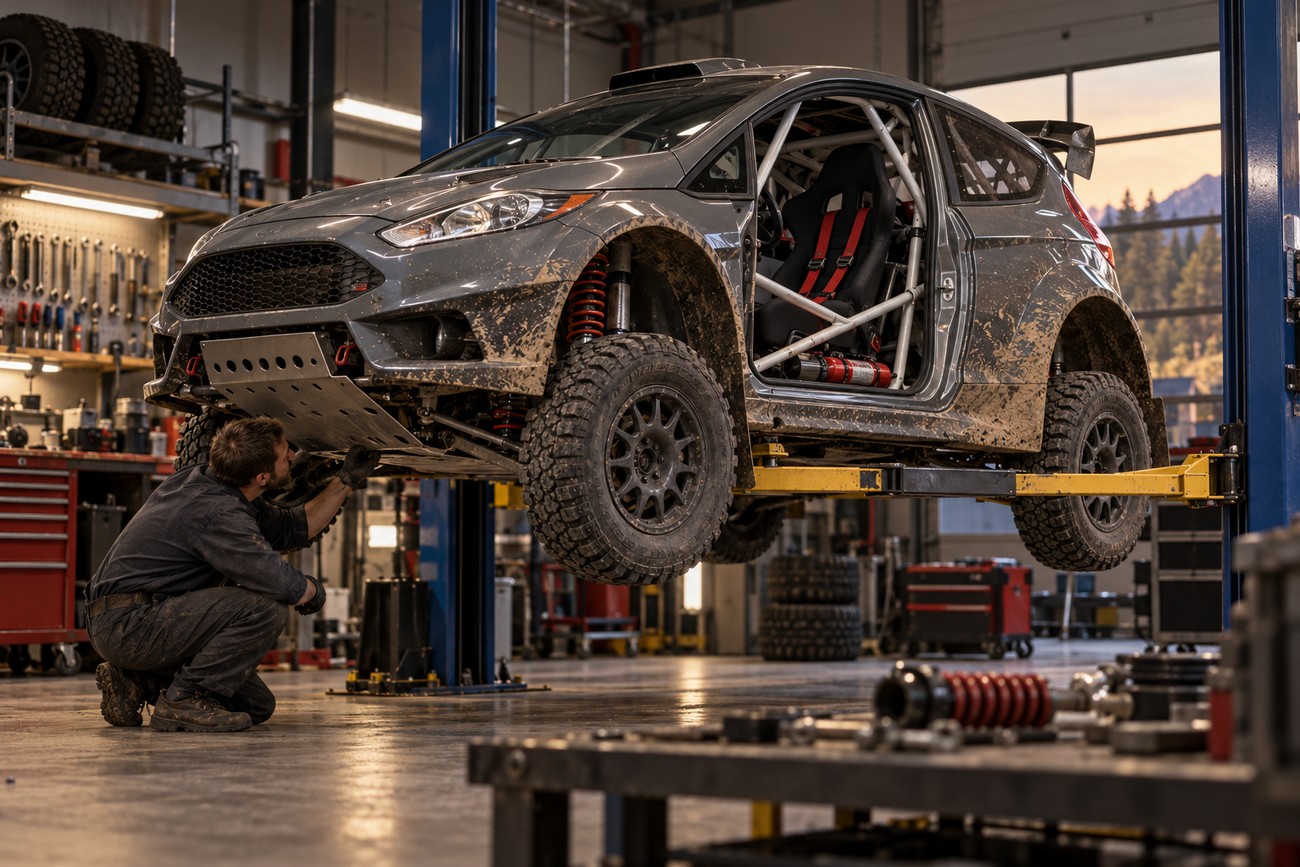
Safety and event eligibility come before performance. A competition build normally needs an approved roll cage, approved seats and harnesses, fire protection, and other equipment required by the event regulations. The original airbags and road restraints should not be treated as a substitute for a compliant rally safety system.
The suspension needs rally-specific dampers, springs, and enough usable travel for the surface. Gravel tires are essential, as is protection for the sump, transmission, fuel lines, brake lines, and vulnerable underbody components. A cited gravel brake arrangement uses 285 mm front and 280 mm rear discs, compared with 310 mm asphalt discs; the correct choice depends on the regulations and the car’s complete setup.
Alignment is easy to get wrong. A cheap lift or stiff spring installation can leave the car with unsuitable camber and toe, making it nervous under braking and unpredictable when it lands from a compression. Gravel geometry should be set as a complete system, with damper adjustment, ride height, steering behavior, and tire choice considered together.
The financial reality is often missed. Cage work, suspension, protection, wheels, tires, brakes, and electrical or fire-safety equipment can bring the conversion cost close to buying a used, ready-built competition car. Building the Fiesta still makes sense when parts access, class rules, or personal preference matter, but it is rarely the cheap route after the first serious event.
Can a Prepared Fiesta ST Be Competitive?
Yes, in the right class and against suitable opposition. A prepared front-wheel-drive Fiesta benefits from low weight, accessible parts, and a responsive engine. Its driver must preserve momentum, use weight transfer deliberately, and accept that throttle discipline is part of the traction system.
The engine character depends on the generation. Mk6 versions used a naturally aspirated 2.0-liter engine producing approximately 150–160 hp. The Mk7 uses a 1.5-liter EcoBoost producing 200 hp and 290 Nm, so gravel driving requires careful boost control and turbo temperature management.
Gravel specialists usually soften the rear response and use slightly more caster with gravel-specific alignment. Carrying a stiff track setup onto loose surfaces often creates a nervous rear axle and increases the understeer it was meant to cure.
Prepared Fiesta cars have competed successfully in national championships and monodrive classes. Their reliability depends on competition servicing: shorter fluid intervals, temperature monitoring, fastener checks, and regular inspection of hubs, bushes, and steering joints. Rally success stories describe Cup, R2, or similarly prepared cars, not showroom examples.
Frequently asked questions
How much horsepower can a Ford Fiesta ST handle?
There is no single horsepower limit that determines whether a Fiesta ST is suitable for gravel. Reliability depends on servicing, temperature control, drivetrain condition, engine calibration, and whether the suspension, tires, brakes, and protection match the power.
A lower-output Mk6 can be competitive through momentum and consistency, while the Mk7’s 200 hp and 290 Nm require closer control of boost and heat.
What should be checked after a Fiesta ST gravel stage?
Check engine oil, brake fluid, coolant, and temperature readings first. Then inspect the wheels, tires, suspension, dampers, underbody protection, and any signs of impact or fluid leakage.
Critical fasteners, wheel hubs, bushes, steering joints, and brake components should also be checked before the next run. Gravel loads can loosen hardware or expose damage that is not visible during a quick inspection.
What car went from 0 to 60 mph in 2.5 seconds on gravel?
The Audi Sport quattro S1 E2 is commonly credited with reaching 0–60 mph in about 2.5 seconds on loose surfaces, depending on the test and setup. Its four-wheel drive, short gearing, and extreme Group B specification made that acceleration possible.
What Ford Fiesta is used for rally?
Fiesta R2, Fiesta Rally, Cup, and similarly prepared Fiesta cars are used for rallying. These are competition builds with safety cages, rally suspension, underbody protection, event-specific brakes, and gravel tires.
A production Fiesta ST can be used as a starting point, but its model name alone does not make it a rally car. Preparation and event regulations determine its competition status.
What car was banned from rally?
Group B rally cars, including the Audi Sport quattro S1, Lancia Delta S4, and Peugeot 205 T16, were withdrawn from top-level World Rallying after the 1986 season because of safety concerns. The category was then replaced by stricter regulations.







