
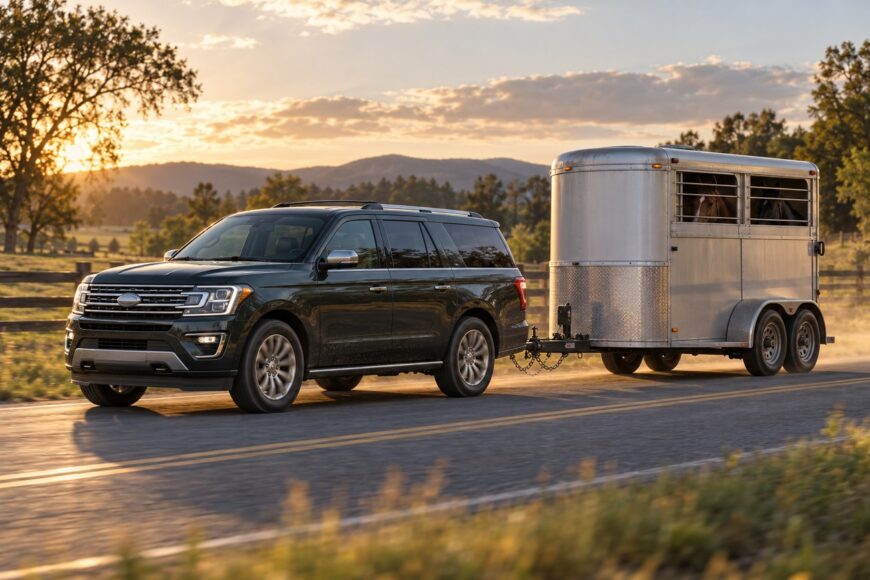
A properly equipped Ford Expedition can tow most loaded two-horse trailers. Modern models may have a braked tow rating of approximately 3,175–4,355 kg, depending on the version and heavy-duty towing equipment. A loaded two-horse bumper-pull trailer commonly weighs approximately 2,000–2,700 kg, including the trailer, two horses, and equipment.
The headline rating does not guarantee a comfortable or safe combination. Payload, tongue weight, rear-axle loading, trailer brakes, tire capacity, stability, road conditions, and local licensing rules can become limiting factors first. Live animals also make smooth control and short, predictable braking more important than simply having enough engine power.
- The Short Answer: Yes, but the Trailer and Package Matter
- Expedition Towing Ratings Versus Real Horse-Trailer Weights
- The Payload and Tongue-Weight Limit Most Owners Miss
- Why It Can Pull the Trailer but Still Feel Unsafe
- What the Heavy-Duty Tow Package and Hitch Must Include
- The Costs and Legal Checks Before You Haul Horses
- A Practical Go/No-Go Decision for Your Expedition
- Frequently asked questions
- How can I tell whether a Ford Expedition has the heavy-duty tow package?
- Which SUV is best for towing a horse trailer?
- What size truck do I need to pull a two-horse trailer?
The Short Answer: Yes, but the Trailer and Package Matter
Ford Expedition tow ratings vary substantially by model year, trim, drivetrain, and towing equipment. Modern Expeditions can be rated to tow approximately 3,175–4,355 kg with functioning trailer brakes and correctly configured brake-control equipment. The lower end of that range may apply to one configuration, while the highest figure belongs only to specific versions with the appropriate heavy-duty towing package.
That capacity formally covers most loaded two-horse bumper-pull trailers. A trailer weighing approximately 2,000–2,700 kg loaded usually sits within the Expedition’s published capability, provided the vehicle’s payload, hitch, axle, tires, and brakes are also within their ratings. The trailer’s actual loaded mass matters more than its empty weight in the sales specifications.
Three-horse trailers and large living-quarters trailers require a more careful calculation. Their height, interior fittings, water, feed, tack, passengers, and equipment can push the combination toward the upper boundary. A vehicle may remain within its maximum trailer rating while having too little payload or rear-axle capacity for a properly balanced load.
A commonly cited practical guideline for live cargo is to work at roughly 70–80% of the published tow maximum. This safety-oriented rule of thumb is not a Ford factory limit. It reflects the value of reserve braking, stability, and control on hills, in crosswinds, and during emergency maneuvers.
Expedition Towing Ratings Versus Real Horse-Trailer Weights
The figures below are a screening tool. They do not replace the ratings on the specific Expedition, hitch, trailer, axles, and tires.
| Combination | Approximate loaded mass or rating | What the comparison means |
|---|---|---|
| Expedition braked tow-rating range | Approximately 3,175–4,355 kg | Applies only to the relevant vehicle configuration and towing equipment, with functioning trailer brakes. |
| Typical loaded two-horse bumper-pull trailer | Approximately 2,000–2,700 kg | Usually within the formal towing capability of a properly equipped Expedition, subject to payload and axle limits. |
| Three-horse trailer | Configuration-dependent | May approach the upper boundary once horses, tack, feed, water, and other equipment are included. |
| Large living-quarters trailer | Configuration-dependent | Requires an exact calculation because interior fittings and supplies can consume payload and hitch capacity quickly. |
The tow-rating range describes the maximum trailer mass under specified conditions. It does not describe how much weight can be placed in the Expedition at the same time. Passengers, luggage, coolers, tools, hitch hardware, and the trailer’s tongue load all count against the vehicle’s available capacity.
Trailer brakes are assumed for heavy towing figures. A heavy horse trailer without working brakes transfers too much stopping demand to the Expedition, especially on descents or during repeated braking. The brake controller must also be correctly wired and adjusted so the trailer contributes predictable braking rather than engaging late or grabbing abruptly.
The trailer’s permitted maximum mass, axle ratings, tire ratings, and actual loaded mass all deserve attention. A trailer that is light when empty may become substantially heavier with two horses, tack, feed, water, spare equipment, and living-quarters supplies. Weighing the complete combination is more reliable than estimating from the brochure.
The table also cannot show how a trailer behaves behind the vehicle. A tall trailer with a high center of gravity can produce more wind sensitivity and sway than its weight alone suggests. This is why a two-horse trailer near the middle of the Expedition’s capability may be a more sensible match than a heavier trailer near the advertised maximum.
The Payload and Tongue-Weight Limit Most Owners Miss
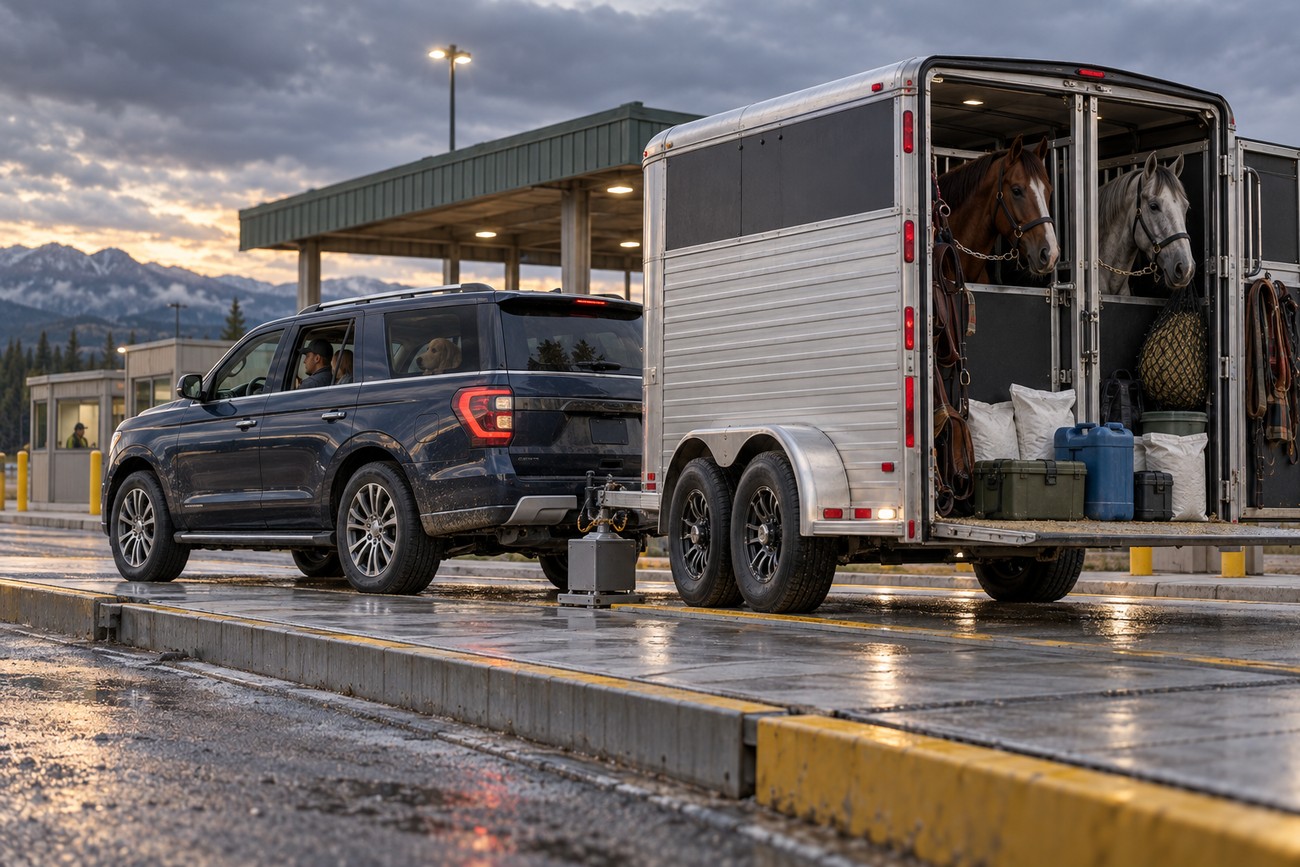
The Expedition’s maximum permitted vehicle mass is approximately 3,300 kg. Typical curb weight is approximately 2,480–2,630 kg, leaving an approximate payload of 700–750 kg before considering the specific vehicle’s door-jamb rating. That payload must cover occupants, luggage, accessories, hitch hardware, and the load imposed by the trailer on the hitch.
Tongue weight is part of the Expedition’s load. A commonly referenced loading range is approximately 10–15% of trailer mass, although the vehicle, hitch, axle, and trailer ratings take priority. On a loaded two-horse trailer, that load can consume a substantial part of the SUV’s available payload and rear-axle margin.
This creates a common failure pattern: the trailer remains below the published tow rating, while the vehicle exceeds its gross vehicle mass or rear-axle rating. Six or eight passengers, luggage, and a heavy hitch load can make the combination illegal or difficult to control even though the engine pulls it without complaint.
Load placement matters. Heavy equipment should be secured according to the trailer manufacturer’s instructions, and the trailer should be weighed in its actual travel condition. Check the total trailer mass, tongue load, front and rear axle loads, and the Expedition’s total mass rather than relying on an empty trailer weight.
Why It Can Pull the Trailer but Still Feel Unsafe
Engine power is only one part of towing performance. Once the Expedition has enough power to maintain speed, braking, wheelbase, suspension control, tires, axle loading, trailer stability, and driver technique become more important. A vehicle can climb a hill confidently while still needing too much distance to stop at the bottom.
Heavy horse trailers need functioning brakes on every applicable axle and a properly configured brake controller. Poor adjustment can leave the trailer pushing the Expedition during a descent, while excessive gain can cause wheel lock or abrupt deceleration. Brake overheating and longer stopping distances are practical concerns associated with heavy towing, particularly on mountain roads and repeated downhill sections.
Crosswinds expose another weakness. A tall horse trailer presents a large side area, and its high center of gravity can increase sway or steering corrections. The result may feel like nervous handling rather than a dramatic trailer failure: the driver makes repeated corrections, the trailer moves behind the SUV, and an emergency lane change becomes harder to manage.
Trailer-brake gain, rear-axle loading, and hitch loading should be checked before trying to use the vehicle’s full tow rating. Sway-free handling is the first target; maximum speed and maximum rated mass come later.
Electronic trailer-stability systems can help when the hitch, wiring, weight distribution, and loading are correct. They cannot overcome an overloaded rear axle, an unsuitable tire, poor tongue loading, or an unstable trailer design. Smooth steering, modest speed, and generous following distance protect the horses as well as the vehicle.
Horse trailers also punish abrupt inputs. A sudden throttle change, sharp steering correction, or hard brake application can unsettle the animals and amplify trailer movement. Test the combination without horses first, including braking and reversing in a controlled area, then use conservative speeds on the first loaded trip.
What the Heavy-Duty Tow Package and Hitch Must Include
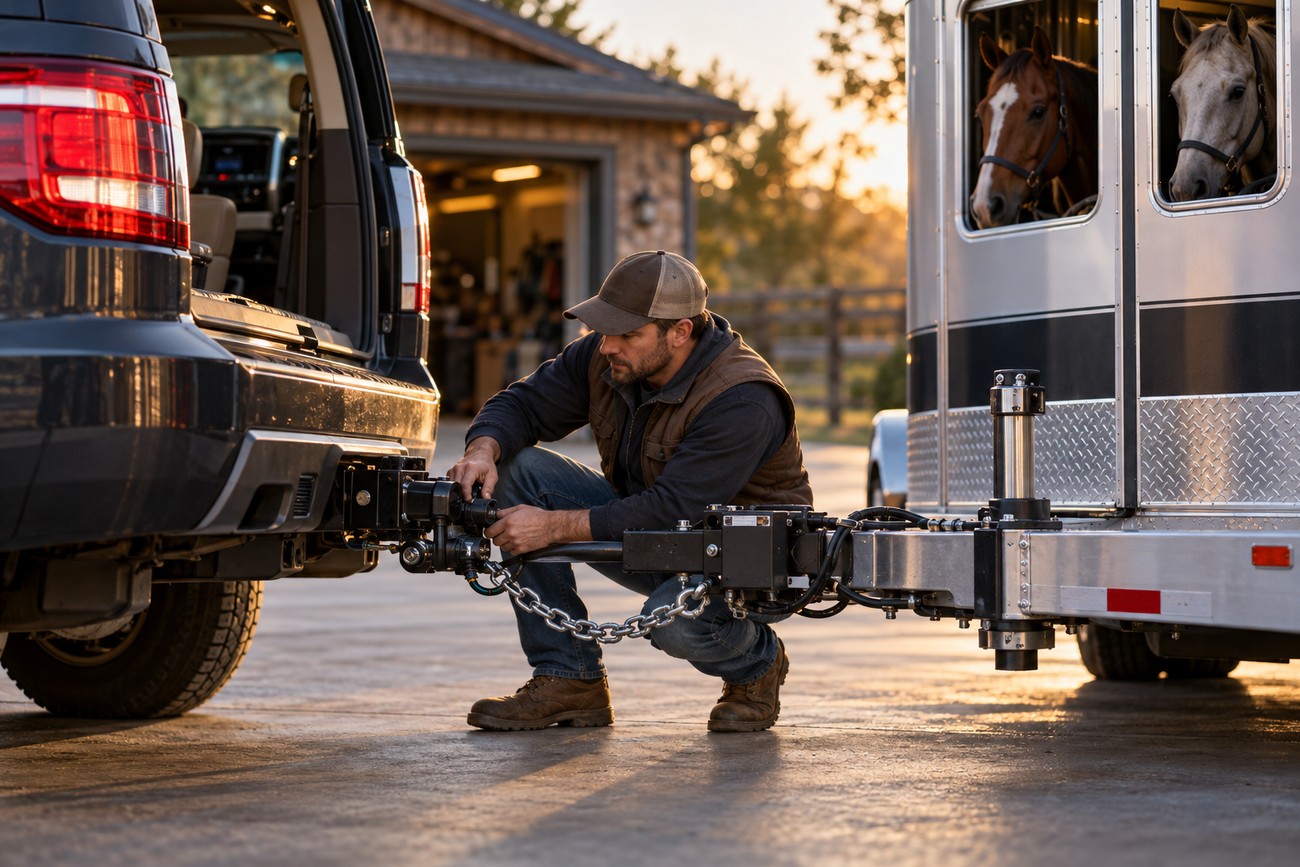
The name “Expedition” does not identify one uniform towing specification. Model year, trim, engine and drivetrain configuration, axle equipment, factory options, and the heavy-duty towing package can change the permitted trailer rating. A correctly rated factory or upgraded hitch, suitable wiring, and trailer-brake control equipment are essential for heavy horse-trailer use.
Start with the owner’s documentation and the vehicle identification details. Confirm the exact tow rating for that vehicle, then read the door-jamb label for the maximum permitted vehicle mass, payload information, and axle ratings. The label on the actual hitch should also be checked; its rating can be lower than the vehicle’s headline tow capacity.
Inspect the trailer connector, brake wiring, brake controller, safety chains, breakaway system, tires, and hitch hardware. Tire capacity and axle ratings can become the limiting factor before the advertised tow rating, especially in North American towing practice. The same principle applies to the trailer’s own axles and tires.
Regular heavy towing increases demand on the automatic transmission, brakes, tires, cooling system, and hitch components. Follow the service schedule for the specific vehicle and consider more frequent inspections when the Expedition regularly carries horses. Any modification should preserve the manufacturer’s ratings rather than simply adding hardware and assuming capacity has increased.
The Costs and Legal Checks Before You Haul Horses
A towing budget should include more than the trailer purchase. Possible costs include a hitch upgrade, trailer-brake electrics, a brake controller, suitable tires, brake components, wiring repairs, and additional transmission servicing. These items directly affect control and reliability, so treating them as optional equipment can create a false saving.
Fuel consumption may rise by approximately 30–60% while towing, according to the brief. A tall trailer creates substantial aerodynamic drag, and frequent hills or strong winds can increase consumption further. Longer trips may therefore require more fuel stops and more careful planning around horse rest, water, and safe parking.
In Russia, a trailer with a permitted mass above 750 kg generally requires category BE or the applicable vehicle-and-trailer mass combination. Horse trailers typically exceed 750 kg, so category B alone may be insufficient for the intended combination. Confirm the permitted masses shown in the vehicle and trailer documents before driving.
North American users should check local requirements for trailer brakes, brake controllers, axle loading, tire capacity, hitch ratings, safety chains, lighting, and registration. Rules differ by jurisdiction, and compliance with one limit does not remove the need to meet the others. A legally compliant combination can still be poorly matched if its stability or payload margin is inadequate.
A Practical Go/No-Go Decision for Your Expedition
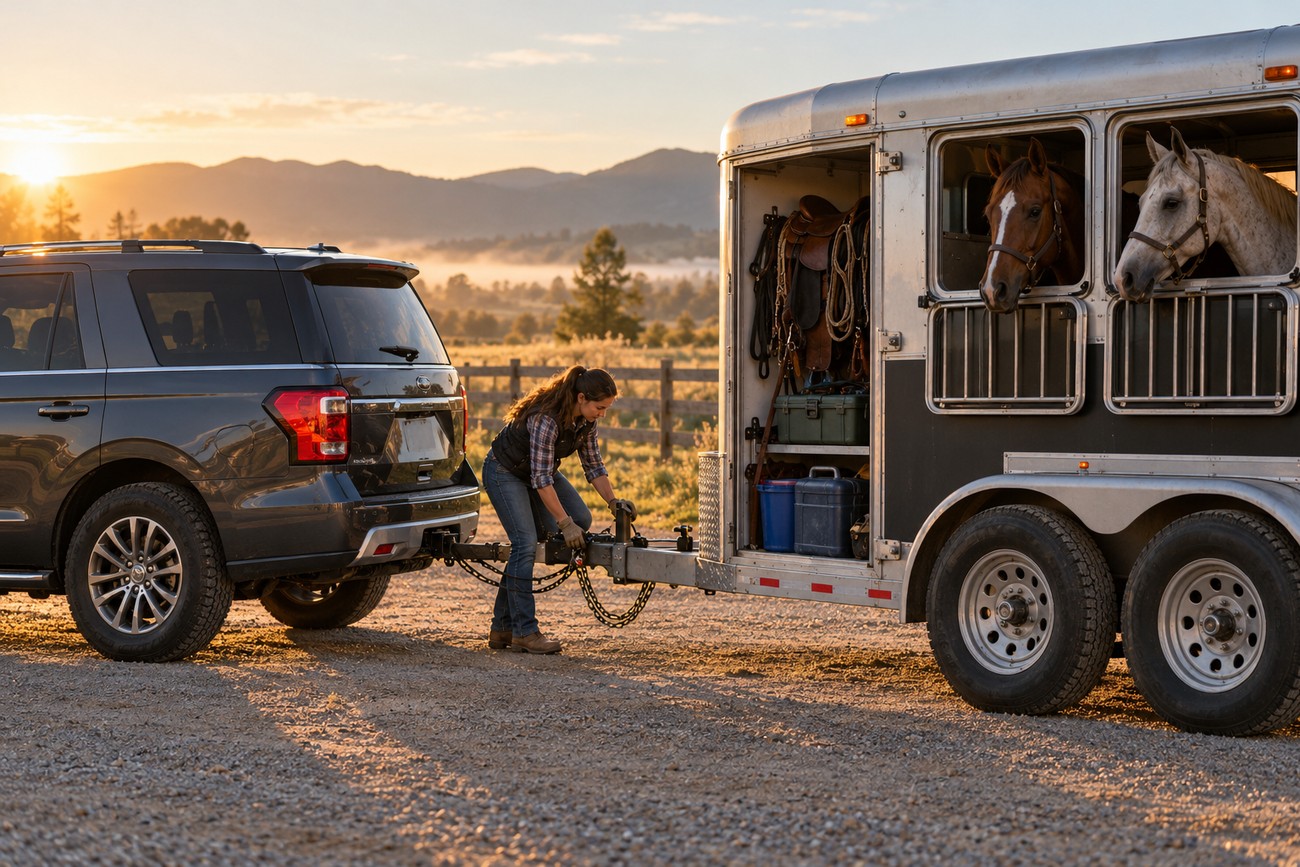
A loaded two-horse trailer is usually the most defensible horse-hauling use case for a properly equipped Expedition. Begin with the trailer’s actual loaded mass, including horses, tack, feed, water, and travel equipment. Then compare it with the exact Expedition tow rating and the trailer’s permitted maximum mass.
Next, verify the vehicle’s payload and rear-axle margin. Measure or obtain the actual hitch load, then account for every passenger and item carried inside the SUV. Confirm that the hitch, axles, tires, and trailer brakes are all rated for the intended combination.
Before carrying horses, inspect the tires and wheel fasteners, test the lights and breakaway system, confirm brake-controller operation, and drive the empty combination in a safe area. Check for sway, delayed trailer braking, unusual steering effort, suspension sag, and excessive heat after controlled stops. Correct the cause before loading animals.
The 70–80% working-margin concept can provide a useful conservative target for live cargo, although it is not a manufacturer specification. Heavy three-horse or living-quarters trailers may be borderline for an SUV even when the published tow rating appears sufficient. Frequent mountain travel, strong crosswinds, long distances, or limited payload may justify moving to a heavy-duty pickup.
Frequently asked questions
Expedition towing capability depends on the specific vehicle and trailer combination. The answers below focus on verification and vehicle selection rather than a single universal rating.
How can I tell whether a Ford Expedition has the heavy-duty tow package?
Use the vehicle’s owner documentation, vehicle identification details, and factory specification records rather than relying on visual features. Confirm the tow rating for the exact model year, trim, drivetrain, and equipment, then compare it with the ratings printed on the door-jamb label and the hitch itself.
A Ford dealer or qualified service department can verify the original equipment record from the vehicle identification details. Also check for a trailer connector and brake-control provisions, while remembering that their presence alone does not prove the highest tow rating. The documentation and component ratings must agree.
Which SUV is best for towing a horse trailer?
The best SUV is the one with enough payload and rear-axle capacity after passengers and equipment are added, along with a suitable wheelbase, controlled suspension, adequate brakes, appropriate tires, and integrated trailer-control equipment. Horsepower is useful for maintaining speed, but it should not be the main selection criterion.
Compare the SUV’s exact ratings with the loaded trailer, then consider the trailer’s height, expected road grades, wind exposure, and trip frequency. A slightly smaller trailer with a healthy stability margin can be a better match than a heavier trailer that technically fits the tow rating.
What size truck do I need to pull a two-horse trailer?
A properly equipped full-size SUV can usually handle a loaded two-horse trailer when the trailer mass, hitch load, axle loads, payload, tires, and brakes remain within their ratings. The vehicle should also have a correctly configured trailer-brake system and enough reserve for the intended roads.
Move toward a heavier-duty pickup when the trailer has living quarters, unusual height, substantial equipment, frequent mountain routes, or a hitch load that leaves little payload margin. A pickup may also be preferable for regular heavy use because its suspension, axle ratings, and braking reserves can better suit the combination.







