
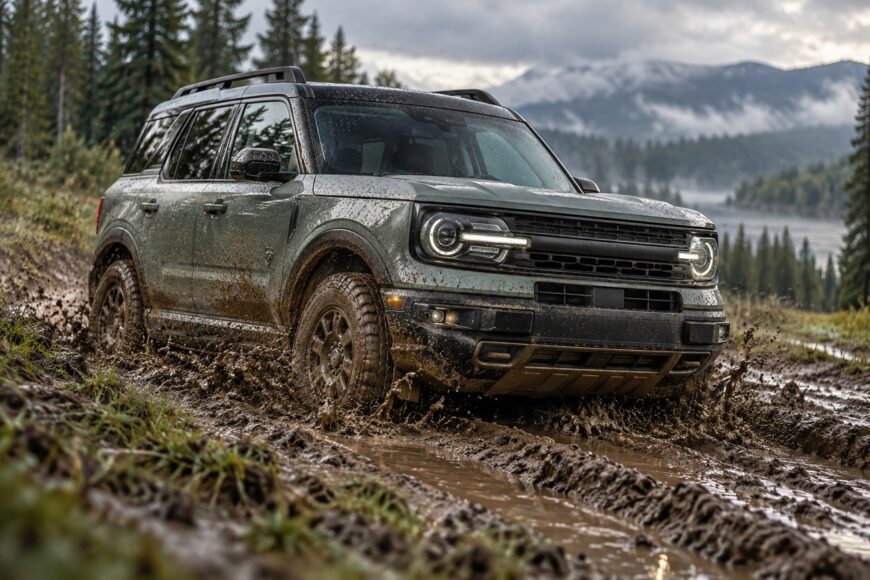
The Ford Bronco Sport has genuine off-road systems and a four-wheel-drive/AWD system, depending on market and trim. It can travel farther off pavement than a typical compact crossover, especially when its terrain modes, traction control, and torque distribution work together.
Its basic limitation remains structural: the Bronco Sport is a compact unibody crossover, not a body-on-frame SUV. A mud pit therefore tests much more than engine output or the G. O. A. T. dial. Tire bite, ground clearance, approach and breakover geometry, wheel-speed control, and a recovery plan usually decide the result.
There is no reliable single mud depth that defines success for every Bronco Sport. Mud consistency, rut shape, tire condition, vehicle trim, and driver technique can change the outcome within a few feet. A properly equipped vehicle can handle moderate mud, while deep silt or a belly-deep rut can stop it quickly.
- What the Bronco Sport Is—and What It Is Not
- Why Its Drivetrain Can Handle Moderate Mud
- The Mud-Pit Variables That Decide the Outcome
- How to Approach a Mud Pit Without Creating a Recovery Problem
- Where the Bronco Sport Usually Gives Up
- What to Do After the Mud: Inspection and Cleanup
- Can It Survive a Mud Pit? The Honest Verdict
- Frequently asked questions
- What year should you avoid when buying a Bronco Sport?
- What is the lawsuit against the Ford Bronco Sport?
- What are the main downsides of the Ford Bronco Sport?
What the Bronco Sport Is—and What It Is Not
The Ford Bronco Sport is a compact crossover with a unibody construction. It shares a platform with the Ford Escape/Kuga, although its suspension tuning, body design, drive modes, and equipment give it a more serious off-road focus than an ordinary road-oriented crossover.
That distinction matters in a mud pit. A unibody vehicle can perform well on uneven trails and slippery surfaces, but it has less tolerance for severe articulation, repeated hard recoveries, and underbody impacts than a dedicated body-on-frame SUV.
The Bronco Sport is also not simply a smaller version of the body-on-frame Ford Bronco. The two vehicles share a family name and an off-road image, yet their construction and mechanical limits are different. Treating the Sport as a traditional Bronco can lead to poor tire choices, excessive speed, and recovery decisions the vehicle was not designed to withstand.
Its off-road positioning still has practical value. With suitable tires and a careful driver, the Bronco Sport can exceed the expectations set by its compact-crossover dimensions. The useful boundary is moderate off-road travel, rather than unrestricted access to deep mud, severe cross-axle terrain, or repeated recovery abuse.
Why Its Drivetrain Can Handle Moderate Mud
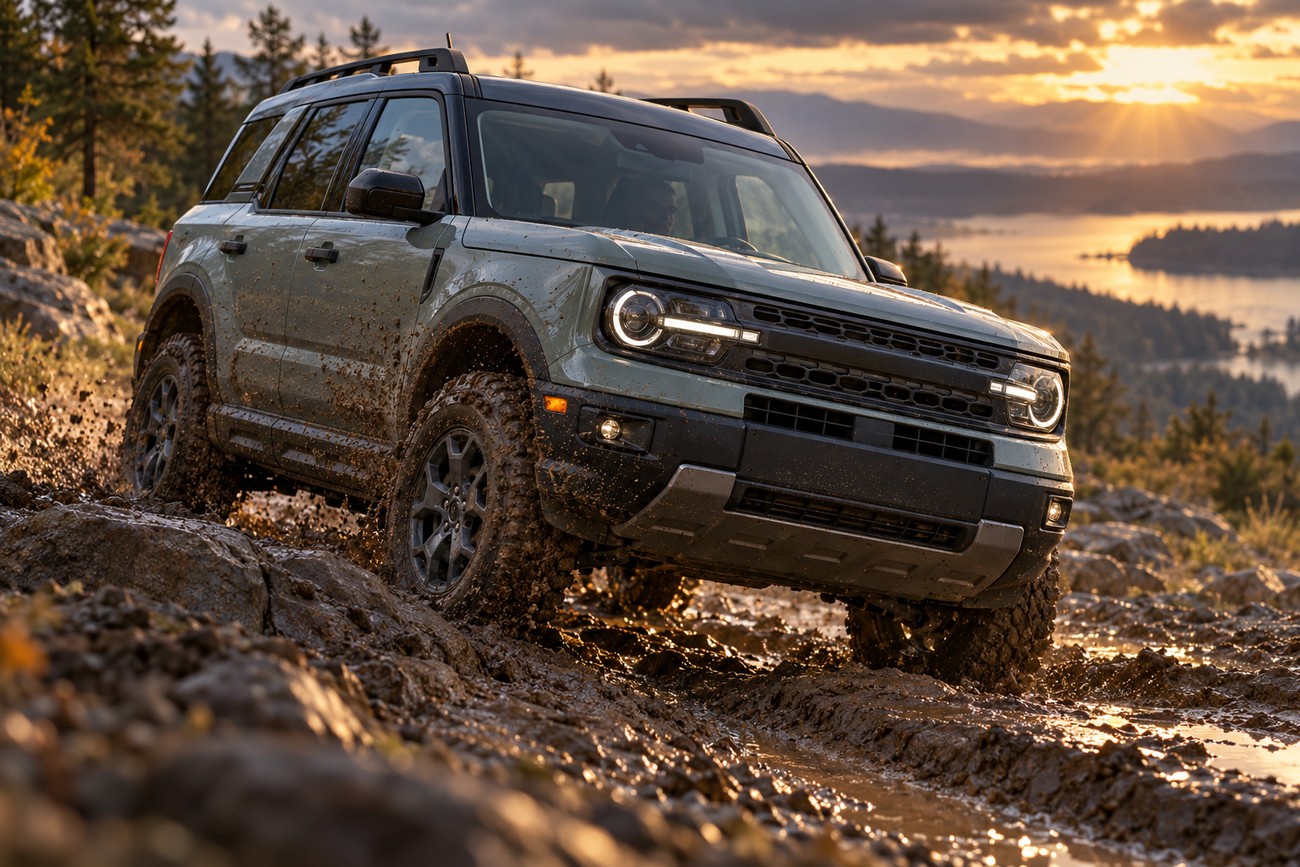
The Bronco Sport uses an automatic transmission and a four-wheel-drive/AWD system, depending on market and trim. Engine outputs in the supplied range are approximately 181–245 hp from engines around 1.5–2.0 L. In mud, however, peak power is usually less important than how the transmission, traction control, and torque distribution deliver that power.
Ford’s G. O. A. T. / Terrain Management System adjusts the vehicle’s response for different surfaces. Normal-road, slippery, and sand modes are commonly available, while more advanced versions can add Mud/Ruts and Rock Crawl modes. These settings can alter throttle response, shift behavior, and traction-control strategy to reduce unnecessary wheelspin.
Some advanced AWD configurations use dual rear clutches or torque-vectoring logic. That can help direct drive to a wheel with better traction when the surface becomes loose or uneven. It does not create grip where the tires have none, and it cannot prevent the underbody from contacting a deep rut.
Controlled forward motion is often more useful than aggressive throttle. A driver who keeps the wheels turning at a measured speed gives the AWD system and tires a chance to maintain traction. A driver who spins the tires rapidly may polish the mud beneath the tread, dig deeper, and lose the remaining usable grip.
The Mud-Pit Variables That Decide the Outcome
Tires are often the first limiting factor. A road-oriented tread can struggle in thick mud even when the vehicle has a Mud/Ruts mode, because the tread cannot clear itself or find a firm surface. Tire size also affects the vehicle’s footprint, sidewall behavior, and ability to stay above soft ruts.
Public sources report approximately 198–224 mm of ground clearance for the Bronco Sport, with the exact figure varying by trim and configuration. That range should be treated as approximate because the figures conflict across sources. Clearance at the lowest underbody point matters more than a headline specification, especially once the vehicle enters a rut.
Mud consistency changes the problem. Sticky clay can pack the tread and wheel arches, while watery silt may allow the tires to sink rapidly. As buildup increases, traction and steering control can deteriorate. A vehicle may appear to have adequate clearance at the entrance and then lose it as the tires dig down.
Tire bite, a steady wheel-speed strategy, and a recovery plan should be decided before selecting Mud/Ruts mode. The mode can manage available traction, but it cannot supply traction after the tires are packed or the vehicle is resting on its belly.
Geometry is equally important. Approach angle determines how easily the front of the vehicle enters the hole, while breakover clearance determines whether the center of the vehicle clears the ridge between ruts. Controlled momentum can help the Bronco Sport cross a soft section, but stopping in the most viscous part sharply increases the chance of getting stuck.
Four-wheel drive cannot overcome a tire with no usable bite or a vehicle supported by its underbody. Once the tires lose contact with a firm surface, electronic control has little remaining leverage. The recovery plan should therefore account for the worst part of the obstacle, not the easier entrance.
How to Approach a Mud Pit Without Creating a Recovery Problem
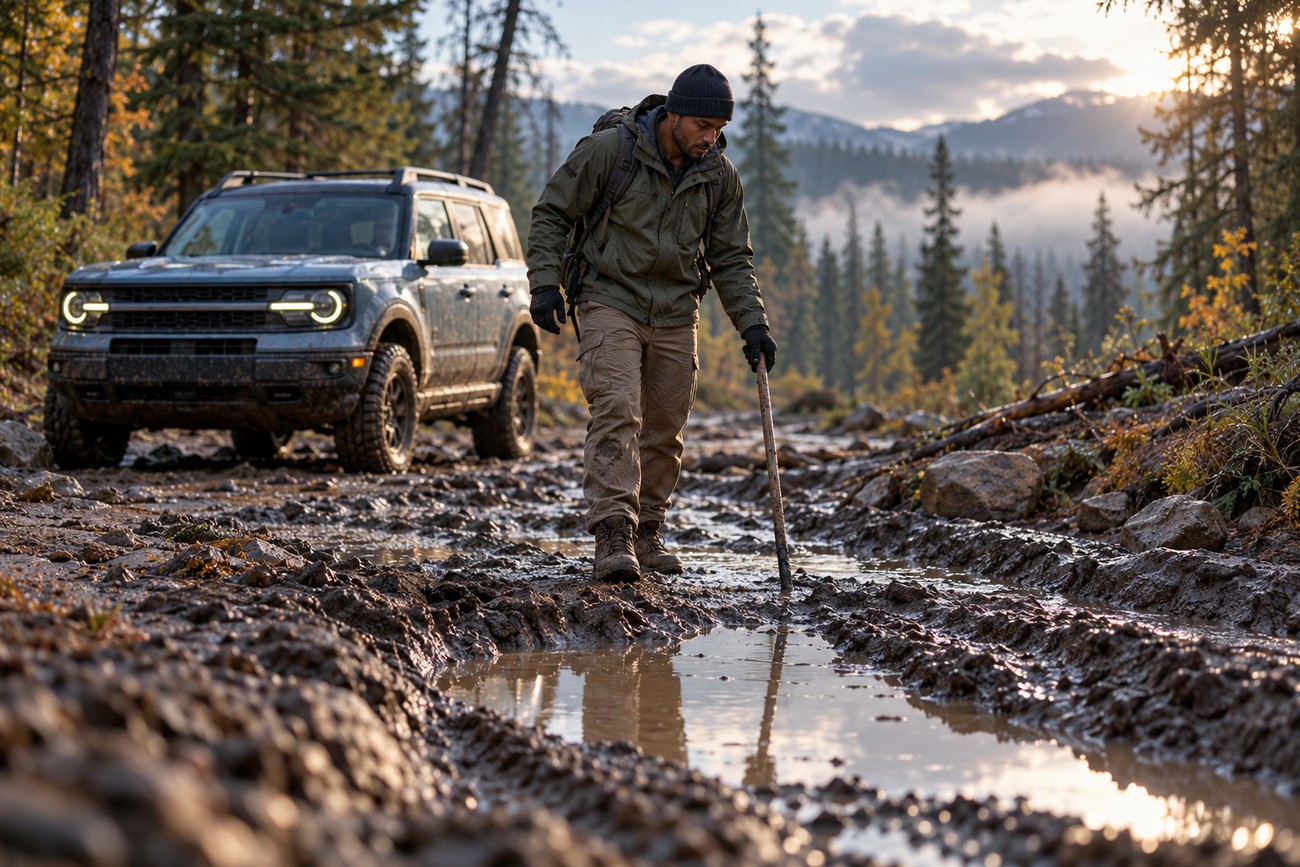
Walk the obstacle first when conditions allow. Check the depth of the ruts, the firmness of the bottom, hidden rocks or branches, the exit line, and whether there is space to turn around. A short inspection can reveal that the apparent route is actually a soft basin with no usable recovery position.
Select the appropriate drive mode before entering. Mud/Ruts mode is available on more advanced Bronco Sport versions, but a drive mode cannot guarantee recovery from deep mud. Confirm the exact equipment on the vehicle, because modes and AWD behavior vary by market and trim.
Use smooth throttle and maintain a steady walking pace. Abrupt inputs can trigger wheelspin, dig the tires down, and make the vehicle harder to steer. Avoid stopping in the lowest or softest section unless stopping is necessary for safety.
Do not enter deep mud or silt alone without a rated recovery point, a suitable recovery strap or winch plan, and a second vehicle. Inspect the recovery equipment before the attempt, and ensure the recovery method is compatible with the Bronco Sport’s approved attachment points. Traction-control and stability-control intervention can limit wheelspin in loose mud, so the driver should understand the vehicle’s instructions rather than switching systems off blindly.
Where the Bronco Sport Usually Gives Up
The practical ceiling arrives when mud becomes deep enough to load the underbody, when ruts force severe cross-axle movement, or when silt allows the vehicle to sink faster than the tires can advance. Packed ruts can also reduce steering control and leave the vehicle with no clean line for the exit.
Some owners and test drivers describe the Bronco Sport as not being a true Bronco. That criticism reflects the difference between a compact crossover and a purpose-built body-on-frame off-roader. A unibody crossover has less heavy-duty tolerance when it is repeatedly lifted by ruts, dragged through mud, or subjected to hard recovery loads.
Reported owner experiences sometimes include rapid mud buildup around the tires and wheel arches, electronic intervention arriving earlier than desired in deep mud, and factory tire tread or size limiting serious mud performance. These are reported experiences rather than universal defects, but they identify sensible areas to evaluate before buying or modifying the vehicle.
The lack of mechanical locking hardware can also matter in severe conditions. Advanced AWD logic may distribute torque intelligently, yet it remains dependent on tire contact, electronics, and available clearance. Once several of those factors deteriorate together, the Bronco Sport can reach its limit quickly.
What to Do After the Mud: Inspection and Cleanup
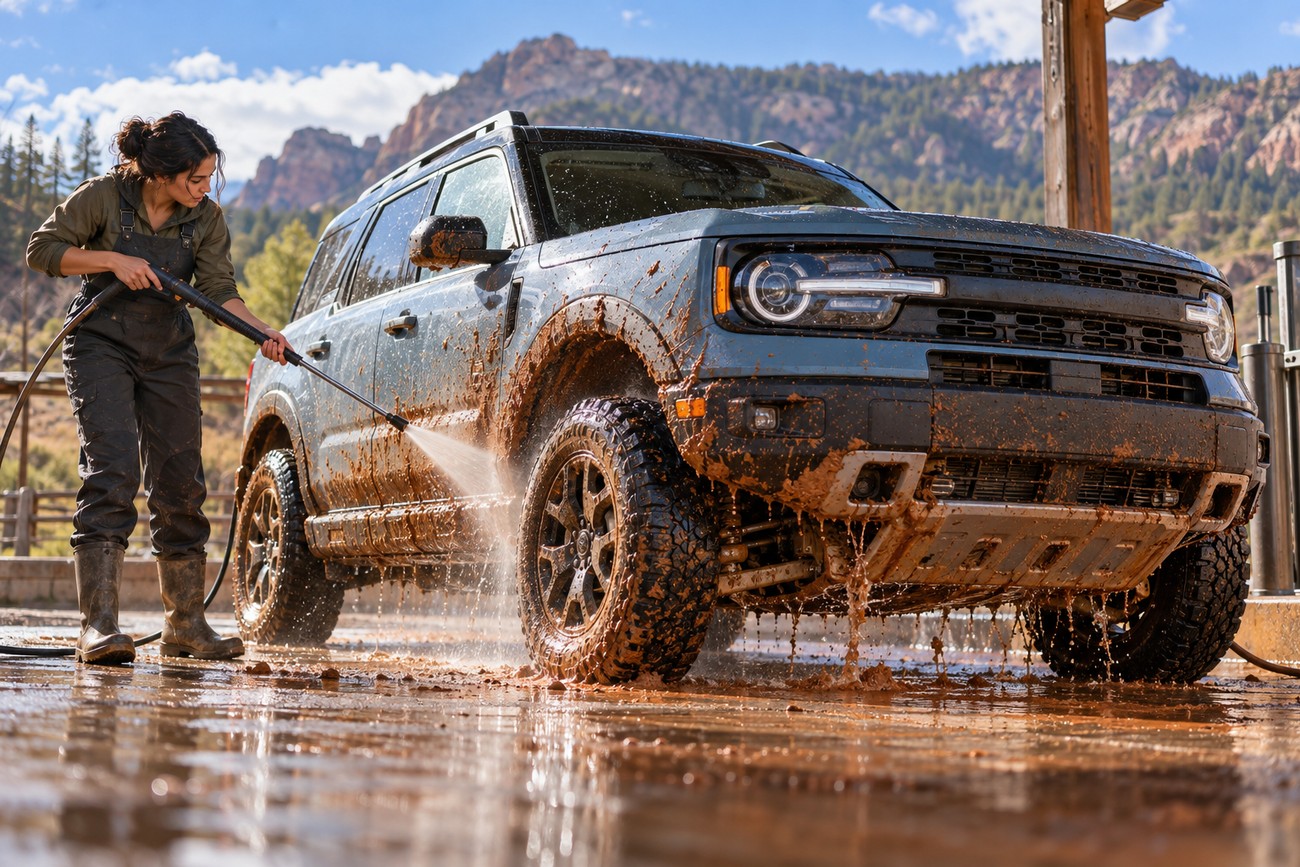
Recovery is not the end of a serious mud outing. Mud can remain in the underbody, wheel arches, brakes, and radiator area, where it may dry into heavy deposits or retain moisture against components.
Rinse the underbody and wheel arches thoroughly, then clean the brakes and radiator area with appropriate water pressure and access. Removing debris can reduce later squeaks, vibration, odors, and cooling problems. Avoid using excessive pressure close to seals, electrical connectors, and sensitive components.
After repeated mud and water exposure, inspect the brakes, wheel bearings, boots, and sensors. Pay attention to new vibration, abnormal noises, brake drag, warning lights, or unusual smells. These symptoms do not prove a Bronco Sport failure, but they justify a closer inspection before the next trip.
Regular deep-mud use deserves more follow-up than a single wet trail drive. A clean underbody also makes it easier to identify damage, fluid leaks, torn boots, or loose protective panels before they become larger problems.
Can It Survive a Mud Pit? The Honest Verdict
Yes, a properly equipped Bronco Sport can handle moderate mud and uneven off-road routes. Its automatic transmission, four-wheel-drive/AWD system, terrain modes, and traction-control calibration give it useful capability on loose and slippery surfaces.
Practical testing has included an approximately 50 km off-road route with climbs to approximately 2,800 m. That supports the vehicle’s moderate off-road capability, but it does not demonstrate unlimited mud performance or place the Bronco Sport on the same footing as a dedicated mud vehicle.
Deep mud changes the test into a contest between tire grip, clearance, geometry, electronic traction strategy, and recovery equipment. Mud/Ruts mode can help the vehicle use available traction, but it cannot overcome a tire with no bite, a rut that reaches the underbody, or the absence of a safe recovery plan.
The most credible setup combines suitable tires, the correct vehicle configuration, measured driving, and recovery support. For occasional moderate off-road travel, the Bronco Sport can be a capable tool. For repeated deep mud, severe articulation, or recovery-intensive routes, its compact unibody design sets a clear practical limit.
Frequently asked questions
What year should you avoid when buying a Bronco Sport?
The supplied evidence does not establish one universally avoidable Bronco Sport model year. Capability and equipment vary by market and trim, so a year-only buying rule can overlook the more important differences in AWD hardware, terrain modes, tires, and vehicle condition.
Screen the exact trim and market specification, check the VIN history, review maintenance records, confirm open recalls through the relevant official channel, and look for evidence of prior water or mud exposure. Inspect the underbody, wheel arches, brakes, boots, sensors, and cooling area for residue, damage, unusual odors, vibration, or neglected cleaning.
What is the lawsuit against the Ford Bronco Sport?
The supplied brief provides no verified lawsuit details. A lawsuit allegation should therefore not be treated as proof of a vehicle-wide defect or as evidence about mud capability without the jurisdiction, claim, affected vehicles, and official case status.
Separate court records from recalls and from anecdotal forum complaints. For a reliable check, use official recall databases, manufacturer notices, and identifiable court documents. A forum post may flag a question for investigation, but it does not establish the scope or validity of a legal claim.
What are the main downsides of the Ford Bronco Sport?
The main compromises are its unibody construction, tire limitations, trim variation, possible electronic intervention in severe mud, and the cleanup and inspection demands that follow serious water or mud exposure. These limits become most important in deep silt, packed ruts, severe cross-axle situations, and recovery-intensive use.
Those compromises do not mean the Bronco Sport cannot handle moderate off-road travel. They mean its useful operating envelope is narrower than that of a dedicated body-on-frame mud vehicle, especially when the vehicle retains road-oriented tires or lacks a complete recovery plan.







