
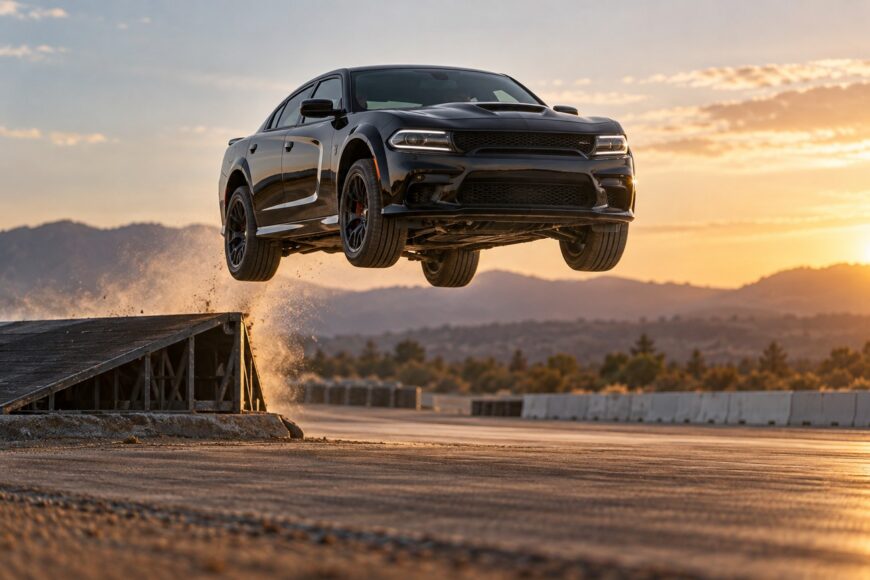
A Dodge Charger clearing a ramp is a familiar movie image: the nose rises, all four wheels leave the ground, and the car lands ready for the next shot. The scene looks plausible because the Charger has the power and visual weight of a performance car. Its factory identity, however, is that of a heavy road vehicle, not an aircraft or a competition landing platform.
A Charger can become airborne if speed and ramp geometry provide enough lift. The more important issue is whether a stock car can survive a controlled landing, then repeat it without hidden damage. Production specifications describe road dimensions, suspension, braking, and tires; they do not certify a safe jump height, landing load, or number of jumps.
- Can a Dodge Charger Really Jump?
- What the Charger’s Weight, Clearance, and Wheelbase Change
- Why the Landing Does More Damage Than the Takeoff
- Why Movie Chargers Are Not Ordinary Stock Cars
- The Mistakes That Turn a Small Jump Into a Major Repair
- Can a Stock Charger Be Prepared for a Jump?
- Frequently asked questions
- What movie features a Dodge Charger?
- Why do police like Dodge Chargers?
- What should you do immediately after a hard Charger landing?
Can a Dodge Charger Really Jump?
Yes, a Charger can leave the ground under suitable speed and ramp conditions. That statement describes a physical event, not a safe operating capability. Once the tires lose contact with the surface, the driver has limited control over pitch, roll, and the exact way the car will meet the landing area.
The current gasoline Charger has a stated curb weight of about 2.18 tonnes. Its road suspension, steering, wheels, and body mountings are designed for normal driving and road impacts. No official safe jump height or jump count is specified for a production Charger.
That missing factory rating matters because a landing is an impact event. The result depends on approach speed, ramp shape, vehicle attitude, landing surface, wheel contact, tire condition, and whether the suspension still has usable travel. A jump that looks small on camera can still produce a severe load if the car lands nose-first or on one corner.
Movie footage usually represents a prepared stunt vehicle, a calculated ramp, and controlled conditions rather than an untouched road car. The vehicle may be modified, the landing zone may be cleared, and unsuccessful or damaging takes may never appear on screen. A successful airborne moment therefore proves that a particular setup worked once; it does not establish a repeatable limit for every Charger.
What the Charger’s Weight, Clearance, and Wheelbase Change
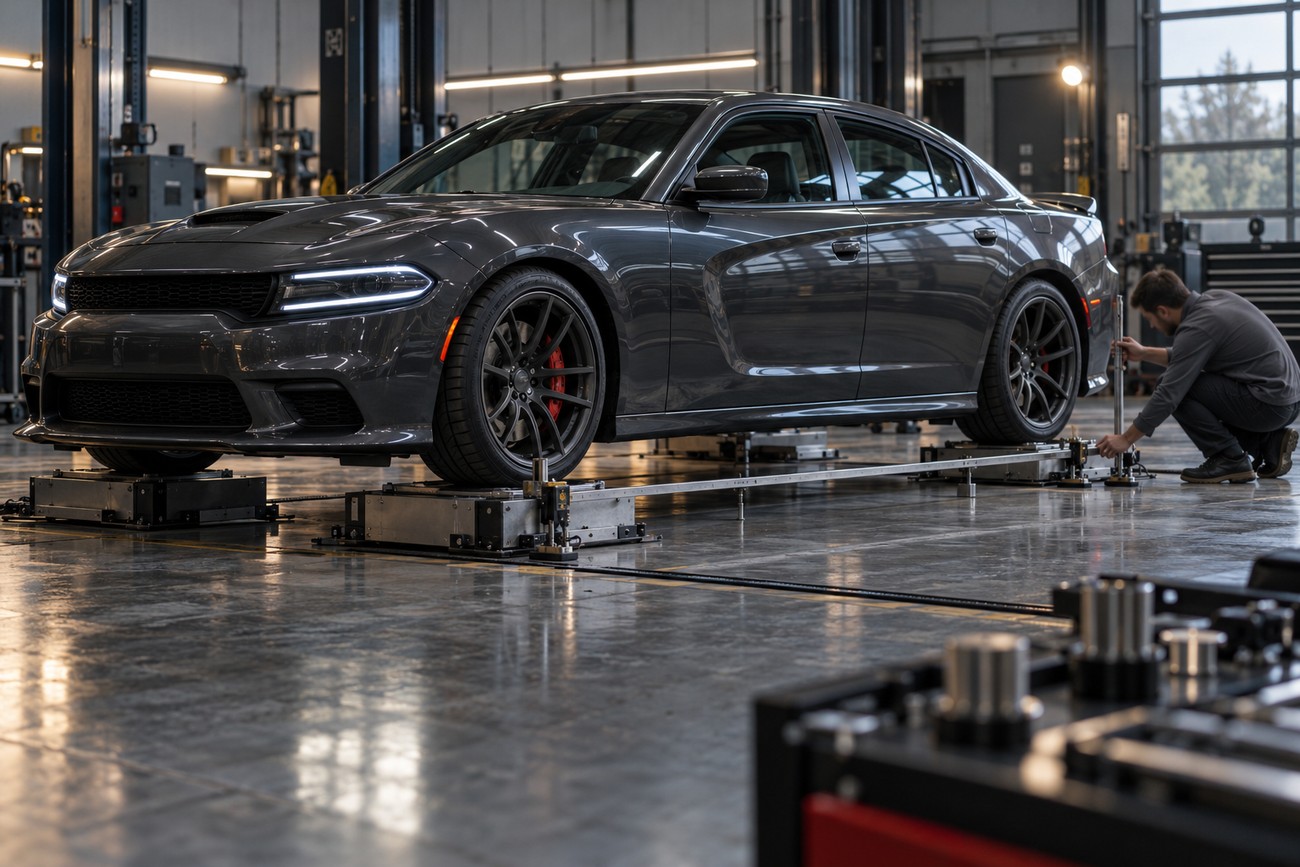
Weight turns a visually modest jump into a substantial mechanical event. Gravitational potential energy is represented by E=mgh. For a 2.18-tonne car lifted by 1 meter, that energy is roughly 21 kJ before speed and impact effects are added.
That figure is not a safe operating limit. It only illustrates why the landing can overwhelm components that appear strong during ordinary driving. The car also carries kinetic energy from its forward motion, and the suspension must absorb the change in vertical and horizontal movement over a short distance.
The current Charger has about 140 mm of ground clearance and a wheelbase of about 3.07 m. Older 2013–2015 Chargers have approximately 124–137 mm of official clearance, while Scat Pack and Hellcat versions are around 116 mm. These figures describe the space available during road use, not permission to clear a ramp.
A long wheelbase can improve stability in a straight line and reduce some abrupt pitch changes. It also increases the chance of underbody contact on a short, steep ramp, especially when the front wheels climb while the center of the car remains close to the surface. A sharp transition can strike the exhaust, protection panels, subframe, or other low-mounted parts before the vehicle is fully airborne.
Why the Landing Does More Damage Than the Takeoff
Takeoff mainly asks the drivetrain to provide acceleration while the suspension follows the ramp. Landing transfers the vehicle’s vertical motion into the tires, wheels, hubs, suspension links, steering components, subframes, and body mounting points. If the wheels are locked, turned, or poorly aligned, the load becomes less predictable and more concentrated.
A one-wheel landing is especially harsh. One corner can receive a disproportionate share of the impact, placing stress on a tire, wheel, hub, control arm, steering joint, and nearby body structure. A heavy sedan is less forgiving in this situation because its mass creates a large force at the contact point.
Wheel alignment, hub runout, and structural mounting points deserve measurement after a hard landing; a normal-looking body panel and a short road test cannot confirm that those parts remain straight.
Damage may first appear as vibration, pulling, uneven tire wear, or a steering wheel that no longer sits straight. Owners can also encounter bent wheels, damaged tires, worn or distorted suspension parts, and renewed alignment problems. ABS or ESC faults may follow damage to wheel-speed sensors, wiring, or hub geometry.
A visual inspection is therefore inadequate. Cracks, loose fasteners, leaking dampers, and gradual alignment drift can develop or become noticeable weeks after the impact. Even when the exterior looks untouched, the suspension mounting points and subframes may require measurement against manufacturer geometry.
Why Movie Chargers Are Not Ordinary Stock Cars
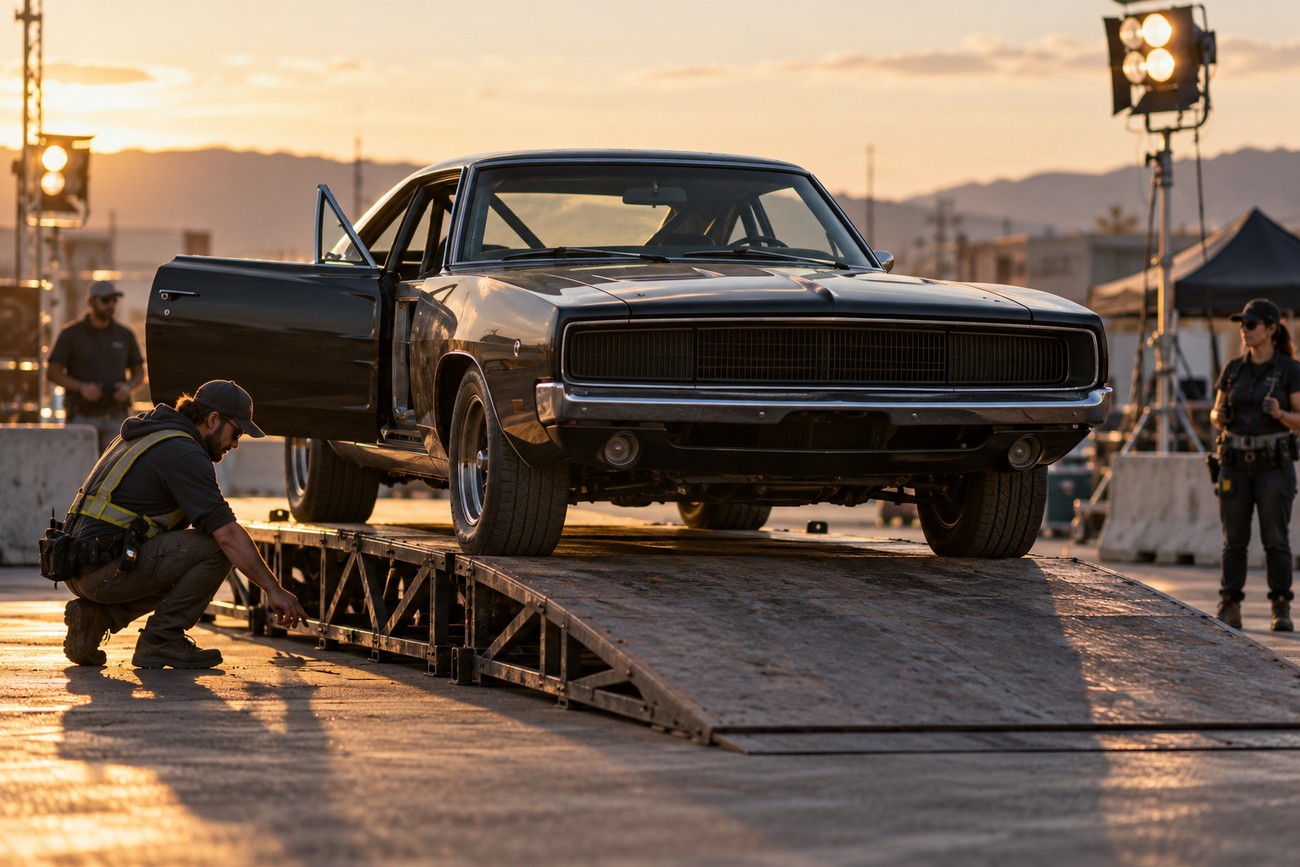
Stunt vehicles may receive reinforced bodies, altered springs and dampers, underbody protection, special tires, or other changes chosen for a specific shot. Those modifications can change how the car rotates, how quickly the suspension reaches its limits, and how the structure carries impact loads.
The ramp itself is part of the engineering. Ramp height is not the same as the vehicle’s vertical rise. Speed, entry angle, ramp length, landing-zone shape, and mass distribution determine the trajectory and the attitude at touchdown.
Production crews can also control factors that do not appear in the finished footage. They may close the site, clear people and equipment from the landing area, calculate the intended path, and use safety systems and multiple vehicles. A car that looks identical to a showroom model may have a very different mechanical specification.
One attractive landing does not prove that the vehicle retained its full service life. Repeated takes can accumulate fatigue damage in the body, suspension mounts, wheels, and fasteners. Footage normally omits preparation, failed attempts, repairs, and vehicles written off after filming, leaving viewers with the most controlled part of the process.
The Mistakes That Turn a Small Jump Into a Major Repair
Horsepower helps create speed, while rear-wheel drive affects how that power reaches the road. Neither controls the landing angle, suspension travel, or distribution of impact forces. Power can make a bad approach faster without making the touchdown more stable.
A small jump can still damage a car. Speed, angle, wheel contact, tire pressure, load index, and tire condition all affect the load that reaches the wheel assembly. A tire with the correct size can still suffer impact damage if its structure is forced against a sharp edge or overloaded during a one-wheel landing.
Switching off ABS, ESC, or the electronic parking brake does not make an airborne landing safe. Electronic systems may intervene in unusual conditions, yet removing that assistance leaves the driver with fewer safeguards. Braking after landing can be particularly unpredictable if the wheels, steering, or alignment have already been damaged.
Public roads and parking areas add a separate danger. Bystanders, other vehicles, curbs, structures, and uneven surfaces leave little margin for a misjudged trajectory. A stunt attempt can injure people, damage property, and create legal consequences even when the driver believes the area is empty.
Can a Stock Charger Be Prepared for a Jump?
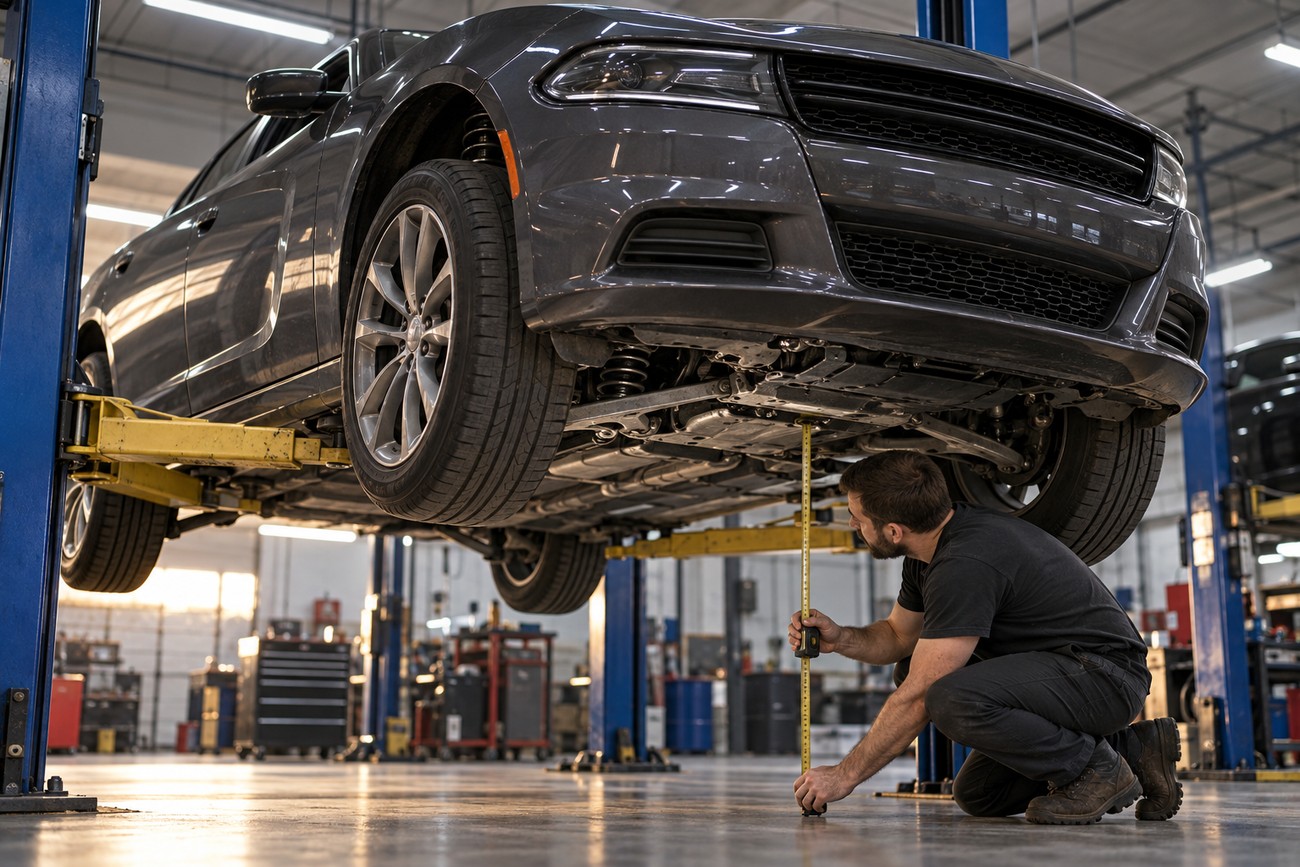
A stock Charger uses a road-oriented spring and multi-link suspension rather than a system rated for airborne landings. Changing springs or dampers may alter ride height and response, yet a modification alone does not create a certified impact system. Lower clearance can increase the chance of underbody contact, and a stiffer setup may reduce suspension travel available to absorb a landing.
Model year and trim do not create a universal limit. Older 2013–2015 Chargers have approximately 124–137 mm of official clearance, while Scat Pack and Hellcat versions are around 116 mm. A lower ride height does not establish a safe jump limit; it can simply leave less room before the underbody strikes the surface.
There is no universal safe jump height for every Charger, ramp, speed, trim, and vehicle condition. A professional stunt environment would require vehicle preparation, trajectory planning, a controlled site, suitable safety measures, and a way to inspect or retire the car after damaging loads. Those requirements are far beyond a driveway modification project.
After any hard landing, a proper inspection should cover the wheels and tires, hubs, suspension, steering, subframes, body geometry, fasteners, and electronic fault scans. Alignment measurements and hub checks are more informative than a brief test drive. If steering, braking, vibration, or fluid leakage feels abnormal, the car should not be driven until it has been assessed professionally.
Frequently asked questions
A Charger’s appearance in films can make stunt scenes look achievable in a standard road car. In practice, the vehicle, ramp, landing area, and safety procedures may differ substantially from what viewers see. The following answers separate screen image from ordinary road use.
What movie features a Dodge Charger?
Recognizable examples include The Dukes of Hazzard and The Fast and the Furious, both of which helped establish the Charger as a screen car associated with dramatic driving. A film appearance does not prove that the vehicle was stock or that it remained mechanically unharmed after the shot.
Screen cars can be purpose-built stunt vehicles, replicas, or modified versions of production models. The visible body shape may match a road Charger while the suspension, structure, safety equipment, and mechanical condition differ substantially.
Why do police like Dodge Chargers?
The Charger offers a roomy sedan body, strong highway presence, available drivetrain options, and performance suitable for duties that require acceleration and sustained road speed. Those practical qualities can make it useful in fleet service.
Police use is evidence of road capability and fleet suitability, not a jump rating. Patrol vehicles are maintained for controlled driving on roads, and their equipment, tires, and suspension remain subject to ordinary operating limits.
What should you do immediately after a hard Charger landing?
Stop in a safe place and check for a damaged tire, a bent wheel, fluid leakage, or visible parts hanging beneath the car. Avoid driving if the steering or braking feels abnormal, the vehicle pulls sharply, or a warning light appears.
Arrange a professional inspection and, where necessary, towing. A technician should check the wheels, tires, hubs, suspension, steering, subframes, body geometry, fasteners, alignment, and electronic fault codes before the Charger returns to the road.







