

A Bugatti Chiron with a road-configured top-speed limit of 420 km/h appears to have an obvious advantage over a jet during takeoff. The picture changes once the runway, aircraft, and finish line are specified. “Jet” could mean a business jet, an airliner, or another aircraft class, while “outrun” could mean reaching a higher speed, covering a set distance first, or staying ahead after liftoff.
The answer depends on the aircraft, its mass, runway length, wind, starting point, and the phase of takeoff being measured. A Chiron accelerates along the ground under tire traction. A jet accelerates along the runway, rotates, lifts off, and continues moving through the air. Those are related events, but they are not the same race.
- What Does “Outrun a Jet” Actually Mean?
- How Fast Is a Bugatti Chiron in the Real Comparison?
- How a Jet’s Takeoff Speed Is Defined
- Bugatti Chiron vs. a Jet on the Same Runway
- Why the Chiron’s Top Speed Can Mislead
- The Honest Verdict: When Could the Bugatti Win?
- Frequently asked questions
- Which car can defeat a Bugatti Chiron?
- How far can a Bugatti go at top speed?
What Does “Outrun a Jet” Actually Mean?
One interpretation is speed: the Chiron may be traveling faster at a particular instant. Another is a time comparison, such as which vehicle reaches a marked point first. A distance comparison asks which vehicle covers a specified segment in less time.
The finish line matters because a car can lead during the early ground run and lose that advantage after the aircraft leaves the runway. If the marker is placed before rotation, the comparison measures only the aircraft’s ground run. If the marker is beyond the runway, the aircraft can continue accelerating and climbing while the Chiron remains constrained to the surface.
A generic “jet” is too vague for a defensible result. An airliner carrying a substantial takeoff mass, a lighter business jet, and a high-performance military aircraft have different thrust, wing loading, operating procedures, and calculated takeoff speeds. Even the same aircraft can produce different results with changes in mass, temperature, wind, and configuration.
A fair comparison must state the aircraft type, mass, runway, wind, starting conditions, timing reference, and finish marker. Without those details, “the Bugatti beats the jet” is a visual impression rather than a defensible performance claim.
How Fast Is a Bugatti Chiron in the Real Comparison?
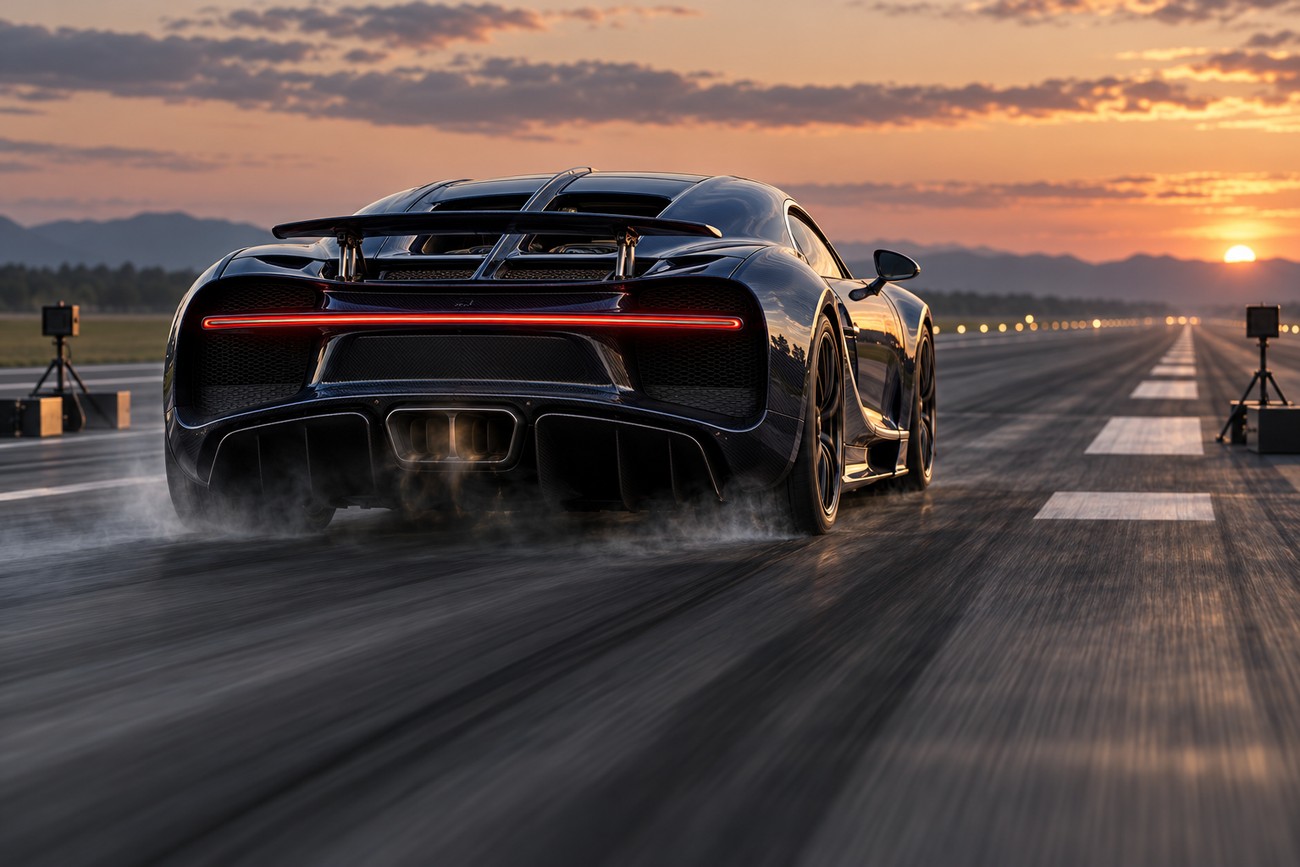
The standard Chiron’s published acceleration figures are more useful here than its headline maximum speed. Bugatti states 0–100 km/h in 2.4 seconds, 0–200 km/h in 6.1 seconds, and 0–300 km/h in 13.1 seconds. These figures show how rapidly the car builds speed through the range relevant to the early part of a runway comparison.
Those numbers do not describe a fixed distance or guarantee the same result on every surface. They are controlled performance figures, and a real comparison would be affected by launch mode, surface condition, available traction, temperature, and the measurement method. A car’s acceleration result also says nothing by itself about whether it will remain ahead once an aircraft lifts off.
The road-configured Chiron has a claimed top speed limited to 420 km/h. The Chiron Super Sport is a different specification, with a claimed 440 km/h top speed and a claimed 0–400 km/h time of 28.6 seconds. Those figures should not be transferred automatically to every Chiron.
The often-cited 490.484 km/h figure belongs to a record run by a non-standard record prototype or special version. It was not the standard road specification. Using that number to represent an ordinary road-configured Chiron makes the comparison look more decisive than the available evidence supports.
How a Jet’s Takeoff Speed Is Defined
A jet takeoff is a sequence rather than a single speed event. The aircraft accelerates along the runway, reaches calculated reference speeds, begins rotation, lifts off, and continues accelerating or climbing. Each stage changes what a car-versus-aircraft comparison measures.
V1 is the takeoff decision speed. It is aircraft- and condition-specific and marks the point after which continuing the takeoff is generally the governing choice under the applicable procedure. V1 is not a universal number shared by all jets.
VR is the speed at which rotation begins during takeoff. In FAA terminology, rotation means the pilot starts raising the aircraft’s nose to establish the attitude required for liftoff. VR cannot be lower than V1, and it is normally associated with the aircraft reaching V2 at 35 feet above ground level.
V2 is the takeoff safety speed associated with the aircraft reaching 35 feet above ground level. It is different from the speed at which rotation starts and should not be treated as the aircraft’s cruising speed or its final speed after climbing.
These speeds are calculated for the particular aircraft and takeoff conditions. Takeoff mass, temperature, wind, runway conditions, aircraft configuration, and runway length all influence the result. A statement such as “the jet takes off at X km/h” is incomplete unless the aircraft and conditions are identified.
Bugatti Chiron vs. a Jet on the Same Runway

The cleanest thought experiment uses one starting line, a named aircraft, a defined runway, and a stated finish marker. Both vehicles should be timed from the same reference point, with the result recorded by distance and time as well as speed. Stopping the clock at rotation answers only one narrow version of the question.
The Chiron Super Sport’s claimed 0–400 km/h time demonstrates rapid acceleration, but it does not prove that a Chiron will outrun an aircraft across a takeoff distance. The aircraft may initially be slower while building runway speed, then change the comparison by lifting off and continuing through the air. A ground-only finish and a finish beyond the runway can produce different winners.
Starting conditions can also reverse an apparently obvious outcome. A headwind changes the relationship between the aircraft’s airspeed and ground speed, while temperature and mass affect the distance required to reach the calculated speeds. The Chiron’s launch mode and available traction matter on the car’s side of the experiment.
The aircraft does not need to reach cruising speed to win a takeoff comparison. It only needs to complete the defined segment or reach the defined point first. Conversely, the Chiron’s high maximum speed may be irrelevant if the marker arrives before the car has enough distance to approach it.
Why the Chiron’s Top Speed Can Mislead
A 420 km/h road specification is not a promise that the car can reach that speed on every surface, in every mode, or within a short runway. The limit is connected to operating modes and tire requirements, as well as the car’s available power. Those constraints are part of the real vehicle, not footnotes that can be removed from a practical comparison.
Maximum speed and acceleration answer different questions. A car may have a high top speed yet need substantial distance to reach it. On a runway, the relevant issue is how quickly the Chiron gains speed before the chosen marker, not whether it could eventually reach 420 km/h under suitable conditions.
The 440 km/h figure applies to the Chiron Super Sport, while the 490.484 km/h record came from a non-standard record prototype or special version. Treating all three figures as interchangeable turns separate vehicles and test conditions into one misleading specification.
The Chiron remains exceptionally quick in the acceleration range that matters early in a ground sprint. That is a meaningful advantage in a carefully defined segment. It cannot, however, establish a universal result against an aircraft that can leave the runway.
The Honest Verdict: When Could the Bugatti Win?

There is no universal answer to whether a Chiron can outrun “a jet.” On a short ground segment, the aircraft still has to accelerate along the runway before rotation, so the Bugatti’s strong launch and acceleration can be competitive. The result depends on the named aircraft, its mass, the runway, and the selected marker.
A comparison that ends at rotation measures a different event from one that ends at liftoff or at a point beyond the runway. Once the aircraft lifts off and continues in the air, it is no longer confined to the same surface as the car. The car may still be accelerating strongly, but the two vehicles are following different paths.
Including climb makes the question even less like a conventional drag race. The aircraft can gain height and continue accelerating while the Chiron remains limited by road-surface traction, operating mode, tire requirements, and available distance. A top-speed comparison does not resolve that difference.
The defensible rule is simple: the Chiron may be competitive in a carefully defined ground segment, but no universal claim covers every jet or every takeoff. Judge the result from acceleration, distance, and time under stated conditions, rather than from the car’s maximum speed alone.
Frequently asked questions
Which car can defeat a Bugatti Chiron?
The answer depends on the race format. A car may beat the Chiron from a rolling start, in a short runway sprint, or in a top-speed run while losing to it in a standing-start acceleration test. “Defeat” therefore requires a specified distance, surface, start method, timing system, and vehicle specification.
Published acceleration and top-speed figures should be compared on equal terms. A lighter car with a different gearing strategy may be stronger in one segment, while the Chiron may have the advantage in another. The winning car on a prepared surface or in a controlled test facility is not automatically the quickest under road conditions or across every performance measure.
How far can a Bugatti go at top speed?
Top speed is a velocity, not a fixed travel distance or range figure. The usable distance at that speed depends on fuel, tires, road conditions, operating mode, and whether the car can safely sustain the run.
The road-configured Chiron’s claimed 420 km/h is a maximum-speed specification, not a promise of continuous travel at that velocity. The Chiron Super Sport’s claimed 440 km/h and the 490.484 km/h record run describe different vehicles or conditions and should not be treated as one standard range claim.







