
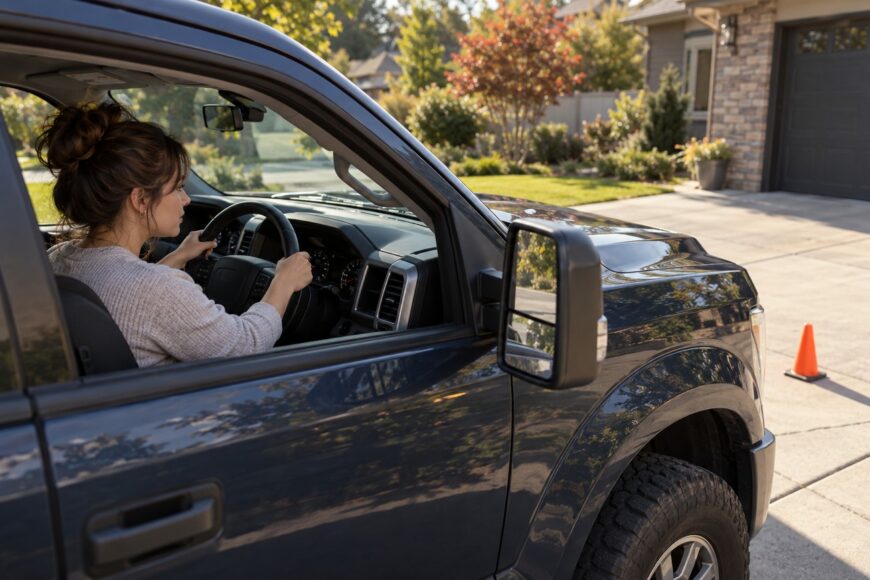
Seeing traffic clearly through the windshield does not necessarily tell you what is close to the front bumper of a Ford F-250. For a 4’11” driver, the unsettling part may be the low area where a child, animal, or parking obstacle could disappear from view while the road farther ahead remains visible.
A 4’11” driver, approximately 150 cm, may be able to drive an F-250 with an acceptable view and fit. Height alone cannot settle that question, because seated eye position, torso length, reach, and the truck’s exact equipment all matter. The answer should come from an in-person test in a safe driving position, rather than from a universal blind-zone measurement or a promise that one accessory will solve the problem.
- The short answer: height alone cannot tell you
- Test the view from a safe driving position
- Why a cushion, camera, or lifted truck changes the answer
- What to do if the standard setup fails
- Frequently asked questions
- Which vehicles have the worst visibility?
- What F-250 model year should I avoid?
- What vehicle has the largest blind spot?
The short answer: height alone cannot tell you
Two drivers who are both 4’11” can sit differently in the same truck. One may have a longer torso and a higher seated eye position, while another may need more seat height or a different backrest angle to reach the pedals and steering wheel. Standing height is therefore a useful starting point, not a complete vehicle-fit measurement.
Forward visibility has several separate parts. You may see traffic and lane markings farther down the road, see part of the hood, and still have limited visibility of a low obstacle close to the front bumper. Seeing the road farther ahead does not establish that the space immediately in front of the truck is visible.
The hood’s edge is also an imperfect reference. Some drivers can see a portion of it while still losing sight of low objects below the front sightline; others may lose sight of the hood itself but have a different view through the windshield. Do not calculate an exact blind-zone distance from an estimated hood height or from the point where the hood disappears.
The practical standard is a combined one: you need useful awareness around the truck, reliable pedal control, comfortable steering access, stable posture, correct seat-belt placement, and a properly positioned head restraint. A view that improves only because you are leaning forward or sitting on the edge of the seat is not a safe driving fit.
Test the view from a safe driving position
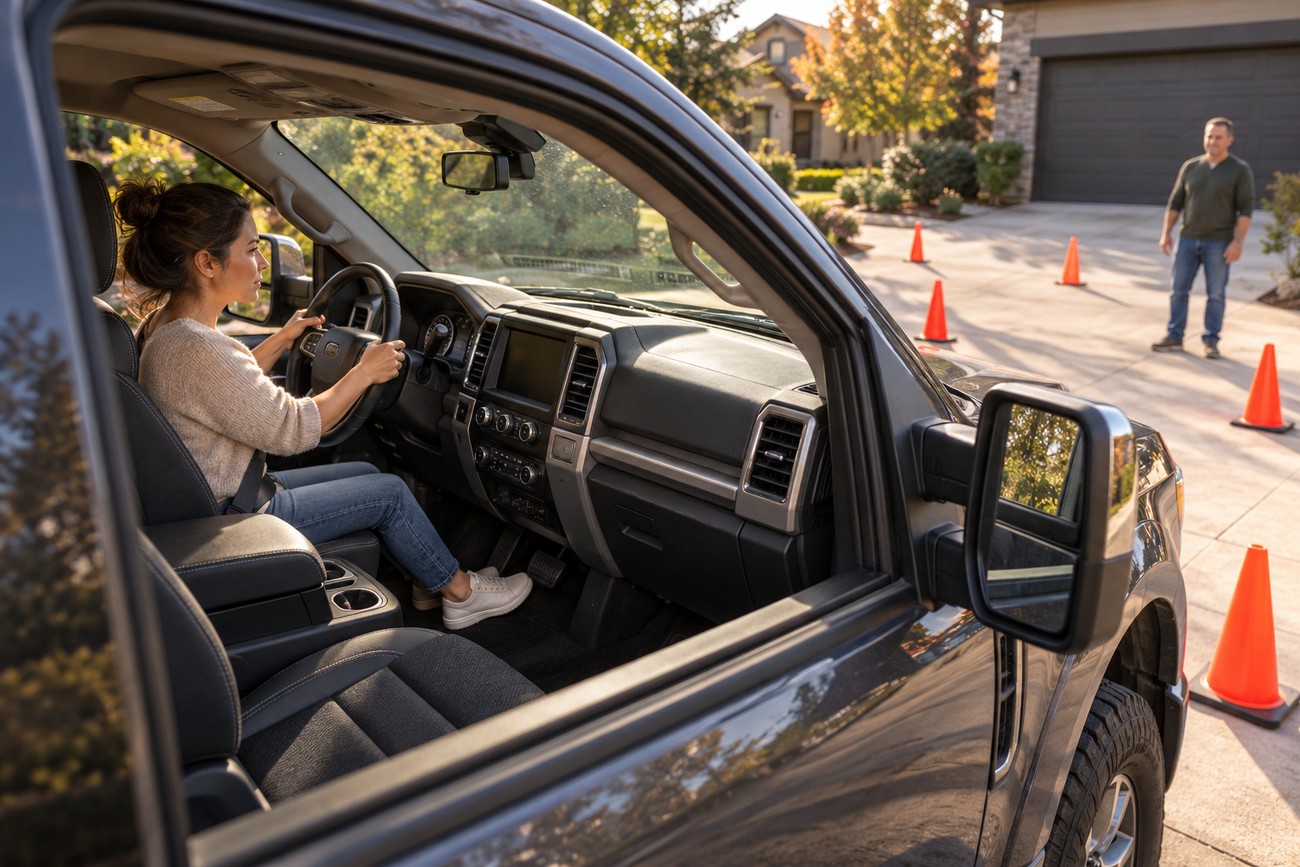
Test the exact F-250 you may buy, including its tire size, suspension, seat, and camera equipment. Begin with the seat in a position that gives you firm pedal control without stretching. Adjust the backrest so your shoulders remain supported, set the steering wheel for comfortable reach, and position the mirrors after the main seating position is established.
With the truck stationary, engine off, and parking brake set, ask a helper to place visible, nonliving markers at different positions in front of the vehicle. Use markers at varying distances and lateral positions, and have the helper confirm where each marker is located. From your normal seated position, note which markers remain visible, which disappear, and when they reappear as the helper moves them; this reveals nearby areas obscured from your eyes without moving the truck while a person is in front of it.
Moving closer to the steering wheel can create a false improvement: the view may improve while belt geometry, pedal control, and steering access become less secure.
Repeat the check after small adjustments to the seat height, backrest, steering wheel, and mirror positions. Do not stretch your neck, lean over the wheel, or perch on the seat edge to produce a better result. If permitted, a low-speed drive in a controlled parking area can then show how the view works during turns, approaches, and parking, but it should follow the stationary check rather than replace it.
Check the belt across your body, the position of the head restraint, and your ability to press every pedal smoothly while maintaining a stable posture. If raising the seat improves the view but makes the belt ride incorrectly, moves your head away from the restraint, or reduces pedal control, that adjustment has not solved the fit problem.
Why a cushion, camera, or lifted truck changes the answer
A loose cushion may raise your body, but it can also change belt placement, head-restraint alignment, hip position, and pedal reach. It may slide during braking or a turn, and a thick cushion can encourage a posture that looks higher while reducing control. Treat a cushion as an unverified seating change, not as a safety solution.
A front camera or parking sensor can add useful information about the area ahead. Its coverage, viewing angle, image quality, activation, and operating limitations depend on the particular equipment, and dirt, weather, glare, or a blocked sensor can reduce its usefulness. Camera images can also make depth harder to judge than direct observation, so the driver still needs to check the surroundings.
A suspension lift or larger tires can change the driver’s sightlines and the position of the truck’s front end. Conclusions from a stock F-250 should not automatically be applied to a modified one. Test the exact truck after the modification, especially if the vehicle will be used in tight driveways, crowded parking areas, or places where low obstacles may be present.
Parking reference points can help you learn how the hood and body relate to lane markings, curbs, and other fixed objects. They are useful for repeatable maneuvers, but they cannot reveal an unseen child, animal, cyclist, or moving obstacle. Use them as a supplement to direct observation and assistance systems, never as proof that the near-bumper area is clear.
What to do if the standard setup fails
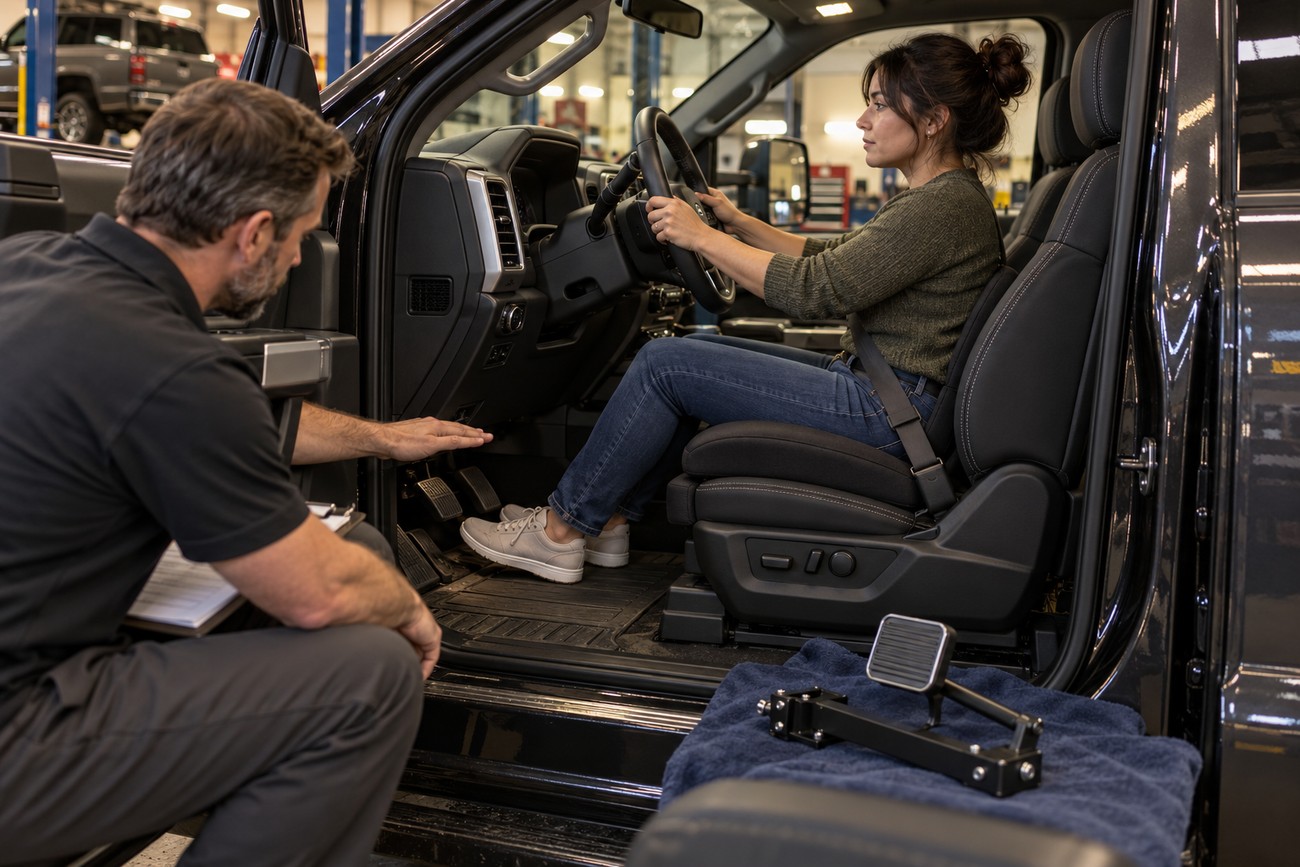
Start by exhausting the factory adjustments on the specific F-250. Check the full seat travel, seat height, backrest, steering-wheel reach and height, mirror positions, pedal access, and any factory camera or sensor settings. A vehicle that fits one driver in a shared household may still be unsuitable for another driver’s adjusted position.
If the standard setup does not provide adequate awareness and control together, consult a qualified driver-fit or mobility specialist. Possible changes may include a compatible seat base, altered seat hardware, or pedal extensions, but each solution must be selected for the vehicle and installed securely. The work should preserve restraint geometry, head-restraint protection, steering access, and dependable pedal operation.
Ask the specialist to assess the complete driving position rather than focusing only on eye height. The useful result is a stable posture with an effective belt, controlled pedals, reachable steering, and a practical view of the areas relevant to normal driving and low-speed maneuvers. Any camera or sensor should also be verified on the vehicle rather than assumed to provide a particular field of view.
If you cannot achieve both adequate situational awareness and safe control, do not buy or drive that configuration on the assumption that practice will fix it. Choosing another truck, a different configuration, or a professionally adapted vehicle is safer than treating an unresolved near-bumper view as a skill problem.
Frequently asked questions
Visibility depends on both the vehicle and the driver’s seated position. No vehicle ranking or F-250 model year can settle whether a particular truck fits a 4’11” driver. Compare vehicles from a safe driving position, paying attention to the low area near the front bumper as well as the view farther ahead.
Which vehicles have the worst visibility?
There is no reliable universal ranking of vehicle visibility. Large trucks, tall SUVs, modified vehicles, and vehicles with high front ends can create difficult near-bumper sightlines, but the result depends on the driver’s seated position, body proportions, hood design, seat adjustment, and equipment.
For a short driver, compare vehicles from the actual driving position rather than relying on marketing descriptions such as “commanding view.” A vehicle that shows traffic well ahead may still obscure low objects near its front bumper.
What F-250 model year should I avoid?
No single F-250 model year can be identified from driver height alone as one to avoid. Fit depends on the individual truck’s seat, tires, suspension, camera equipment, condition, and any modifications, as well as the driver’s body proportions.
Inspect and test the exact vehicle, check its equipment and service history, and verify any relevant safety or recall information through appropriate official sources. A newer truck is not automatically a better fit for a 4’11” driver, and an older truck is not automatically unsuitable.
What vehicle has the largest blind spot?
There is no single vehicle with the largest blind spot for every driver. Blind areas vary by direction, object height, vehicle geometry, seat position, mirrors, cameras, and modifications, so a universal winner would be misleading.
For a particular truck, assess the low area near the front bumper separately from the side and rear areas. Use a stationary marker check, direct observation, mirrors, and available assistance systems, then confirm that the driver can maintain safe control from the properly adjusted seat.







