
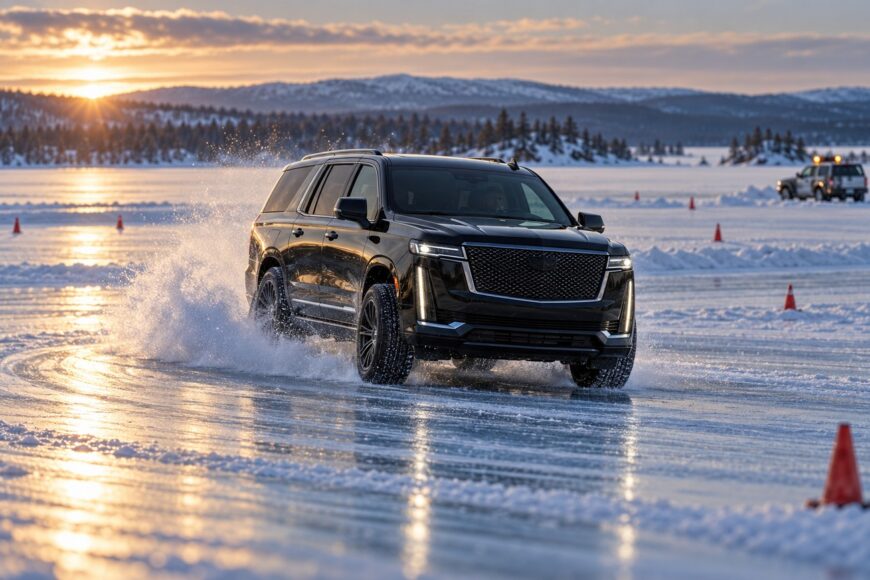
A Cadillac Escalade weighing about 5,950–6,400 lb sliding across a frozen Arctic lake makes a striking image. Its size also changes the stakes: the vehicle needs room to stop, and the ice must withstand more than the weight of a parked SUV. A clean-looking drift can conceal the work that made it possible.
For a Lake Inari run, the central issue is whether the ice, tires, course, vehicle setup, and liability arrangements can support it. Polished footage may suggest open-lake freedom, while organized ice driving commonly takes place on surveyed, partially closed tracks. A video alone cannot establish where a run occurred or whether the surrounding ice was safe.
- What the Lake Inari Drift Videos Leave Out
- Can Lake Inari Ice Carry a 6,000-lb SUV?
- Why a Heavy Escalade Feels Awkward on Ice
- Tires and Stability Electronics Decide the Result
- How a Responsible Ice-Driving Course Is Managed
- The Expensive Failure Points Behind the Spectacle
- Escalade on Ice: Myth Versus Reality
- The Minimum Standard Before Anyone Pays to Drive
- Frequently asked questions
- Which Cadillac Escalade should you stay away from for an ice-drift event?
- What should I confirm with an organizer before paying for an Escalade ice-driving session?
- How much is a Hennessey H1000 Escalade, and does it make sense on ice?
- What is the fastest Cadillac Escalade for a frozen-lake event?
What the Lake Inari Drift Videos Leave Out
A stock Cadillac Escalade weighs approximately 2,700–2,900 kg (about 5,950–6,400 lb), depending on generation and specification. On ice, that mass keeps moving after a small steering or throttle error. A camera angle can make the slide look precise while hiding the run-off space needed if the vehicle travels wider than intended.
A controlled course has marked routes, clear exclusion areas, and access for recovery or emergency vehicles. Those boundaries matter because an Escalade can leave its intended line with considerable momentum. Drivers, filming crews, spectators, and other lake users all need to remain outside the areas a sliding vehicle could reach.
Organizers also control spacing. Sending heavy vehicles close together adds collision risk and repeated loading to the same section of ice. A sequence of dramatic shots may have been recorded with only one vehicle moving at a time, on a prepared route that was inspected between runs.
That preparation is easy to edit out. The result can look like an ordinary owner has found an empty stretch of frozen lake and started drifting. In practice, a large SUV calls for instruction, a suitable course, and permission from people who have assessed that specific ice—not confidence drawn from footage.
Can Lake Inari Ice Carry a 6,000-lb SUV?
Lake Inari covers approximately 1,040 km² and reaches about 92 m at its maximum depth. Its size alone makes a lake-wide claim about ice strength unreliable. Conditions along one marked route cannot be assumed to apply near a shore, an island, a channel, or an unmarked filming position.
Finnish guidance commonly cites roughly 15–20 cm of ice for a passenger car, subject to local conditions and assessment. A heavy SUV requires substantially greater thickness and stable freezing conditions; approximately 20–30 cm or more is a reference range, not a universal safety guarantee. Neither figure gives a driver permission to test an unmarked area of Lake Inari.
Thickness is only one measurement. Clear or black ice can differ in strength from snow ice or layered ice, while cracks, currents, springs, and local weak zones can change conditions over a short distance. Snow may also hide damage and affect how the ice freezes. Repeated checks along the intended route are more useful than a single reassuring reading.
The vehicle’s stationary weight is only the starting point for an assessment. Sudden steering, wheelspin, braking, and repeated acceleration can impose impact and wave-like loads on the ice. Several vehicles using the same area can add to that loading, particularly where the prepared line is deteriorating.
Temperature history matters as well as the reading on the day: stable freezing conditions offer a different margin from ice affected by a warm spell. A responsible decision depends on current local inspection, the approved vehicle class, and the planned driving pattern. It should be made by the course operator, not inferred from a seasonal thickness claim.
Why a Heavy Escalade Feels Awkward on Ice
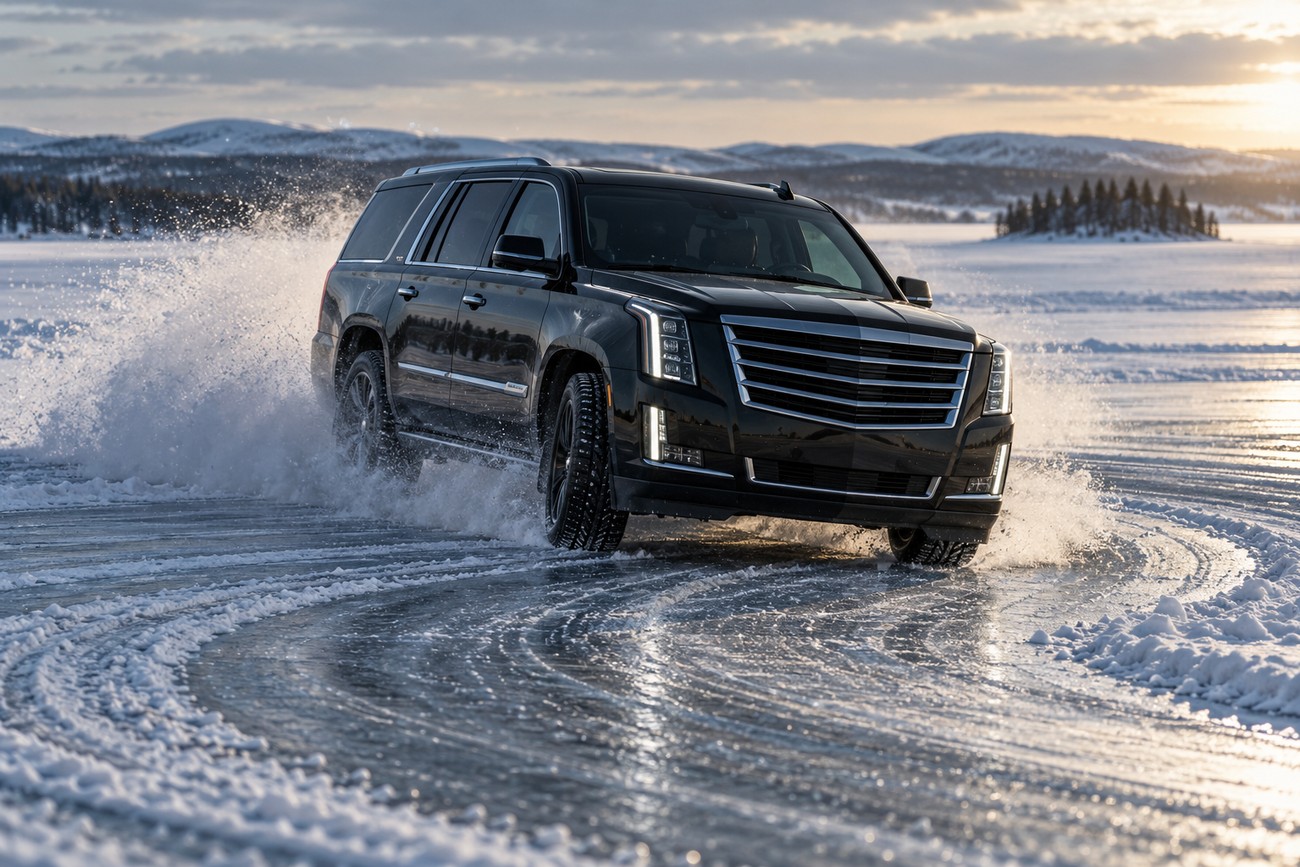
At approximately 2,700–2,900 kg in stock form, an Escalade can feel slow to respond when grip is scarce. Steering input may arrive before the body settles, and body roll can make the vehicle seem to float across the surface. That delay encourages larger corrections, which can turn a manageable slide into a rotation.
A controlled drift stays within a predictable path and leaves room to recover. An accidental spin develops when the available grip and space are no longer enough for the driver’s correction. The Escalade’s mass does not make either maneuver inevitable, but it makes a missed line harder to recover and increases the consequences at the course edge.
Sustained cornering places substantial lateral loads on the tires and ice. Abrupt weight transfers and Scandinavian-style direction changes are especially demanding in a high-bodied SUV. Long stopping distances also mean a driver must account for where the vehicle will end up, rather than judging only how neatly a slide begins.
Repeated attempts can tire a driver who is constantly waiting for the SUV to respond and then correcting its motion. An even, controlled pace is generally less disruptive to the ice than a pattern of hard acceleration and braking. That is a reason for disciplined course operation, not a reason to treat a sustained drift as harmless.
Tires and Stability Electronics Decide the Result
Ordinary friction winter tires are designed for winter roads, not necessarily for deliberate sideways driving on polished lake ice. If they cannot provide enough directional grip, the Escalade may slide without following the intended line and take a long distance to stop. A driver cannot compensate for an unsuitable tire simply by relying on the vehicle’s power or mass.
Ice-drift operators use specialized studded tires, sometimes with custom longer studs where course rules allow them. Experienced teams may adjust pressure to increase the contact patch, but only within tire and event limits. Stud choice and pressure affect handling and course wear, so they belong in an approved vehicle setup rather than an improvised change at the lake.
Factory electronic stability control, or ESC, and traction control may resist a deliberate drift by reducing power or intervening as the vehicle rotates. That can interrupt a planned maneuver. Fully disabling them removes an intervention that might otherwise help contain an error and raises the training requirement.
Neither electronics setting makes a weak course safe. Tires must suit the surface, the vehicle must be in sound mechanical condition, and the driver must understand how it reacts before attempting a slide. A course operator may also restrict acceptable tires or system settings to protect the ice and other participants.
How a Responsible Ice-Driving Course Is Managed
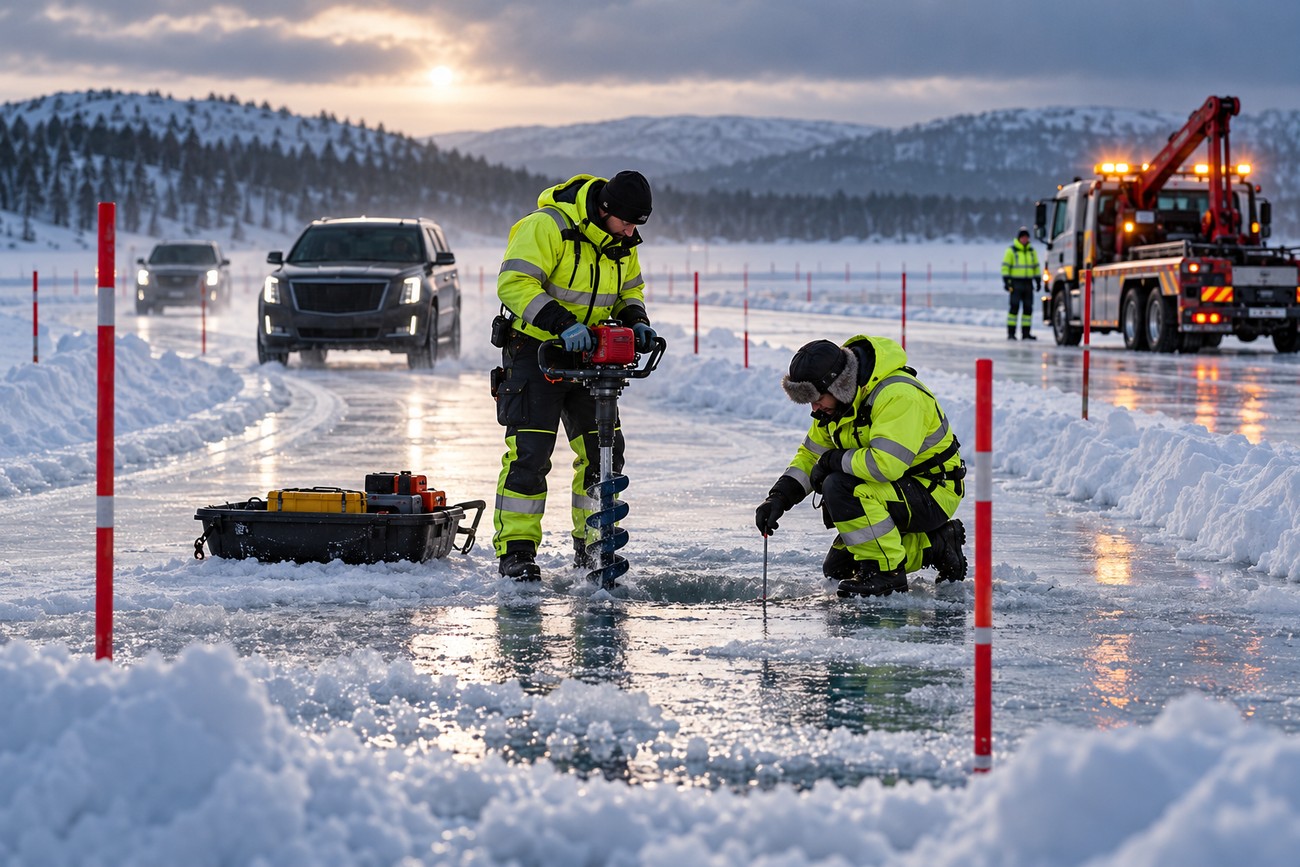
Organized winter driving centers in Finland and Norway use ice inspections and drilling, marked routes, and restrictions on off-route travel. Checks need to reflect the route being used and changing conditions, rather than a reading taken once at the start of the season. An operator should be able to explain who assesses the ice and when driving stops.
Course markings do more than show the driving line. They keep vehicles away from known weak areas, leave space for a missed corner, and preserve access for recovery equipment. Snowbanks, ruts, and rough patches can change during a session, so the course needs reassessment as vehicles use it.
Separating heavy SUVs, or running them one at a time, limits combined wave loading on the ice and gives the prepared line time to be inspected before another heavy pass. Collision avoidance is only part of the spacing decision.
A recovery plan identifies a suitable tow method, nearby equipment, an accessible route, and how to contact local emergency services. Improvised towing from the edge of questionable ice can expose another vehicle and its occupants to the same hazard. Exclusion zones also keep bystanders clear of both the driving line and any recovery work.
Open-lake weather affects the vehicle as well as the surface. A strong crosswind can influence a large, high-bodied Escalade when tire grip is limited. For filming, carrying fewer passengers and less equipment reduces the vehicle’s actual load, although it does not remove the need to assess the ice for that vehicle and run.
The Expensive Failure Points Behind the Spectacle
One recurring concern at ice events is a gap between a general assurance that “the ice is safe” and the checks visible at the course. Thickness can vary along a route, and participants may have little basis for judging whether drilling is frequent enough. Before paying, ask how the route is inspected and what change in conditions would stop the session.
Prepared lines can deteriorate quickly under heavy vehicles. Ruts, holes, and broken, rough ice can unsettle an SUV that already responds slowly, while unsuitable tires make it harder to hold a safe line. Repeated corrections add to driver fatigue; an extra run is a poor bargain if the surface or driver is no longer performing consistently.
The contract can be as consequential as the driving. Insurance may exclude driving on ice or organized performance use, and an agreement may place vehicle damage and recovery costs on the owner. Potential extra charges for helmets, additional instruction, photography, or recovery should be disclosed before a booking is made.
Filming creates its own pressure to move people closer to the action or toward visually appealing areas near cracks and open water. Safe distances must take priority over the shot, including around local travel and fishing routes. A spill of fuel or oil after a failure can affect the ice environment and areas other people use, with cleanup responsibilities that may extend beyond vehicle repair.
Escalade on Ice: Myth Versus Reality
A successful-looking run shows what happened on that run. It does not establish the safety of a different vehicle, route, or day. The distinctions below matter before anyone treats the footage as a plan.
| Myth | Operational reality |
|---|---|
| Ice that carries people or lighter cars will carry an Escalade. | A heavy SUV needs its own local assessment, including the effects of motion and repeated loading. |
| One adequate thickness reading proves the whole lake is safe. | Ice type, cracks, snow, currents, springs, and local weak zones can change strength along a route. |
| Vehicle weight is the only load that matters. | Steering, wheelspin, braking, and repeated passes can create impact and wave-like stresses. |
| Stability electronics make a drift safe. | ESC and traction control can interrupt a deliberate slide; disabling them increases the need for skill and does not replace course controls. |
| Stock winter tires are enough for an ice-drift session. | Deliberate drifting generally calls for specialized studded ice tires approved for the event. |
| The video shows how easily an owner can drift on open lake ice. | Footage may omit surveying, restricted access, instruction, spacing, and reduced passengers or cargo. |
The Minimum Standard Before Anyone Pays to Drive
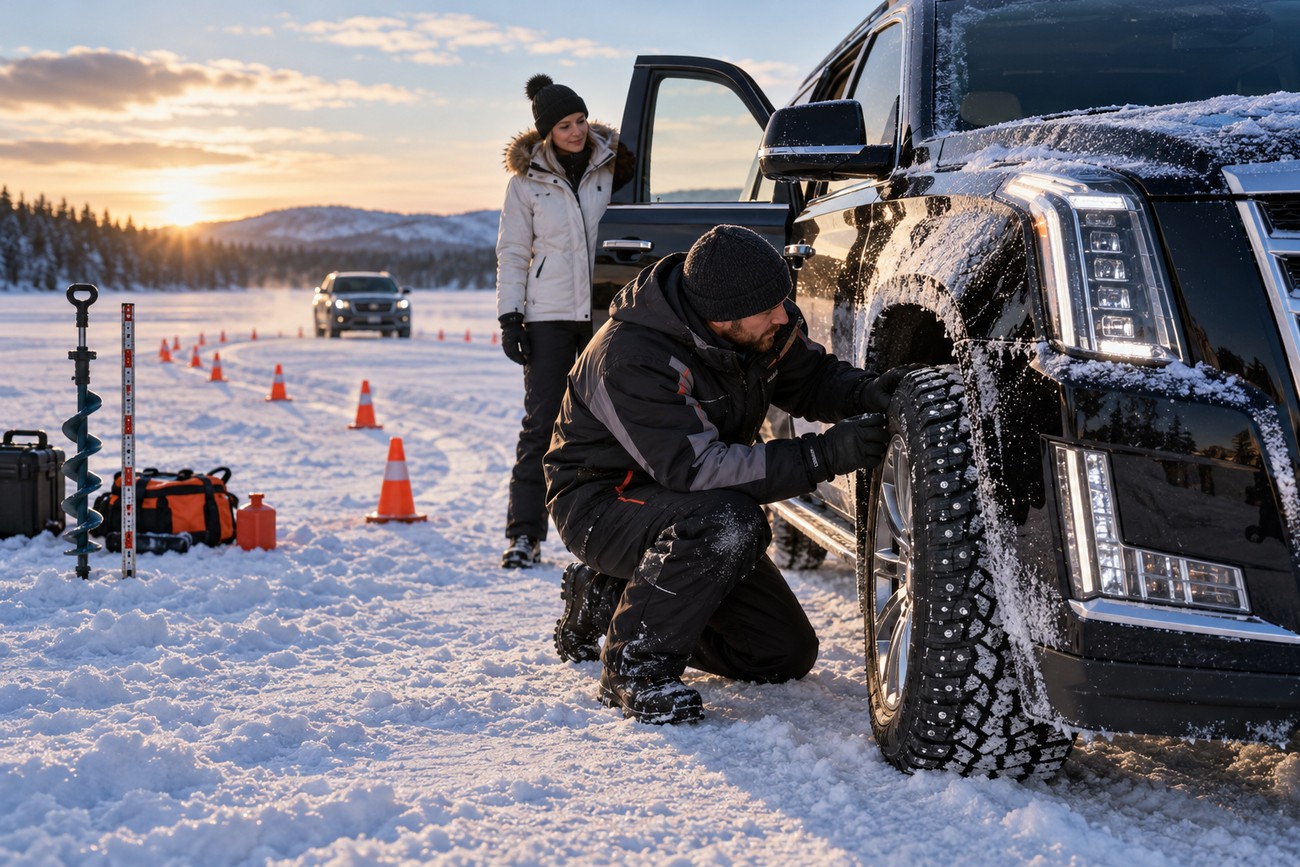
Ask who checks the ice, how they check it, and how often they repeat those checks during the event. The answer should concern the current marked route, not a general statement about Lake Inari in winter. Confirm the approved vehicle class and whether the assessment accounts for an Escalade weighing approximately 2,700–2,900 kg in stock form during dynamic use.
Next, establish the vehicle requirements: permitted tires, their condition, any rules for stability systems, and whether an instructor must accompany or supervise the run. Find out how many vehicles may be on the course together and which areas are off-limits. If the operator cannot describe the route and its restrictions, the booking is missing a basic safety condition.
Locate the recovery equipment and ask how a stranded vehicle would be reached without sending another driver onto unassessed ice. Confirm that staff know the local emergency contacts. Read the insurance and liability terms for ice driving, performance use, vehicle damage, recovery, and environmental cleanup; check which equipment and services are included in the price.
Clear answers before arrival leave room to decline an event whose controls are vague. A marked course can still close when conditions change, and cancellation terms should account for that possibility. An unmarked Lake Inari test session is not an acceptable substitute for a managed course.
Frequently asked questions
These questions address vehicle choice, organizer checks, and performance considerations for an Escalade ice-driving session. The same basic requirements apply throughout: assessed ice, a managed course, suitable tires, and clear liability terms. Performance claims do not replace those conditions.
Which Cadillac Escalade should you stay away from for an ice-drift event?
Avoid any Escalade with unknown tire condition, damaged stability systems, unresolved mechanical faults, excessive cargo, or no organizer approval. No generation is automatically fit or unfit for ice drifting based on its name alone. Have the specific vehicle checked against the event’s tire, weight, and condition rules before committing to drive it.
What should I confirm with an organizer before paying for an Escalade ice-driving session?
Confirm the date and method of the latest ice testing, how often checks continue, and the vehicle limits for the course. Ask which tires, helmets, and instruction are included, what recovery costs, and whether insurance excludes ice or performance driving. Get the cancellation rules in writing, particularly for a closure caused by changing conditions.
How much is a Hennessey H1000 Escalade, and does it make sense on ice?
A reliable current price cannot be established here; request a current quote from a builder or seller for the specific vehicle. Extra power does not improve the ice’s strength or replace suitable tires, predictable control, and organizer approval. It may also complicate vehicle eligibility and insurance, so confirm both before considering an ice session.
What is the fastest Cadillac Escalade for a frozen-lake event?
Peak speed is a poor way to select an Escalade for a frozen-lake event. A vehicle with predictable throttle response, compatible tires, sound mechanical condition, and accessible service support is more useful than one chosen for straight-line performance. The deciding requirement is approval for the particular course and conditions, not a top-speed claim.







