
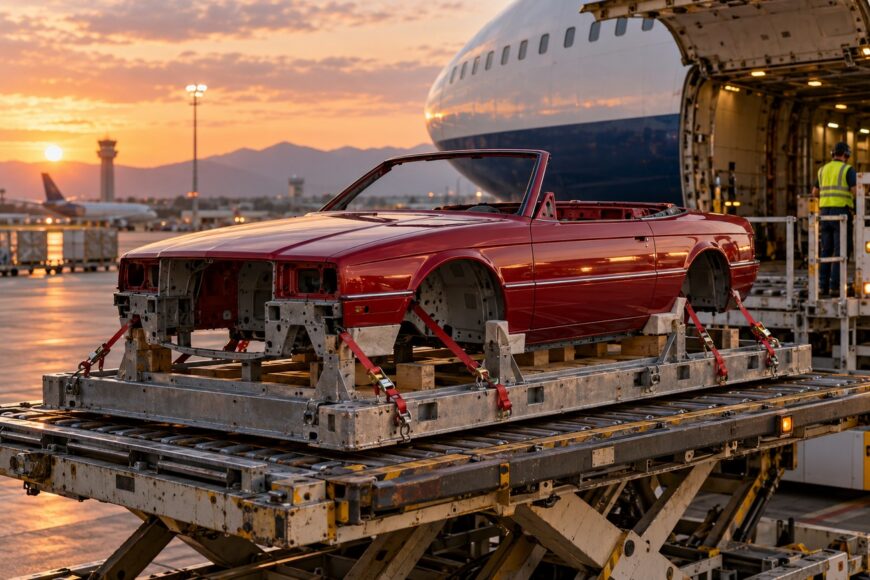
Cadillac Allanté bodies crossed the Atlantic in Boeing 747s, flying from Italy to Detroit before the cars could be completed. The image suggests a Cadillac built in Italy and delivered by air. In reality, the Allanté depended on two-stage production linking Pininfarina in Italy with GM’s Detroit plant.
That arrangement gave Cadillac a Pininfarina-finished convertible with American mechanical hardware, but it also made a relatively small production run expensive and complex. For a buyer today, the aircraft story is less consequential than the condition of the folding top, its seals, the electrical systems, and parts that may be difficult to replace. A sound engine cannot make a leaking, poorly adjusted Allanté an easy car to own.
- Why Cadillac Put the Allanté on a 747
- Inside the Italy–Detroit Airbridge
- What Was Built in Italy—and What Detroit Finished
- A Brilliant Process Behind a Small Production Run
- The Ownership Trap: Roofs, Seals, and Rare Parts
- Myths and Inspection Mistakes That Change the Price
- Frequently asked questions
- What documents matter most when buying a used Cadillac Allanté?
- Why can an Allanté restoration cost more than its drivetrain suggests?
- How should a buyer compare a cosmetically attractive Allanté with a less polished but documented one?
Why Cadillac Put the Allanté on a 747
Cadillac wanted a distinctive convertible that could draw on Pininfarina’s body design and finishing while retaining GM’s mechanical systems. Pininfarina produced the bodies at a separate facility in San Giorgio near Turin. References to “Turin production” describe the wider location; they should not obscure the dedicated San Giorgio site.
The arrangement split work across the Atlantic. Italy handled the body and much of what occupants would see and touch, while Detroit completed the car around its American chassis and powertrain. That division let each partner contribute established capabilities, but it required parts and partly built bodies to arrive in the right order.
Air transport was therefore a production decision, not merely an extravagant advertisement. A regular airbridge kept the Italian and Detroit stages connected on a workable schedule. It also added freight, handling, and coordination costs to a car that would never benefit from the scale of a conventional high-volume Cadillac program.
Inside the Italy–Detroit Airbridge
The outbound cargo was more substantial than a bare metal shell. Specially equipped Boeing 747s carried up to 56 partially assembled bodies per flight in aluminum cargo modules. Those bodies had already received significant finishing work, but none was a complete, drivable car.
Alitalia and Lufthansa operated flights approximately three times per week. The modules allowed the bodies to be secured and moved through a repeatable shipping process, an important consideration when painted and trimmed components had to reach final assembly without avoidable damage. “Up to 56” describes capacity, rather than a guarantee that every flight carried that number.
Published route figures disagree: sources cite approximately 4,600 miles, 7,000 miles, or about 7,403 km. Rounding and whether an account describes one leg or a wider logistics cycle help explain the variation. No single figure is needed to understand the central point: routine transatlantic freight was built into the manufacturing plan.
The aircraft also carried cargo in the other direction. Subframes, engine compartments, rear sections, electrical equipment, and other components traveled from Detroit back to Italy to support work at San Giorgio. The return flow makes the airbridge easier to understand as an interconnected supply chain rather than a one-way publicity flight.
What Was Built in Italy—and What Detroit Finished
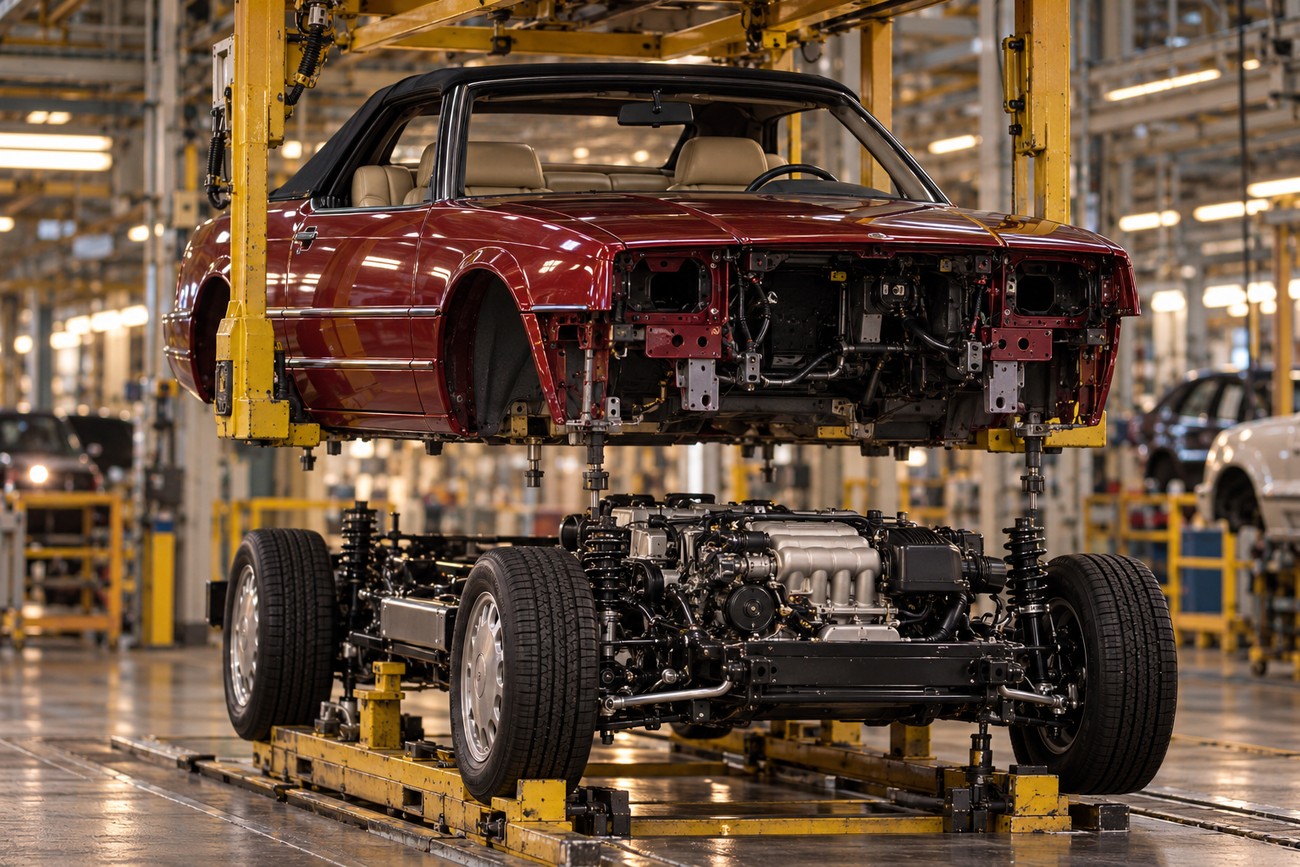
At the Italian stage, Pininfarina fitted body panels, applied paint, completed exterior finishing, and installed electrical equipment, the leather interior, and the folding top. The body that arrived in Detroit was consequently trimmed and partially assembled. Calling it an unpainted shell understates the work already done; calling it a finished automobile goes too far.
Detroit connected that assembly to the American chassis and installed the engine, transmission, and part of the running gear. The final car combined Pininfarina’s visible craftsmanship with GM’s mechanical architecture and final integration. Its origin is best understood as a joint Pininfarina–GM production system, not a fully Italian automobile.
That distinction has a practical afterlife. Familiar Cadillac mechanical components may make some routine service relatively approachable, while a damaged panel, missing interior piece, or troublesome top calls for Allanté-specific knowledge and parts. The car’s mixed origins affect repair decisions long after its unusual journey has ended.
A Brilliant Process Behind a Small Production Run
Allanté production ran from 1987 through 1993, with total output commonly estimated at approximately 21,000 cars. The airbridge demonstrated that a transatlantic, two-stage process could function as regular automobile production. It did not make that process economical at the volumes achieved.
GM’s early plan was approximately 7,000 cars per year. The best annual sales result reached only approximately 4,670 cars, so the plan should not be mistaken for actual yearly sales or output. Lower volume left the program fewer cars over which to spread the costs of its dedicated Italian facility, specialized transport, and unique components.
For an owner, modest production numbers are more than a historical footnote. Common mechanical items may have a broader GM service context, but Allanté-specific trim, body, and roof parts draw on a much smaller pool. A component that seems minor during a viewing can become the item that delays a repair.
The Ownership Trap: Roofs, Seals, and Rare Parts
Water leaks and wind noise around the folding top and windows are recurring owner complaints. Their causes need to be established on the individual car: worn seals, glass alignment, roof adjustment, and drainage all deserve attention. A clean cabin on a dry viewing day proves little about how the car behaves in sustained rain.
Age adds further variables. Seals deteriorate, hydraulic components can demand work, and electrical faults can complicate diagnosis or operation. Storage and previous maintenance matter, so neither a model-wide reputation nor an attractive odometer reading should stand in for testing the particular car.
Parts supply changes the economics of a repair. Unique body, interior, glass, and roof-mechanism components may be scarce or costly because of the car’s limited production and mixed Italian-American construction. A standard GM shop may be well placed to address familiar mechanical work yet lack the parts or specific experience for trim and top problems.
Price a promising car against the work it actually needs. Ask a prospective repairer to inspect an uncertain roof or leak before purchase, and check whether required parts can be sourced. An apparently healthy drivetrain offers little protection from a larger bill for sealing, adjustment, and interior damage.
Myths and Inspection Mistakes That Change the Price
The familiar claim that every Allanté was assembled in Italy leaves out Detroit’s final integration with the American chassis and powertrain. Likewise, “56 cars per 747” turns a maximum load of partially assembled bodies in special modules into 56 road-ready vehicles. Both shortcuts make a memorable story less accurate.
The airbridge had return cargo, including components needed for the Italian stage; it was not an empty flight staged solely for publicity. Sources generally identify 1987–1993 as the production and model-year span. A car advertised as a 1994 model year warrants a close check of its identification and paperwork rather than acceptance of the listing description.
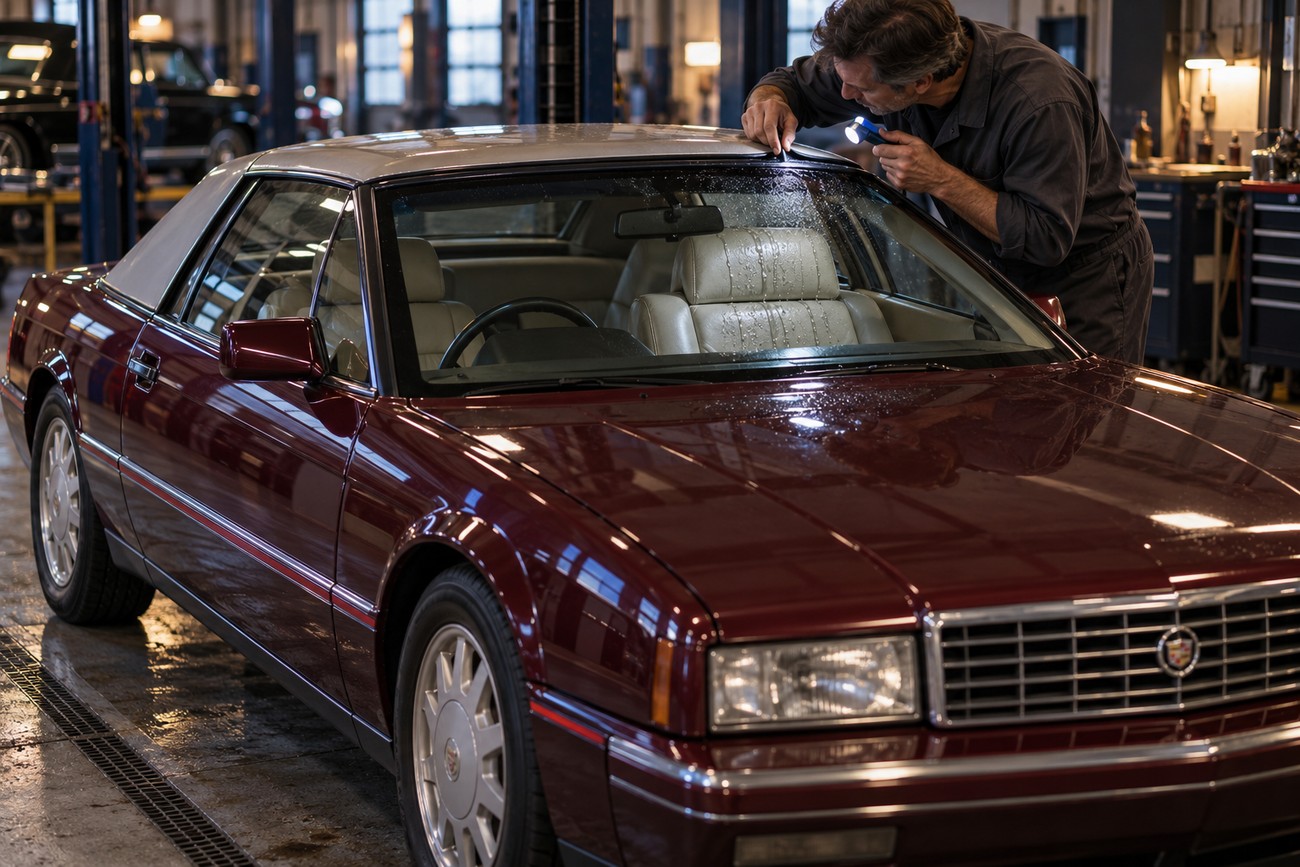
Physical inspection should follow the expensive failure paths. Operate the roof, check its fit against the glass, examine seals and drains, and look for signs of water entry beneath the visible interior surfaces. Inspect corrosion, earlier repairs to aluminum and steel elements, panel fit, and paint quality; a fresh finish can conceal work that needs closer examination.
Compare cars of the same period and equipment before using an asking price as a guide. Early examples and later updates differ, so a seller’s valuation of a later car should not automatically transfer to an earlier one. Condition and a credible repair history matter more than either the aircraft story or a polished first impression.
Frequently asked questions
A used Allanté is best judged through both evidence and inspection. These questions help separate a car with a persuasive presentation from one whose upkeep can be verified.
What documents matter most when buying a used Cadillac Allanté?
Prioritize dated service invoices for the folding top, seals, hydraulic work, and electrical repairs. They should identify what was fixed, which parts were used, and whether a recurring complaint was investigated rather than temporarily masked. A stack of general service receipts is useful, but it does not establish the condition of the car’s unique systems.
Keep records of paint and body work in the same file. Photographs taken before and during repairs can help explain a refinished panel more clearly than a seller’s recollection, while parts invoices may show how a scarce replacement was obtained.
Why can an Allanté restoration cost more than its drivetrain suggests?
A serviceable engine and transmission do not settle the cost of restoring the rest of the car. Roof adjustment, sealing, glass fit, interior refurbishment, and trim replacement can involve substantial labor as well as parts that are hard to source. Several modest-looking defects can therefore form a larger project than expected.
Build an estimate by repair area, including diagnosis, labor, parts availability, and any work needed after water damage. If a shop cannot yet establish the cause of a leak or confirm a part supply, treat its preliminary figure as uncertain rather than as a firm restoration budget.
How should a buyer compare a cosmetically attractive Allanté with a less polished but documented one?
Favor the documented car when its roof and water-management work can be verified and the cosmetic shortcomings are understood. Paint and cabin presentation are easy to appreciate at a glance; proof that a persistent leak was correctly repaired is more valuable to ownership.
Apply the same inspection standard to both cars, then compare the unresolved work. An attractive example can still be the better purchase if its systems test well, but its appearance alone should not outweigh clear invoices and a dry, properly operating roof on the less polished car.







