
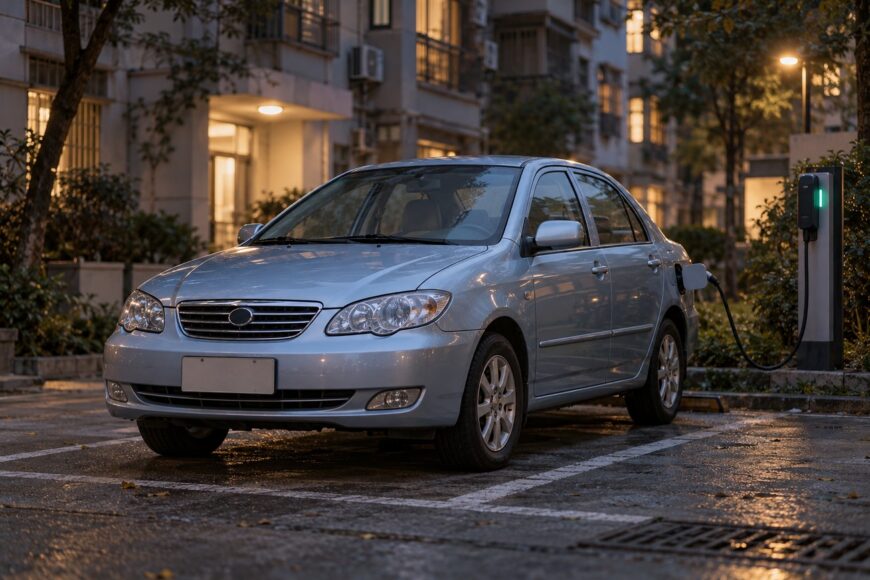
The BYD F3DM matters because it was an early production plug-in hybrid, launched in China in late 2008. It could draw energy from the electrical grid, use a gasoline engine when required, and recover some energy through braking. That placed it ahead of many better-known plug-in hybrids in production history.
The phrase “mass-market” needs careful handling. BYD presented the F3DM as a vehicle for ordinary buyers, and the underlying F3 sedan platform sold in large numbers. Documented F3DM production and sales were limited, however, so the hybrid should not inherit the sales volume of the conventional F3. For a buyer today, its appeal lies in its place in automotive history; its risk lies in owning an early, poorly documented high-voltage system.
The sensible way to assess an F3DM is to separate verified specifications, marketing claims, and owner reports. The approximately 480 km combined-range figure is a claim rather than a guarantee, while battery condition, charging behavior, and specialist support can matter more than the original brochure.
- Why the F3DM Matters—and Why “Mass-Market” Needs a Footnote
- How the BYD F3DM Powertrain Works
- Range, Size, and the Gap Between Brochure and Road
- Charging and Battery Ownership: The Mistakes That Cost Most
- Early F3DM Weak Points: Rust, Electronics, and Service Access
- Used-Buying Verdict: A Historic Car, Not a Simple Cheap Sedan
- Frequently asked questions
- How can a buyer check an F3DM battery when there is no standard battery-health report?
- Was the BYD F3DM the $8,000 Chinese car?
- What is the $8,000 Chinese car?
- Why is BYD falling?
Why the F3DM Matters—and Why “Mass-Market” Needs a Footnote
BYD launched the F3DM in China in late 2008 as an early production plug-in hybrid. Its basic idea was straightforward: use grid electricity for shorter trips, retain a gasoline engine for longer journeys, and reduce dependence on fuel without requiring a dedicated charging network. At the time, that combination was unusual in a production sedan aimed at ordinary customers.
The car was based on the BYD F3 sedan, with broadly related cabin architecture and running gear. This helped BYD present the F3DM as a familiar compact sedan rather than an experimental body style. It also created a practical advantage for some repairs, because selected body and chassis parts may overlap with conventional F3 applications.
That common platform can create a misleading impression in historical summaries. The F3 sold in large numbers, while the F3DM was produced and sold in limited quantities. High-volume figures associated with the F3 platform should therefore not be attributed to the plug-in hybrid.
“Mass-market” describes BYD’s intended positioning more reliably than documented F3DM volume. The car was designed around a mainstream sedan and marketed as accessible technology, yet its limited distribution, unusual software, and specialist service needs made ownership far less ordinary than the badge suggested.
How the BYD F3DM Powertrain Works

The F3DM combines an AC electric motor with a 1.0-liter gasoline engine. The electric system supplies the smooth, quiet response expected in low-speed urban driving, while the gasoline side extends operating flexibility when the battery cannot provide the required energy. The stated combined output is approximately 125 kW, or about 168 hp.
Its traction battery uses LiFePO₄, also known as lithium iron phosphate, and has an approximate capacity of 16 kWh. The pack can be charged from the grid, while regenerative braking sends part of the vehicle’s kinetic energy back into the battery. Regeneration is useful, although it cannot replace external charging over a normal driving cycle.
The important ownership point is that this is a high-voltage vehicle built on a conventional compact-sedan design. Battery modules, contactors, inverters, charging equipment, insulation monitoring, and battery-management software all add potential failure points that an ordinary F3 does not have. A warning light or drivability complaint can involve either the gasoline system, the electric system, or communication between them.
Early cars should not be assumed to share identical hardware or software revisions. Documentation for first-series powertrain and battery-management systems is limited, and compatibility can depend on the specific vehicle. Ordinary F3 wiring and hybrid high-voltage wiring are separate systems, even where the surrounding body and cabin appear familiar.
Range, Size, and the Gap Between Brochure and Road
Some early BYD material quotes up to approximately 480 km on a full tank and full charge. That is a claimed combined figure with limited independent confirmation, and it should not be treated as guaranteed real-world range. Traffic, temperature, speed, charging habits, gasoline-engine operation, and battery condition can all change the result.
Pure-electric driving is described as several tens of kilometers, depending on conditions and battery state. A regularly charged car can therefore use electricity effectively for short urban journeys, while a car that is rarely plugged in loses much of the practical reason to carry the extra hybrid hardware.
The F3DM is approximately 4,533 mm long, 1,705 mm wide, and 1,520 mm high, with a wheelbase of about 2,600 mm. Its curb weight is approximately 1,560 kg. Those dimensions keep it within familiar compact-sedan territory, although the battery and associated equipment make it heavier than a conventional F3.
Extra mass has consequences that advertising usually leaves in the background. Suspension components, tires, and brakes may experience greater loads, particularly on poor roads or where maintenance has been deferred. A quiet electric launch can also hide mechanical wear until the gasoline engine starts or the chassis encounters a rough surface.
Charging and Battery Ownership: The Mistakes That Cost Most

Charging should be treated as a system rather than a simple connection between a socket and a car. Owners report charging interruptions and onboard charger (OBC) faults, including codes P33E6, P1AEE, and B2485. Those codes do not establish a universal diagnosis; they require system-specific testing of the charging path, battery, control units, and supporting electrical circuits.
Unsuitable extension equipment can cause voltage drop, heat, and poor connections. Repeatedly interrupting a charge to work around faults, ignoring abnormal noises or smells, or continuing to use a vehicle after repeated OBC errors can increase the chance of damage to charging hardware. The safest arrangement uses properly rated equipment and a supply that has been checked for condition and grounding.
A charging fault code is not enough to condemn the battery. A sound diagnosis isolates the charging path, checks connectors and insulation, verifies the 12-volt support system, and only then assesses the high-voltage pack.
Long storage also deserves attention. Prolonged parking with the battery nearly full or nearly empty may accelerate LiFePO₄ aging, particularly in cold conditions. Some owners recommend leaving the car at approximately 40–60% charge for winter storage; this is a cautious owner practice rather than a confirmed factory rule.
Used buyers face a separate problem: there is no widely standardized report showing remaining F3DM battery capacity. A dashboard range estimate is only a rough clue because it reflects recent driving and operating conditions. A proper inspection should include a system scan, charging observation, and battery data review by a technician familiar with this vehicle.
Any work near orange high-voltage cables, the battery enclosure, or power electronics requires trained technicians, isolation procedures, and insulated equipment. Treating the hybrid section as ordinary wiring can damage components and create a serious safety hazard.
Early F3DM Weak Points: Rust, Electronics, and Service Access
Body condition is often more important than a seller’s description suggests. Owner reports frequently mention weak paint and corrosion around wheel arches and sills, especially where road salt is used or corrosion protection is inadequate. Small chips can become visible rust, so the inspection should include inner arch lips, sill seams, floor edges, and areas hidden by trim.
The conventional side of the car has its own reported complaints. These include ABS sensor faults, frequent low-beam bulb failures, wiring problems, and issues affecting idle control. Some conventional F3 engines are reported to develop unstable idle around 60,000–70,000 km; diagnosing the same symptom in an F3DM can take longer because the gasoline engine may start and stop as part of normal hybrid operation.
A warning lamp should therefore be investigated with a system-level scan rather than judged by a short test drive. A rough idle may be a gasoline-engine fault, a control issue, or an unrelated electrical problem. The electric motor can mask some vibration during low-speed operation, while a weak 12-volt system can produce confusing symptoms across several control modules.
Parts access is another hidden cost. Some original hybrid-system components may need to be sourced through China, with delivery times and prices that are difficult to predict. Specialist high-voltage service is also limited by region, and early software revisions for the powertrain and BMS are poorly documented.
Reports of burning smells or excessive heat from power electronics should be treated as warning signs requiring immediate inspection. They do not prove a universal defect in every F3DM, but continued driving before identifying the source is an unnecessary risk. A seller who dismisses such symptoms as normal provides a reason to stop the purchase process.
Used-Buying Verdict: A Historic Car, Not a Simple Cheap Sedan

An F3DM can make sense for an owner who values its historical importance, has reliable charging, and can reach a qualified hybrid technician. When charged regularly and operating correctly, it may be more economical in mixed use than a conventional compact sedan. That benefit can shrink substantially if the battery is weak or the car is driven mainly without external charging.
Some body and running-gear parts may overlap with the F3 or related compact-sedan applications. This can reduce the cost of ordinary suspension or body repairs. It does not make the battery, inverter, charging system, control modules, or high-voltage wiring interchangeable with a normal F3.
A price around $22,000 is cited in some materials as Chinese-market positioning, but official pricing and complete market documentation are not readily available. The figure should therefore be treated as a reported historical reference, not a reliable guide to current value. The same caution applies to the roof solar panel fitted to some cars: its energy contribution is minimal compared with the traction battery, and its demonstration value is greater than its range-extension value.
Before buying, arrange a cold-start inspection, a charging test, a system scan, and a battery data review. Check the underside and corrosion-prone body areas, confirm that replacement parts can be obtained in your region, and ask who will handle high-voltage work. The F3DM is a compelling early PHEV for an owner with access to technical support; it is a poor choice for someone seeking cheap, predictable transportation with ordinary sedan servicing.
Frequently asked questions
Battery condition is one of the biggest uncertainties for a used F3DM buyer. Historical price claims also need to be kept separate from a car’s current value. Questions about BYD’s modern business require their own context rather than an inference from this early model.
How can a buyer check an F3DM battery when there is no standard battery-health report?
Use several imperfect checks together. Treat the available electric range during a controlled drive as a rough clue, observe whether charging completes without interruption, and request a system scan from a technician familiar with the F3DM. The scan should examine available cell or pack data rather than simply clearing stored fault codes.
Battery condition should also be judged against charging behavior, temperature, and recent driving history. A short electric range alone does not prove pack failure, while a car that charges normally can still have reduced capacity. A seller who refuses a specialist inspection leaves the most expensive part of the car unverified.
Was the BYD F3DM the $8,000 Chinese car?
No verified information presented here establishes an $8,000 price for the F3DM. Some historical material places its reported Chinese-market positioning around $22,000, although the official pricing record is incomplete.
The $8,000 figure is often connected to later headlines about inexpensive Chinese cars or to other models. It should not be used to identify the F3DM or estimate its original value without a specific, reliable source.
What is the $8,000 Chinese car?
The phrase does not identify one confirmed F3DM model. It is commonly used in online coverage of low-priced Chinese electric or gasoline cars, and the exact vehicle depends on the article, market, and year.
For the F3DM, the safer conclusion is that an $8,000 price is unverified here. Buyers should identify the model, market, equipment, taxes, and date before comparing such a headline with the early BYD plug-in hybrid.
Why is BYD falling?
A fall in BYD’s share price, sales growth, or public attention can have different causes, including market competition, pricing pressure, investor expectations, trade policy, or weaker demand in a particular region. The question cannot be answered accurately without specifying which measure and time period are meant.
That broader business question should also be kept separate from the F3DM’s historical assessment. The car’s limited documented sales and early technical design remain relevant regardless of short-term movements in the modern BYD business.







