
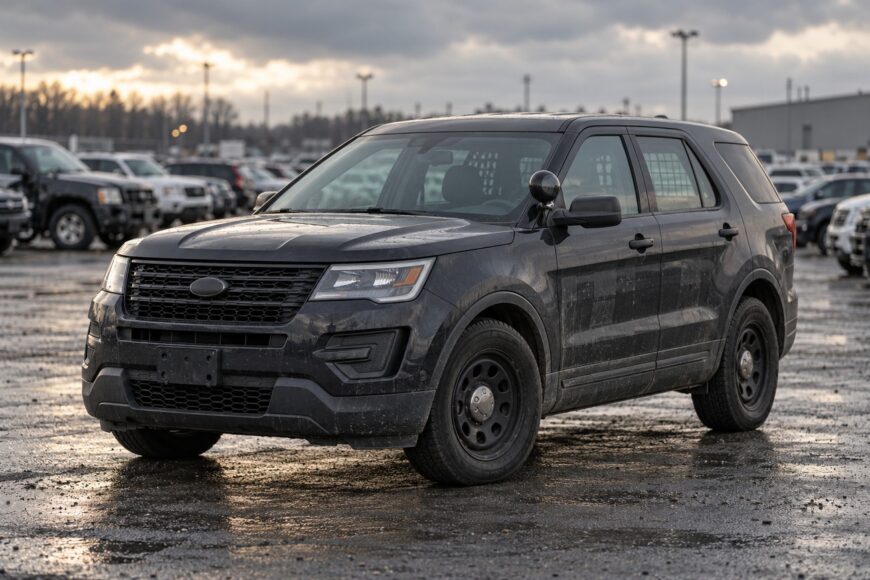
The Ford Police Interceptor Utility, the police version based on the Explorer, has an obvious appeal: strong available power, full-time AWD, and equipment built for demanding service. A low auction bid can look especially attractive beside a civilian SUV. Yet a retired unit may have spent long periods idling, lost part of its wiring when police equipment was removed, or reached the auction after a collision.
Judge the vehicle in front of you, not the mileage or the Police Interceptor badge. Idle hours, title status, damage records, missing keys, and the quality of decommissioning work can change its value substantially. The sensible purchase is the one whose condition and paperwork you can verify—and whose likely repairs still fit your total ownership budget.
- What You Are Actually Buying at a Police Auction
- Read the Auction Listing Before You Bid
- Inspect the Hidden Wear: Idle Hours, Cooling, Wiring, and Interior
- 3.0 EcoBoost, 3.3 V6, or 3.3 Hybrid: Which Fits the Buy?
- Build a Realistic Bid and Repair Budget
- A Safe Pre-Bid and Inspection Sequence
- After the Sale: Make the Interceptor Civilian-Ready
- Frequently asked questions
- How can I verify idle hours when the auction listing does not show them?
- What documents should I request before paying for an auction Interceptor?
- When should I reject a Police Interceptor Utility even if the bid price is low?
What You Are Actually Buying at a Police Auction
The Police Interceptor Utility shares its Explorer basis with a familiar family SUV, but its specification reflects a different job. Full-time AWD, police-tuned suspension, heavy-duty cooling and braking components, and stamped-steel wheels are intended to support repeated hard use. Those parts may be useful to a civilian owner, though their condition matters more than their original rating.
The cabin can differ as much as the hardware. Seats and interior fittings may have been chosen or altered around uniforms, equipment, and a partition rather than everyday passenger comfort. Some active-safety systems may also be disabled in police configuration. Check the individual vehicle’s build information and operating condition before assuming it has the same features—or behaves the same way—as a similarly aged civilian Explorer.
Police preparation does not erase police use. Hours spent stationary with the engine running can put work on the engine, cooling system, and exhaust without adding much to the odometer. Frequent stops, heavy loads, and equipment installation can also leave wear, including on the transmission, that a clean exterior photograph will not show.
Think of the heavy-duty package as a description of what the vehicle was built to do, not a condition report. A well-documented unit with intact wiring and sound mechanical systems may be a sensible buy. A low-mileage unit with unknown idle hours, warning lights, and stripped interior fittings may need more work than an ordinary used SUV.
Read the Auction Listing Before You Bid
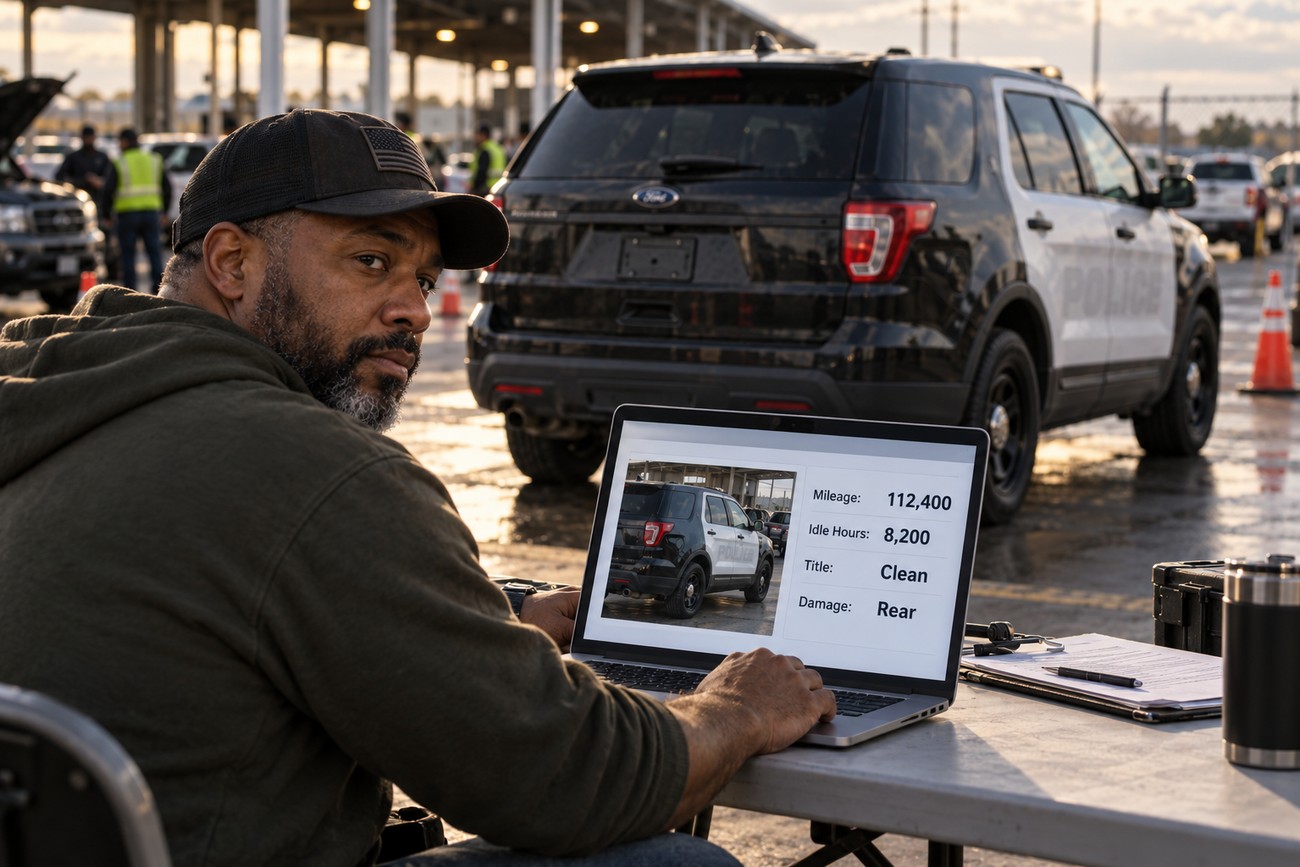
Start with the VIN, title status, odometer reading, and any stated idle hours. Then read the damage description and sale terms closely: an auction may be offering a retired service vehicle, a damaged vehicle, or both. “AWD/Automatic” confirms little about the condition of the full-time AWD system or 10-speed automatic. Front or rear damage needs its own assessment, even if the listing photographs make the vehicle appear complete.
Match the VIN to the available build sheet, history, inspection records, and photographs. This helps establish which powertrain and equipment the specific vehicle had when built. Auction descriptions can be abbreviated or use ambiguous drivetrain wording; treat a conflicting description as a reason to verify, rather than choosing whichever version sounds more valuable.
Look through every image for gaps in the listing. A photograph of one key does not establish that a spare exists, and a tidy dashboard view cannot confirm that removed lights, computers, or a partition left the wiring intact. Check whether documents, keys, trim, seats, and other equipment are expressly included. Replacement and repair costs start accumulating as soon as those items are missing.
Finally, establish what the seller is actually promising. An engine shown running in a video is different from a vehicle inspected on the road; a readable VIN photograph is different from clear title paperwork. If the auction will not provide information needed to assess registration, damage, or mechanical condition, lower your bid ceiling—or pass.
Inspect the Hidden Wear: Idle Hours, Cooling, Wiring, and Interior
Begin with service use, then test the systems most exposed to it. Request recorded idle hours if available and compare them with the odometer and maintenance history. Prolonged idling can mean substantial engine, cooling, and exhaust wear that mileage alone does not reflect. Oil condition and service intervals matter here, though neither can prove that an engine is healthy without inspection.
A cold start is more revealing than a vehicle already warmed up for viewing. Listen for abnormal noise, watch for warning lights, and check for leaks or evidence of previous overheating. Inspect the radiator, pump, thermostat, fans, hoses, and cooling-system repairs as far as access allows. A temperature gauge that behaves during a brief idle test does not establish how the vehicle will perform in traffic or under load.
Next, inspect the parts that absorb road and braking loads. Check brakes and tires for remaining usable life, inspect suspension joints and dampers, and listen for wheel-bearing hum during a permitted road test. Police-tuned hardware may feel firmer than civilian Explorer equipment; persistent knocks, looseness, pulling, or vibration still require an explanation. These repairs are easier to budget before bidding than after the vehicle arrives.
Give the electrical system and cabin their own inspection time. Removed light bars, radios, computers, and partitions may leave mounting holes, cut wiring, damaged connectors, CAN faults, or factory options that no longer work. Scan the modules where possible, then operate the controls rather than relying on a clear dashboard alone. Finish with the upholstery, floor, and cargo area: tears, burns, embedded dirt, and missing trim affect both repair cost and daily usability.
3.0 EcoBoost, 3.3 V6, or 3.3 Hybrid: Which Fits the Buy?
All three listed Police Interceptor Utility powertrains use a 10-speed automatic and full-time AWD. Choose by verified condition, diagnostic access, and the repairs you can afford, rather than by engine badge alone.
| Powertrain | Confirmed role and specifications | Inspection priority | Daily-driver consideration |
|---|---|---|---|
| 3.0 EcoBoost V6 | 400 hp and 415 lb-ft. Published claims include 0–60 mph in under 6 seconds and an approximately 150 mph top speed. | Confirm cooling condition, service history, engine operation, and drivetrain behavior under an appropriate road test. | Strong performance has little value if repair needs consume the purchase budget. |
| 3.3 V6 | Gasoline V6 option; output should be checked against documentation for the specific VIN. | Check idle hours, cooling, transmission operation, and full-time AWD condition. | Worth considering when records and condition are clearer than those of a more powerful lot. |
| 3.3 hybrid V6 | Uses a lithium-ion battery to support onboard equipment and reduce engine idling. | Scan hybrid modules and assess the battery, inverter, cooling, and full-time AWD system. | Can suit regular use if hybrid diagnostics are available and repair exposure is understood. |
The 3.0 EcoBoost figures describe capability, not the performance or health of an auction vehicle. Power is no substitute for evidence that its cooling system, engine, transmission, and full-time AWD operate correctly. If inspection access is limited, the potential cost of an unresolved fault should weigh more heavily than the performance claim.
The 3.3 V6 deserves the same lot-by-lot scrutiny. One reference lists a 2025 3.3 AWD at 289 hp and 260 lb-ft, but that output is unconfirmed by the cited police or factory documentation. Do not use those figures to identify a vehicle or value a bid; obtain the build information for its VIN.
The hybrid’s original operating advantage was specific to police work: its lithium-ion battery could support onboard equipment while reducing engine idling. A civilian owner should not assume that this makes a retired hybrid cheaper or simpler to maintain. Battery, inverter, and related fault-code checks require suitable diagnostic access, and uncertainty in those systems belongs in the bid calculation.
Build a Realistic Bid and Repair Budget
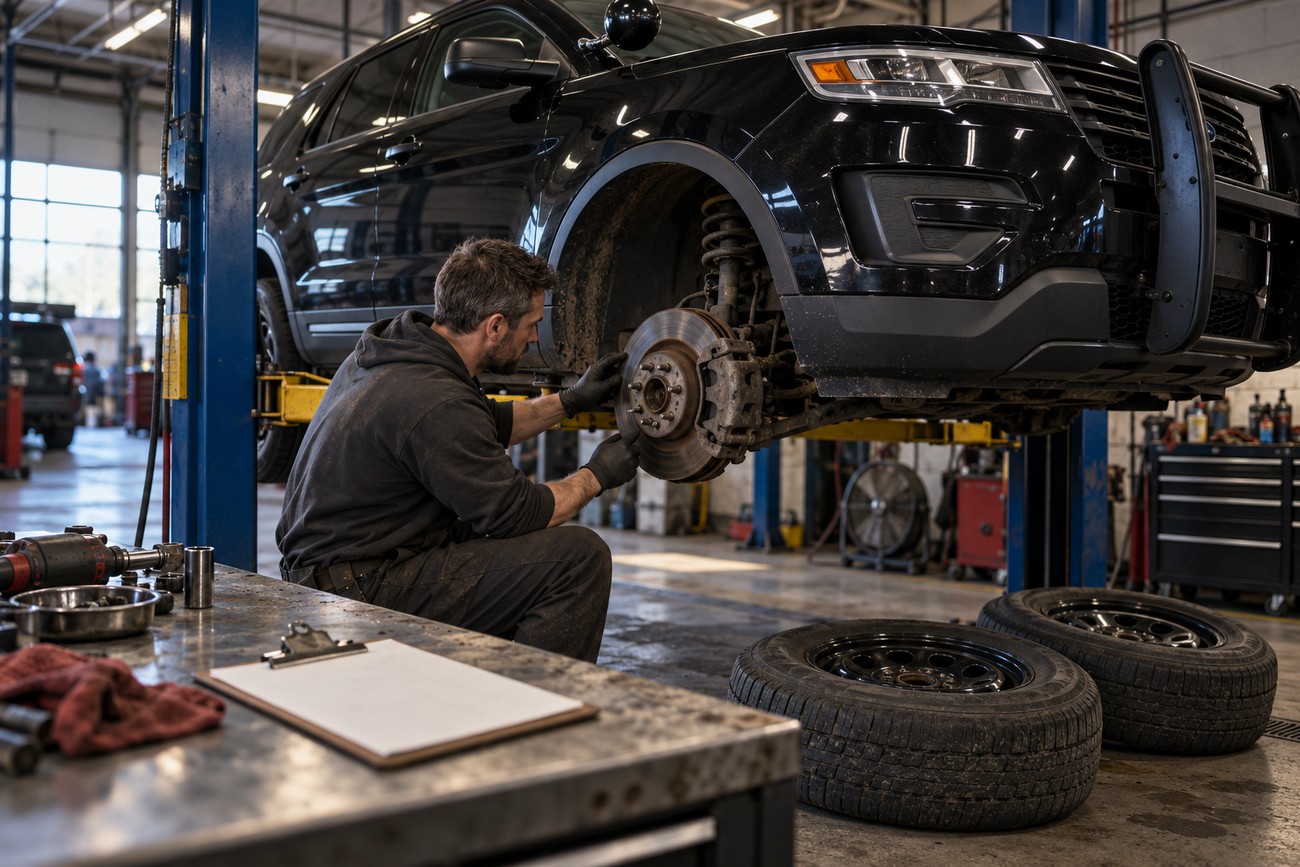
The winning bid is only the first number. Add auction fees, transport, title and registration work, and any costs caused by missing keys or documents. Then allow for post-purchase diagnostics and the items that can make a newly acquired Interceptor immediately unsuitable for daily use: tires, brakes, suspension, cooling repairs, and electrical restoration.
Separate known work from uncertain work. Visible worn tires or absent trim can usually be priced before bidding; an unexplained CAN fault, overheating history, or poorly documented wiring removal is harder to contain. Keep a repair allowance for findings that an auction inspection cannot resolve. Spending the full budget on the hammer price leaves no room to make the vehicle dependable.
Risk also changes with the type of lot. A running former-service vehicle with records and an intact structure is a different proposition from one with front or rear impact damage. A hybrid or an AWD vehicle with unresolved drivetrain faults needs additional diagnostic attention to the battery, inverter where applicable, and drivetrain. Price a damaged or poorly documented vehicle for that uncertainty, rather than against the asking price of an intact retired unit.
Set a walk-away ceiling before bidding starts: total landed cost plus a realistic repair reserve must remain acceptable for the vehicle you expect to own. If new information raises the likely bill, revise the ceiling downward. An inexpensive Interceptor stops being inexpensive when essential work is deferred because the purchase used up the available funds.
A Safe Pre-Bid and Inspection Sequence
Decode the VIN first, obtain the build sheet and available history, and compare them with the auction description. Confirm the powertrain, full-time AWD specification, title details, and any recorded service or damage events. If the paperwork cannot establish which vehicle is being sold or whether it can be registered as intended, do not rely on photographs to fill the gap.
Review images of every side, the cabin, engine bay, and underside before arranging a closer look. Compare panel gaps and damage locations with the listing, and check visible airbag areas, structural members, and evidence of previous repairs. Missing underside or interior views are limits on what you know, not proof that those areas are sound.
Where access is allowed, arrange an independent inspection and request idle-hour information. A technician should assess cooling, brakes, suspension, hubs, wiring, and drivetrain operation, then scan all accessible modules rather than reading only engine faults. Hybrid candidates also need battery, inverter, and related fault-code checks. If a road test is permitted, use it to assess behavior under varied conditions; if it is prohibited, carry that uncertainty into the bid.
Stop bidding when a major risk cannot be bounded: unclear title, severe structural damage, missing evidence of a functioning drivetrain, persistent CAN faults, overheating, or wiring repairs nobody can trace. Unknown idle hours alone may be manageable at the right price, but they become more serious alongside weak records and mechanical symptoms. Several independent unknowns should never be treated as one small repair.
After the Sale: Make the Interceptor Civilian-Ready
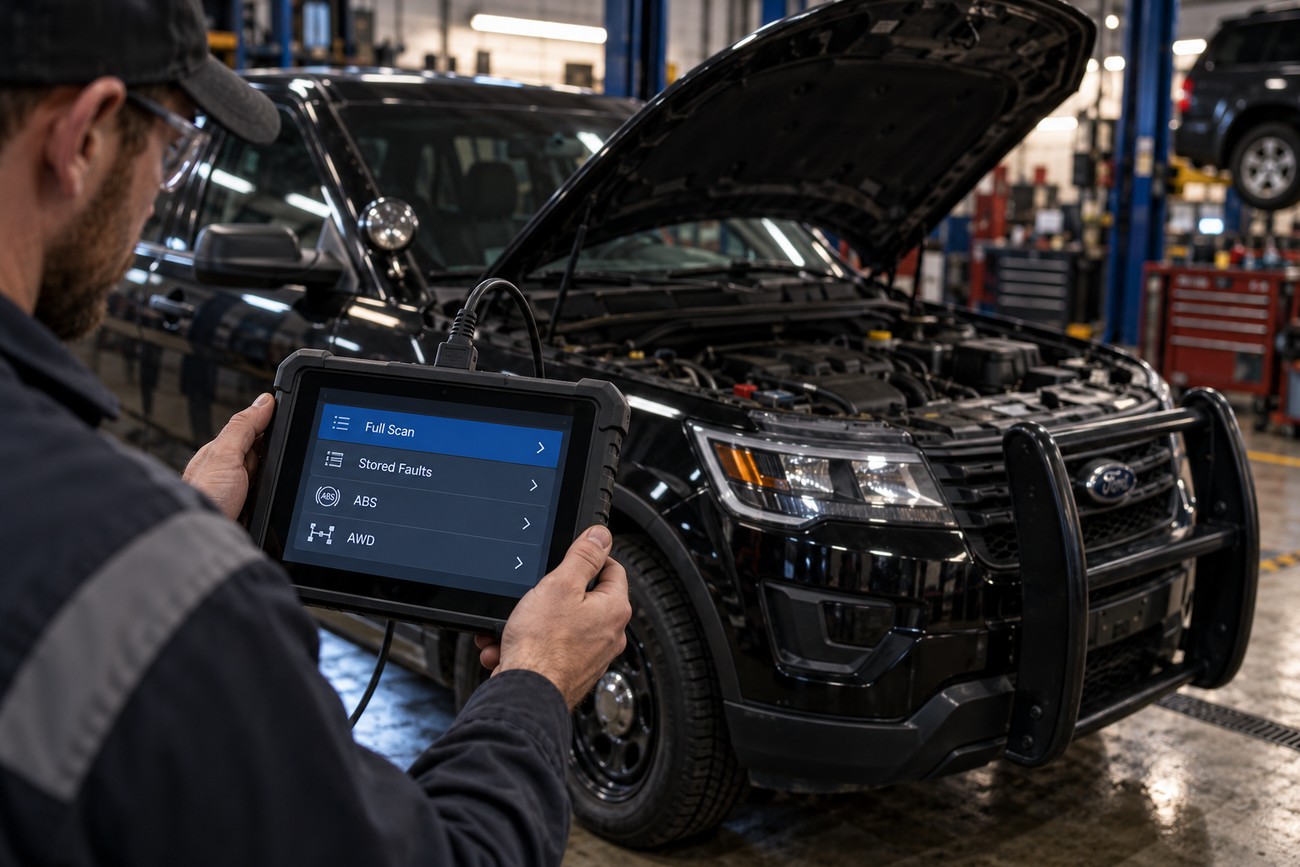
Before putting the vehicle into routine use, reconcile the title, release paperwork, VIN, and equipment received with the sale. Arrange a full module scan and record the faults before clearing anything; that initial record helps distinguish existing issues from faults that appear during repairs. Check fluids and filters against available service evidence rather than assuming a fleet maintenance schedule was followed to the end.
Put safety and reliability work ahead of cosmetic restoration. Inspect the cooling system, brakes, and tires, followed by suspension components and wheel hubs. Repair damaged wiring and secure or remove obsolete equipment without leaving exposed circuits or unexplained warning lights. A vehicle that starts and drives can still have inactive functions after decommissioning.
Road-test the vehicle under varied permitted conditions after the essential work is complete. Confirm temperature behavior, braking, steering, transmission operation, and full-time AWD function as far as the inspection allows. Then test the remaining factory controls and active-safety features against the vehicle’s build information; some systems may have been disabled in police configuration.
Expect the police-tuned suspension and heavy-duty braking equipment to feel different from civilian Explorer parts and potentially cost more to maintain. The aim is not to make the vehicle appear untouched. It is to reach a documented, safe operating condition with known faults repaired and future maintenance costs understood.
Frequently asked questions
A listing can establish useful facts, but it rarely answers every question that matters to ownership. The following checks help separate information you can request before paying from condition that needs diagnostics, documents, or an in-person inspection.
How can I verify idle hours when the auction listing does not show them?
Ask the seller for any vehicle records that include engine or idle hours, then request a scan or inspection that checks whether the relevant module data can be read on that specific vehicle. Maintenance records may also show recorded hours at earlier services. Compare dates and readings rather than accepting a single undocumented figure.
If the hours remain unavailable, treat them as unknown, not zero. Price the vehicle as one with uncertain stationary-use wear, and give more weight to cooling condition, oil-service evidence, exhaust condition, and cold-start findings. A low odometer reading should not raise your bid when those checks are missing.
What documents should I request before paying for an auction Interceptor?
Request the title or applicable ownership document, sale and release paperwork, VIN identification, disclosed damage information, and a written account of the keys and equipment included. Ask for any available service, repair, and decommissioning records as well. Check that the VIN and seller details agree across the documents before arranging payment or transport.
A listing image may show a title status or key icon without establishing that the physical documents and usable keys will be handed over. Confirm the auction’s terms for missing paperwork and the registration requirements that apply where you plan to use the vehicle. Resolve discrepancies before paying; correcting them afterward can delay or prevent civilian use.
When should I reject a Police Interceptor Utility even if the bid price is low?
Reject it when combined risks cannot be verified or priced: unclear title with missing release records, severe impact damage with inadequate structural evidence, overheating with no diagnosis, or extensive cut wiring accompanied by persistent CAN faults. Any one of these may demand substantial work; together they leave too little basis for a reliable repair estimate.
A low bid does not compensate for an inspection you cannot perform or a drivetrain you cannot confirm. If critical photographs, records, or diagnostic access are unavailable, set a ceiling that reflects the worst plausible repair exposure you are willing to accept. If that ceiling will not buy the lot, let it go.







