
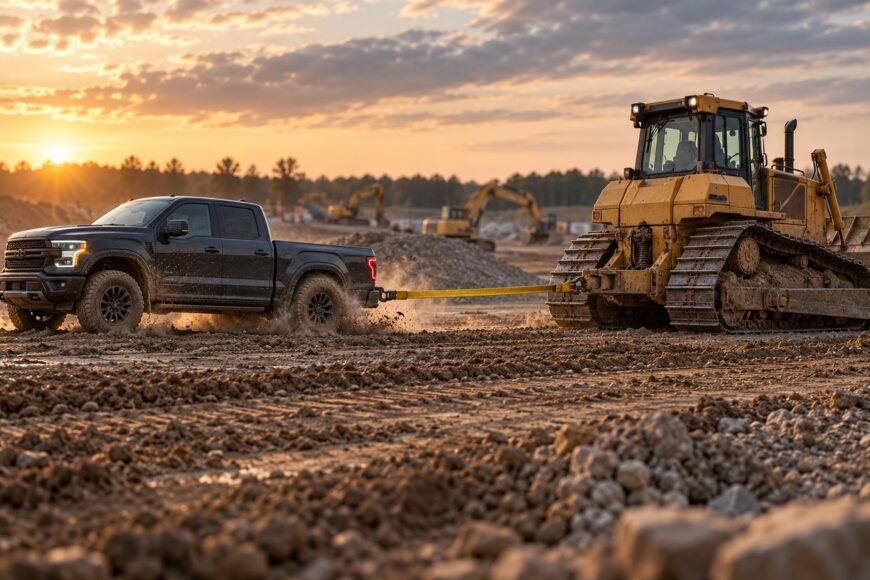
An F-150 may carry a published tow rating of up to 13,500 lb, yet a bulldozer is purpose-built for low-speed engagement with the ground. Those figures describe different jobs. Trailer towing measures a vehicle’s ability to move a rolling load under a defined test method, while a tug-of-war measures traction-limited pulling force against another machine.
The result therefore depends on mass, surface, contact area, drivetrain setup, center of mass, and wheel or track slip. A powerful engine can lose the contest if the tires spin, while a slower machine can keep pulling because its tracks maintain contact with the ground. Neither vehicle deserves an unconditional victory before those conditions are identified.
- What a Tug-of-War Actually Measures
- Why the F-150’s Tow Rating Does Not Predict the Winner
- Why a Bulldozer Has the Traction Advantage
- F-150 Engine Ratings: What the 2026 Numbers Really Say
- F-150 and Bulldozer: The Factors That Decide the Pull
- F-150 vs Bulldozer: A Fair Comparison Checklist
- Why Viral Tug-of-War Videos Often Mislead
- So Who Wins: Bulldozer or Ford F-150?
- Frequently asked questions
- Which F-150 configuration should buyers avoid for heavy pulling?
- Which F-150 should buyers stay away from?
- Who would win a Ford F-150 vs. bulldozer tug-of-war?
What a Tug-of-War Actually Measures
A trailer rolls, and its resistance changes with trailer weight, bearings, tires, grade, and acceleration. The truck’s tow rating is established for that operating condition, with defined limits for the vehicle and trailer. A tug-of-war creates a different load: the opposing machine resists movement directly, often at very low speed or from a stationary start.
The practical limit is commonly available traction at the tire or track contact surface rather than engine output alone. The engine can produce more torque than the ground can accept, causing wheelspin or track slip. Once that happens, additional horsepower may add noise and heat without increasing useful pulling force.
Mass helps because it increases the normal force between the machine and the surface, although weight distribution matters as much as total weight. Center of mass, axle loading, gearing, final-drive reduction, and the direction of the pull all influence how much force can be transmitted before slipping begins.
A viral result records one setup at one location. It does not establish a universal specification for every F-150 or every bulldozer. Change the surface, tire pressure, machine loading, drivetrain setting, or start technique, and the outcome can change substantially.
Why the F-150’s Tow Rating Does Not Predict the Winner
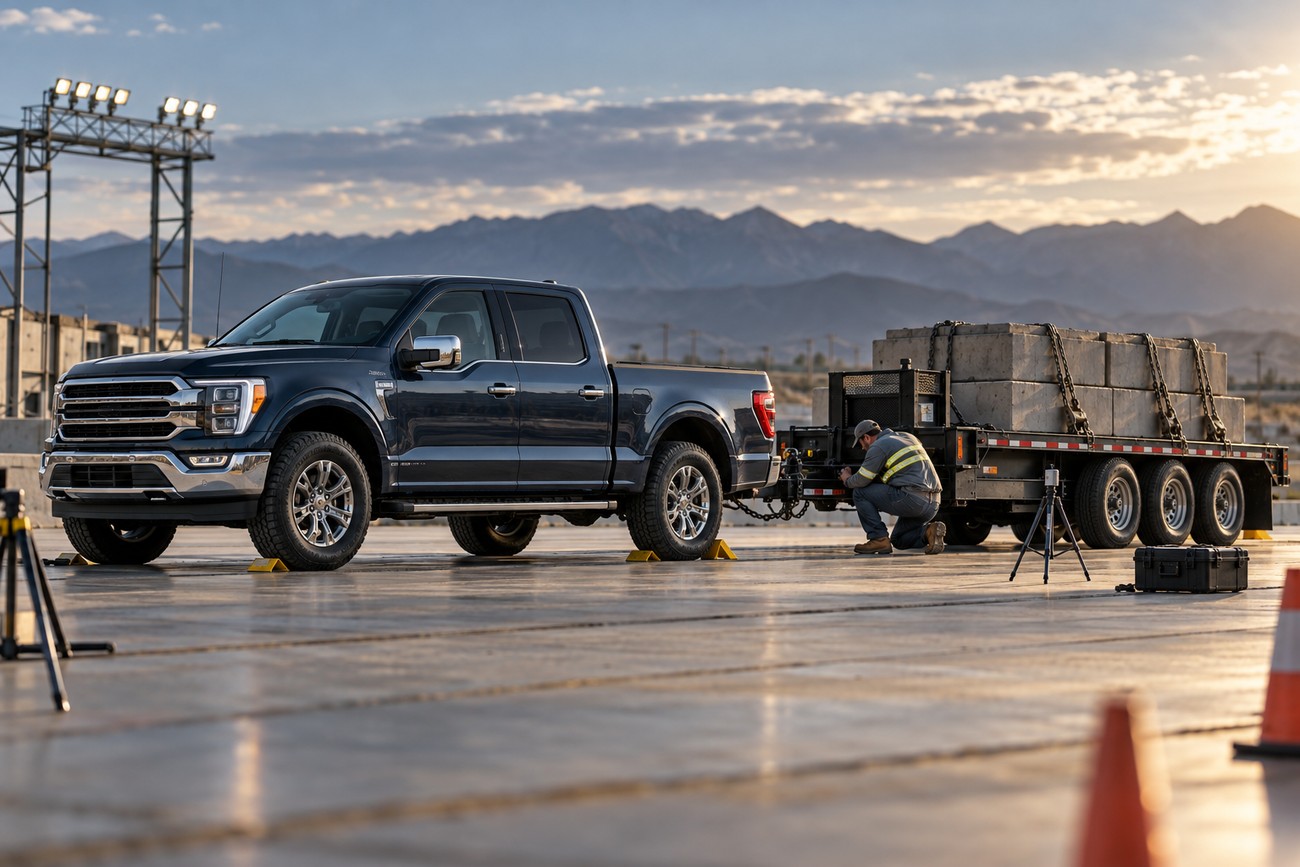
Ford states that F-150 tow ratings are calculated under SAE J2807. That provides a defined basis for trailer-towing comparisons, including the vehicle’s configuration and operating limits. It does not turn the rating into a direct measurement of static or low-speed ground-pulling force.
The maximum F-150 tow rating is up to 13,500 lb on qualifying configurations; it is not a universal rating for every F-150. Ford identifies the relevant value through the specific vehicle configuration, and the result can change with the engine, drivetrain, cab, wheelbase, axle, and tow package.
Real loading matters as well. Cargo, passengers, accessories, and fuel load consume payload, leaving less capacity for trailer tongue weight and other loads. A truck may carry a high theoretical tow figure in a brochure while its actual VIN-specific payload and equipment limits make that figure unavailable in the intended use.
A Ford Canada reference to up to 40,000 lb applies to selected F-Series classes or configurations, not specifically to the F-150 tug-of-war scenario. Using that broader F-Series figure to predict a direct pull confuses model families, test conditions, and operating tasks.
Why a Bulldozer Has the Traction Advantage
A bulldozer uses continuous tracks that spread the machine’s load over a large contact area. This generally lowers ground pressure and helps the machine maintain traction on soft or uneven surfaces where a tire may sink, deform, or spin. The track system also keeps a long section of the machine engaged with the ground.
Bulldozer drivetrains are designed around controlled, low-speed push and pull work. Low travel speed is an engineering tradeoff that allows substantial force at the final drive, precise control, and steady contact during grading or earthmoving. A low speed should not be mistaken for weak pulling capability.
Track advantage is strongest when the ground can support the track without allowing it to shear or slide. A bulldozer still needs usable surface resistance; tracks do not eliminate the effects of loose material, poor alignment, or an unsuitable pull point.
The same design brings operating costs. Undercarriage components experience significant wear, and inspection, adjustment, and replacement can be major maintenance demands. The bulldozer gains low-speed ground engagement at the cost of road speed, component wear, and a specialized operating role.
Tracks do not guarantee victory on every surface. Firm ground can reduce their practical advantage, especially if the opposing truck has greater effective mass, favorable loading, and a better starting position.
F-150 Engine Ratings: What the 2026 Numbers Really Say
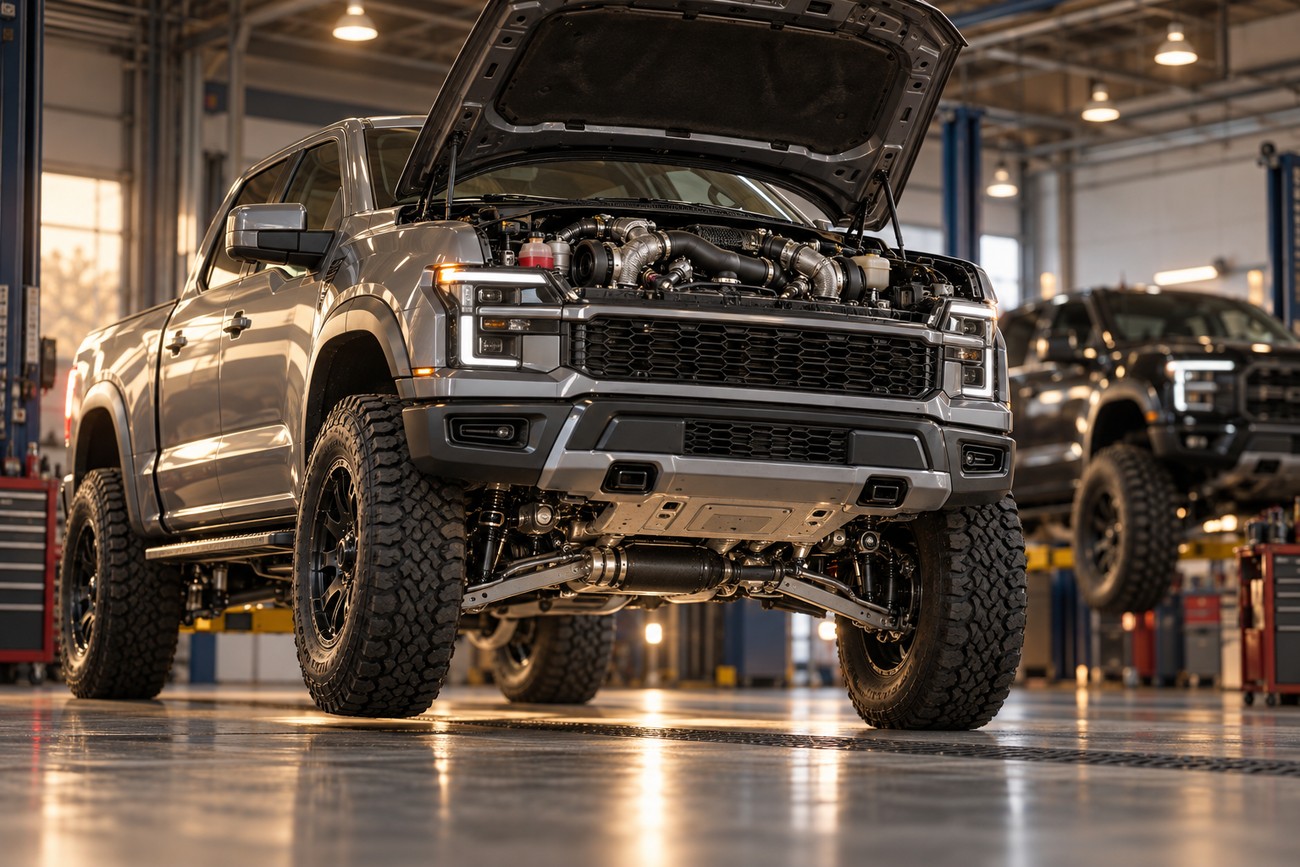
For the 2026 F-150, Ford lists up to 13,500 lb with the 3.5L EcoBoost V6. The same guide lists up to 12,800 lb with the 5.0L V8, up to 11,600 lb with the 3.5L PowerBoost, and up to 8,400 lb with the 2.7L EcoBoost.
These figures work as a configuration guide for trailer towing, rather than a ranking for a tug-of-war. The highest tow number does not automatically provide the best ground traction. Tire grip, axle loading, four-wheel-drive operation, gearing, and surface resistance determine how much of the available engine torque reaches the ground.
Each maximum applies only to qualifying equipment. Cab style, drivetrain, wheelbase, axle, tow package, payload, passengers, accessories, and fuel load can change the usable rating. A loaded truck must be evaluated against its own VIN-specific information rather than the most favorable engine figure.
The engine figures can still inform a buying decision. They help identify which truck may suit a rated trailer, while the tug-of-war comparison requires separate attention to contact mechanics and vehicle setup.
F-150 and Bulldozer: The Factors That Decide the Pull
Soft or uneven ground generally strengthens the bulldozer’s traction advantage. Its tracks distribute load over a larger area and reduce ground pressure, allowing the machine to preserve contact where a tire-equipped truck may dig in or spin. Soil condition, moisture, grade, and the depth of existing ruts can all influence the result.
Firm, level ground changes the balance. The track advantage may become less pronounced, leaving mass, weight distribution, starting conditions, gearing, and slip as more important variables. A bulldozer can still pull strongly, yet the surface may prevent it from converting its available force into movement without sliding.
Tire condition and pressure matter on the F-150, while track condition and undercarriage state matter on the bulldozer. Four-wheel-drive engagement, transmission mode, differential behavior, and other drivetrain settings can alter the force delivered at the contact surface. These details are often absent from short videos.
Line alignment also matters. A straight, level pull loads the machines differently from an angled line, a rising line, or a connection point above the center of mass. Starting technique can create a temporary advantage, especially if one machine applies torque before the other has established stable contact.
Either machine can lose when its contact surface slips. A large engine does not overcome a spinning tire, and a tracked machine cannot rely on track area if the surface breaks away beneath it. The decisive question is how much usable force reaches the ground under the exact test conditions.
F-150 vs Bulldozer: A Fair Comparison Checklist
A useful comparison identifies the exact machines, their loading, and the surface before judging the result.
| Factor | Ford F-150 | Bulldozer |
|---|---|---|
| Operating purpose | Road use, cargo transport, and rated trailer towing | Low-speed earthmoving, pushing, and ground engagement |
| Contact system | Pneumatic tires | Continuous tracks |
| Traction behavior | Can be limited by tire grip, pressure, condition, and axle loading | Large contact area generally lowers ground pressure and supports soft-ground traction |
| Speed | Designed for road travel and broader transport use | Designed for controlled low-speed work |
| Tow-rating relevance | Up to 13,500 lb on qualifying configurations; this is a trailer rating, not a tug force | Its ground-pulling capability is related to track contact and low-speed drivetrain design |
| Payload constraints | Configuration-specific limits include cargo, passengers, accessories, and fuel | Operating weight and attachment setup affect ground behavior |
| Maintenance burden | Tires, drivetrain, and towing equipment require service | Undercarriage wear and maintenance are major operating costs |
| Soft or uneven ground | More likely to encounter tire slip or loss of usable traction | Generally favored by track contact and lower ground pressure |
| Firm ground | May benefit from stable tire contact and favorable loading | Track advantage may narrow; mass, setup, and slip become more decisive |
| Realistic use case | Rated trailer towing and mixed road work | Sustained low-speed pushing and pulling on job sites |
Before judging a pull, verify tire pressure, track condition, drivetrain settings, line alignment, and surface. Those checks often explain a result more accurately than comparing engine output alone.
The table shows why the two machines are built for different work. The F-150 uses tires and is constrained by configuration-specific payload and tow ratings, while the bulldozer uses continuous tracks for low-speed contact with the ground.
Neither vehicle can be ranked fairly without identifying the exact configuration and surface. A lightly loaded four-wheel-drive F-150 on firm ground is a different test from a loaded truck on loose soil, just as a compact bulldozer differs from a larger tracked tractor.
The F-150’s maximum published tow figure remains relevant for a rated trailer. It should not be used as a substitute for measuring ground traction in a direct pull.
Why Viral Tug-of-War Videos Often Mislead
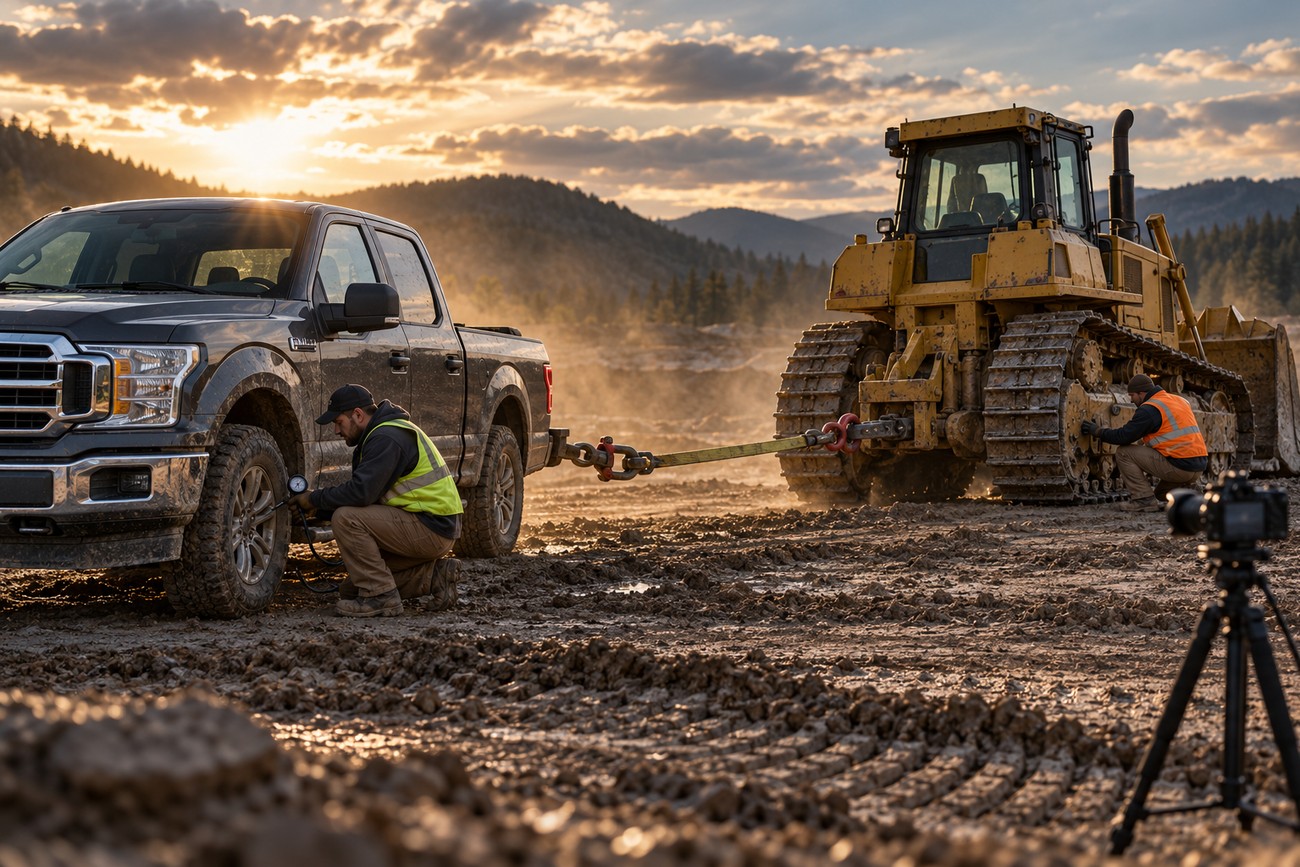
Popular claims often present the bulldozer as an absolute winner because of its mass and tracks. Those features create a strong starting assumption, especially on soft ground, yet the actual outcome depends on traction, center of mass, gearing, surface, setup, and whether either machine slips.
Short videos commonly omit tire pressure, tire condition, track condition, and transmission or drivetrain settings. They may also leave the machine masses, fuel levels, payloads, and connection points unspecified. Without those details, viewers cannot tell whether the test compares engineering concepts or merely two unequal setups.
Timing can shape the first movement. One operator may apply torque earlier, one machine may start with a better line angle, or the surface may be disturbed before the second attempt. A staged start or selective edit can make a narrow setup advantage look like a permanent difference between vehicle types.
A video can demonstrate how those two machines behaved on that surface under those conditions. It cannot validate the F-150’s official tow rating, represent every bulldozer, or prove a universal winner. Trailer towing and ground pulling remain separate engineering questions.
So Who Wins: Bulldozer or Ford F-150?
A properly configured bulldozer will generally have the traction advantage on soft or uneven ground because its tracks preserve a large contact area and lower ground pressure. That advantage suits sustained low-speed push and pull work, where maintaining contact matters more than road speed.
A high F-150 tow rating does not guarantee victory in a direct tug-of-war. The rating concerns a rolling trailer under SAE J2807-based conditions, while a stationary or low-speed contest is commonly limited by tire traction, weight transfer, and slip.
On hard, firm ground, the gap can narrow. Mass, line alignment, drivetrain settings, starting conditions, and which machine slips first may decide the result. A bulldozer is therefore not an automatic winner in every controlled contest.
The practical rule is straightforward: choose the F-150 for rated trailer towing and road-based utility, and choose the bulldozer for sustained low-speed ground work. Match the machine to the task rather than treating a viral pull as a product specification.
Frequently asked questions
For heavy pulling, check the specific F-150’s payload and tow ratings before judging its suitability. Its condition matters too, particularly its tires and drivetrain. In a tug-of-war, surface and setup matter more than a published tow rating.
Which F-150 configuration should buyers avoid for heavy pulling?
Avoid any truck whose VIN-specific payload and tow figures do not accommodate the intended load, including passengers, cargo, accessories, and trailer tongue weight. No engine or trim is universally unsuitable: the deciding factor is whether the specific truck meets the task’s limits.
Which F-150 should buyers stay away from?
Stay away from one with unverifiable payload or towing information, or with tires or drivetrain components in poor condition for the planned work. Check the specific vehicle’s ratings and condition rather than relying on a maximum rating advertised for the model range.
Who would win a Ford F-150 vs. bulldozer tug-of-war?
The bulldozer is generally favored on soft or uneven ground because its tracks help it maintain traction. On firm ground, the result depends on the machines’ mass, setup, alignment, and slip; the F-150’s trailer tow rating does not predict the winner.







