
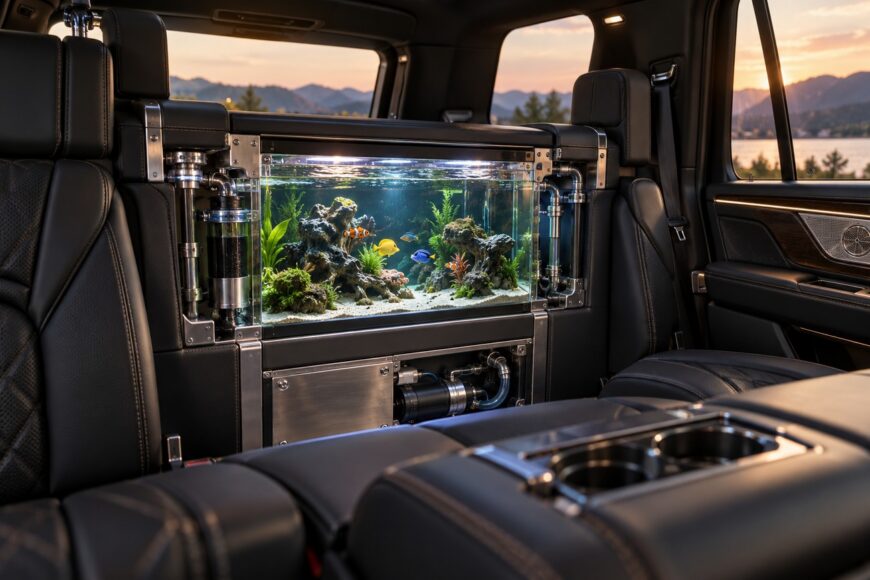
A built-in fish tank can give a Cadillac Escalade cabin the look of a rolling showpiece. Lit water behind custom trim makes a striking photograph, especially in a vehicle with room for an elaborate interior. On the road, though, that water adds moving mass alongside passengers, seats, wiring, and safety equipment.
The Cadillac Escalade has no factory built-in fish-tank option; such a feature is aftermarket and custom. Building one responsibly would require answers about crash loads, leaks, electrical protection, and the welfare of any fish inside it. A display that looks finished in photos has not necessarily proved it can withstand daily driving.
- Is a Built-In Fish Tank a Factory Cadillac Escalade Option?
- How Much Weight Does an Escalade Aquarium Add?
- Why Moving Water Becomes a Safety Problem
- Leaks, Condensation, and Electrical Damage Inside the Cabin
- Can Fish Actually Live Comfortably in a Moving Escalade?
- Common Build Mistakes and the Hidden Cost of Ownership
- What a Responsible Custom Installation Would Need
- Is an Escalade Fish Tank Worth It as a Daily-Use Modification?
- Frequently asked questions
- What should an owner document before showing a custom Escalade aquarium to an insurer or inspector?
- Why do online Escalade fish-tank projects often lack reliable specifications?
- How many gallons are in a Cadillac Escalade?
- How to transport an aquarium in a car?
- What is the most expensive fish tank ever made on Tanked?
Is a Built-In Fish Tank a Factory Cadillac Escalade Option?
No Cadillac Escalade is offered with a factory built-in fish tank. An aquarium shown inside one is a custom aftermarket installation, even if its trim appears to match the cabin. That distinction matters because a polished finish says little about how the tank is restrained or serviced.
A factory feature would be integrated into the vehicle’s design and support arrangements. A one-off aquarium instead depends on the particular tank, mounts, electrical work, and interior changes chosen for that vehicle. Another owner cannot assume the same layout will fit or perform safely in their Escalade.
Some accounts of custom projects mention decorative mini-aquariums holding several gallons. Those claims do not come with verifiable safety or durability data in the available information, so the stated volume should not be treated as a tested specification. Promotional images also rarely show what happens after repeated driving, cleaning, or exposure to cabin heat.
How Much Weight Does an Escalade Aquarium Add?
The water alone gives a useful starting calculation: 1 liter of water = 1 kilogram. A 50–100 liter tank contains 50–100 kilograms of water before the tank, substrate, filter, supports, and hardware are counted. An installation that looks modest behind a panel can therefore impose a substantial load.
The finished weight must include the container and everything required to hold and operate it. Glass or acrylic, decorative material, pumps, and a supporting frame all add mass. A weight estimate based only on tank capacity leaves the people designing its mounts with an incomplete figure.
Location matters alongside total weight. A high-mounted tank changes the center of gravity differently from a low installation, while a tank placed near occupants raises different restraint concerns from one in a cargo area. There is no single payload assumption that establishes whether every Escalade or every proposed position can accommodate the same build.
Why Moving Water Becomes a Safety Problem
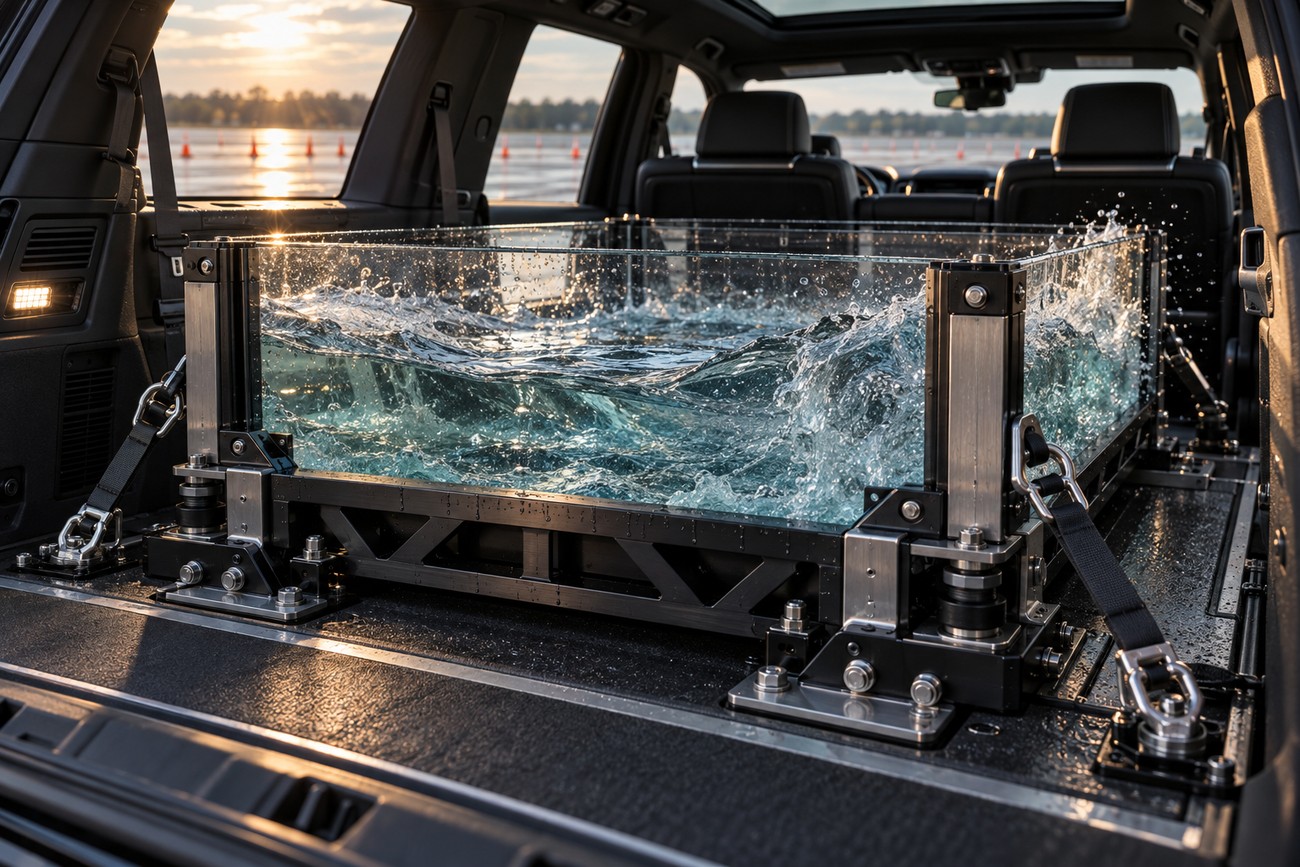
Water shifts when the vehicle brakes, turns, or crosses uneven pavement. Its movement loads the tank walls and supports in changing directions, rather than acting like a fixed piece of luggage. During hard braking or a crash, failed mounts could let the tank move or break, creating a secondary injury risk for occupants.
Shape affects that behavior. A low, wide tank is more stable under braking than a tall, narrow tank, although neither shape removes the need for suitable restraint. Designers must consider both the container and the structure connecting it to the vehicle.
A watertight lid may contain routine splashes, but sealing does not resolve impact damage or mounting failure. Ordinary driving without a visible leak is also a poor substitute for evaluating emergency loads. Keeping a tank intact during a sharp maneuver is a separate problem from keeping its water inside during normal travel.
Leaks, Condensation, and Electrical Damage Inside the Cabin
Vehicle interiors are not designed for constant humidity. Condensation, splashes, and small leaks can reach fasteners, electrical connectors, carpet backing, and sound insulation before dampness becomes obvious at the surface. A persistent musty smell may be the first sign that water has entered material that is difficult to dry in place.
Water can also travel behind trim toward hidden wiring and vehicle control modules. That makes a minor-looking leak potentially more expensive than wet upholstery alone. Pumps, lighting, and their connections introduce further exposure unless the electrical installation is protected and accessible for inspection.
Saltwater makes the corrosion problem more severe than freshwater because salt exposure is more aggressive toward metal and electrical components. Even a freshwater build needs a plan for finding, containing, and drying a leak. Decorative panels that conceal every hose and fitting can make a tidy installation harder to maintain.
Can Fish Actually Live Comfortably in a Moving Escalade?
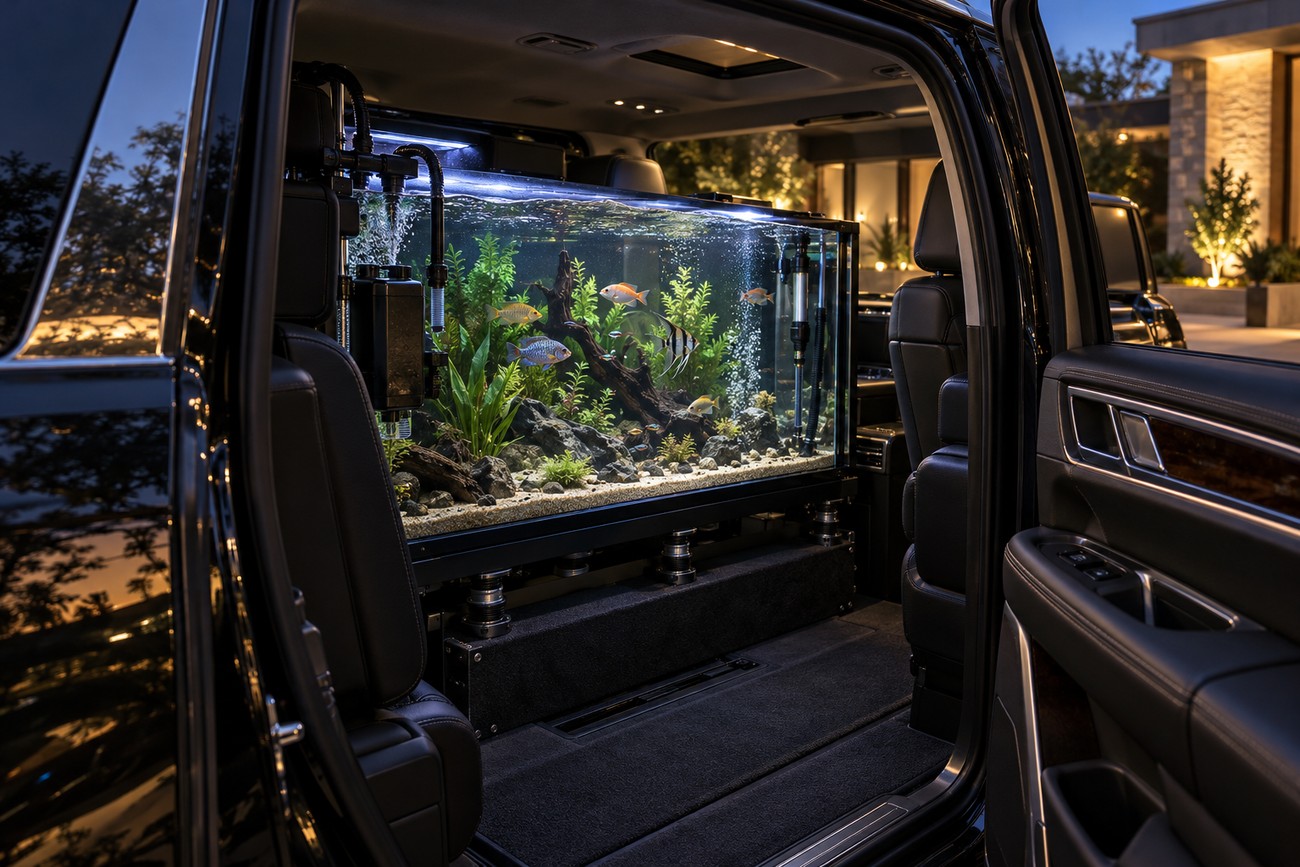
Fish require stable temperature, oxygen, filtration, and biological balance. A vehicle makes each condition harder to maintain: the cabin can change temperature while parked, equipment needs power during inactivity, and vibration continues during drives and periods of idling. A tank that looks clear may still be unstable for its inhabitants.
Sudden temperature changes and vibration can stress fish and may contribute to illness or death. Traffic and idling deserve attention as well as trips on rough roads, particularly if an enclosed display has poor ventilation. Lighting enclosed behind trim may add localized heat that a cabin temperature reading does not reveal.
Live fish should never be the first test of a new installation. Leak checks and driving-load checks must come before biological setup, and the aquarium then needs time to establish stable conditions before stocking. A show build that cannot maintain those conditions while parked and in use is unsuitable for live animals, regardless of how it looks.
Common Build Mistakes and the Hidden Cost of Ownership
One failure begins with calculating water volume while ignoring total mass and center of gravity. Another is relying on interior trim or weak supports to hold a load that shifts under braking. Rigid mounting and spill protection need to be considered for sudden maneuvers, not only for a stationary display.
Material choice presents another trap. Ordinary glass or plastic may be selected for appearance without accounting for impact, vibration, and thermal expansion. Seals, tubes, and connections also face repeated movement, so an initially dry installation still needs regular inspection.
Electrical shortcuts can place pumps, lighting, and wiring too close to water without adequate protection. Stocking fish before leak testing and biological stabilization compounds the mistake: a failure then threatens both the cabin and the animals. These are connected design decisions, rather than finishing details to address after the tank is installed.
Ownership brings a continuing demand for power, temperature control, cleaning, water changes, and service access. The structure may take cargo room or obstruct seats and vehicle service points, while custom alterations can narrow the pool of future buyers. The visual effect may last for years, but so does the obligation to inspect and maintain what sits behind it.
What a Responsible Custom Installation Would Need
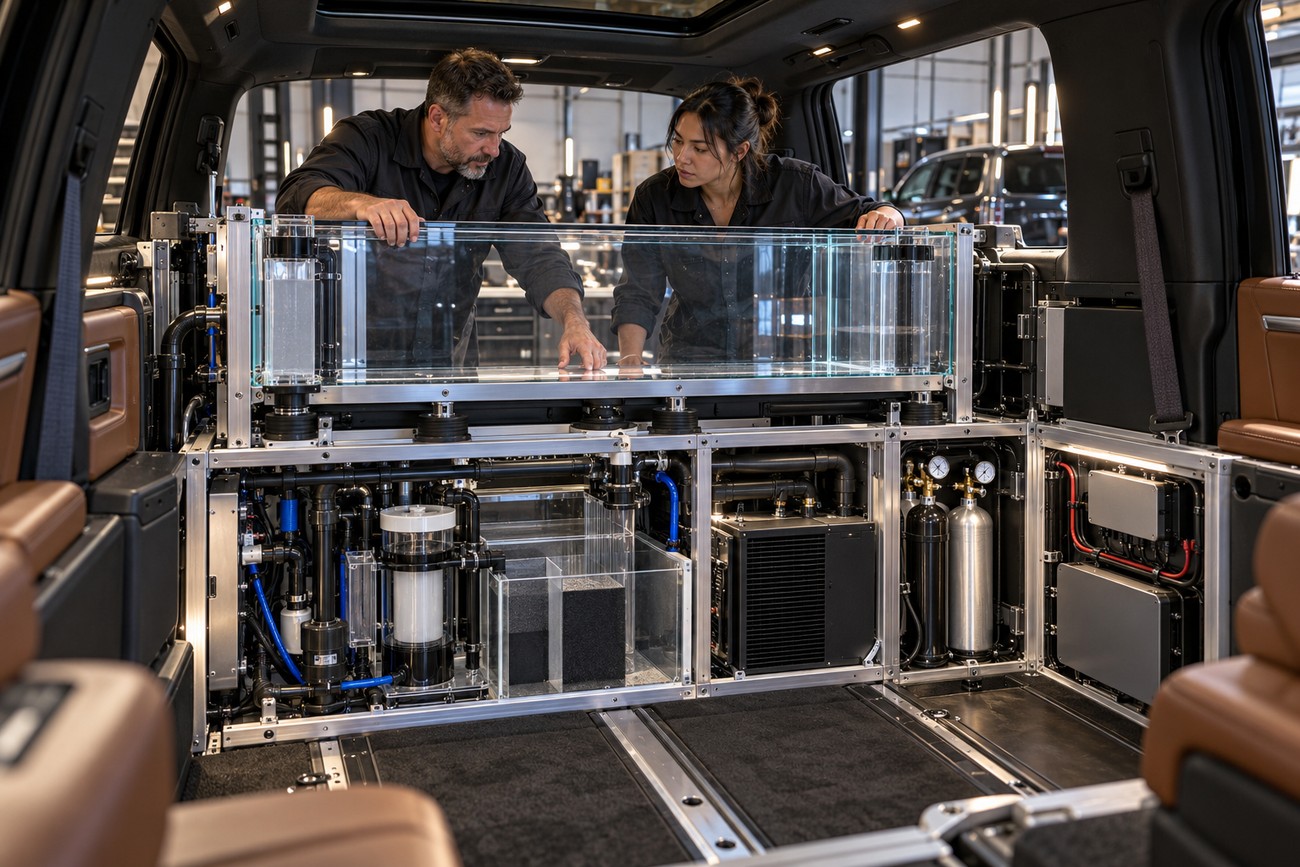
A responsible proposal starts as a custom engineering project, not a plug-and-play accessory. It must account for the complete mass, center of gravity, vibration, and emergency braking, with tank materials and mounts chosen for those loads. Service access and spill containment belong in the design before decorative panels are fitted.
Protected, separately managed electrical equipment needs to remain inspectable near the water. A plan for oxygen, filtration, and temperature must cover both driving and parking, including periods when the vehicle is unused. If those systems cannot be maintained reliably, adding fish is difficult to justify.
Run a water-only test for weeks while checking vibration, braking behavior, heat, and leaks. Biological media and live fish come later, after the physical installation has shown that it can remain stable.
Keep records of the materials, mounting design, electrical layout, and tests. Aftermarket changes affecting safety, cargo restraint, or visibility may affect inspection and insurance, depending on jurisdiction and policy. Discuss the specific installation with the relevant inspector and insurer rather than assuming approval from its appearance or from another custom build.
Is an Escalade Fish Tank Worth It as a Daily-Use Modification?
An Escalade aquarium can succeed as a visual statement, and the craftsmanship behind a show vehicle can be compelling. Daily use imposes a different standard: occupants need secure loads, the cabin needs to stay dry, and live fish need stable water conditions. A photograph demonstrates none of those outcomes.
Recurring leak checks, cleaning, power management, and access to hidden components can make the modification burdensome. Damp odors, electrical faults, and interior damage are plausible consequences when water escapes. Inspection, insurance, and resale questions add work that may continue long after the original build is complete.
For most daily-use vehicles, a dry, non-living decorative display is the safer direction if the goal is the aquarium look. If the need is to move an actual aquarium or fish, use a removable, properly secured transport setup instead of treating a permanent cabin tank as storage. Neither option excuses poor cargo restraint, but both avoid presenting an unverified show build as a dependable home for fish.
Frequently asked questions
Custom aquarium projects raise practical questions beyond the installation itself. Owners may need documentation for an insurer or inspector, while online photos seldom provide reliable specifications. The answers below also distinguish fuel capacity from a custom tank’s volume and cover aquarium transport.
What should an owner document before showing a custom Escalade aquarium to an insurer or inspector?
Prepare the mounting design, tank and support materials, electrical layout, and records of leak and driving-load tests. Include photographs of components hidden by trim and the installer’s details so the work can be examined or clarified. Ask the insurer or inspector what else applies to that particular modification; requirements depend on the jurisdiction and policy.
Why do online Escalade fish-tank projects often lack reliable specifications?
Promotional images can show the finished cabin without identifying tank volume, mounting tests, service history, or long-term durability. Claims that a decorative mini-aquarium holds several gallons remain unverified in the available information. Treat a photo as evidence of appearance, not proof that the installation has been tested for regular use.
How many gallons are in a Cadillac Escalade?
If you mean fuel capacity, it depends on the Escalade’s model year and configuration; check the owner’s manual for the specific vehicle. If you mean an aquarium, there is no factory tank or standard gallon capacity. Any stated aquarium volume belongs to an individual custom build and should be verified from its measurements or documentation.
How to transport an aquarium in a car?
Transport the aquarium as secured cargo rather than carrying a filled display tank with fish inside. Drain it, protect it against impact, and restrain it so it cannot slide or tip; move fish separately in suitable closed containers while maintaining appropriate temperature and oxygen for the journey. Keep containers away from occupants and electrical equipment, and set up stable, conditioned water before reintroducing the fish.
What is the most expensive fish tank ever made on Tanked?
There is no verified price or ranking in the available information that establishes a single most expensive tank from Tanked. Episode figures may refer to different parts of a project, such as the tank, installation, or surrounding display. A defensible answer would need a documented, comparable final cost rather than a promotional claim.







