
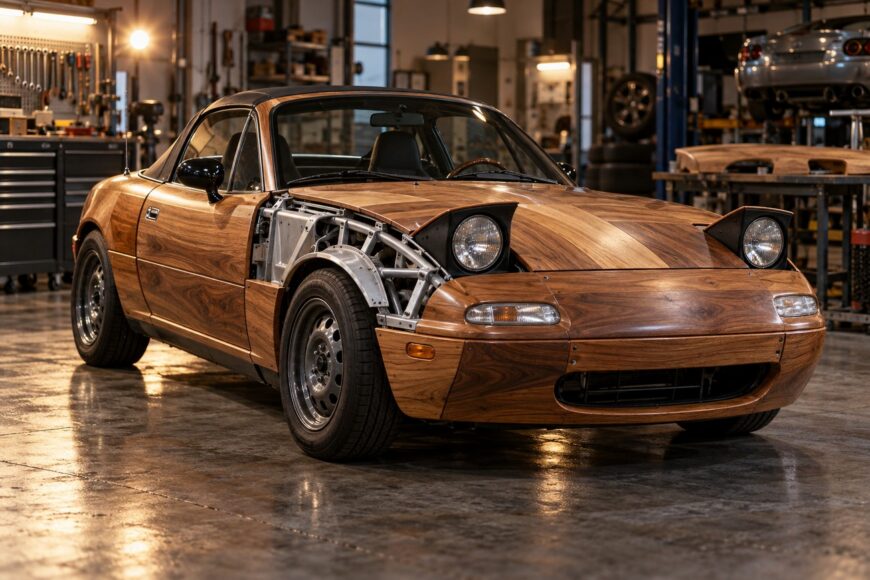
A wooden-bodied Mazda Miata has immediate visual appeal: warm material, classic proportions, and a handcrafted finish can make a familiar roadster look like a limited-production coachbuilt car. The appearance, however, is only the visible part of the project. Moisture, fastening, weight, repair access, and legal approval determine whether the result remains usable after the photo session.
NA, NB, NC, and ND Mazda MX-5 Miata models use a steel unibody structure, not a separate body-on-frame chassis. Wood therefore cannot simply replace the factory load-bearing structure or crash structure. In practical terms, a wooden Miata normally uses a custom outer body, cladding, frame, or trim system around the original chassis, with trade-offs among appearance, durability, labor, mass, and road legality.
- What a Wooden Miata Body Really Means
- Choose the Architecture Before Cutting Wood
- Build Sequence and the Failure Points That Matter
- Weight, Maintenance, Cost, and Road Use
- Frequently asked questions
- What Miata year should you avoid for a wooden-body project?
- What are the best body-kit options for a Mazda Miata if you want a wood look?
- Which Miata is the most sought after for a custom body project?
- How much horsepower can a Miata with a wooden body handle?
What a Wooden Miata Body Really Means
A true wooden shell would require a major structural redesign because the Miata’s steel unibody carries suspension loads and contributes to occupant protection. A wooden-framed outer skin is a more realistic interpretation: the original structure remains, while a secondary structure supports new exterior panels. This keeps the donor’s basic geometry and running gear intact.
The simplest option is decorative wood on selected panels, the dashboard, or other interior surfaces. A more ambitious build may use wood for visible exterior sections over fiberglass or metal supports. In both cases, the wood is a custom body or trim system, not a factory-equivalent replacement for the steel crash structure.
Custom projects generally retain the Miata chassis and drivetrain, and often retain the suspension and other running gear. Simpson Design, for example, used a 2007 Miata chassis and drivetrain as the basis for a new body. That approach reduces the amount of engineering required while retaining the original unibody in safety-critical areas.
Choose the Architecture Before Cutting Wood
Start by deciding what the project must achieve. Wood trim offers the lowest fabrication risk and easiest repair. Fiberglass or metal panels with wooden accents provide more stable outer surfaces and better resistance to weather. A substantially wooden outer structure delivers the strongest visual effect, but it creates more work around load paths, service access, joints, and mounting hardware.
Curved parts require more than attractive grain. Suitable stock must have controlled moisture content, proper drying, and fiber direction that follows the bend. Steaming, soaking, or controlled bending may be necessary, and a piece that looks good on a workbench can split once it is pulled into the final shape.
Make full-size templates before committing to timber. Check door gaps, wheel clearance, hood movement, lighting, mirrors, and access to service points. The template stage is where you discover that a graceful panel may block a drain, interfere with a suspension component, or require a compound curve that is impractical to form from one piece.
Build Sequence and the Failure Points That Matter
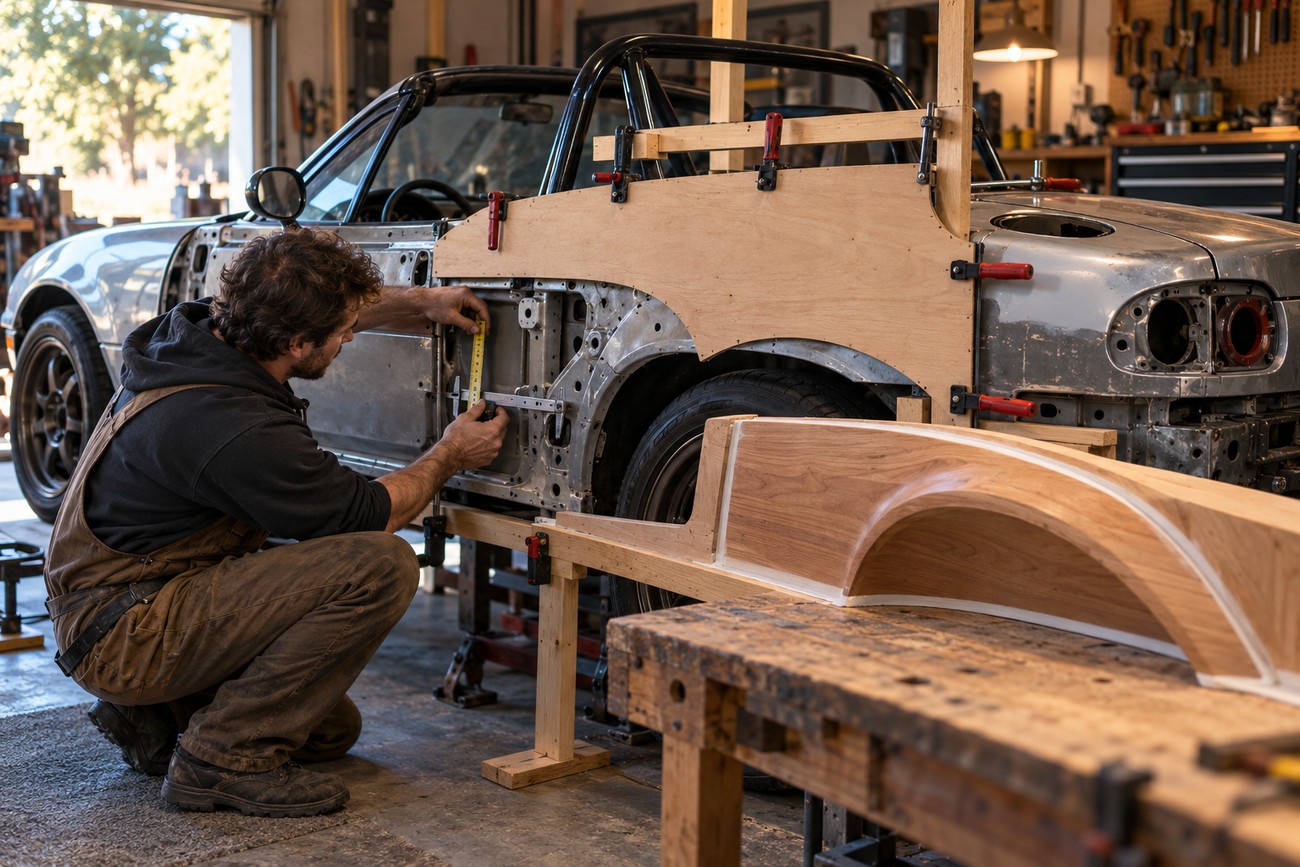
Measure the donor car before removing anything, then record fixed points on the body and chassis. Build a reference framework and full-size templates, define mounting points, and test the intended panel lines in inexpensive material. Only after confirming the geometry should you shape the visible wood.
Wood should receive preservative treatment, suitable drying, and moisture control before assembly. Every joint needs a plan for sealing and inspection. Trapped water in a seam can cause hidden rot, coating failure, warping, or delamination while the outside still appears sound.
Use serviceable joints that tolerate small movements between wood, metal, and composite materials. Rigid or poorly located fasteners create stress concentrations, especially near corners and panel ends, where cracks can start. Allow for expansion, avoid sharp transitions, and keep fasteners away from unsupported edges.
Final fitting should include repeated opening, closing, and removal of panels. Check alignment in changing conditions, inspect the underside, and provide drainage rather than relying only on sealant. Access for inspection is a design requirement because hidden moisture cannot be managed if the joint cannot be seen or opened.
Weight, Maintenance, Cost, and Road Use
Wood is not automatically lighter than steel. The finished system also includes reinforcements, brackets, fasteners, adhesives, and protective coatings. The added mass can affect the balance and behavior of a lightweight roadster, particularly when heavy panels sit high or far from the vehicle’s center.
Ownership requires recurring inspection, resealing, and hardware checks. Sun, rain, temperature changes, and road spray can expose small coating defects. Moisture may remain inside a joint long after the surface has dried, so annual visual checks alone may miss early damage.
Changing the exterior contour can raise questions about registration, inspection, crash compatibility, seat-belt mounts, and deformation zones. A wooden outer body must not interfere with the original safety structure or be assumed to provide equivalent protection. Requirements vary by jurisdiction, so approval should be investigated before fabrication begins.
GOST 9008-94 concerns wooden parts of truck platforms and does not directly validate a wooden passenger-car body. This Miata conversion is an individual engineering and certification matter. Historical estimates of 15–30 million rubles refer to exclusive hand-built wooden automobiles, not to a typical Miata conversion budget; the real cost depends on design complexity, donor condition, and labor.
Frequently asked questions
Donor selection and the intended visual result usually matter more than the model year alone. The following points help separate a workable custom build from an expensive styling exercise.
What Miata year should you avoid for a wooden-body project?
There is no single Miata model year that should automatically be avoided. Rust, accident damage, missing structural metal, and poor documentation matter more than the model year. A straight, complete donor with sound mounting points is a better starting point than a desirable year with hidden corrosion or repaired structural damage.
What are the best body-kit options for a Mazda Miata if you want a wood look?
For the lowest risk, use wood veneer or trim on selected nonstructural areas, with weather protection where exposed. Fiberglass or metal panels with wood accents provide a more stable body-kit solution, while real wood panels offer the most authentic appearance and the greatest maintenance burden. Choose based on whether appearance, low mass, repairability, or genuine wood construction is the priority.
Which Miata is the most sought after for a custom body project?
Collector appeal and fabrication suitability are different criteria. A popular or historically significant donor may be valuable to preserve, while a less collectible car with accessible parts, sound metal, and complete documentation may be easier to modify. Inspect the chassis condition and availability of replacement components before choosing based on reputation alone.
How much horsepower can a Miata with a wooden body handle?
The body material does not set the engine or drivetrain limit. Safe output depends on the engine, transmission, differential, cooling, brakes, suspension, tires, chassis condition, and the quality of any structural modifications. A wooden exterior can add mass and alter balance, so the complete vehicle must be assessed rather than assigned a universal horsepower figure.







