
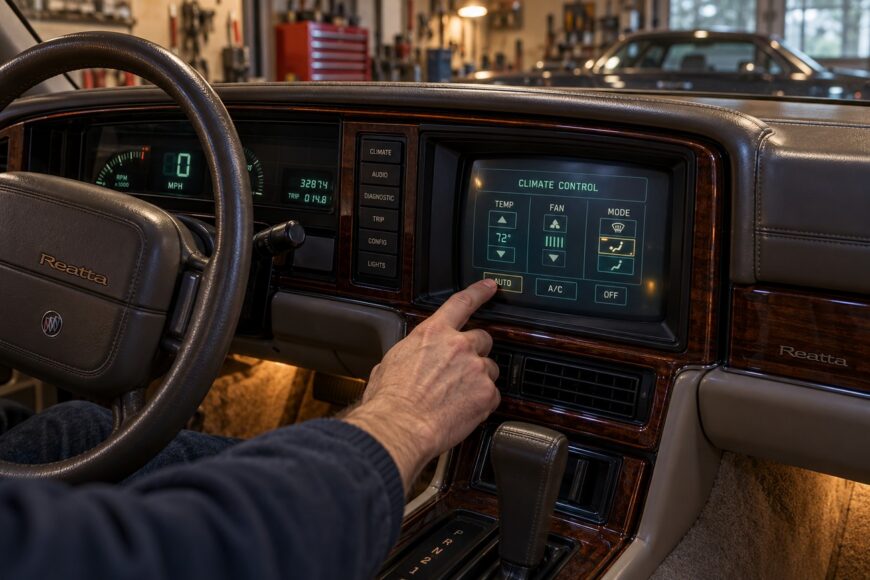
Finding a genuine touchscreen in a 1988 Buick Reatta still feels surprising. Its Electronic Control Center, or ECC, used a monochrome CRT and an infrared touch frame to put climate, audio, settings, and diagnostics behind one computer-like interface. This was advanced equipment in a luxury car of the late 1980s, even if its controls now look slow and dated.
The same design creates the Reatta’s central ownership problem. A working ECC makes the car historically distinctive; a failing one can leave climate and audio functions dependent on an aging, scarce module. Buyers, owners, and restorers therefore need more than a model-history summary. They need to understand what the system did, how it fails, what repairs involve, and which popular assumptions can make restoration more expensive.
- Why the 1988 Reatta’s Touchscreen Was So Radical
- How the Reatta ECC Worked and What It Controlled
- The Failure Patterns Owners Learn to Fear
- Repair, Replacement, and the Parts Problem
- Ownership Mistakes That Make an ECC Failure Worse
- Innovation, Ergonomics, and the Riviera Compatibility Debate
- Frequently asked questions
- How much is a 1988 Buick Reatta worth?
- What Buick had the first touchscreen?
- What should I test before buying a 1988 Buick Reatta?
Why the 1988 Reatta’s Touchscreen Was So Radical
The Reatta received the Electronic Control Center with its 1988 debut. Buick had already used the ECC in Riviera models during the 1986–1989 model years, so the Reatta was part of a broader Buick experiment with electronic cabin controls. Its importance lies in bringing that idea into a relatively recognizable production luxury coupe rather than in being unambiguously the first automotive touchscreen.
The interface made the cabin feel like a computer workstation. A driver selected functions from a screen instead of a conventional bank of switches, and the system could display settings, warnings, and vehicle information. A monochrome CRT was hardly futuristic by modern standards, yet integrating it into the dashboard gave the Reatta a clear technological identity.
That novelty came with a short development life. The Reatta moved toward partially replacing the touchscreen interface with physical buttons in 1990. The change says as much about usability and durability as it does about styling: virtual controls looked advanced, but physical controls were easier to operate without staring at the dashboard.
How the Reatta ECC Worked and What It Controlled
The ECC used an approximately 9-inch monochrome CRT, often specified as about 8.9 inches. Touch detection came from an infrared sensor matrix around the screen perimeter, rather than capacitive or resistive touchscreen technology. Interrupting the infrared grid with a finger identified the selected area, so the touch frame was as important as the CRT itself.
Through the ECC, the driver controlled climate and audio functions, selected cabin preferences, and adjusted several user-configurable settings. The system could also present diagnostics, voltage information, warnings, and selected system-status displays. This concentration of functions explains why an apparently small screen fault can affect the daily usability of an otherwise complete car.
The ECC was an interface module rather than the core controller for every safety-critical function. If its touch interface failed, ignition, transmission, and braking remained operational. Climate and audio control could become unavailable, however, and some warnings appeared only through the ECC, so a dead unit still deserves serious attention during diagnosis and driving.
The Failure Patterns Owners Learn to Fear
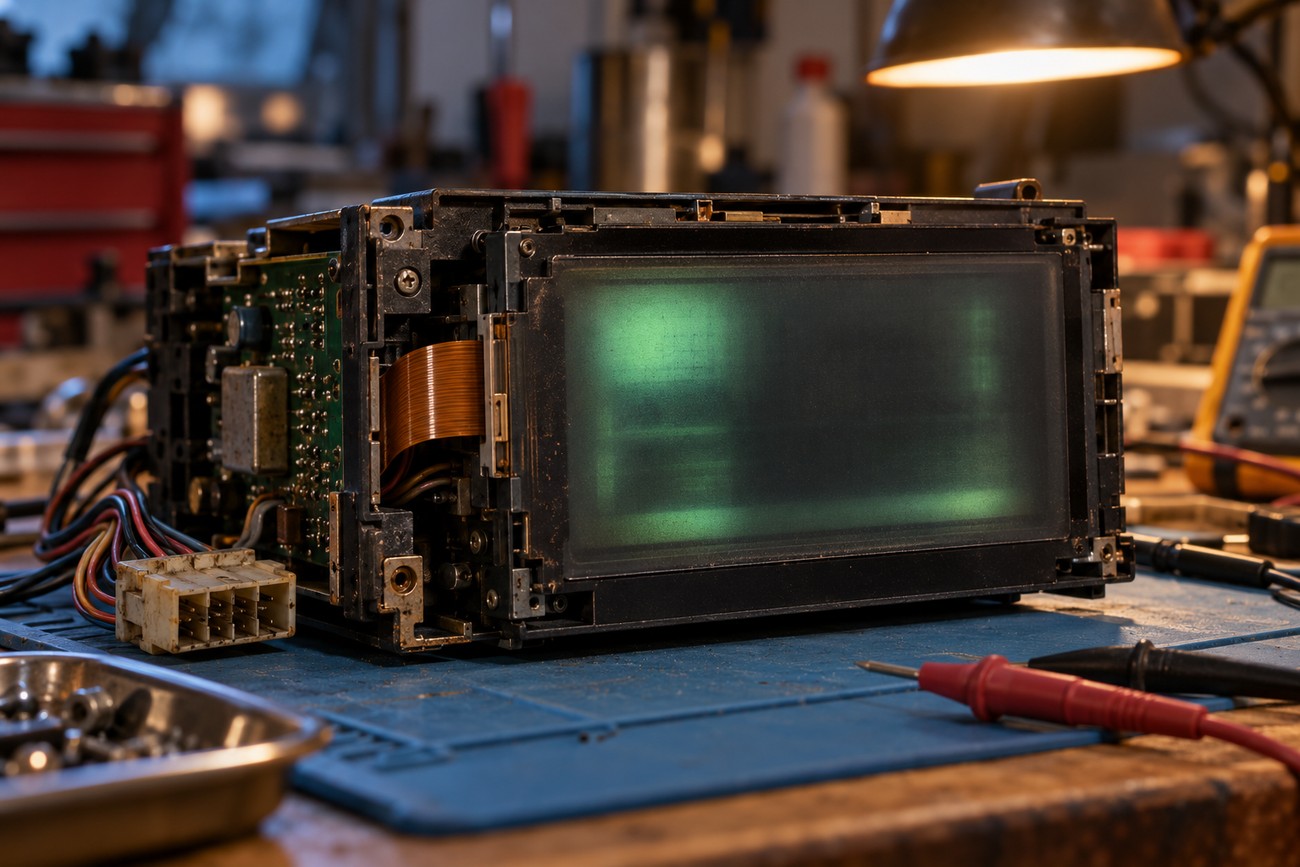
The most obvious failure is unreliable touch response. A selected area may react only after several attempts, respond with a delay, or stop responding altogether. Hot and cold conditions can make the behavior more noticeable, which often leads owners to blame the glass before checking the electronics, sensor frame, grounds, and connectors.
The CRT has its own aging problems. Graphics may become dim, develop shadows, or show burned-in characters, leaving the display difficult to read at night even with the brightness increased. A system that appears frozen may recover after the ignition is switched off and on again, although that temporary recovery does not identify the underlying fault.
Electrical faults can imitate a failed screen. Poor grounds and corroded contacts create unstable symptoms, while cracked solder joints and dried-out capacitors can interrupt operation inside the ECC module. These faults are especially frustrating because replacing a screen without testing the surrounding circuitry may spend money on the wrong component.
A failed ECC also changes the information available to the driver. Some warnings and system-status messages are presented through the display, so a nonworking unit can delay awareness of a vehicle problem. For a car being driven regularly, that makes repair a functional and monitoring issue rather than a cosmetic restoration choice.
Repair, Replacement, and the Parts Problem
Original ECC replacement parts are limited, and donor modules may have their own dim displays, damaged touch frames, or electronic faults. Dealer instructions traditionally recommended installing a new ECC rather than repairing the original unit. That approach made sense for a supported new car, but new replacement inventory is a poor assumption for a collectible Buick today.
Modern restoration commonly starts with the original module. Specialists may repair the circuit board, address cracked solder joints and dried-out capacitors, service the infrared sensor frame, and calibrate the touch sensors. Careful cleaning and calibration can improve response in some cases, although improvised cleaning is risky and cannot substitute for electronic diagnosis.
Test the grounds, solder joints, capacitors, and infrared frame before condemning the CRT itself. Returning the original module for diagnosis usually preserves more restoration options than replacing it blindly with an unverified donor.
Repair cost can seem disproportionate to the market value of an ordinary Reatta, especially when the car also needs mechanical and cosmetic work. A complete, working ECC nevertheless has real collector relevance: it preserves the car’s defining period technology and can materially improve its appeal and value. Keep every original module, even if a temporary workaround is installed.
Ownership Mistakes That Make an ECC Failure Worse
A Reatta with a dead ECC should be treated as a major inspection and budgeting issue. Assuming that a blank or unresponsive screen needs only a simple replacement can lead to a long search for a specialist, an uncertain donor unit, and additional electrical work. The rest of the car may be sound, but the touchscreen should be priced as a serious restoration component.
Modern head-unit installations and custom panels can create electronic problems when the original wiring relationships are ignored. Removing or bypassing the ECC may affect more than the appearance of the dashboard. Before modifying the audio system, document the factory wiring and retain the original equipment so a specialist can trace faults or restore the car later.
Household repair methods are especially dangerous here. Heating the assembly with a hair dryer, flooding the sensor frame with solvent, or probing connectors carelessly can damage plastics, boards, contacts, and infrared components. Static electricity, impact, and poor packaging can also damage an ECC during storage or shipping, so the module needs antistatic protection and firm cushioning.
The CRT also consumes more energy and produces more heat than a modern display, adding stress to an aging electrical system. That makes clean grounds, sound connections, and correct charging-system operation relevant to ECC reliability. Replacing the original unit with a modern display can be considered later; discarding it first removes an important path to stock restoration.
Innovation, Ergonomics, and the Riviera Compatibility Debate
Buick presented the ECC as advanced and intuitive for the late 1980s. In practice, virtual controls require visual attention and precise finger placement. A physical switch can often be found by touch, while a screen asks the driver to look, identify the correct area, and press accurately. That limitation matters most while adjusting climate or audio functions on the move.
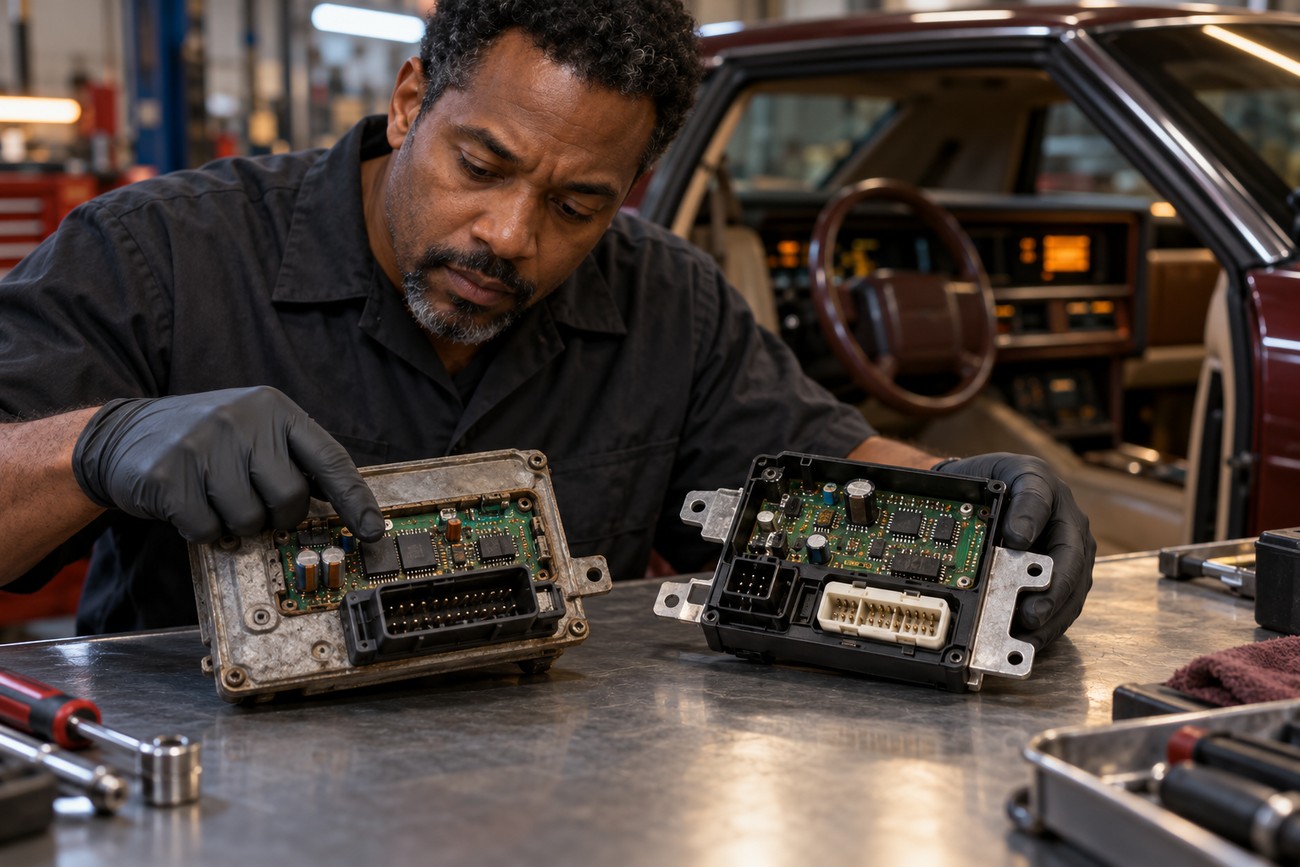
Compatibility with Riviera units is another area where simple claims are unreliable. Some sources describe Reatta and Riviera ECC units as identical or interchangeable. Repair specialists report differences in software, some connectors, and configuration, meaning that a physically similar module may not be a direct plug-and-play substitute.
Check the exact application before buying a donor unit. A specialist may be able to use a Riviera component, adapt it, or transfer useful parts, but compatibility should be established from the module and vehicle details rather than assumed from appearance. The ECC firmware is fixed, so modern menu improvements require substantial custom work rather than a routine software update.
LCD conversions do exist, sometimes retaining the original control logic. They can improve readability and reduce the limitations of an aging CRT, yet they are custom modifications rather than simple replacements. For a historically important Reatta, preserving the original ECC alongside any retrofit gives the owner a credible route back to factory specification.
Frequently asked questions
How much is a 1988 Buick Reatta worth?
There is no universal value determined by the touchscreen alone. Start with body and interior condition, rust and trim completeness, mechanical history, and documented maintenance. Then assess the ECC separately: a fully functioning original unit supports collector appeal, while a dead or modified system should be treated as a substantial restoration expense.
Service history can matter more than a polished presentation. A clean car with an untested ECC may be less attractive than a less perfect example with documented repairs, complete original electronics, and a realistic maintenance record. Regional demand and the quality of any restoration also influence the final price.
What Buick had the first touchscreen?
For Buick’s production timeline, Riviera models used the ECC from the 1986 model year, while the Reatta received it at its 1988 debut. The Reatta is often associated with the system because the screen became central to its identity.
The Riviera/Reatta ECC should be described as one of the early mass-produced automotive touchscreen systems. Calling it definitively the first automotive touchscreen overlooks earlier experimental and limited applications.
What should I test before buying a 1988 Buick Reatta?
Test every touch zone repeatedly, including the corners and less-used controls. Check screen brightness, shadows, burned-in characters, climate operation, audio functions, diagnostics, voltage information, warnings, and system-status displays. Switch the ignition off and on again to see whether the unit freezes or recovers abnormally.
Inspect for aftermarket head-unit work, missing original parts, damaged connectors, poor grounds, and evidence of improvised repairs. Confirm whether the seller has preserved the original ECC and whether any proposed donor or retrofit has been checked for Reatta-specific software and connector compatibility.







