
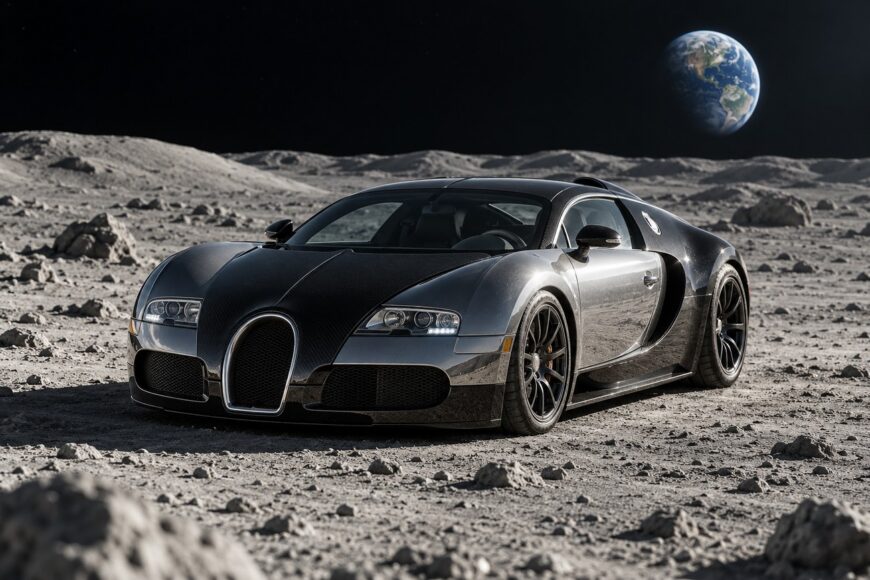
The apparent paradox is straightforward: a 1,001-PS Bugatti Veyron has enormous power, yet the Moon removes the air, tire loading, cooling, and operating conditions that made its 253-mph figure possible. The engine’s output remains impressive on paper, but power reaches the ground through tires and surface contact, not through the specification sheet alone.
The official 253-mph maximum speed belongs to the closed-roof Bugatti Veyron 16.4 under terrestrial test conditions. No confirmed lunar test or verified owner report establishes that speed on the Moon. The useful engineering question is therefore whether the car could maintain traction, run its powertrain, manage heat, and stop safely on loose regolith.
Low gravity changes the vehicle’s interaction with the surface more radically than it changes its inertia. The car remains just as massive, while its vertical tire load falls sharply. That combination makes a lunar Veyron a problem of propulsion support, wheel-soil mechanics, thermal control, and braking rather than a simple exercise in adding horsepower.
- What the Veyron’s 253-mph Figure Actually Means
- Why One-Sixth Gravity Does Not Mean Six Times the Speed
- Earth Road vs. Lunar Regolith: The Conditions That Change Everything
- The Vacuum Problem Is Bigger Than Cooling
- At 253 mph, the Energy Is Still Earth-Sized
- The Verdict: A Stock Veyron Would Not Have a Defensible Lunar 253-mph Run
- Frequently asked questions
- What is the Bugatti Veyron’s 0 to 100 mph time?
- Why is a Bugatti oil change sometimes quoted at $20,000?
- What would lunar wheels need that Veyron tires do not have?
What the Veyron’s 253-mph Figure Actually Means
The Bugatti Veyron 16.4 uses an 8.0-liter W16 with four turbochargers. Its stated output is 1,001 PS, equivalent to 736 kW, with 1,250 N·m of torque. Those figures describe the capacity of the powertrain under the operating conditions for which the car was engineered and tested.
The 253-mph maximum speed applies to the closed-roof version under terrestrial test conditions. A high-speed road run depends on a prepared surface, functioning tires, adequate cooling, stable suspension behavior, and an atmosphere that allows the car’s aerodynamic systems to work. The specification is therefore a complete vehicle-and-environment result, not an isolated property of the engine.
On the Moon, the same number cannot be treated as a demonstrated performance target. No confirmed lunar Veyron test or verified owner experience establishes a 253-mph run. The absence of evidence matters here because the environment changes several limiting mechanisms at once.
Even a hypothetical modified Veyron would need testing to establish a lunar maximum speed. Gearing, motor operation, wheel slip, surface strength, suspension response, thermal rejection, and braking would all influence the result. The terrestrial figure can provide context for the car’s design ambition, but it does not establish a lunar speed limit.
Why One-Sixth Gravity Does Not Mean Six Times the Speed
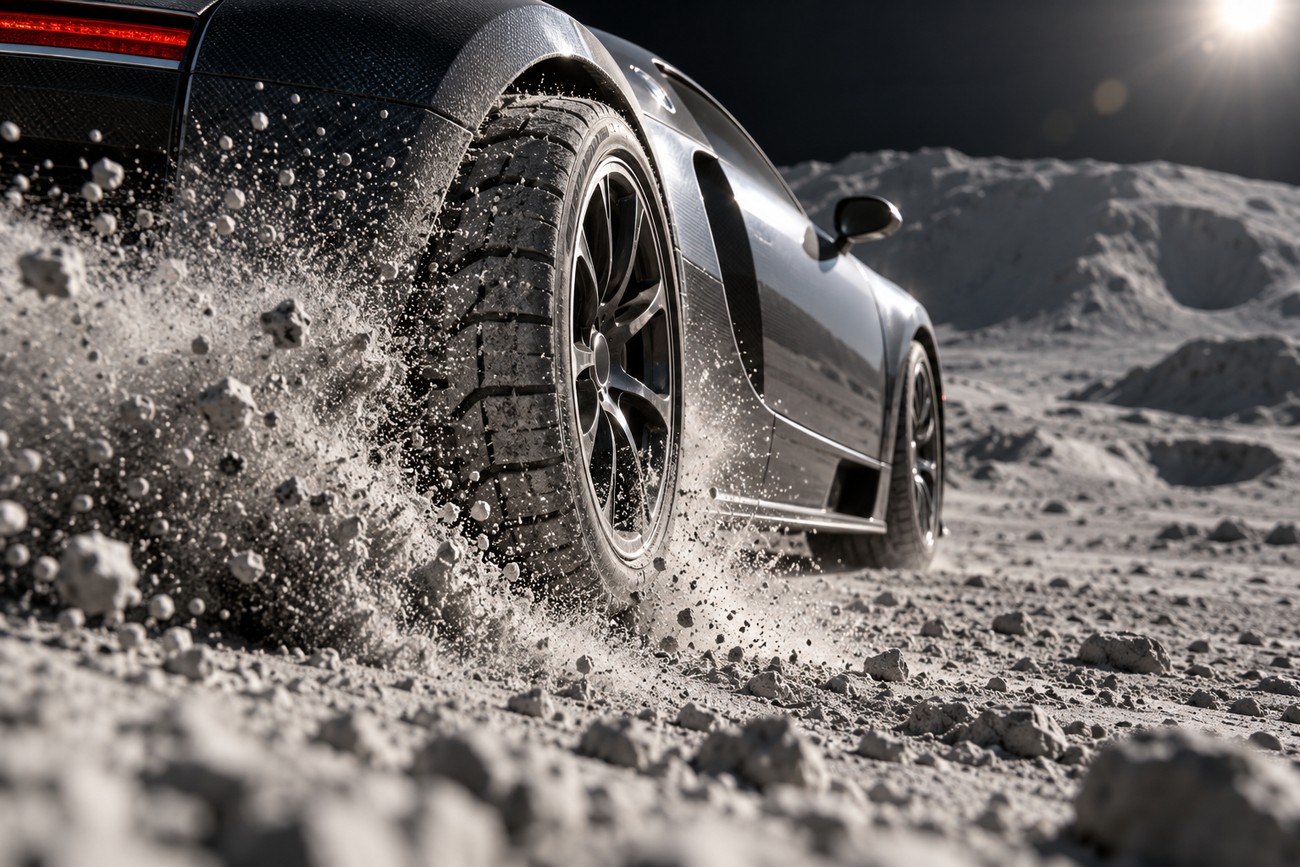
Lunar gravity is 1.62 m/s², approximately 16.5% of Earth’s gravity. The vehicle’s mass does not change on the Moon, so its resistance to acceleration remains tied to the same mass. What changes sharply is weight: the vertical tire load becomes approximately six times lower than on Earth, absent other loading effects.
That distinction separates inertia from traction. A tire can transmit force through contact with the ground only within the limits created by its normal load and the behavior of the surface. On loose regolith, available traction is governed by normal load, wheel slip, wheel geometry, and soil behavior—not engine power alone.
More throttle can therefore produce wheelspin rather than useful acceleration. The tire may disturb and displace the regolith, deepen a rut, or lose support while the engine continues producing torque. The Veyron’s 1,250 N·m does not guarantee forward motion when the surface cannot react against the driven wheels.
Controlled slip and load distribution matter more than simply adding torque. A spinning wheel can deepen a rut while producing little useful forward thrust, so lunar wheel testing prioritizes how the contact patch carries load and disturbs the soil.
The lower load also affects cornering and changes in elevation. A bump that only unloads a tire briefly on Earth could produce a longer loss of contact in low gravity. Once a wheel leaves the surface, its ability to transmit drive, steering, or braking force disappears until contact is restored.
Earth Road vs. Lunar Regolith: The Conditions That Change Everything
The table separates the terrestrial conditions behind the Veyron’s specification from the physical environment a vehicle would face on the Moon.
| Condition | Earth road | Lunar regolith |
|---|---|---|
| Gravity | Earth gravity supports the vehicle’s normal operating load. | Gravity is 1.62 m/s², approximately 16.5% of Earth’s gravity. |
| Tire loading | Vertical tire load supports ordinary road traction. | Vertical tire load is approximately six times lower, absent other loading effects. |
| Atmosphere | Air supports conventional engine operation and airflow systems. | The Moon has no atmosphere for a conventional internal-combustion engine or ordinary airflow cooling. |
| Aerodynamic assistance | Airflow can create downforce and aerodynamic drag. | Vacuum removes aerodynamic downforce and air-based drag. |
| Surface | A prepared road offers relatively consistent support and friction. | Regolith is loose, abrasive, heterogeneous, and can compact in tracks while being disturbed near the surface. |
| Cooling | Radiators and airflow can reject heat to the atmosphere. | Ordinary airflow cooling is absent, and stock Veyron radiators were not designed for lunar vacuum. |
| Braking | Road tires and brakes operate in their designed terrestrial environment. | Road tires and air-cooled brakes lack their normal operating conditions, while regolith offers uncertain support. |
Regolith is not simply a rough version of asphalt. It is abrasive, heterogeneous, and mechanically variable. A wheel can compact material in a track, while its tread elements disturb the loose surface near the contact patch. A repeated pass may therefore encounter different resistance and grip from the first pass.
The stock Veyron’s radiators, seals, oils, tires, and brakes were not designed for lunar vacuum and regolith. Road tires also rely on a surface and load regime that differs fundamentally from loose soil. Their width and tread may influence flotation and slip, but those traits do not turn them into purpose-built lunar wheels.
Surface interaction can dominate the powertrain. A driver who responds to poor forward motion by applying more throttle may increase wheelspin and excavate the surface. That response can reduce support beneath the tire, leaving a powerful car less mobile than a slower vehicle designed to distribute its load carefully.
The Vacuum Problem Is Bigger Than Cooling
A conventional internal-combustion engine needs an oxidizer. Without atmospheric oxygen or a separate oxidizer supply, the Veyron’s engine cannot run normally in lunar vacuum. Cooling is a separate issue: even if combustion were supported by an engineered oxidizer system, the stock cooling architecture would still lack ordinary airflow and would require a different method of rejecting heat.
Vacuum also removes aerodynamic downforce. On Earth, airflow can add load to a high-speed car and help its tires maintain contact with the road. The Moon supplies no such aerodynamic assistance, so the vehicle must rely on its static weight, suspension behavior, and any mechanically or actively generated load.
The absence of air changes more than engine breathing and downforce. The stock Veyron’s seals, oils, road tires, and brakes were selected for terrestrial service. Vacuum compatibility, lubricant behavior, material outgassing, thermal paths, and dust protection would require engineering validation rather than assumptions based on road use.
Braking becomes a separate design problem. Road tires may struggle to generate usable longitudinal force on loose regolith, while ordinary air-cooled brakes lose the airflow that normally helps manage heat. A vehicle could have enough drive power to reach a high speed yet lack a credible, repeatable way to reduce that speed without losing contact or control.
At 253 mph, the Energy Is Still Earth-Sized
At the same mass and speed, kinetic energy remains governed by Eₖ = 1/2mv². Lower lunar gravity does not make that energy six times smaller. A Veyron traveling at 253 mph would carry the same kinetic energy as the same vehicle traveling at 253 mph on Earth, assuming the mass and speed are identical.
Gravity does affect the vehicle’s path over uneven ground. After a bump or a launch from a ridge, lower gravity can keep the car airborne for longer. During that interval, the tires cannot transmit drive, steering, or braking forces through the surface, and the vehicle may return with an unfavorable attitude or uneven wheel loading.
Reduced tire loading makes the contact problem worse after landing. Regolith may deform under the wheels, and a road-oriented suspension and tire package would not have a validated response to those impacts. Stability at speed would depend on surface strength, wheel geometry, suspension control, and the ability to keep the tires in predictable contact.
Stopping may be harder than accelerating. Drive torque can be applied briefly even during slip, whereas a controlled stop requires the tires and surface to generate repeatable braking force while the vehicle remains stable. The absence of aerodynamic assistance, reduced normal load, unsuitable brakes, and uncertain regolith behavior leave high-speed stopping unresolved.
The Verdict: A Stock Veyron Would Not Have a Defensible Lunar 253-mph Run
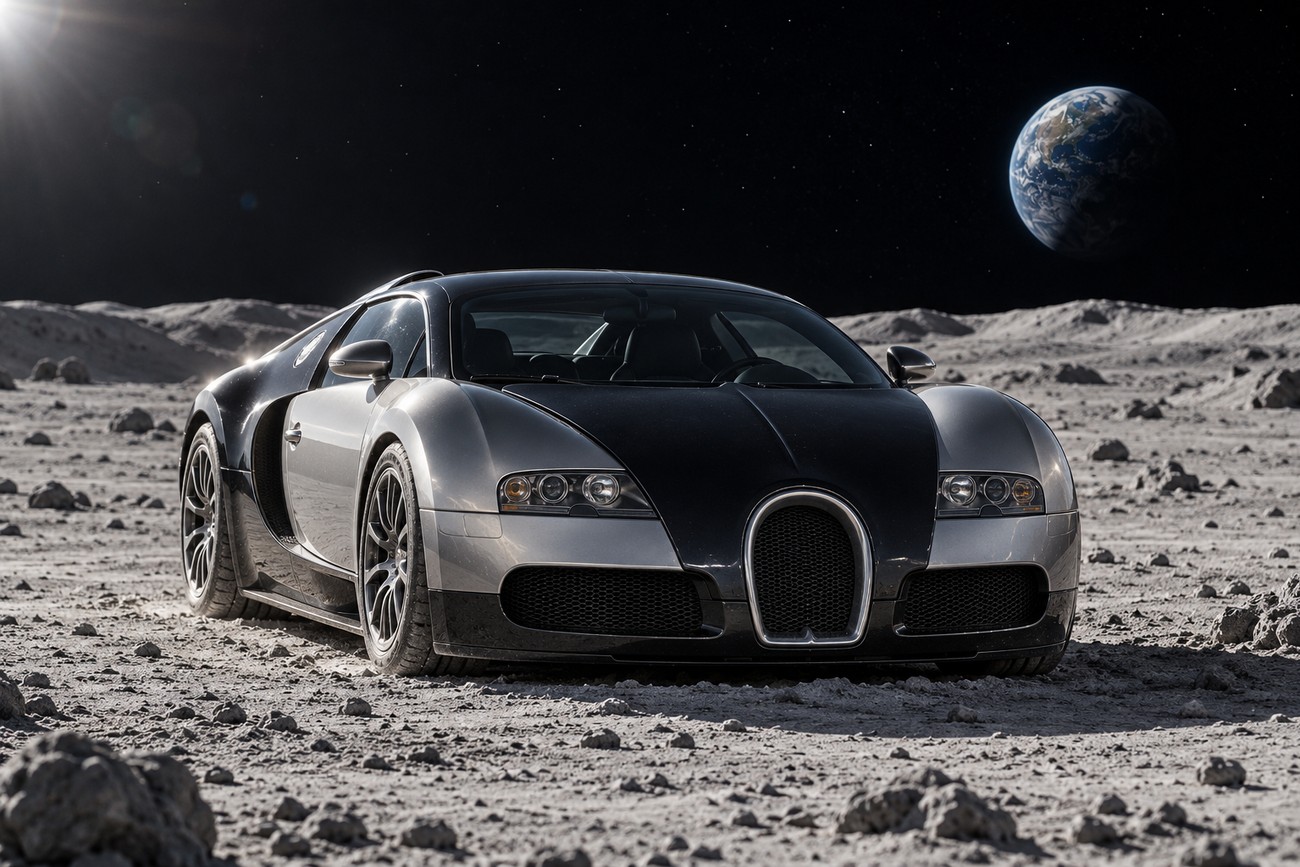
The 253-mph claim is a terrestrial specification for the closed-roof Bugatti Veyron 16.4. It does not establish a lunar maximum speed, and no confirmed lunar test or verified owner report supports treating it as one. On loose lunar regolith, a stock Veyron has no credible path to a defensible 253-mph run.
The first obstacle is operation. A conventional internal-combustion engine would need a separate oxidizer supply, while the vehicle would need redesigned thermal management for vacuum. Materials, seals, lubricants, and electrical or mechanical systems would also require qualification against vacuum and abrasive dust.
The surface systems would need comparable redesign. A lunar vehicle would require purpose-developed wheels or tires, traction control, suspension, and load distribution suited to regolith. Its brakes would need to manage heat and generate controllable deceleration without relying on ordinary road friction or atmospheric airflow.
Power alone cannot overcome reduced normal load, regolith slip, vacuum, and the loss of aerodynamic assistance. A modified lunar concept might be engineered and tested, but its speed would be a new experimental result. The Veyron’s Earth-road figure cannot supply that evidence by extrapolation.
Frequently asked questions
What is the Bugatti Veyron’s 0 to 100 mph time?
A verified 0–100 mph figure is not supplied by the available brief and should be source-checked before publication. Acceleration results can vary with trim, test method, surface, tires, fuel load, and launch conditions, so a single number should not be presented as universal without a specific, credible source.
The 253-mph figure is a separate specification: it is the stated maximum speed for the closed-roof version under terrestrial test conditions. It does not confirm any lunar acceleration result or show how the car would launch on loose regolith.
Why is a Bugatti oil change sometimes quoted at $20,000?
The $20,000 oil-change figure is an unverified search-query claim, not a universal canonical service price. Such a quote may refer to a broader specialist service involving difficult access, multiple fluids, inspection work, labor, and other maintenance operations rather than a simple oil-and-filter replacement.
The exact cost depends on the service scope, location, parts, labor, and vehicle condition. It should therefore be checked against a documented service estimate or an authoritative maintenance source before being treated as a standard Veyron price. The claim also has no direct bearing on whether the car could operate in lunar vacuum.
What would lunar wheels need that Veyron tires do not have?
Lunar wheels would need a carefully engineered interaction with loose, abrasive, heterogeneous regolith. Important variables include the shape and spacing of traction elements, side openings, wheel width, compliance, vibration behavior, and the way the wheel distributes load rather than simply applying torque to a small contact patch.
Wheel geometry can change how soil compacts in a track and how material escapes from the contact area. Repeated passes may alter both compaction and surface resistance, while tread elements can disturb material near the surface. Those effects make wheel design and controlled slip central to mobility; ordinary road tires do not provide a validated substitute.







