
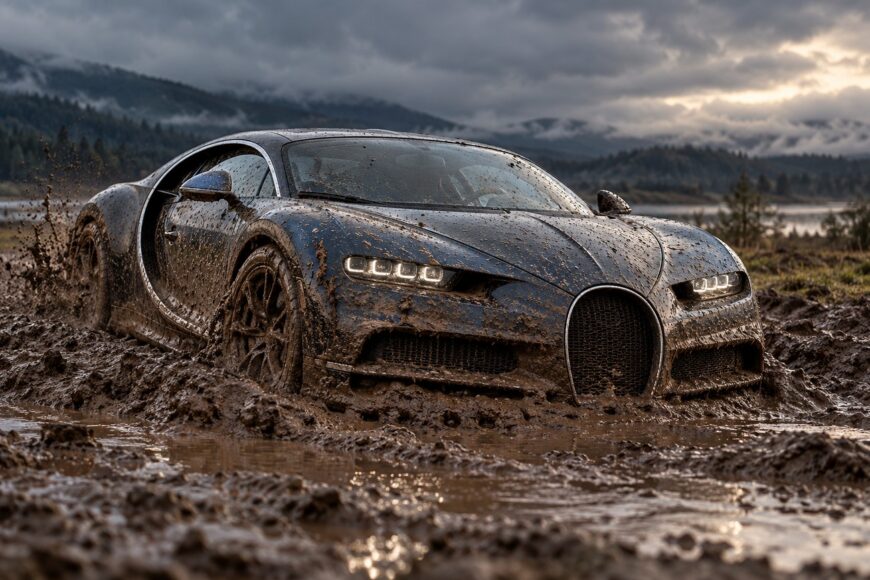
A Bugatti Chiron sitting in a bog is a sharp visual contradiction: a hypercar with approximately 1,500 hp stopped by mud that a much less powerful off-road vehicle might cross. The engine has power to spare. The question is whether the tires can grip, the chassis can clear the ground, and the electronics can turn engine torque into useful movement.
That answer changes with the depth of the mud. A Chiron might cross a short, shallow wet patch if the surface beneath it remains firm. Once the wheels sink into ruts and the underbody bears on the ground, more throttle is likely to deepen the problem rather than solve it.
- The 1,500-hp advantage stops where grip ends
- Why the Chiron’s tires and geometry lose the fight
- What happens when a Chiron starts digging in
- The mistakes that turn a wet track into a recovery job
- How professionals would recover the car without making it worse
- So, can 1,500 hp dig a Bugatti Chiron out of a bog?
- Frequently asked questions
- Which Bugatti has 1,500 hp?
- What should be checked after a Chiron has been driven through deep mud?
The 1,500-hp advantage stops where grip ends
The Chiron’s 8.0-liter W16 with four turbochargers produces approximately 1,500 hp and approximately 1,600 Nm. Permanent all-wheel drive distributes torque to both axles, and the car has front and rear differential locking capability. Those features help it put power down during acceleration on suitable surfaces; they do not guarantee that a tire can push against soft ground.
At a muddy contact patch, usable driving force is limited by tire grip and by how much resistance the soil puts in the car’s path. Once a tire spins freely, additional engine torque mostly turns the wheel faster. Sticky mud may resist the tires, underside, and bodywork at the same time while offering little purchase in return.
All-wheel drive can help when one pair of tires finds firmer ground than the other. It cannot manufacture grip if all four contact patches are coated in mud, nor can differential locking lift a grounded chassis. The Chiron’s system is built chiefly for high-speed traction and acceleration control, a different task from moving slowly through a bog.
There is also a distinction between horsepower and force at the wheel. The full engine output is a performance figure available under appropriate operating conditions, while a slow escape attempt is governed by what the tires and ground will accept. In deep mud, the Chiron can run out of usable traction long before it runs out of engine power.
Why the Chiron’s tires and geometry lose the fight
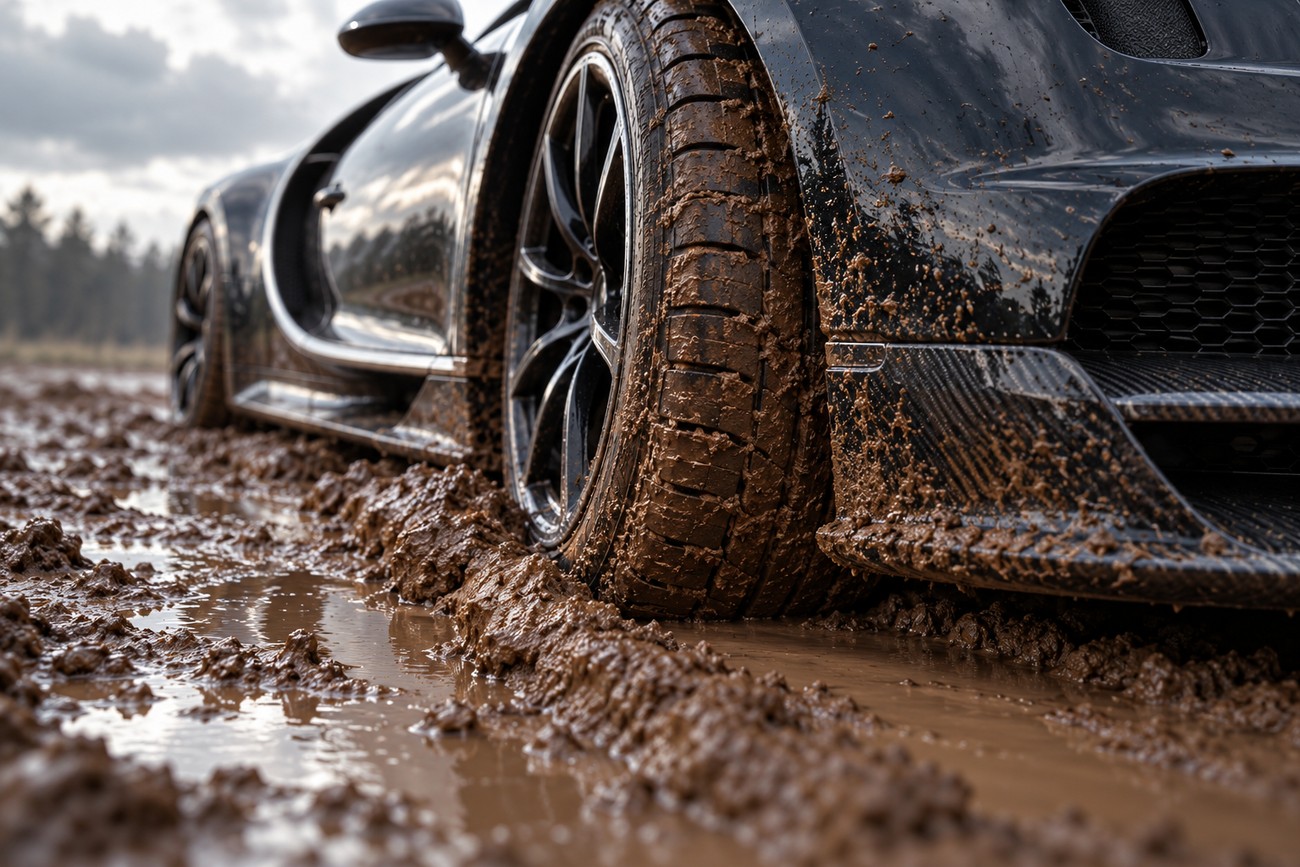
Depending on the version, the Chiron weighs approximately 1,995–2,040 kg. That mass has to travel over ground that may give way beneath each wheel. As the tires settle, the car needs enough clearance to keep its underside above the mud and any hidden ridges; power cannot make a low chassis pass through solid earth.
Its specialized Michelin road tires are designed for speeds above 400 km/h. Their road-oriented tread is not designed for deep-mud self-cleaning, so sticky soil can pack its grooves and leave a comparatively smooth contact surface. Wide tires alone are no safeguard: without a tread that sheds mud and bites into a suitable layer below, their size offers little escape traction.
Low ground clearance and a long wheelbase make ruts and raised ground between them especially troublesome. The wheels may still turn while the center of the car rests on a ridge. At that point, some of the car’s weight is supported by the underbody rather than the tires, reducing the grip available for driving out.
The carbon underbody, diffuser components, and other low-mounted bodywork add a costly reason to avoid forcing a passage. Stones, roots, and hard edges concealed by muddy water can strike parts intended for clean roads, while thick mud can collect around exposed lower components. A track that looks passable from the driver’s seat may leave little room beneath the car.
What happens when a Chiron starts digging in
On a shallow wet surface, the tires may slip briefly and then regain purchase on firm ground. In a genuine bog, the sequence can move in the opposite direction: the tires spin, their tread packs with mud, and the wheels cut deeper ruts. Each attempt then starts with less clearance and more mud to push aside.
ESP, ABS, and traction-control functions are tuned primarily for firm road surfaces. Traction control may reduce delivered torque when it detects wheelspin, which can frustrate an attempted escape. Disabling assistance, however, cannot create grip where the road tires have none; it can allow the wheels to excavate faster.
There is no dedicated deep-mud or off-road mode. Raising the suspension to its maximum available height and choosing softer settings can offer limited clearance and comfort benefits, but neither change gives the Chiron off-road tires or meaningful bog clearance. If the underbody makes contact, wheel power becomes largely irrelevant to forward progress.
Prolonged spinning also loads the transmission and driveline while the car makes little ground. Heat and mechanical stress can accumulate during repeated attempts, particularly if the tires alternately spin and catch. The useful distinction for a driver is whether a brief, gentle movement still carries the car toward firm ground or whether every attempt makes the ruts deeper.
The mistakes that turn a wet track into a recovery job
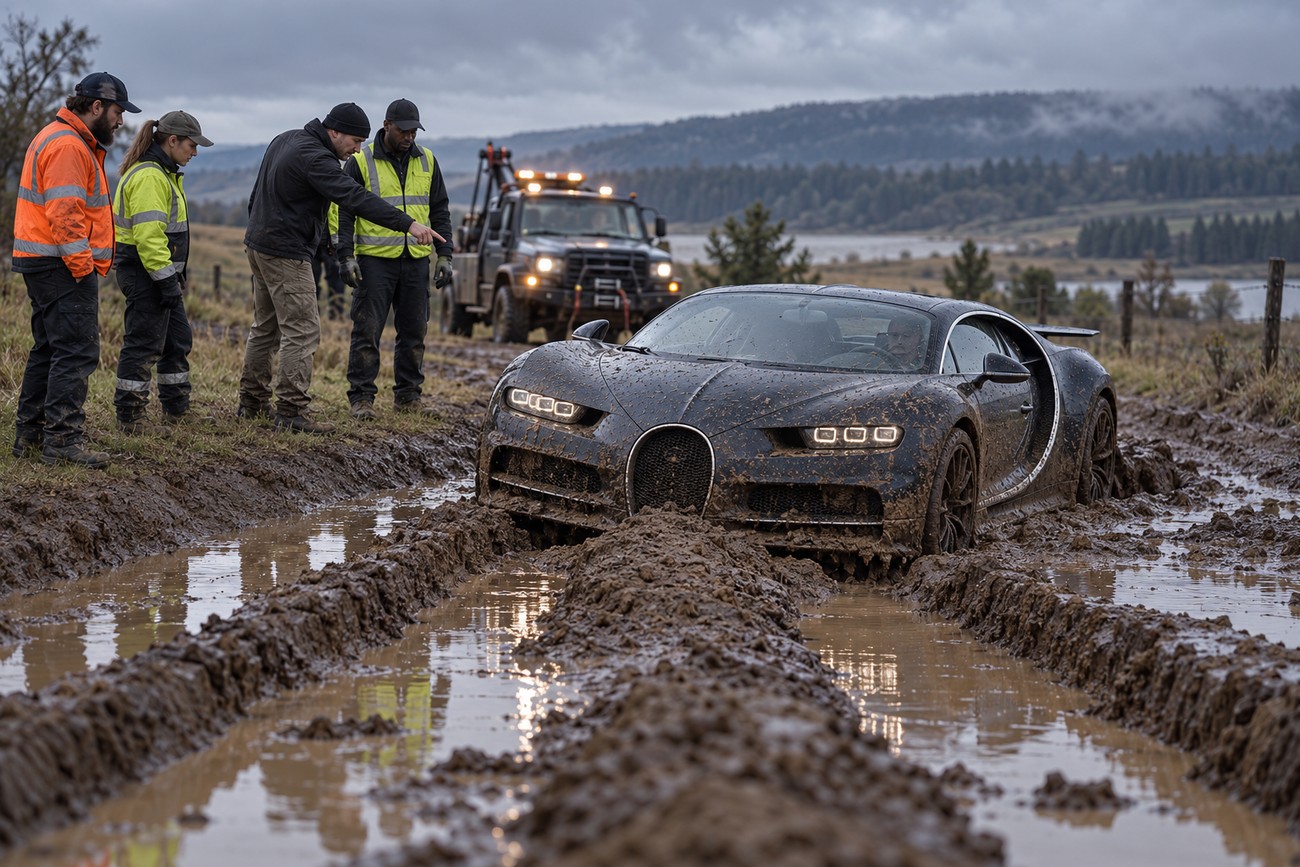
The first mistake often happens before the car enters the mud. Standing water can hide deep ruts, soft clay, stones, and a raised center ridge. Checking the route and its exit from a safe position, rather than discovering its depth with the Chiron’s underbody, is more valuable.
Flooring the throttle after the car slows is another poor bet. On road-oriented tread, rapid wheelspin can remove supporting soil from beneath the tires. A car that was slipping across the surface can become one that is settled into four holes, with its underside dragging between them.
Turning off stability functions without understanding the surface and the car’s response adds uncertainty without changing the tire-ground contact. The available approximately 1,600 Nm remains constrained by grip. A sudden return of traction can also subject the driveline to a sharp load, so repeated attempts to rock the car deserve particular caution.
Improvised towing can make a difficult recovery more expensive. The diffuser, decorative bodywork, and unsuitable suspension components are not substitutes for approved recovery points. When a car weighing approximately 1,995–2,040 kg is stuck, resistance from the mud adds to the load on whatever is used to pull it; a hard jerk is no place to discover that the attachment was wrong.
How professionals would recover the car without making it worse
The restrained response begins by stopping wheelspin and assessing the car’s position. If the tires still carry its weight and firm ground is close, a controlled movement may be possible. If the chassis is resting on mud, further throttle is unlikely to free it and may increase the depth of the ruts.
Confirm whether the underside is grounded before applying a pull. That assessment determines whether the tires can help move the car or whether they are largely along for the ride.
Once the car is bottomed out, suitable external assistance is preferable to high-load self-extraction. The aim is to move it back toward firm ground in a controlled manner, using the approved recovery points and equipment appropriate to the load. The attachment and pulling direction should be verified for the particular car rather than guessed from a visible opening or suspension part.
A recovery operator also has to consider what the bodywork may strike as the car moves. Pulling a low car across the edge of a rut can damage carbon underbody or diffuser components even after its wheels begin rolling. Repeated rocking and abrupt pulls increase the chance of harm to the structure, suspension, transmission, or driveline.
Maximum ride height and softer settings may help with a small clearance or comfort issue during the process. They do not turn the Chiron into a vehicle equipped for deep mud. If the route back to firm ground remains obstructed, planning a gentler extraction is wiser than asking the engine to overcome the bog.
So, can 1,500 hp dig a Bugatti Chiron out of a bog?
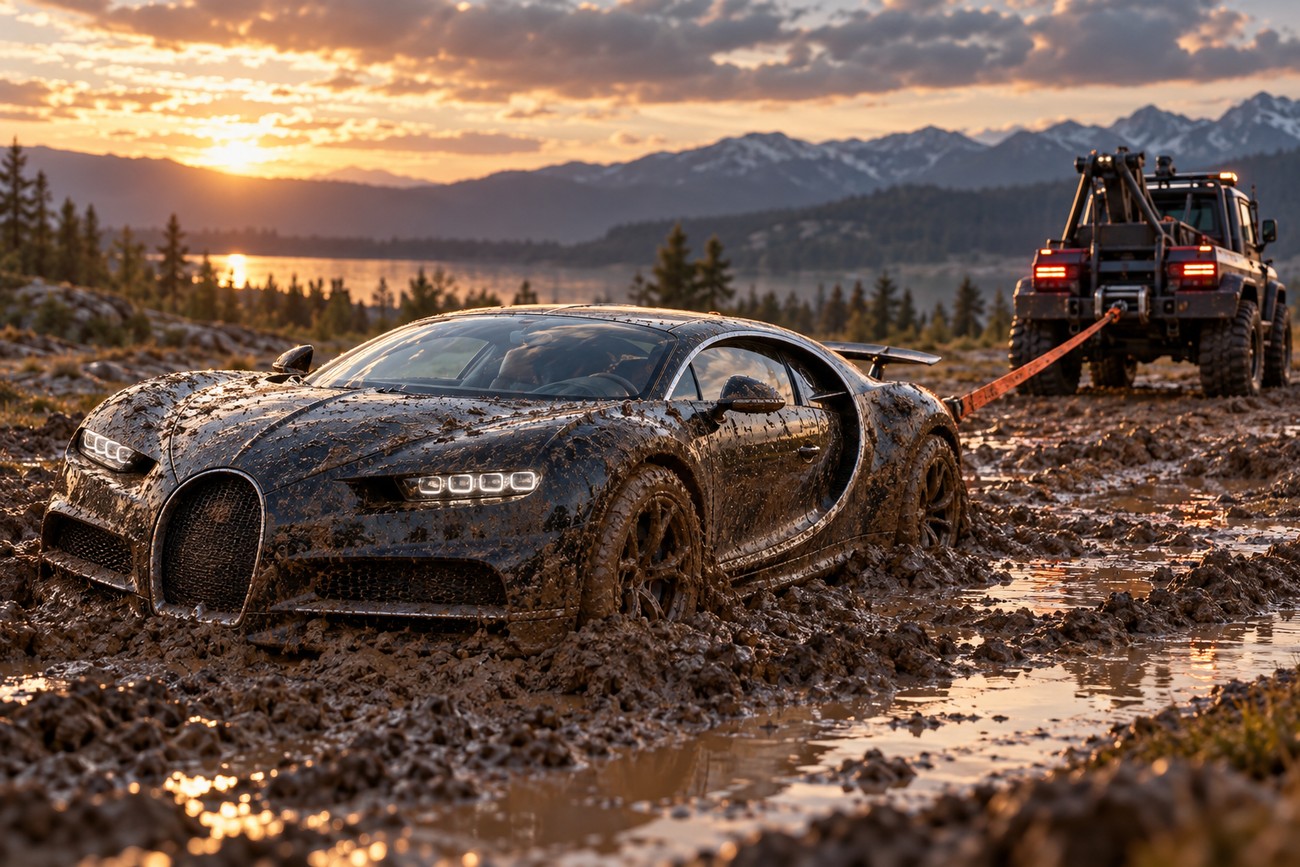
A Chiron may traverse a short, shallow, already-scouted wet section when the ground beneath its tires stays supportive. In that case, it is crossing slippery ground rather than escaping a bog. Modest wheel slip is possible, but the car still depends on tire grip and adequate clearance.
Deep, viscous mud changes the problem. Road tires can pack up, ruts can take away the little clearance available, and the underbody can begin carrying the car’s weight. More engine output then offers no useful substitute for contact between tire and firm ground; aggressive throttle may bury the wheels further.
The Chiron’s permanent all-wheel drive improves acceleration and control on suitable surfaces. Its low chassis, road-oriented tires, and vulnerable underside remain severe limits in mud, regardless of the power sent to both axles. If it settles onto its belly, controlled external recovery is the sensible expectation.
So the practical answer is no: approximately 1,500 hp cannot reliably dig a Bugatti Chiron out of a serious bog. Grip and clearance decide whether it can move; once both are gone, the engine is no longer the solution.
Frequently asked questions
The Chiron’s output depends on the specific version. Recovery after deep mud also requires attention to the car’s low bodywork and exposed components.
Which Bugatti has 1,500 hp?
The figure commonly refers to the original Bugatti Chiron, whose output is generally rounded to approximately 1,500 hp. Different Chiron derivatives may be quoted with different outputs, so the version matters when comparing specifications.
What should be checked after a Chiron has been driven through deep mud?
Check radiator openings for blockages, the brakes for trapped mud, and the underbody panels for damage. Inspect exposed wiring and active aerodynamic mechanisms for contamination or impaired movement before returning to normal road speeds.







