
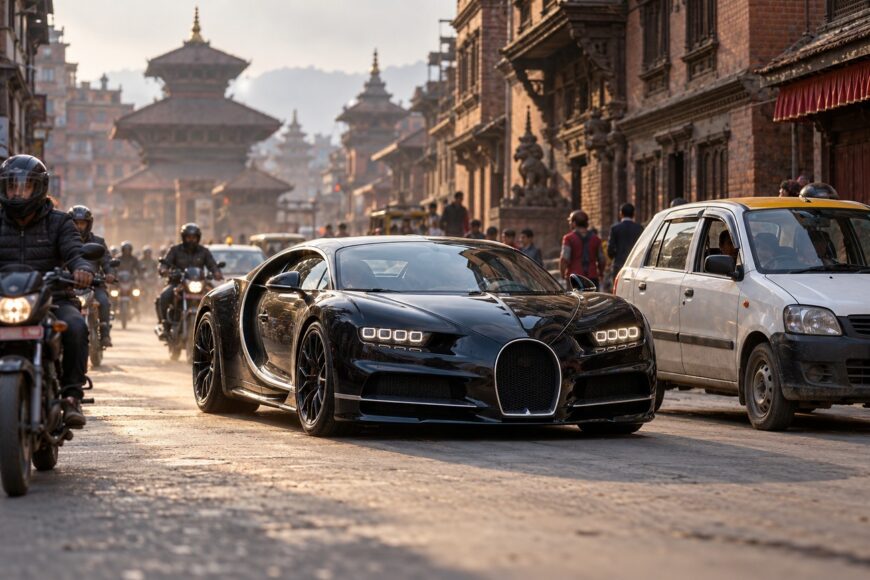
A Bugatti Chiron easing past motorcycles on a Kathmandu street makes a striking image. As a taxi, though, it remains hypothetical. No confirmed Bugatti Chiron taxi operator, specific vehicle, or working route in Kathmandu was found in the available research.
The car’s specifications make the premise more interesting than its speed. A Chiron has room for one passenger beside the driver, a body 2,038 mm wide before the mirrors, and fuel-consumption figures that deserve more attention in slow traffic than on an open road. Those details cannot tell us how a particular trip would go, but they do show what a real operator would have to solve.
- Is there really a Bugatti Chiron taxi in Kathmandu?
- One passenger, a wide body, and almost no luggage space
- Why Himalayan roads make horsepower the wrong measure
- Fuel, damage, and downtime behind a novelty fare
- Frequently asked questions
- What is the price of a Bugatti Chiron in Nepal?
- What evidence would prove that a photographed Chiron is operating as a Kathmandu taxi?
- How should a passenger agree on the price of an unusual private ride in Kathmandu?
Is there really a Bugatti Chiron taxi in Kathmandu?
There is no verified Chiron taxi service to book based on the available evidence. The research found no operator, identifiable vehicle working as a taxi, or paid route in Kathmandu. It also found no verified passenger reviews of such a ride.
A photograph, even one showing a Chiron on a Kathmandu street, would establish little about its purpose. A car can be parked, passing through, displayed for an event, or photographed for a staged scene without carrying fare-paying passengers. The taxi claim would need evidence of commercial operation beyond the image.
That distinction matters because the visual story is plausible enough to circulate without its context. A caption calling a luxury car a “taxi” does not identify who runs it, whether rides can be booked, or whether the vehicle is registered for commercial passenger service. Until those points are substantiated, the Chiron taxi belongs in the realm of hypothetical motoring rather than local transport advice.
One passenger, a wide body, and almost no luggage space
The standard Chiron has two seats total: one for the driver and one for a passenger. An ordinary airport pickup for two travelers would therefore exceed its passenger capacity before luggage enters the equation. Its limited luggage space would also make even a solo traveler’s bags something to check before agreeing to a ride.
At 4,544 × 2,038 × 1,212 mm, with a 2,711 mm wheelbase, the Chiron presents an unusual shape for taxi work. The stated width is before the mirrors, so the space needed to pass a parked car or pull up at the curb is greater still. Conventional Kathmandu taxis are often small cars, including Suzuki Altos, whose size better suits streets where drivers must share limited room.
Getting in and out matters as much as fitting through. In a hypothetical pickup beside an uneven roadside, the Chiron’s low seating position could make entry awkward, while opening a door beside motorcycles and other moving traffic would demand care. A suitable stopping place would be part of the journey plan rather than an afterthought.
These limits leave little flexibility for a taxi operator. A second paying passenger cannot squeeze into a rear seat that does not exist, and bulky baggage cannot simply be moved out of the cabin. The Chiron could offer a distinctive ride for one lightly packed passenger, but it could not cover the range of trips a small everyday taxi handles.
Why Himalayan roads make horsepower the wrong measure
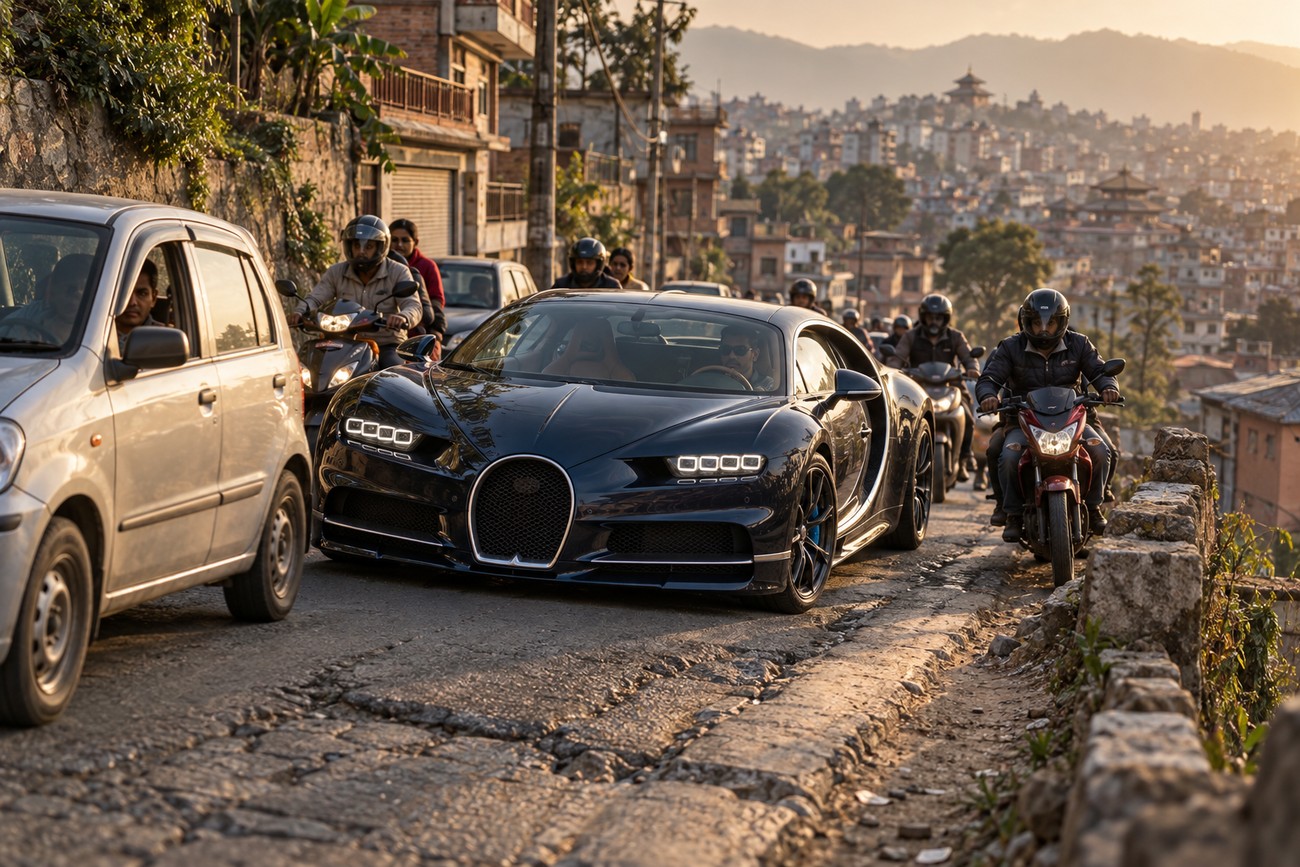
The Chiron’s 8.0-liter W16, 7-speed dual-clutch transmission, and all-wheel drive are formidable specifications. In Kathmandu congestion, they do not shorten a queue or create room to pass. Traffic can substantially lengthen journeys, and rush-hour travel may roughly double on some trips, though that is no guarantee for any particular route.
Beyond traffic, a route may include uneven pavement, steep approaches, and tight places to turn or meet oncoming vehicles. The body is 2,038 mm wide before the mirrors, a consequential dimension where motorcycles, parked cars, and roadside edges compete for space. On a hypothetical hill-bound journey, safe passage would depend on the condition of each approach rather than the car’s potential speed.
A route check should examine how the car enters a steep ramp and where it can safely pass at each narrow point. A road that looks wide enough on a map may still leave too little usable space at a bend or beside a raised edge.
All-wheel drive helps transmit power to the road; it cannot lift low bodywork over a crest or protect a tire from a damaged surface. The Chiron’s transmission likewise offers no answer to an abrupt change in road angle. A driver would have to judge whether a specific stretch is suitable before treating it as part of a paid route.
Some aggregator listings put Chiron ground clearance at 125 mm, but the available official Bugatti specification does not confirm that figure. It should not be treated as guaranteed clearance for every car or driving condition. No documented Kathmandu Chiron trip establishes how one has handled local road defects, so the risk of contact remains an assessment rather than a reported incident.
Fuel, damage, and downtime behind a novelty fare
A 100-liter tank sounds useful until consumption enters the picture. Official WLTP figures for the Chiron are 25.2 L/100 km combined and 44.6 L/100 km in the low-speed phase; neither predicts the result of a particular Kathmandu trip. Slow progress would make the low-speed figure more relevant to planning than the combined figure, without turning either into a local fuel bill.
At about 1,995 kg unladen, the Chiron is also a substantial vehicle to place near curbs, broken pavement, and tight parking spaces. Contact with a low body panel or aerodynamic component could be costly, but no Nepal-specific Chiron repair tariff was verified. Local authorized service availability and insurance terms were not established either, leaving downtime and financial exposure impossible to price responsibly.
Ordinary Kathmandu taxi complaints include drivers declining to use the meter and negotiating fares. An unusual private ride would make agreement on price particularly important, yet no viable Chiron taxi fare has been verified. Paying for novelty would not provide a way around the same congestion faced by other road users.
Frequently asked questions
The questions below concern evidence and booking decisions rather than a confirmed Chiron taxi service. They can help separate a photograph or private offer from a ride a passenger can verify. Nepal-specific costs and commercial terms remain unestablished.
What is the price of a Bugatti Chiron in Nepal?
No verified Nepal-specific Chiron price was established, so quoting a local purchase figure would be misleading. A meaningful landed-cost estimate would need to identify the particular car, its purchase and shipping terms, applicable import taxes and fees, and the basis on which it could be registered. None of those details can be replaced with a generic overseas asking price.
What evidence would prove that a photographed Chiron is operating as a Kathmandu taxi?
Look for an identifiable vehicle linked to a named operator, evidence of appropriate commercial registration, and records showing that paid rides can actually be booked. A stated booking channel, service terms, and a verifiable working route would strengthen the claim. A photograph alone cannot establish who owns the car or what it was doing when the image was taken.
How should a passenger agree on the price of an unusual private ride in Kathmandu?
Before booking, ask for the written total and confirm the route, pickup and drop-off points, included waiting time, cancellation terms, and payment method. Clarify any charge for delays or route changes before the trip begins. Those steps can reduce a fare dispute, but a privately arranged ride should not be described as a verified Chiron taxi service without evidence of commercial operation.







