
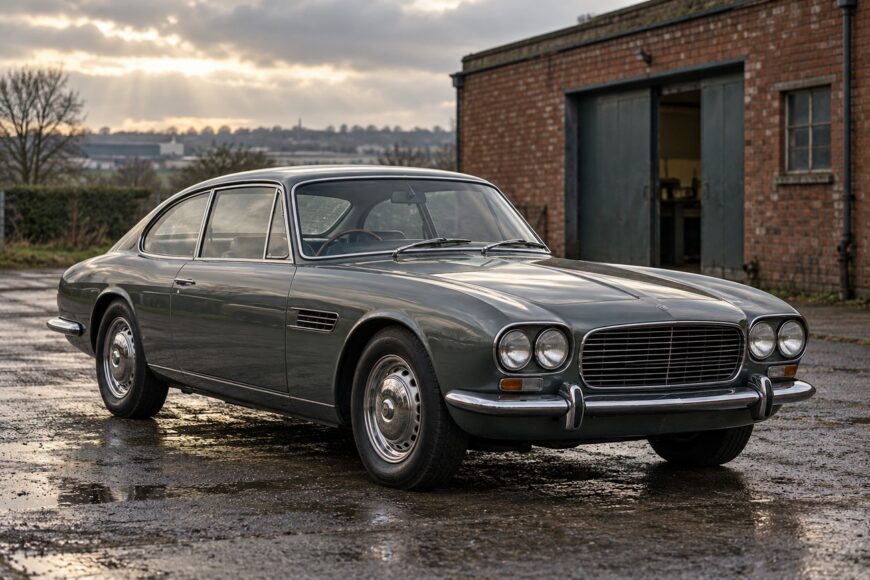
The Bristol 411 carried its Filton association discreetly: a restrained British two-door GT with an American V8 beneath the bonnet. Its pace suited long journeys, while its appearance gave little away.
That apparent simplicity can mislead a buyer. The 411 name spans five series, and published specifications vary by car and source. With only 287 built, a surviving example deserves to be judged by its identity, records, and condition rather than by a familiar headline figure.
A discreet express from Filton
Produced from 1969 to 1976, the Bristol 411 was a British two-door, front-engined, rear-wheel-drive GT. Bristol built 287 cars across five series. Its reserved shape suited a marque associated with Filton and with cars that revealed more of their purpose on the road than at the kerb.
A Chrysler V8 supplied the power, driving the rear wheels through a three-speed Chrysler Torqueflite automatic. That combination placed the 411 firmly in grand-touring territory: an engine with ample capacity and a transmission suited to making progress without constant driver intervention.
The distinction matters because a discreet body and a large engine can invite the wrong expectations. The 411 was conceived as a substantial touring car, rather than an overt sports car. Its character is easier to understand through its layout and intended use than through a single maximum-speed claim.
Five series, several sets of figures
Across the five series produced from 1969 to 1976, the 411’s specification evolved. Early cars used a 6.3-liter Chrysler B V8, quoted as 6,277–6,286 cm³; a later version used a 6.6-liter V8, quoted as 6,556 cm³. A model name alone therefore cannot establish which engine is in a particular car.
Power figures need equal care. Series 1 is quoted at 264 bhp or 268 PS, while later descriptions give up to 335 SAE hp. Those labels reflect different units and rating conventions; placing the numbers side by side does not provide a like-for-like measure of the change between cars.
Published top-speed claims include 130 mph (approximately 209 km/h) and 143 mph (approximately 230 km/h). Neither should be attached automatically to every 411. A description that combines an early engine, a later power rating, and the higher speed claim may be mixing information from different specifications.
The useful starting point is the individual car’s series and documented equipment. From there, period figures can help describe its place in the range, provided their source and measurement convention remain clear.
Fast travel, not sports-car theater
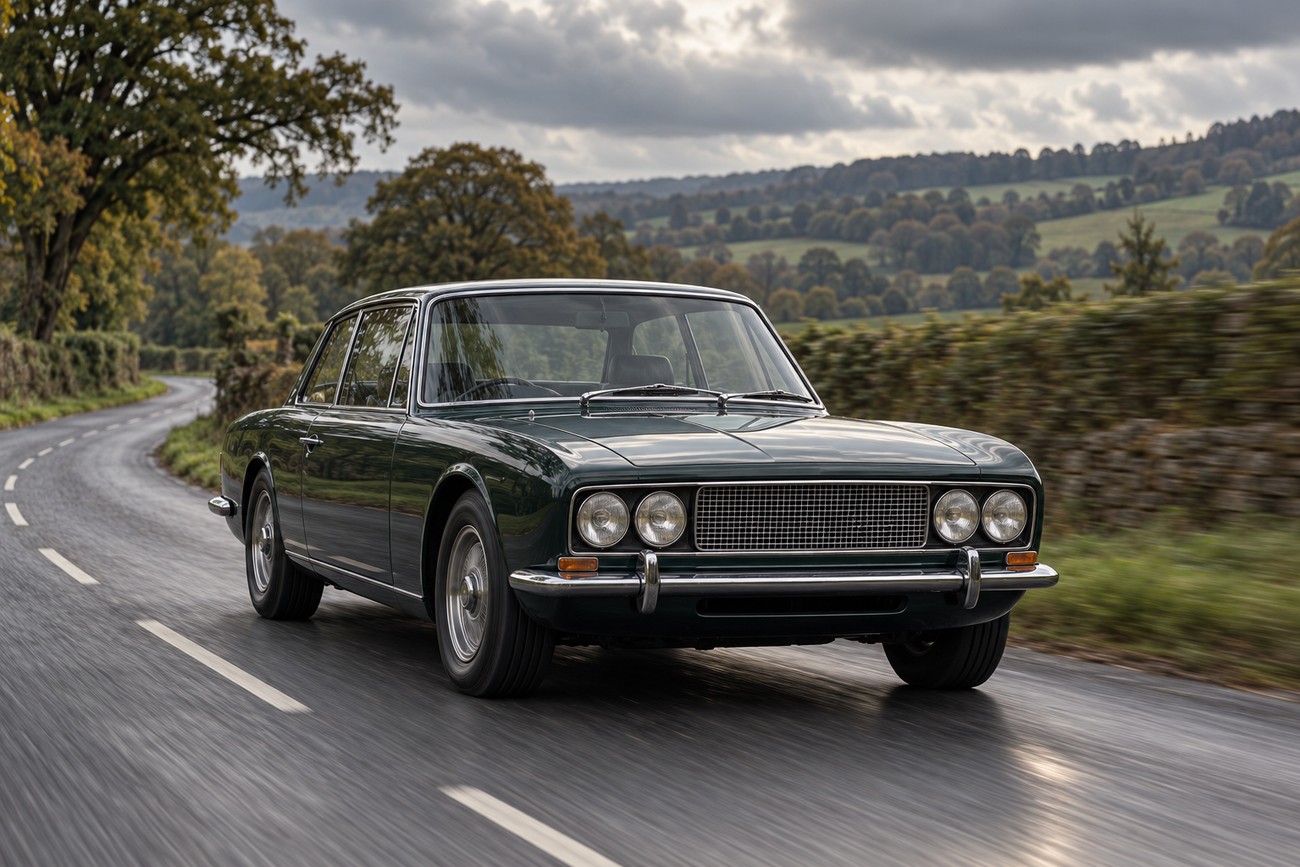
The front-mounted Chrysler V8, rear-wheel drive, and three-speed Chrysler Torqueflite automatic shaped the 411’s appeal. Its engineering offered an unhurried way to cover distance with substantial power available when needed. That is a more dependable account of its character than an acceleration claim detached from a specific version.
Bristol’s contribution extended beyond fitting an American engine. The chassis and suspension gave the 411 its own grand-touring identity, while later cars used a limited-slip differential. That differential should be checked on an individual example, rather than assumed to have been fitted throughout production.
For a prospective owner, the automatic is part of the car’s purpose, not a detail to explain away. Someone seeking the responses of a lighter, more overt sports car may find the 411’s measured manner less compelling. Someone drawn to discreet, V8-powered travel will recognize why the package made sense.
Buying the car, not the legend
Begin with the chassis identity and establish which of the five series the car belongs to. Then compare the advertised engine and equipment with its records. A year, a series label, and a quoted performance figure should agree where the evidence permits; an inconsistency calls for investigation, not an assumed explanation.
Restoration history is a separate question from originality. Ask what work was done, which components were retained or replaced, and what documents support those claims. A convincing visible finish cannot, by itself, establish the condition of less accessible areas or prove that the specification remains as supplied.
Only 287 were built, so parts availability and knowledgeable support deserve attention before purchase. That small production run also makes a clear account of the individual car particularly valuable: two 411s bearing the same model name may differ in specification and in the extent of later work.
Finally, keep performance claims in their proper place. Published speeds vary by version and source, while power figures use different rating conventions. Neither tells you whether the car in front of you has been accurately described or maintained to the standard its condition suggests.
Frequently asked questions
Two recurring claims need particular care when reading a 411 advertisement. Both can sound precise while leaving out the context that makes them useful.
Why do Bristol 411 horsepower figures use different units?
Descriptions quote power in bhp, PS, and SAE hp. BHP and PS are different units, while SAE hp can also reflect a different rating convention. Converting units alone does not make every published 411 figure directly comparable; check the unit and source before using a figure to identify a car’s specification.
Was the Bristol 411 the world’s fastest production car?
It should not be described unconditionally as the world’s fastest production car. Such a claim needs a named 411 version, a date, and a defined comparison with other production cars. Without those limits, it is an advertising-style superlative rather than a reliable description of the whole range.







