
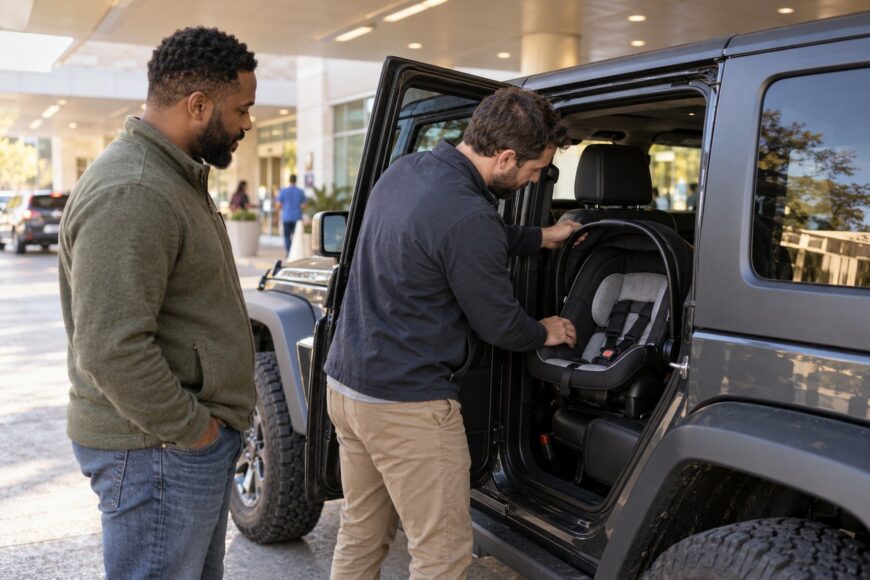
Bringing a newborn home in a Jeep Wrangler can become difficult before the vehicle even leaves the hospital parking area. A rear-facing seat may technically fit, but the door opening can make loading awkward, the carrier may sit high above the ground, or the front seat may need to move so far forward that an adult can no longer sit comfortably.
The answer depends on the specific Wrangler year, configuration, seating position, and car seat. Before the baby arrives, test the actual seat in the actual vehicle, follow both manuals, and rehearse the complete loading routine. A seat approved for your baby’s size still needs to fit the Wrangler’s geometry and leave every occupant in a usable, safe position.
- Choose a rear-facing seat that fits your Wrangler
- Dry-fit the seat before hospital pickup
- Install it securely without assuming LATCH is required
- Buckle your newborn in and check their position
- Plan the first drive around noise, bumps, and temperature
- Make daily loading workable—or reconsider the setup
- Frequently asked questions
- What if my infant car seat has no removable base?
- Where can I have my car-seat installation checked before pickup?
- What is the 3 6 9 rule for babies?
Choose a rear-facing seat that fits your Wrangler
A newborn rides rear-facing in a car seat approved for their size. A suitable rear-facing convertible seat may also be an option if its newborn fit and installation instructions allow it. The harness, recline setting, and infant inserts must all be used as the manufacturer specifies.
An infant carrier can make short trips easier because you can lift the carrier out without necessarily waking the baby. Its base, handle position, shell shape, and required recline can also consume substantial space in a compact rear row. A convertible seat may use the cabin differently, so comparing both types in the vehicle is more useful than choosing by weight range alone.
Wrangler rear-seat geometry, door access, and available anchors vary by year and configuration. A setup that works in a four-door model may be unsuitable in a two-door model, and a different seating position can change both access and front-seat clearance. Check the vehicle manual and car-seat manual for the exact position and installation method.
Do not treat another owner’s successful setup as proof that yours will work. The baby’s size approval addresses the child restraint; it does not establish vehicle compatibility. A dealer or retailer may allow a trial installation, which is worth arranging before the hospital discharge day.
Dry-fit the seat before hospital pickup
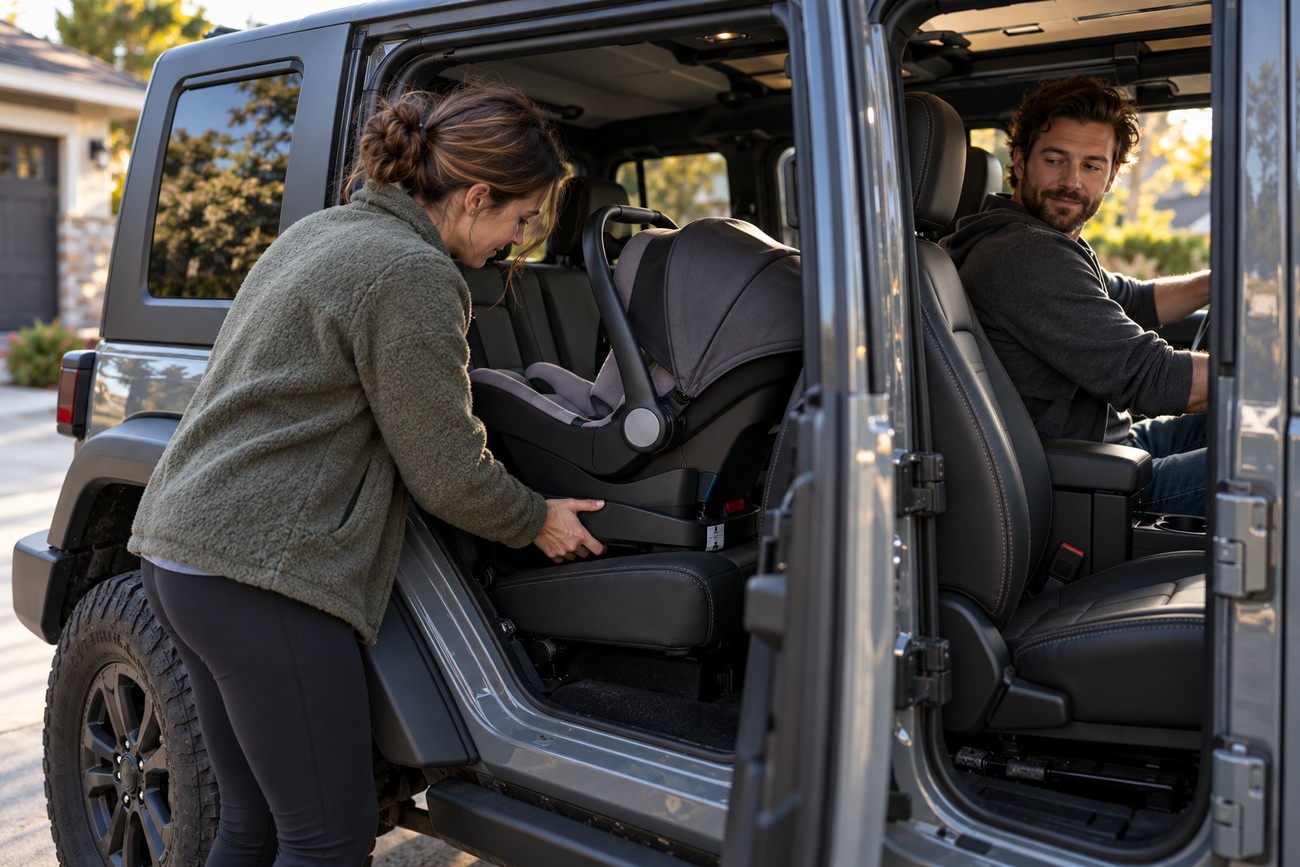
Start with the adults in their real driving and riding positions. Place the car seat in the intended rear position, set the permitted recline, and check whether the front seat remains usable without violating either manual’s clearance instructions. This test matters more than fitting the seat into an empty cabin.
Wrangler rear seats can have short cushions and relatively upright seatbacks. Tight door openings may make it hard to angle a carrier into place or reach the belt path, especially when the rear seat is behind the driver. Practice bringing the carrier through the door, setting it down without striking the vehicle, and reaching the buckle or anchor without forcing your hands into a narrow gap.
Repeat the rehearsal from both sides if possible. Check whether a passenger can enter, whether the driver can see and operate the vehicle normally, and whether the carrier can be removed without twisting your back. Physical fit alone does not establish correct recline, secure installation, infant positioning, or usable front-seat space.
Install it securely without assuming LATCH is required
Choose a permitted rear seating position and one installation method described by both manuals. Depending on the Wrangler year, configuration, and seating position, lower anchors may be limited, difficult to access, or unavailable where you expected them. Read the vehicle manual rather than assuming every rear position has the same hardware.
A vehicle seat-belt installation can be appropriate when the car-seat and vehicle manuals permit it. LATCH is not inherently required, and forcing an awkward anchor setup can create confusion during daily use. Use the belt path identified for that mode, follow the instructions for locking or securing the belt, and avoid combining methods unless the manufacturers specifically allow it.
After installation, check the seat’s recline indicator and its security at the belt path as instructed. Infant-seat guidance is often approximately 30–45 degrees, but the specific seat’s indicator and instructions control. A base that looks level from outside the vehicle may still be at the wrong angle for that particular seat.
Do not correct a poor fit with towels, cushions, or other padding unless the car-seat manufacturer specifically approves the item and placement. If the belt path is inaccessible, the seat cannot reach its required recline, or the installation remains loose after careful work, try another permitted seating position or another compatible seat.
Buckle your newborn in and check their position
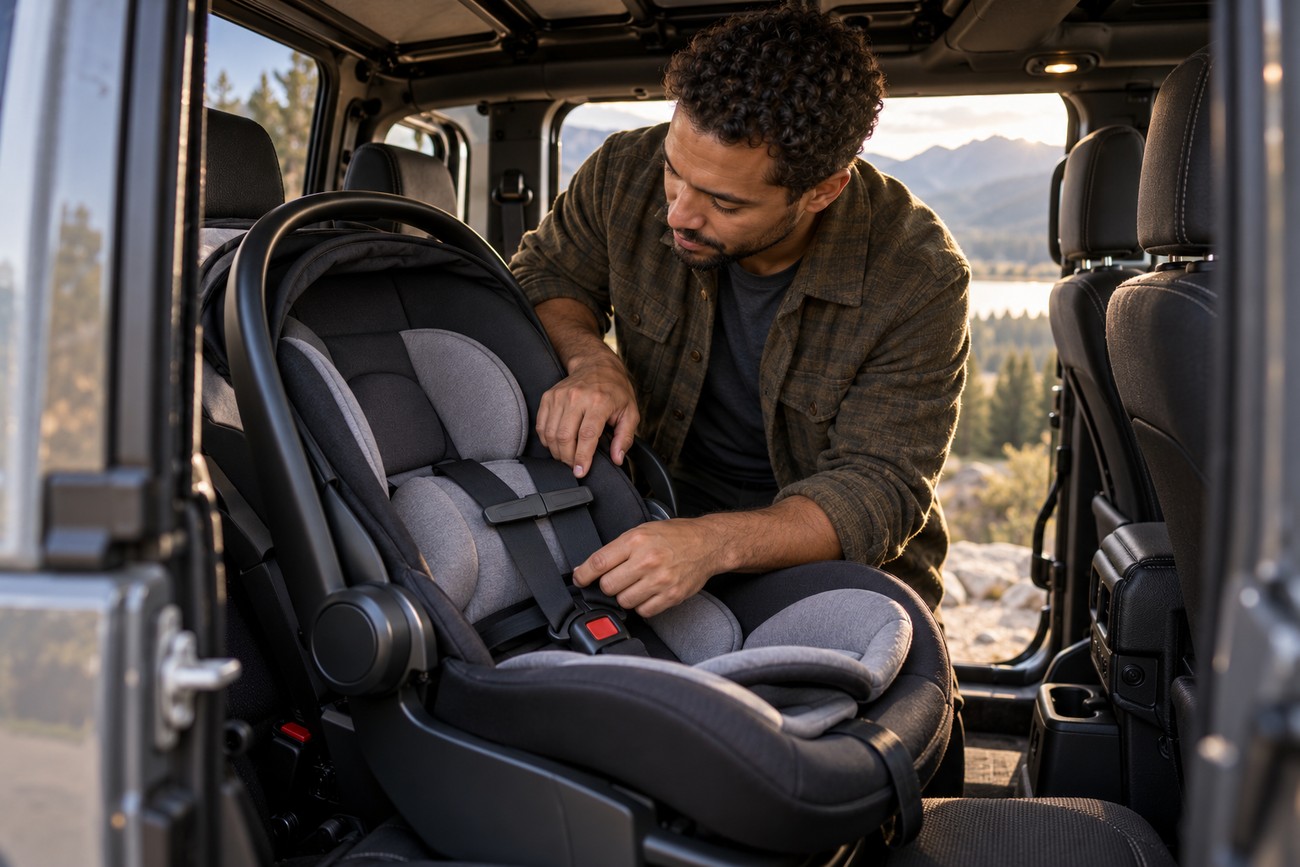
Dress the baby so the harness can lie close to the body. Bulky clothing can interfere with harness tension, so follow the restraint’s instructions for clothing, blankets, and any approved cold-weather arrangement. Use manufacturer-approved infant inserts only when the instructions permit them for that baby’s size and stage.
Adjust the harness so it is snug according to the car-seat manual, with the chest clip or equivalent component positioned as directed. Check that the straps are flat and that the baby’s hips and shoulders are supported. A newborn may look small in the shell, so a visual impression of “plenty of room” is not a reason to add unapproved padding.
Before moving off, look at the baby’s head and chin. An overly upright position can allow the head to fall forward, which is why the recline indicator matters. Guessing at a flatter angle is not a solution; follow the approved recline range and installation instructions for the seat.
Check the baby again at a safe stop, especially after the first few trips. A Wrangler’s movement may unsettle a baby, but ordinary road vibration should not be described as inherently harmful. If the baby’s position needs attention, stop the vehicle fully before touching the harness or seat.
Plan the first drive around noise, bumps, and temperature
Allow extra time for the first loading. Secure the roof panels or soft top as the vehicle instructions require, and choose a straightforward paved route where you can concentrate on driving. An open top or removable panels can increase wind, noise, and temperature exposure, even during a short trip.
Wrangler road noise and a firm ride may wake or unsettle a newborn. That can lead to crying, repeated stops, and rushed decisions at the roadside. Ordinary bumps are not automatically harmful, but they can make a poorly prepared journey harder for both the baby and the driver.
Keep the cabin temperature comfortable and check the baby’s clothing rather than relying on an adult’s comfort. Avoid placing loose items around the car seat, and keep the harness area clear. If the baby becomes upset, pull over safely before checking position, offering comfort, or making any adjustment.
The first journey does not need to be a test of endurance. A short route with a helper in the rear or passenger seat can reveal whether the carrier handle, rear door, climate control, and front-seat position work together. Once the routine is familiar, longer trips become easier to plan without treating a quiet ride as evidence that the installation is correct.
Make daily loading workable—or reconsider the setup
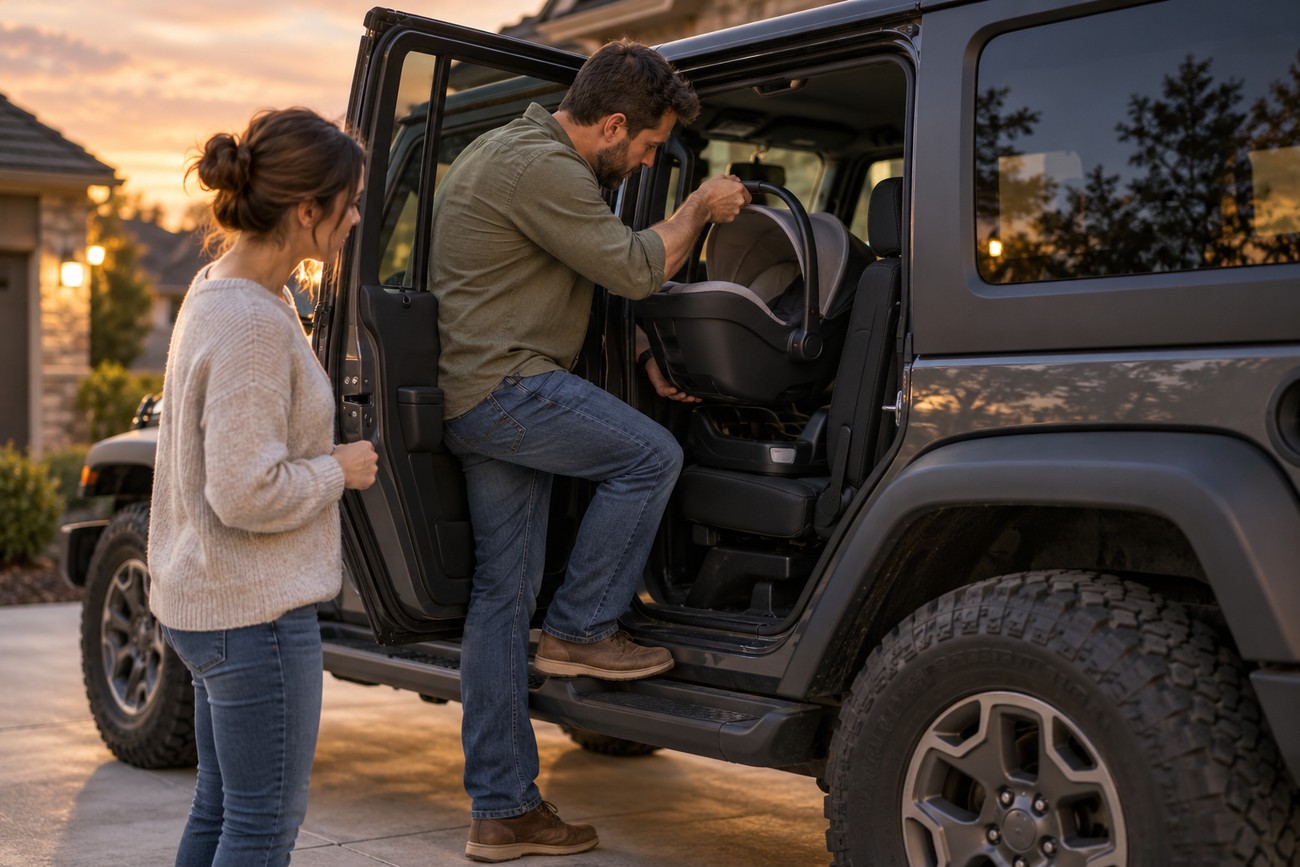
Wrangler ride height can make lifting a newborn into the carrier more demanding than it appears in a showroom. Limited rear-door access may require you to lean in farther, rotate the carrier carefully, or reach across a short cushion. Repeating that movement several times a day can expose problems that a single showroom trial misses.
Practice the entire sequence without the baby: open the door, carry the seat, place or attach it, buckle an imaginary passenger, remove the carrier, and close the vehicle. Then repeat it with the baby and a helper who can watch the door clearance and the baby’s head position. This rehearsal also shows whether the driver can get settled without leaving the car seat in an awkward position.
A practical setup should preserve a comfortable, usable front-seat position and comply with the car-seat and vehicle manuals. A seat that physically fits is not necessarily correctly installed, and a technically secure installation may still be unsuitable if daily loading requires unsafe reaching or leaves the driver unable to sit properly.
If the seat cannot be installed as instructed, the required recline cannot be achieved, or the adults cannot occupy their seats safely, change the setup. Try another compatible seat, another permitted rear position, or another vehicle rather than improvising with padding, altered belt routing, or a front-seat installation that conflicts with the manual or airbag requirements.
Frequently asked questions
The questions below cover baseless installation, installation checks, and the phrase “3 6 9 rule.” For any installation method, follow the instructions for the specific car seat and Wrangler. If someone uses an unfamiliar safety phrase, ask what they mean before applying it.
What if my infant car seat has no removable base?
A baseless installation may be possible only if that specific seat’s instructions allow it. The manual will show the permitted belt routing, recline method, and any required locking procedure. Follow that routing every time the seat is installed; do not assume the belt path used with a base also applies to the carrier alone.
Practice the baseless installation in the Wrangler before the hospital trip. Check that the seat reaches its required recline and that the belt can be tightened without blocking the door or leaving the front seat unusable.
Where can I have my car-seat installation checked before pickup?
Look for a qualified child passenger safety technician or a local child-restraint inspection service. Availability and inspection methods vary by location, so confirm that the service checks both the installation and the baby’s harness fit.
Bring the actual Wrangler, the car-seat manual, and the vehicle manual. A check performed in another vehicle, or without the relevant instructions, may miss differences in seating geometry, belt routing, anchor access, or recline.
What is the 3 6 9 rule for babies?
The “3 6 9 rule” is not a universal child-passenger-safety standard. It may refer to informal guidance about age, weight, or developmental milestones, so its meaning depends on who uses the phrase.
For a newborn, use the specific car seat’s size limits and instructions, keep the baby rear-facing, and follow the vehicle manual. If a clinician or local safety service uses the phrase, ask them to define each number rather than applying it as a substitute for the restraint manufacturer’s guidance.







