
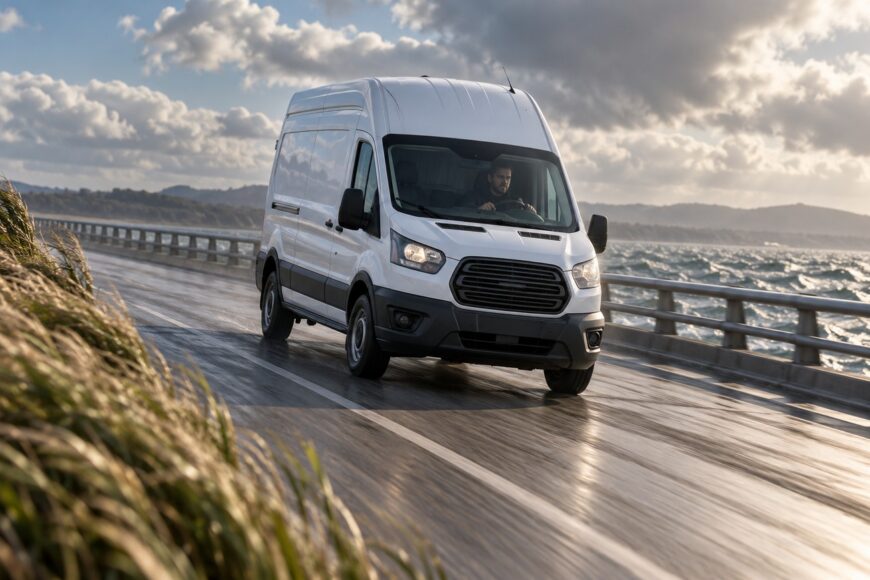
A Ford Transit can feel as though it has been shoved sideways on an exposed bridge, especially when it is empty, passing a truck, or leaving a sheltered section. The movement may arrive as one sharp lane drift, followed by a second correction as the body settles.
A Transit is not automatically unsafe in high winds. Risk depends on the van’s height and side area, total mass, load position, tire condition, speed, roof equipment, and the pattern of the gusts. There is no universal safe wind speed that applies to every Transit configuration and every bridge.
The practical decision is to treat exposed bridges as changing conditions rather than ordinary straight road. Check warnings and gust information, slow down before the open section, leave room around the van, and be ready to delay the crossing if the conditions exceed your confidence or the posted restrictions.
- Why a Ford Transit Sways More on an Open Bridge
- What Actually Determines Transit Crosswind Risk
- The Bridge Moments Drivers Underestimate
- Common Mistakes That Turn a Gust Into a Near Miss
- How to Drive a Ford Transit Across a Windy Bridge
- What ESC Can—and Cannot—Do in Crosswinds
- Frequently asked questions
- What are the most common problems with Ford Transit vans besides crosswind sway?
- What vehicle is most affected by high winds?
- Should I use cruise control when driving a Ford Transit across a windy bridge?
- How can I tell whether a Transit sway is caused by wind or a mechanical problem?
Why a Ford Transit Sways More on an Open Bridge
A high-roof Transit presents a broad, relatively flat side profile to the wind. That sail area, combined with a relatively high center of pressure, gives a gust more leverage over the body than it would have over a low passenger car. This is a design characteristic of a tall van, not automatically a defect in the vehicle.
Side-wind force grows approximately with the square of wind speed. Under comparable conditions, doubling wind speed increases aerodynamic force by roughly four times. A short gust can therefore produce a much sharper response than the reported average wind speed suggests.
Open bridge decks usually provide less shielding from buildings, trees, embankments, or sound barriers. Airflow can also accelerate and become uneven across the deck, so a local gust may be stronger than the area’s reported average wind.
From the driver’s seat, this often feels like a sudden pull toward the next lane rather than a gradual change in direction. The driver may correct once, then feel a second movement as the suspension and tires respond. The critical input is frequently the brief gust at the bridge edge, rather than the steady wind felt on the approach.
What Actually Determines Transit Crosswind Risk
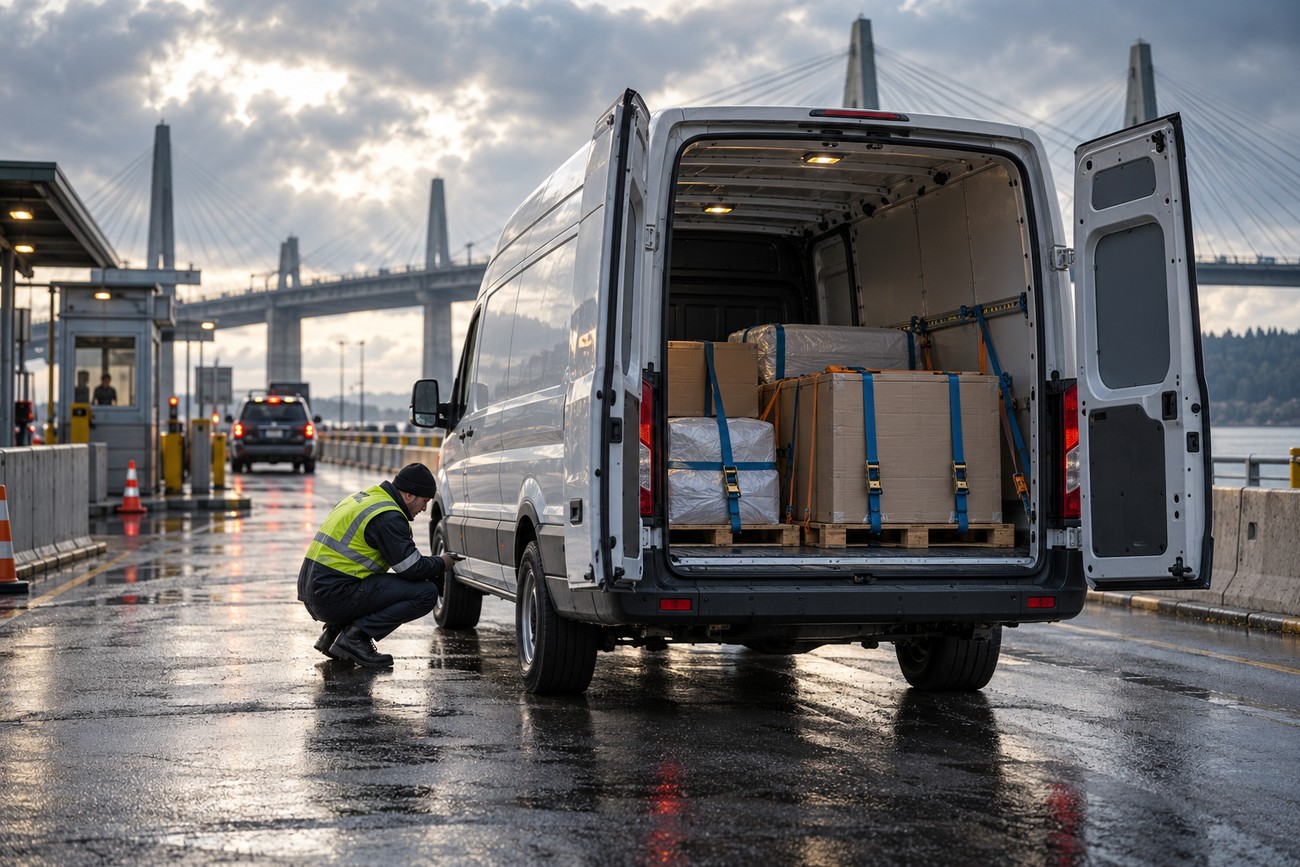
The Transit badge gives little useful information about crosswind behavior by itself. Wheelbase, body length, roof height, drivetrain, total mass, tire condition, load position, and added equipment all affect how the van responds. Short- and long-wheelbase models, low- and high-roof versions, and differently equipped vans can feel substantially different in the same wind.
A partially or properly loaded van is usually less accelerated by gusts than an empty van because additional mass reduces the initial movement. The load needs to be low, evenly distributed, and secured. Maximum gross weight does not automatically make a van safer if the load is concentrated high in the body or close to the roof.
Roof racks, ladders, antennas, and other elevated equipment can increase effective side area and raise the center of gravity. A ladder or rack may seem small compared with the van’s body, yet it can change the airflow and add leverage at the highest point. Loose equipment also creates a separate safety risk if the wind catches it.
Tires matter especially on an empty van. Correct pressure and good condition help the tires respond predictably; underinflation can increase roll and delay the vehicle’s reaction to a gust. Check the pressure against the vehicle’s specified load setting, inspect for damage, and account for the actual load rather than relying on a generic assumption.
The Bridge Moments Drivers Underestimate
The bridge entrance and exit can be more troublesome than the middle. A van may move from a sheltered approach into exposed airflow in a moment, or pass the end of a noise barrier and receive a sudden side impact. The change in shielding can create a stronger surprise than the steady wind across the center of the deck.
Large trucks add another layer of turbulence. A passing or meeting truck can briefly change the pressure around the Transit, then expose it to the open wind as the truck clears. The event may feel like a push toward the truck followed by a push away, especially when the van is already traveling close to the lane edge.
An angled gust can create two sensations at once: lateral displacement and a rocking or unloading feeling as pressure changes across the body. Drivers sometimes describe this as the van being pushed and lifted on one side. That sensation does not necessarily indicate a suspension failure, although persistent symptoms away from windy locations deserve inspection.
Cruise control can feel uncomfortable in these conditions because the driver may need immediate authority over speed. Traffic compression, a truck-passing event, or a new gust can call for a small reduction before the system’s set speed is helpful. Manual speed control also makes it easier to slow before the exposed section instead of reacting after the van has already moved.
Common Mistakes That Turn a Gust Into a Near Miss
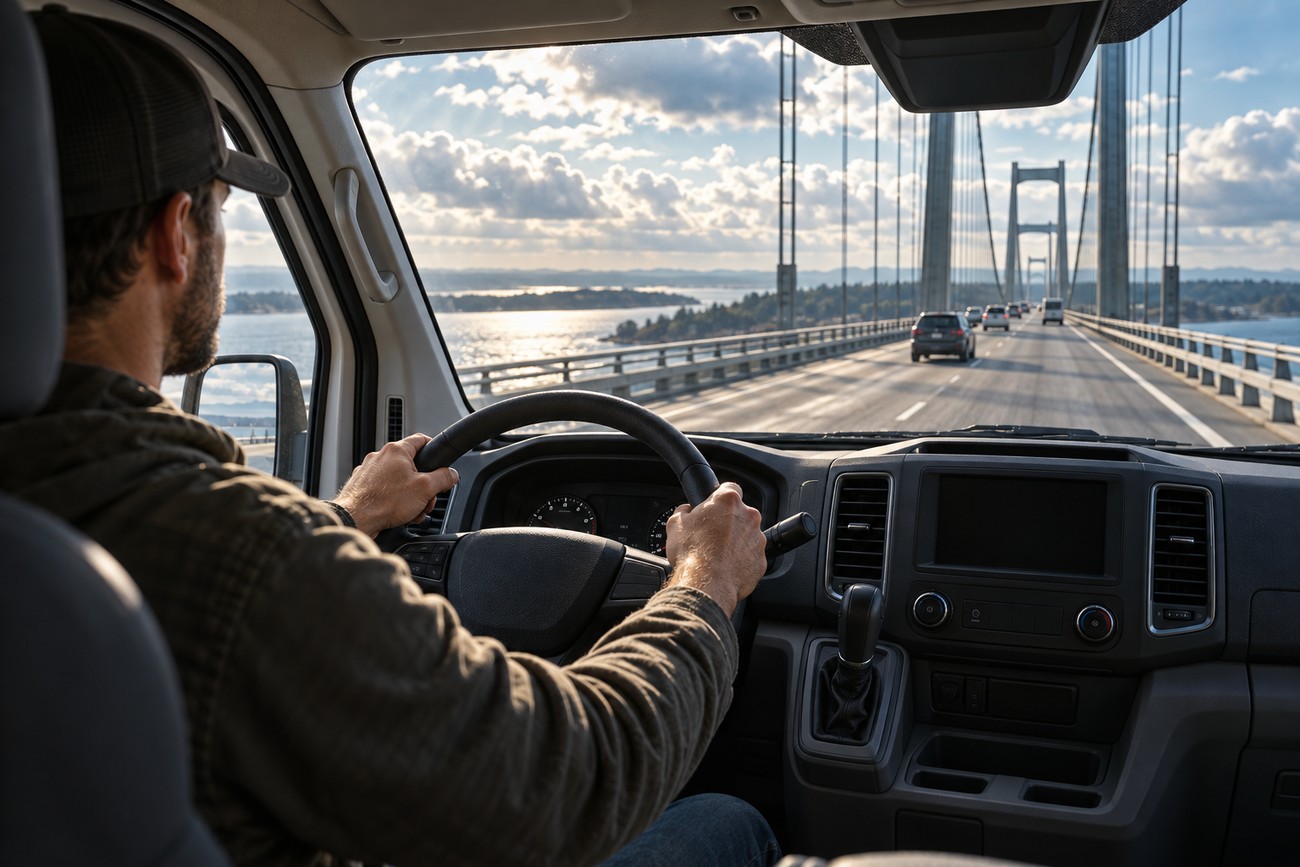
Entering an exposed bridge at normal motorway speed leaves less time to respond and increases the severity of the vehicle’s movement. Reduce speed before the gust zone, while the van is still sheltered and stable. Waiting for the first shove often leads to a hurried steering correction.
One-handed steering reduces the margin for a sudden lateral movement, particularly when the driver is also adjusting speed or checking mirrors. Keep both hands on the wheel and use smooth, modest corrections. Large, late steering inputs can turn a brief drift into a more serious swerve.
Warnings for high vehicles, empty commercial vans, or strong crosswinds deserve the same attention as other bridge restrictions. A full van is not automatically safe if its load is high, poorly secured, or concentrated near the roof. Roof loading can worsen the response even when the van feels heavier overall.
A van that tracks straight in calm weather has demonstrated straight-line stability, not guaranteed gust resilience. Wind introduces short, changing forces that test the tires, suspension, steering input, and driver reaction together. Avoid unnecessary overtaking in the exposed area, and leave enough space to correct without immediately entering another lane.
How to Drive a Ford Transit Across a Windy Bridge
Start with the information available before entering the bridge. Read the posted warning, check the stated vehicle category, and look for crosswind or gust information rather than relying only on the general weather forecast. Commercial bridge warnings are commonly based on measured crosswind, gusts, and vehicle category rather than the Transit badge alone.
Reduce speed before the exposed section and keep both hands on the wheel. Hold a relaxed, steady line, leave space from adjacent traffic, and avoid abrupt steering, braking, or acceleration. Lower speed reduces the severity of the vehicle’s response and gives you more time to correct.
Reduce speed before the exposed section and avoid overtaking there because a gust can move the van before a late reaction is possible. The safest correction is usually a small steering input made with room around the vehicle.
Keep extra distance from trucks and avoid passing where the bridge is most exposed. If a truck is approaching, expect a short pressure change and keep the van centered in its lane without chasing every small movement. A steady grip and a clear escape space are more useful than trying to hold an exact steering angle.
Before the trip, check tire pressures, tire condition, load security, roof racks, ladders, and other equipment. Confirm that doors and external fittings are secure, and remove unnecessary high or loose items. If warnings indicate restrictions, the van is empty and lightly equipped, or the gusts are producing repeated lane movement, delay the crossing, stop in a safe location, or choose another route where possible.
What ESC Can—and Cannot—Do in Crosswinds
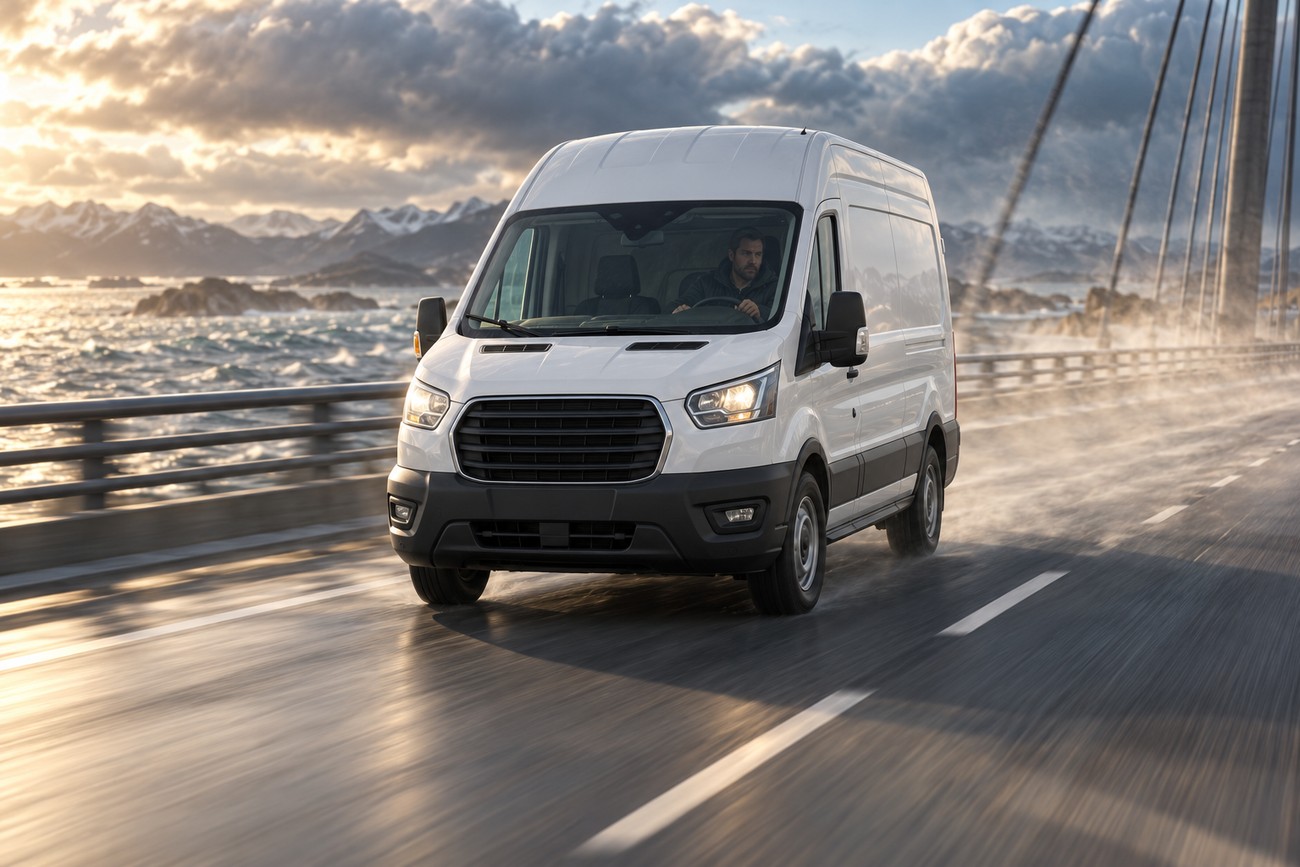
Electronic stability control, also called ESC or ESP, can help correct an emerging loss of course or stability after the vehicle begins to deviate. It may brake individual wheels or reduce engine torque when the system detects a swerve, wheel slip, or related instability.
The system cannot remove aerodynamic side force, prevent every body movement, or guarantee control in any wind. A gust can move the van without producing the wheel-speed or yaw conditions needed for a strong intervention. Body roll and lane displacement may therefore remain noticeable even when the system is functioning correctly.
Use ESC as a supporting system rather than a wind rating. Speed, tire condition, load position, steering control, and route judgment still determine the available margin. If a warning calls for restrictions or the driver cannot maintain a stable lane position, electronic assistance is not a reason to continue.
There is no universal manufacturer-published safe wind-speed limit that applies to every Ford Transit configuration. Bridge thresholds also vary by country, bridge, measurement method, and vehicle category. In some regions, commercial bridge warnings for vans may begin around 15–20 m/s gusts, but that range is only indicative and should never replace the local warning.
Frequently asked questions
What are the most common problems with Ford Transit vans besides crosswind sway?
Many ownership concerns are configuration-dependent rather than universal Transit defects. Loading practices, tire pressure, tire wear, roof equipment, and the condition of steering or suspension components can all affect how the van feels. Driver-assistance systems also have limits: they support control during an emerging problem and do not replace correct loading or maintenance.
A useful distinction is whether a complaint changes with the load or equipment. A van that feels different after a roof rack is fitted or after heavy cargo is placed high may need a setup review. Persistent pulling, vibration, uneven tire wear, or wandering on calm roads deserves a mechanical inspection instead of being attributed to wind.
What vehicle is most affected by high winds?
High-sided, lightly loaded vehicles with a large flat profile and a high center of gravity are generally more sensitive to gusts than low, wide passenger cars. The relevant comparison includes height, side area, total mass, load distribution, tire condition, and roof equipment.
There is no single model that is always the most affected. A lightly loaded high-roof Transit with roof equipment may respond more sharply than a heavier van with a low, secure load, while a different Transit configuration may behave differently again. Exposure and setup matter more than a simple model ranking.
Should I use cruise control when driving a Ford Transit across a windy bridge?
Manual speed control can give you more immediate authority to slow during a gust, traffic compression, or a truck-passing event. Cruise control is not automatically unsafe, yet many drivers find it less comfortable when speed needs to change quickly on an exposed bridge.
If conditions are unsettled, approach at a controlled speed and remain ready to disengage the system smoothly. Do not use cruise control to maintain speed through a warning area where reducing speed or abandoning the crossing would be the safer decision.
How can I tell whether a Transit sway is caused by wind or a mechanical problem?
Wind-related movement usually appears in exposed locations, changes with gust direction, and may occur when passing a truck or leaving a barrier. It often disappears on sheltered roads or in calm conditions. The timing and location provide useful clues.
Persistent pulling, wandering, vibration, uneven response, or steering that remains off-center on calm roads points toward a possible tire, alignment, steering, suspension, or load issue. Stop using the van for exposed high-speed travel until the cause is checked if the behavior is severe, new, or accompanied by unusual noise or warning lights.







