
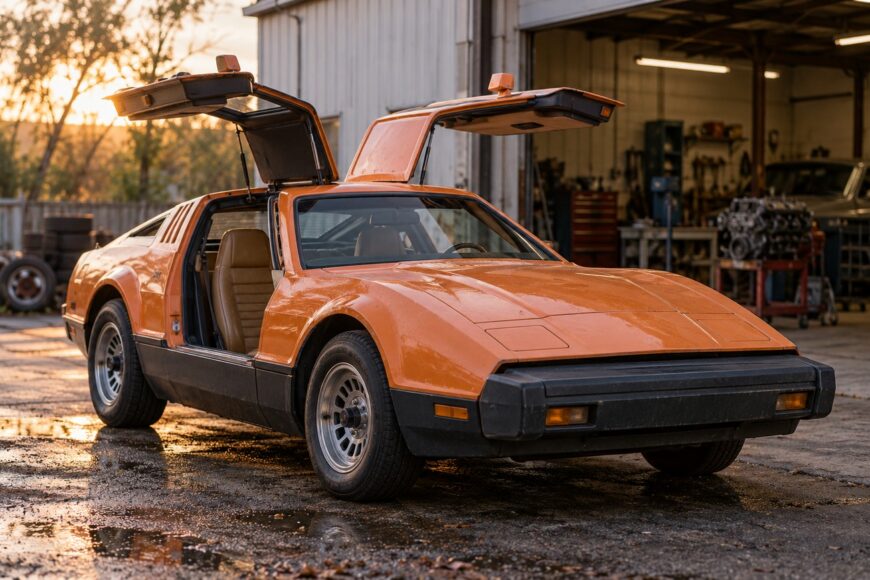
The Bricklin SV-1 promised a safer sports car with a futuristic silhouette and gullwing doors. Today, those same doors can be difficult to align, its composite panels can conceal trouble in the steel beneath, and missing model-specific parts can stall a restoration. Its striking appearance tells a buyer little about how well it has survived.
Rarity is only the starting point. The useful question is whether a particular SV-1 has sound door and body geometry, a credible history, and a realistic path to repair. A polished car with undocumented structural work may be a harder purchase than a worn example whose faults are visible and whose parts are complete.
- Why the Bricklin SV-1 Still Matters
- How the Safety-Car Idea Shaped the SV-1
- The V8, Weight, and Real-World Driving Experience
- The Expensive Trouble Spots: Doors, Body, and Hidden Metal
- What Buyers Get Wrong About a Rare SV-1
- Bricklin SV-1 Pre-Purchase Inspection: What to Check First
- Why the Bricklin Failed—and Why Rarity Costs More Today
- Frequently asked questions
- What is the average price of a Bricklin SV-1?
- What was the first car with gullwing doors?
- How should I verify a Bricklin SV-1 before buying it?
Why the Bricklin SV-1 Still Matters
SV-1 stands for Safety Vehicle 1. Produced from 1974 to 1976, it presented a safety-oriented take on the American sports car rather than a conventional performance coupe. Its gullwing profile made that ambition visible before anyone opened a door or started the engine.
Approximately 2,850–2,854 cars were built; sources vary slightly on the total. The short run gives the SV-1 a distinct place in automotive history, and collectors often value it for rarity and historical status more than outright performance. Those qualities explain the interest in a surviving car, though they do not make it easier to maintain.
Factory specification is only part of a surviving SV-1’s story. Decades of storage, repairs, and parts substitutions can have more influence on its present condition than the details it left the factory with. A carefully documented restoration with correct geometry may therefore be more compelling than apparent originality that has never been examined closely.
How the Safety-Car Idea Shaped the SV-1
The SV-1’s construction reflects its safety-oriented concept: acrylic/ABS composite body panels are paired with an integrated steel frame. That combination gave the car a different character from a conventional all-metal coupe. It also created two distinct inspection jobs, because a sound-looking outer panel says little about the metal behind it.
Its gullwing doors lift upward and remain the car’s defining visual feature. Their weight and mechanism make them more demanding than ordinary side-hinged doors, while their opening path needs sufficient clearance in a tight parking space or garage. Owners must consider where the car can be parked as well as how it looks with the doors raised.
The substantial construction contributes to a car that feels more focused on its original concept than on light, agile driving. Yet the word “safety” needs its period context. The SV-1 was safety-oriented for its 1970s concept; it should not be treated as equivalent to a modern passive-safety standard.
The V8, Weight, and Real-World Driving Experience
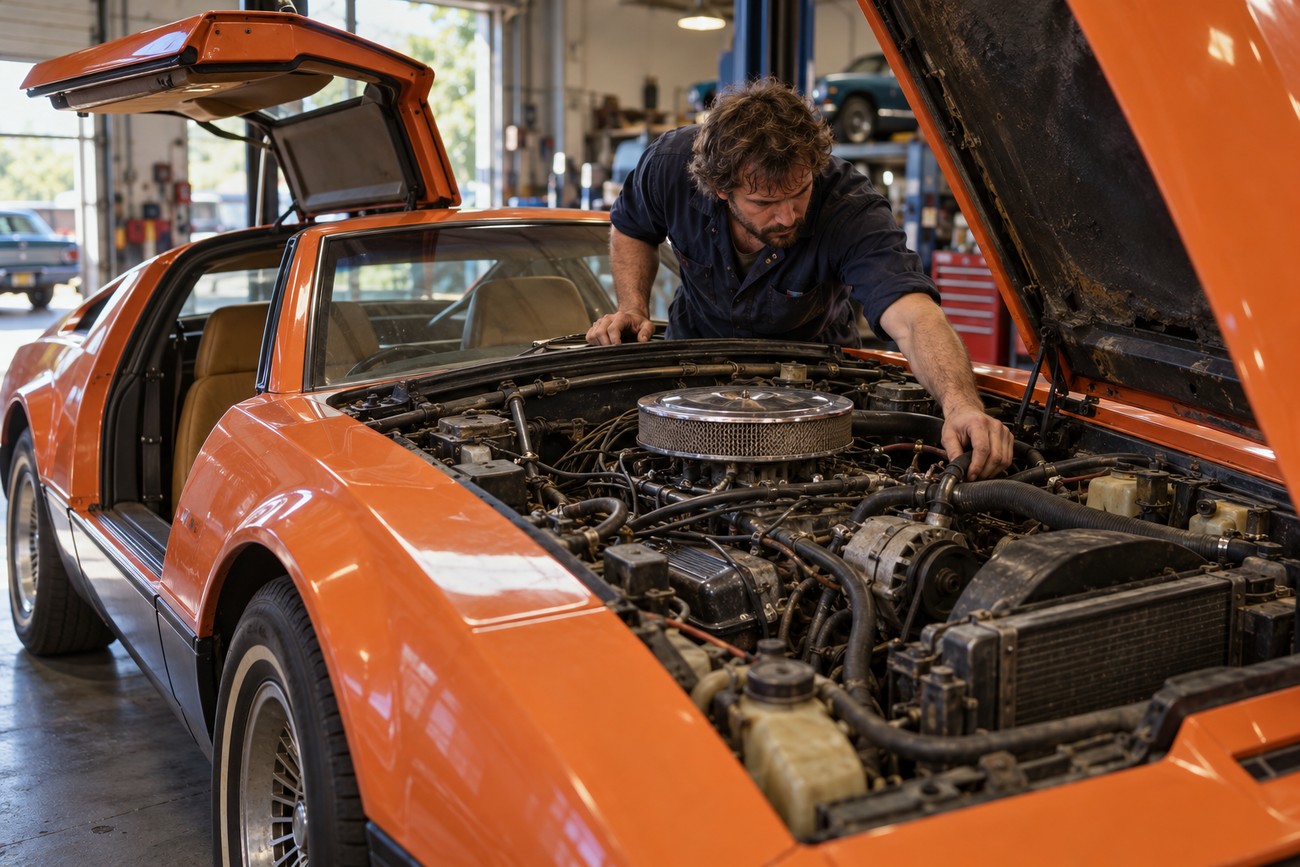
Commonly encountered SV-1 engines include the Ford 351 Windsor and AMC 360, depending on year and market. The V8 sound and dramatic body suggest a forceful sports car, but the SV-1 is heavier and less performance-focused than a typical sports car of its era. A test drive is most useful when judged against that character rather than the promise made by its shape.
Packaging matters as much as the engine badge. Tight engine-bay access can complicate routine maintenance and make it harder to see the quality of earlier work. A car that starts cleanly and drives well for a few minutes still needs a thorough mechanical inspection.
Cooling deserves particular attention where repairs or modifications have accumulated. Inadequate work can leave heat-management problems that emerge only once the car is fully warm. Ask what was changed, inspect the installation, and assess the cooling system during a sustained drive rather than accepting a brief idle test.
The Expensive Trouble Spots: Doors, Body, and Hidden Metal
Start with the doors. Tired hinges or dampers can affect operating effort, while poor alignment can disturb the fit of the panels and seals. Watch each door open and close repeatedly, check its position when shut, and look for signs that someone has adjusted around a deeper problem.
Repeatable door operation matters more than fresh paint: a door that lands differently on successive closures can point toward hinge, frame, seal, or previous-repair issues that cosmetic work will not resolve.
Composite panels resist ordinary body-panel rust, but they can crack, deform, leak, or develop poor fit. Squeaks and shifting gaps deserve attention alongside visible damage. Repair can involve difficult matching of geometry, texture, and color, so a seemingly small defect may demand more than a local cosmetic fix.
The integrated steel frame and concealed metal components can still corrode. Inspection has to reach beyond the clean exterior, especially around areas where moisture or earlier repairs may have hidden deterioration. A plastic outer skin is no guarantee of a sound structure.
Previous work often complicates the diagnosis. A door seal, panel, or mounting point may have been altered to compensate for another fault, leaving a later restorer to unravel several layers of repair. Specialized panels, trim, interior pieces, and hardware can be scarce; some replacements may depend on a donor car or low-volume fabrication.
What Buyers Get Wrong About a Rare SV-1
Photographs are a poor test of gullwing alignment. They can show an attractive stance while concealing uneven gaps, heavy operation, or a door that does not seal. Before committing to a car, see both doors operated in person or arrange a knowledgeable independent inspection.
The next mistake is to equate composite panels with freedom from corrosion. The outer body may look clean while the integrated steel frame or concealed metal has deteriorated. Inspection should follow the load-bearing structure and mounting areas, rather than stop at the finish.
Cosmetic shine can also obscure the difference between preservation and originality. A car may retain old-looking parts yet have undocumented modifications; another may have replacement components installed carefully as part of a credible restoration. Condition, repair quality, correct geometry, and records provide a stronger basis for judgment than either label alone.
Finally, check the car’s identification and paperwork before treating any deal as settled. Inconsistent numbers or an incomplete history can complicate registration and eventual resale. Records of earlier repairs and parts changes help establish what you are buying and what may still need correction.
Bricklin SV-1 Pre-Purchase Inspection: What to Check First
Inspect the doors and structure before judging the paint. Ask for evidence that repairs work in use, rather than accepting a tidy appearance as proof.
| Inspection area | Typical failure | Why it matters | Evidence to seek |
|---|---|---|---|
| Gullwing doors | Tired hinges or dampers, heavy operation, poor alignment, or failed seals | Faults affect access, weather protection, and restoration scope | Repeated opening and closing of both doors; consistent gaps and seal contact |
| Steel frame and concealed metal | Corrosion or questionable earlier structural work | Clean composite panels can hide consequential damage | Close physical inspection and records of any structural repairs |
| Composite panels and fit | Cracks, distortion, leaks, or poorly matched repairs | Restoring geometry, texture, and color may be difficult | Inspection of panel gaps, surfaces, water-entry signs, and repair photographs |
| Engine bay and cooling | Crowded access, inadequate modifications, or overheating | Mechanical work may be harder than a brief test suggests | Repair records, inspection of installations, and a fully warm test drive |
| Identity, records, and parts | Inconsistent paperwork or missing specialized components | Registration, resale, and completion of repairs can become difficult | Matching identification and documents, restoration history, and an inventory of missing parts |
Why the Bricklin Failed—and Why Rarity Costs More Today
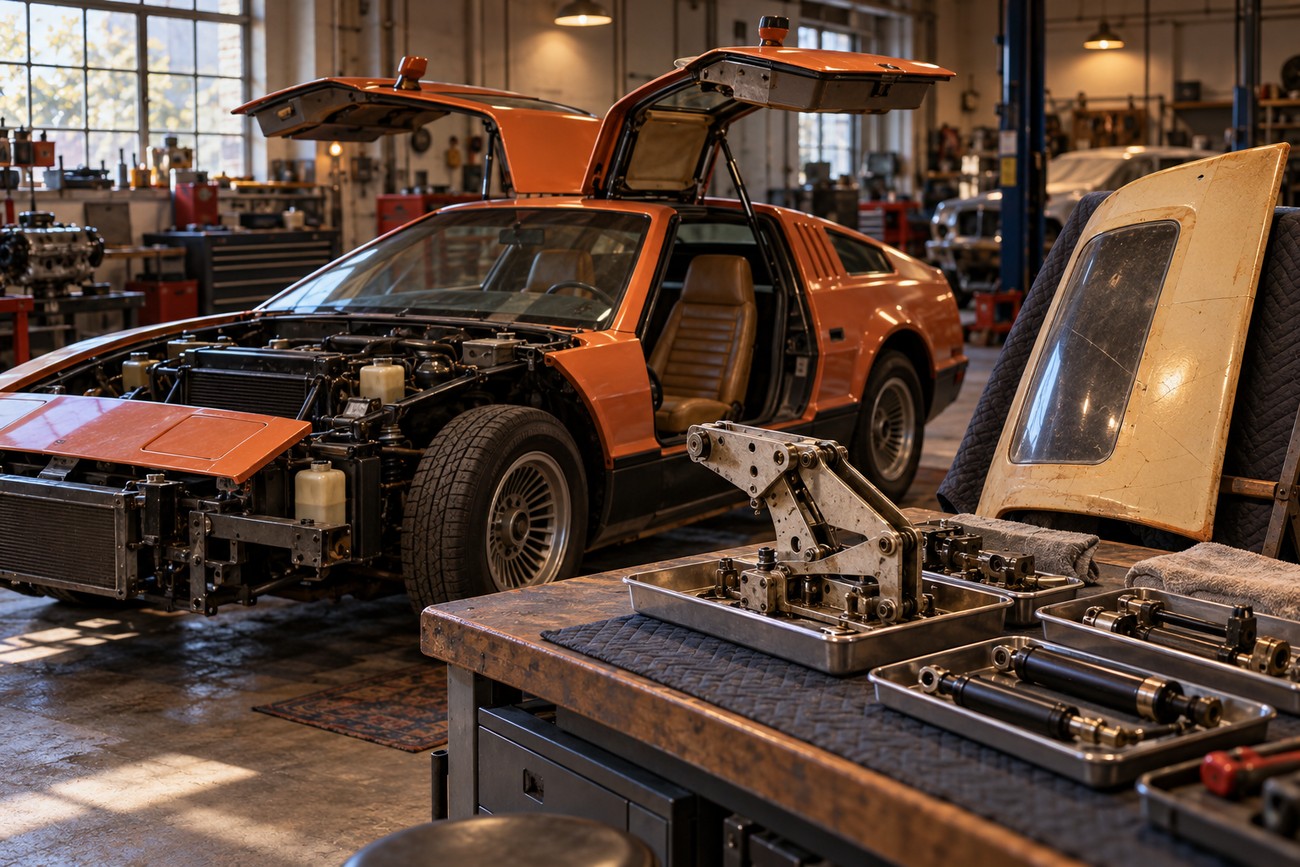
The SV-1’s production ended in 1976 after a short commercial life. That outcome left far fewer cars and specialized components in circulation than a long-running model would have. It also limited the pool of repair knowledge available to a buyer decades later.
Body panels, door hardware, and interior pieces can be harder to source than familiar V8 service items. Where an original component is unavailable, a restoration may depend on finding a donor part or arranging low-volume fabrication. Either route requires planning before a buyer assumes a damaged car is complete enough to restore.
Earlier owners may have solved shortages in different ways, and those solutions do not always work well together. A fresh restoration estimate should account for investigating old repairs as well as correcting visible faults. This is why an inexpensive-looking project can demand substantially more work than its surface condition suggests.
Collectors may reasonably value the SV-1 for the ambition and rarity of its 1970s safety-car concept. Ownership is more satisfying when that historical interest is matched by a sound, documented example and access to appropriate repair help. Rarity adds to the car’s appeal; it does not reduce its maintenance needs.
Frequently asked questions
These buying questions are best answered with a specific car in view. Price, usability, and even an apparently straightforward description depend on evidence that can be checked before purchase.
What is the average price of a Bricklin SV-1?
There is no single dependable average price that represents all SV-1s. Door geometry, structural condition, restoration quality, documentation, and the completeness of scarce parts can make two outwardly similar cars very different purchases. Compare individual cars by the work they need and the evidence supporting their condition, rather than relying on one headline figure.
What was the first car with gullwing doors?
The Mercedes-Benz 300 SL is widely credited as the first famous production car with gullwing doors. The Bricklin SV-1 came later and used the layout as part of its own 1970s safety-car identity. Shared door terminology does not imply the cars have the same construction or ownership demands.
How should I verify a Bricklin SV-1 before buying it?
Match the car’s identification numbers to its paperwork, then trace its ownership and restoration records as far as possible. Confirm that the engine and body configuration agree with the description, request photographs or invoices for substantial repairs, and list unresolved defects before negotiating. If the records or numbers conflict, clarify them before purchase rather than leaving them for registration or resale.







