
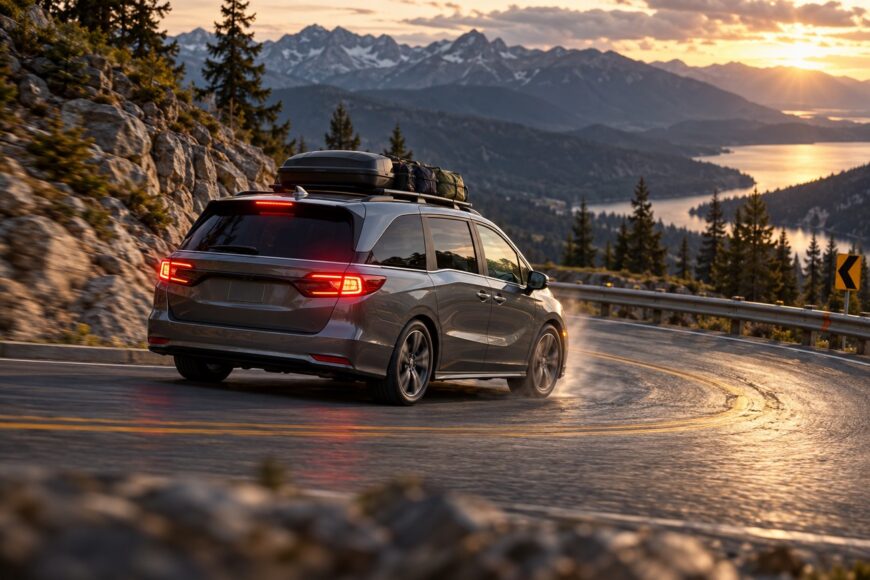
The unsettling moment comes after the long descent: the Honda Odyssey still has pedal travel, yet it slows much less than it did at the top of the pass. After sitting for a while, the brakes may feel normal again. That pattern is consistent with heat-related brake fade, although it does not prove that every component has escaped damage.
A heavily loaded family minivan places a substantial energy demand on its brakes during repeated downhill stops. Speed, grade length, passengers, luggage, towing, pad condition, and brake-fluid condition all affect how quickly heat accumulates. Safe descent technique can reduce that load, while a careful inspection is needed if braking has already deteriorated.
- What Brake Fade Feels Like in a Honda Odyssey
- Why a Heavy Odyssey Can Overheat Its Brakes on a Pass
- The Safer Way to Descend in an Odyssey
- What to Do When the Brakes Start Fading
- Inspection and Repair Priorities Before the Next Mountain Trip
- Common Myths About Odyssey Brakes in the Mountains
- Frequently asked questions
- When driving in mountain conditions, what exactly causes brake fade?
- What are the claims in a Honda Odyssey brake class action lawsuit?
- How can I tell whether a mountain-pass brake problem is fade or a hydraulic failure?
What Brake Fade Feels Like in a Honda Odyssey
Brake fade usually feels like a loss of stopping authority rather than an instant mechanical failure. You press the pedal with familiar effort, but the Odyssey takes longer to slow, especially after several braking events on a steep road. The pedal may remain reasonably firm while the vehicle responds weakly, which differs from a hydraulic system that has lost pressure.
One Odyssey owner reported temporary loss of braking effectiveness after a descent, followed by normal operation after approximately 30 minutes of cooling. That is a useful clue because cooling can restore friction performance after overheating. It is an anecdotal observation, however, and 30 minutes is not a guaranteed safe recovery interval for another vehicle, load, or weather condition.
A soft or sinking pedal changes the concern. It can indicate overheated or aerated fluid, a leak, a hydraulic fault, or another problem that cannot be diagnosed as ordinary pad fade from the driver’s seat. A strong burning odor, smoke, grinding, or fluid loss also warrants stopping and inspection rather than continuing to see whether the brakes improve.
Vibration adds another layer. A shaking steering wheel or front end under braking may accompany rotor or pad problems, but front vibration can also involve a driveshaft, CV joint, wheel, or suspension component. Treating every mountain-pass symptom as “just fade” can leave a second safety problem unaddressed.
Why a Heavy Odyssey Can Overheat Its Brakes on a Pass
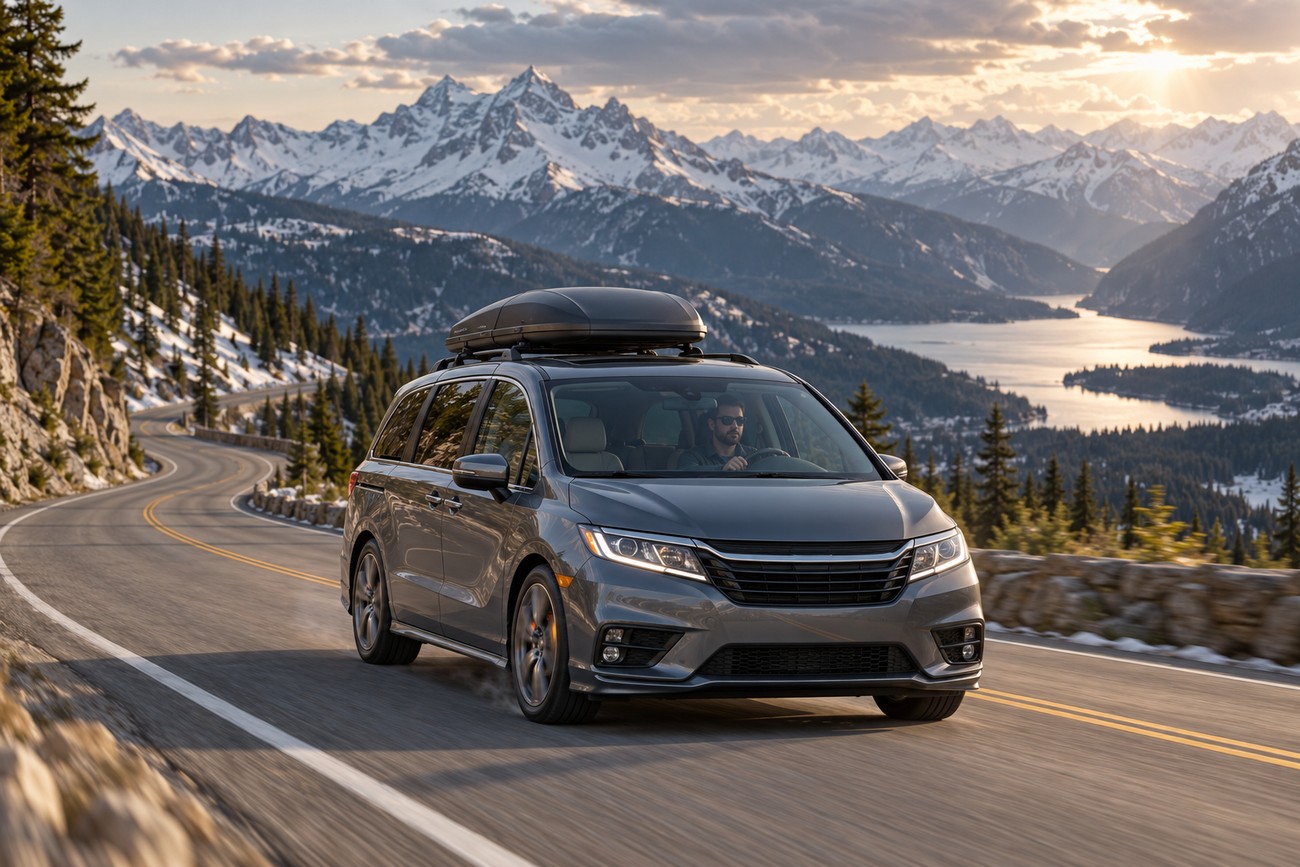
Every downhill braking event converts vehicle motion into heat. A full Odyssey carrying passengers and luggage has more energy to dissipate than an unloaded vehicle, and towing or added cargo increases the demand further. A long grade, high entry speed, and repeated braking leave less time for the rotors and pads to release that heat.
Modern Honda Odyssey versions are commonly listed with four-wheel disc brakes, and many use ventilated front rotors with rear disc brakes. Those arrangements improve heat management, yet they do not make a prolonged, loaded descent immune to fade. Exact rotor dimensions, thickness, and caliper configurations vary by generation and trim, so one Odyssey cannot be treated as mechanically identical to another.
ABS, EBD, traction control, and brake assist can support control or braking input. They do not prevent thermal fade or increase the heat capacity of the pad-and-rotor friction pair. Electronic assistance may help you maintain control during a hard stop, but it cannot remove heat already stored in the friction material, rotor, caliper, or fluid.
Some Odyssey specifications are associated with approximately 155 mm of ground clearance and a long wheelbase. Those characteristics affect vehicle geometry and road clearance; they do not create extra brake heat capacity. The practical issue is the combination of minivan mass, road grade, load, speed, and the condition of the particular brake system.
The Safer Way to Descend in an Odyssey
Select a lower gear before the descent begins, using the range appropriate to your specific Odyssey and the road conditions. Engine braking should help control speed so the service brakes do not carry the entire load. Enter the grade at a controlled speed rather than building speed and trying to remove it repeatedly with the pedal.
On a sustained descent, short, firm braking applications followed by release periods generally produce less continuous friction heat than riding the brake pedal. The release periods give the rotors and pads an opportunity to shed heat. The exact timing depends on the grade, traffic, weather, load, and available pull-offs, so no single speed or gear is safe for every mountain pass.
Do not accelerate strongly between braking events and then compensate with a longer pedal application. That pattern can create large heat spikes while making speed harder to manage. Wet roads, limited visibility, a full passenger compartment, cargo, and a trailer all justify a more conservative entry speed and greater following distance.
ABS and brake assist are safety aids, not a descent strategy. They do not replace engine braking, controlled speed, or a planned stop if the brakes begin to smell, fade, or feel different. If the road provides a safe turnout, using it early is preferable to waiting until braking performance has deteriorated sharply.
What to Do When the Brakes Start Fading
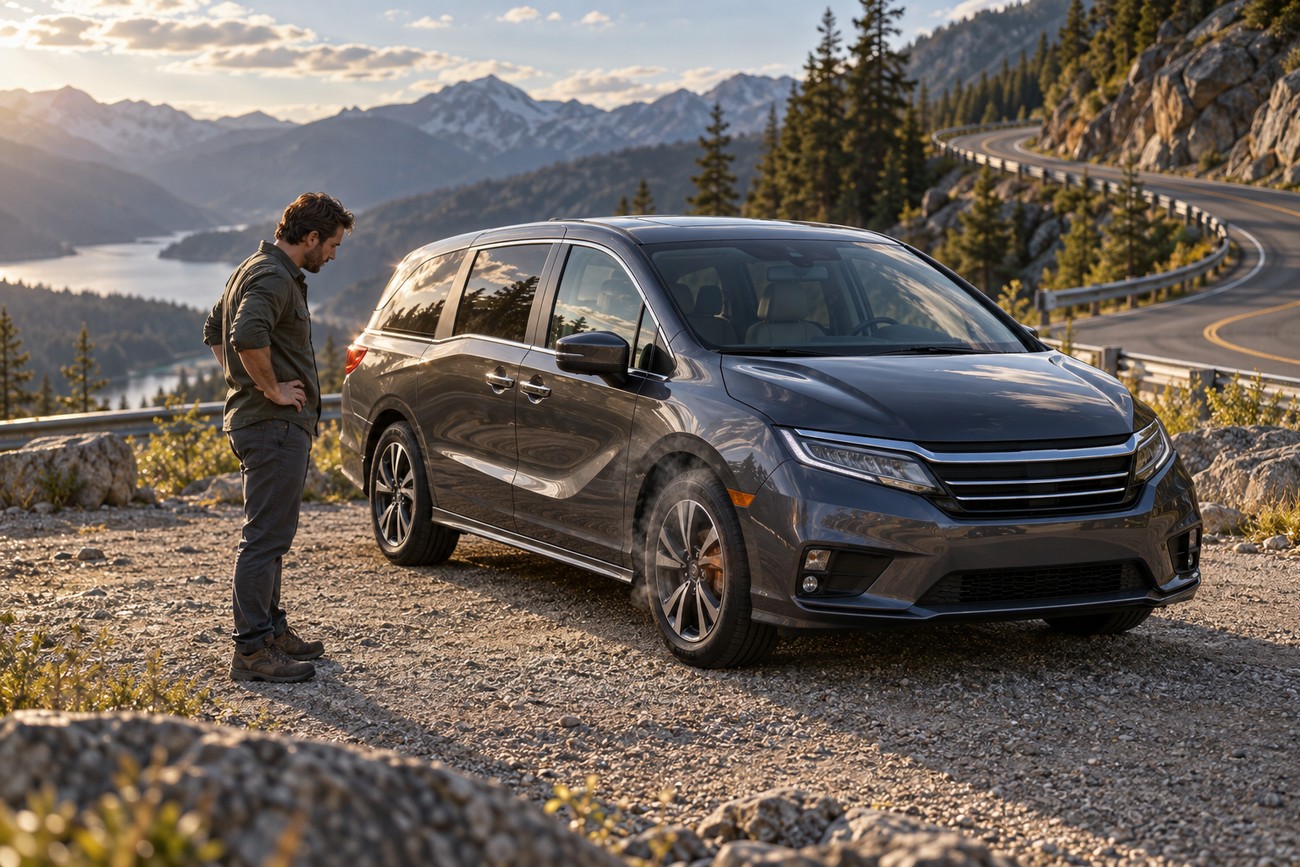
Reduce speed smoothly and stop using continuous pedal pressure. Select an appropriate lower gear, maintain a safe line, and move to a suitable pull-off when one is available. Avoid abrupt maneuvers, but treat the change in braking performance as an immediate safety problem rather than a minor inconvenience.
Allow the system to cool without touching the rotors, calipers, or other hot components. Never pour water on hot brakes; rapid temperature change can damage components, and steam or splashing can create additional hazards. A cooling stop may restore pedal feel temporarily, but it does not confirm that pads, rotors, calipers, or fluid remain undamaged.
Continuing downhill to “test” the brakes is dangerous. Stop driving and arrange a professional inspection if the pedal stays low, smoke is visible, the burning odor is strong or persistent, fluid is leaking, grinding occurs, or severe vibration remains. A vehicle with uncertain braking should generally be towed rather than driven onward, particularly on another descent.
If braking seems normal after a pause, drive only if the vehicle has been assessed as safe and the route allows a conservative alternative. Recovery after cooling is evidence of a heat-related component, not evidence that the original condition was harmless. The next episode may occur sooner, especially with the same load and driving technique.
Inspection and Repair Priorities Before the Next Mountain Trip
Begin with the exact vehicle application: model year, generation, trim, rotor size, and caliper configuration. Check pad thickness and condition, rotor thickness and heat damage, and whether the friction surfaces show cracking, glazing, blue discoloration, or uneven contact. Parts selected by the name “Odyssey” alone may be incorrect because brake hardware differs across generations.
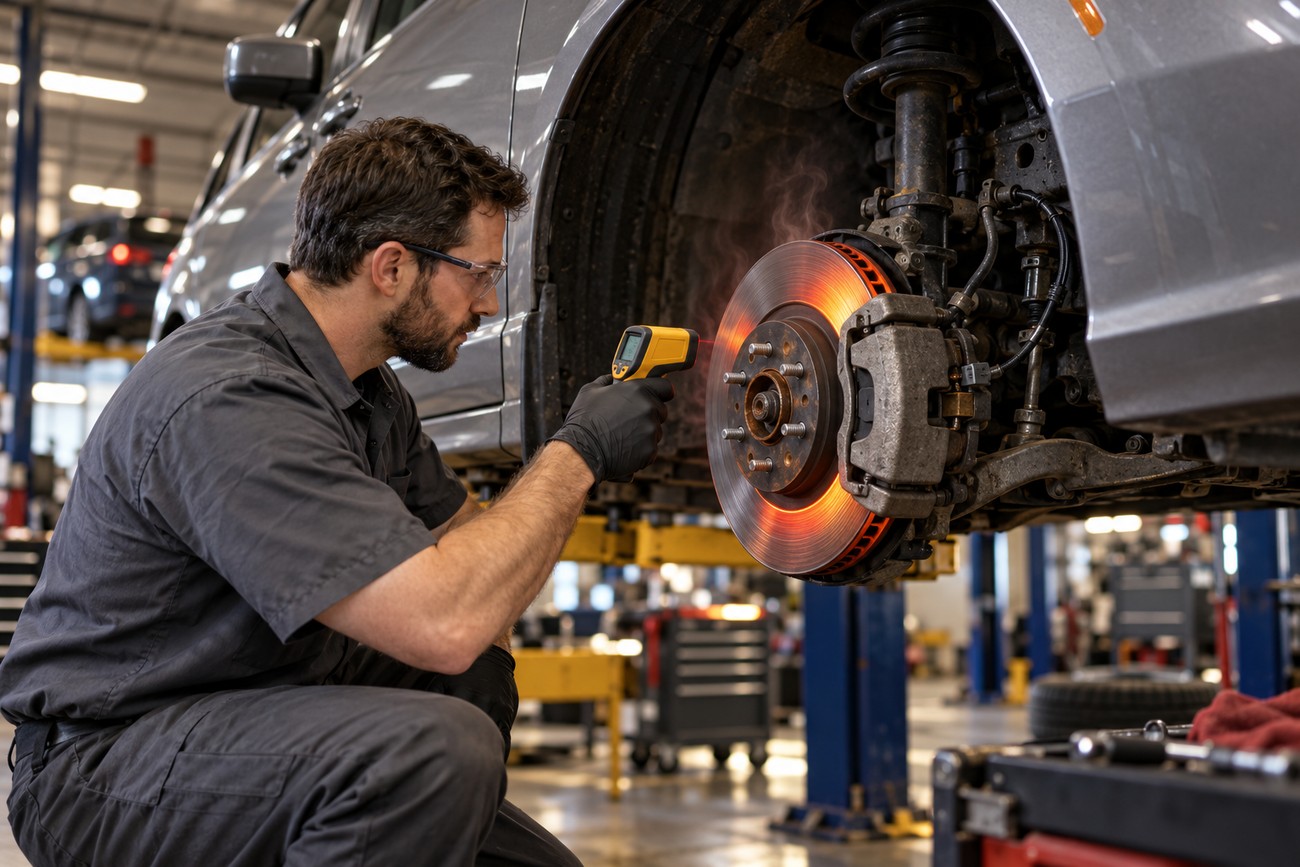
Brake fluid deserves attention even when the dashboard warning light is off. Check its condition and the system for leaks, then inspect hoses, caliper pistons, and guide pins for restricted movement. A seized guide pin or piston can keep one pad dragging against the rotor, retaining heat and producing uneven wear before a driver notices a broader braking problem.
Unequal pad wear can make a general “mountain fade” diagnosis misleading: one hot corner may point to a restricted guide pin or caliper piston that cannot release the pad properly.
Confirm that the rear brakes are operating correctly, because a weak rear contribution shifts more work to the front axle. Inspect tire condition and pressures as well; tires cannot create brake fade, but poor grip changes stopping distance and can make a brake complaint harder to interpret. Any vibration should also prompt checks of the wheel, suspension, driveshaft, and CV-joint condition.
One source gives an approximate rotor-life estimate of 60,000–70,000 km in ordinary use and 35,000–50,000 km under active loads. This is a nonstandardized estimate, not a service interval or a prediction for every Odyssey. Driving style, load, parts, climate, maintenance, and prior overheating can change rotor condition substantially.
A larger or marketed performance rotor alone cannot guarantee fade resistance. Suitable pads, sound fluid, free-moving calipers, correct parts, and proper downhill technique all matter. A repair plan should address the cause of heat retention and the condition of the complete system, rather than relying on one upgraded component.
Common Myths About Odyssey Brakes in the Mountains
Myth: ABS or brake assist prevents overheating. Reality: these systems help maintain control or support braking input, but they do not add thermal capacity to pads, rotors, or fluid. A warning light may remain off during friction fade, so the absence of a dashboard message does not confirm normal braking performance.
Myth: four-wheel discs make fade impossible. Reality: four-wheel disc brakes and ventilated front rotors are well suited to heat management, yet a heavy minivan can still overheat its brakes on a long, fast, or heavily loaded descent. The hardware improves the margin; it does not remove the need for correct technique.
Myth: fade always means a broken part. Reality: overheating can cause a temporary reduction in friction that improves after cooling. That improvement is still a safety warning, and repeated overheating can damage friction surfaces, fluid, or hardware even when the pedal later feels normal.
Myth: aftermarket rotors alone solve the problem. Reality: advertised larger disc area or stronger calipers is not the same as comparative, measured fade testing. A family vehicle designed for normal road use may be entirely serviceable without having the thermal reserve demanded by repeated mountain-pass descents.
Frequently asked questions
These answers separate heat-related friction problems from hydraulic faults and keep online claims in their proper context. If braking remains uncertain, do not use a general explanation as permission to continue driving.
When driving in mountain conditions, what exactly causes brake fade?
Brake fade occurs when sustained or repeated braking overheats the friction system. Friction-material fade reduces the pad’s ability to generate braking force, while an overheated rotor can reduce the consistency of contact and transfer heat back into the pad. The result is often a firm-feeling pedal with weak deceleration.
Brake-fluid boiling is different: vapor in the hydraulic system can produce a soft, spongy, or sinking pedal, sometimes with improved pressure after pumping. These effects can occur together, and the distinction requires inspection. A firm pedal with poor stopping and a soft pedal with poor stopping are both unsafe, but they suggest different repair priorities.
What are the claims in a Honda Odyssey brake class action lawsuit?
An online reference to a class action does not establish a universal Odyssey brake defect. To evaluate a claim, identify the jurisdiction, affected model years, alleged defect, the specific braking symptoms or components involved, and the current status, such as pending litigation, settlement, or dismissal.
Legal information is jurisdiction- and case-specific. A complaint may contain allegations rather than proven findings, and a case about one component or model group may not apply to every Odyssey. Vehicle diagnosis should rely on the individual vehicle’s symptoms and inspection, regardless of what a lawsuit summary says.
How can I tell whether a mountain-pass brake problem is fade or a hydraulic failure?
Friction fade more often leaves the pedal relatively firm while stopping power falls after repeated braking, then improves as the system cools. Hydraulic problems are more likely to produce a soft or sinking pedal, visible fluid loss, or a pedal that changes markedly when pumped. These clues are useful, but they cannot safely rule out combined faults.
Stop driving if the pedal is low, braking does not return, fluid is present, or the vehicle pulls, grinds, or vibrates severely. A cooling-related improvement does not clear the vehicle for another demanding descent. Professional inspection, and towing when the condition is uncertain, is the safer decision.







