
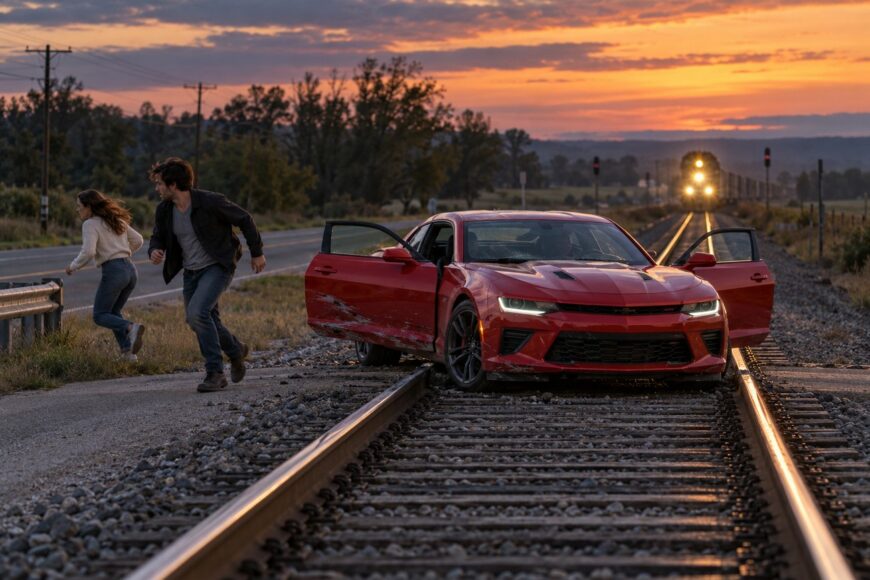
A jolt or scraping sound at a railroad crossing raises an urgent question: did your Chevy Camaro make contact and keep moving, or is it unable to clear the tracks? If it is still on the crossing, get everyone clear before trying to identify what touched the road. An approaching train may be unable to stop in time, even under emergency braking.
Once you are safely away, the sound alone cannot tell you whether the car is damaged. Changes in grade at a crossing can make a low Camaro scrape or become high-centered; the approach and exit matter as well as the rails. What you do next depends on where the car is and whether it remains safe to drive.
- If the Camaro is still on the tracks, get out first
- Why a railroad crossing catches a low Camaro
- What to check after you have cleared the crossing
- When to stop driving and arrange a tow
- Avoiding another scrape without creating a rail hazard
- Frequently asked questions
- What can cause a Camaro to stall on railroad tracks?
- Which vehicles must stop at a railroad crossing even when no train is visible?
- How can I report a crossing that repeatedly scrapes low cars?
If the Camaro is still on the tracks, get out first
If the Camaro is moving normally and you can safely continue across, clear the entire crossing without stopping to investigate the noise. Pull over only after you are well away from the tracks. Do not pause on the rails to check a bumper or look underneath.
If the car has stopped and cannot clear the tracks, get everyone out and away from the tracks immediately. Call 911 and, when available, use the crossing’s Emergency Notification System sign to identify and report the crossing. Do not return for the car. Report that a vehicle is obstructing the crossing and give the location information on the sign if you can obtain it safely.
A stall may feel temporary, and a car caught underneath may appear close to freeing itself. Neither possibility makes it safe to remain inside, push the car, or retrieve belongings while it occupies the tracks.
Move away from the crossing and follow emergency responders’ directions. If there is a collision or another immediate hazard, keep clear of damaged equipment and any downed wires. The car can be assessed only after the rail hazard has been addressed.
Why a railroad crossing catches a low Camaro
A crossing changes the road’s slope in a short distance. A low front bumper may touch on the approach before the wheels reach the rails. As the wheels move over the raised portion, the underside can meet the crest, and the rear of the car may scrape on the exit.
Ride height, front and rear overhangs, passengers or cargo, and the shape of the particular crossing all affect clearance. Camaros do not all sit at the same height, and a crossing that one car clears may catch another.
A brief scrape means something made contact, but it does not show what touched or how hard. Possible affected areas include bumpers, exhaust components, the underbody, and suspension. A car that becomes high-centered is a different, immediate problem because it may be unable to move off the crossing.
Slowing before entry may help you assess the road profile, but speed or a particular angle cannot guarantee clearance. If the grade looks unsuitable while you are still safely before the crossing, choose another route rather than testing whether the underside will clear.
What to check after you have cleared the crossing
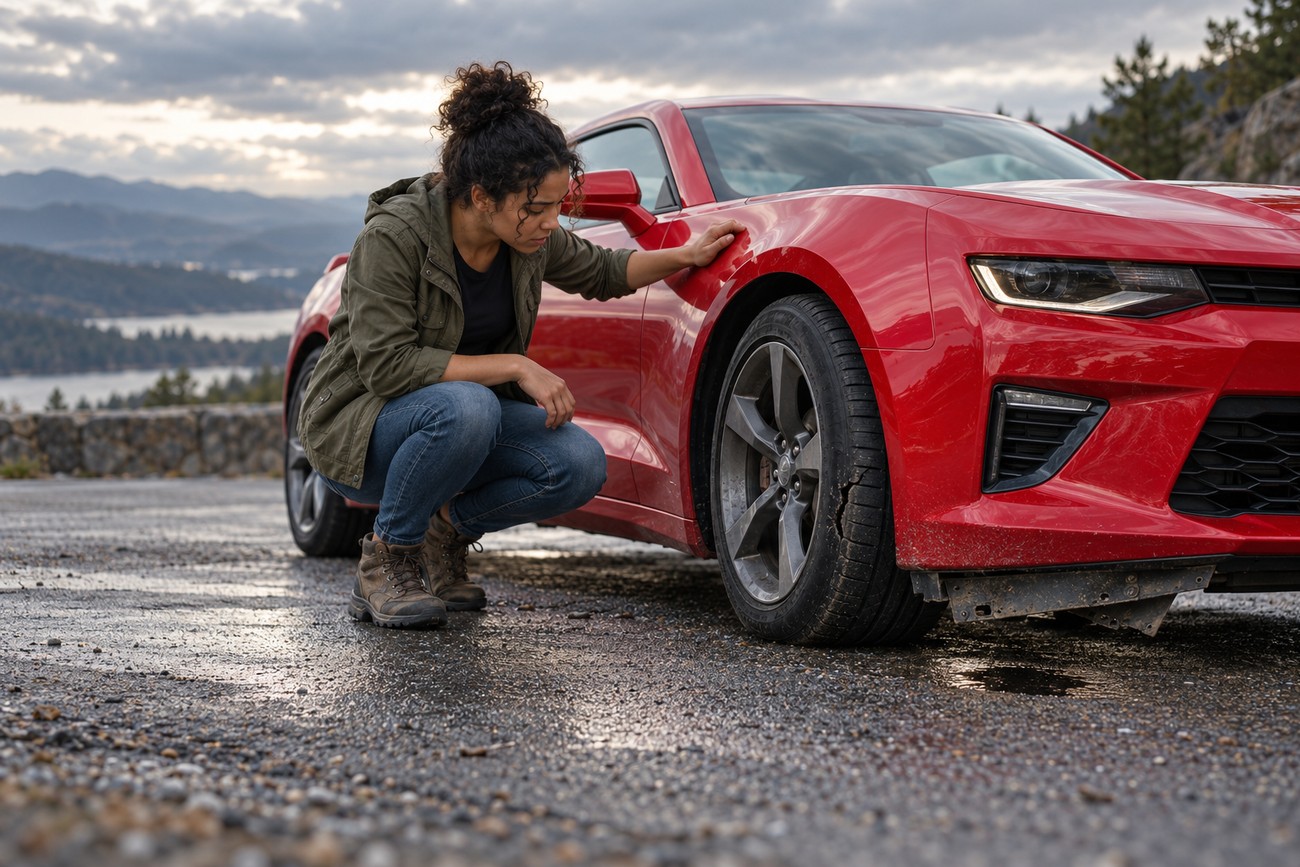
Pull over in a safe place away from the tracks and traffic before checking the Camaro. From outside the car, look for fluid beneath it, a loose or dragging part, and visible tire damage. Note any new warning lights or changes in how the car sounds, steers, or brakes.
A car can drive away from a crossing and still need inspection. The sound of a scrape alone does not establish damage or its location, and an intact-looking bumper tells you little about parts you cannot see.
Do not crawl underneath a car at the roadside. A repair shop can check parts that are difficult to see safely, especially if a new noise appears or something feels different while driving. If you find a leak, a dragging part, tire damage, or a change in steering or braking, avoid driving farther to investigate.
When to stop driving and arrange a tow
Stop driving and arrange help if you see a leak, a component dragging on the road, or a damaged tire. Impaired steering or braking, or a serious new warning, also calls for stopping in a safe place. Continuing to drive can turn a contact point into further damage or make the car harder to control.
If the Camaro is already away from the tracks but cannot be driven safely, leave it parked and arrange a tow rather than driving to see whether the problem clears up. Tell the tow operator that it is a low-clearance car and describe what you observed. That information helps the operator plan how to approach and load it without assuming a particular tow method will suit every vehicle.
A shop may need to inspect the exhaust, underbody, bumpers, and suspension to establish what, if anything, was damaged. A scrape by itself does not justify naming a failed part or predicting a repair. Record the symptoms you noticed after the crossing so the inspection can focus on the change.
Avoiding another scrape without creating a rail hazard
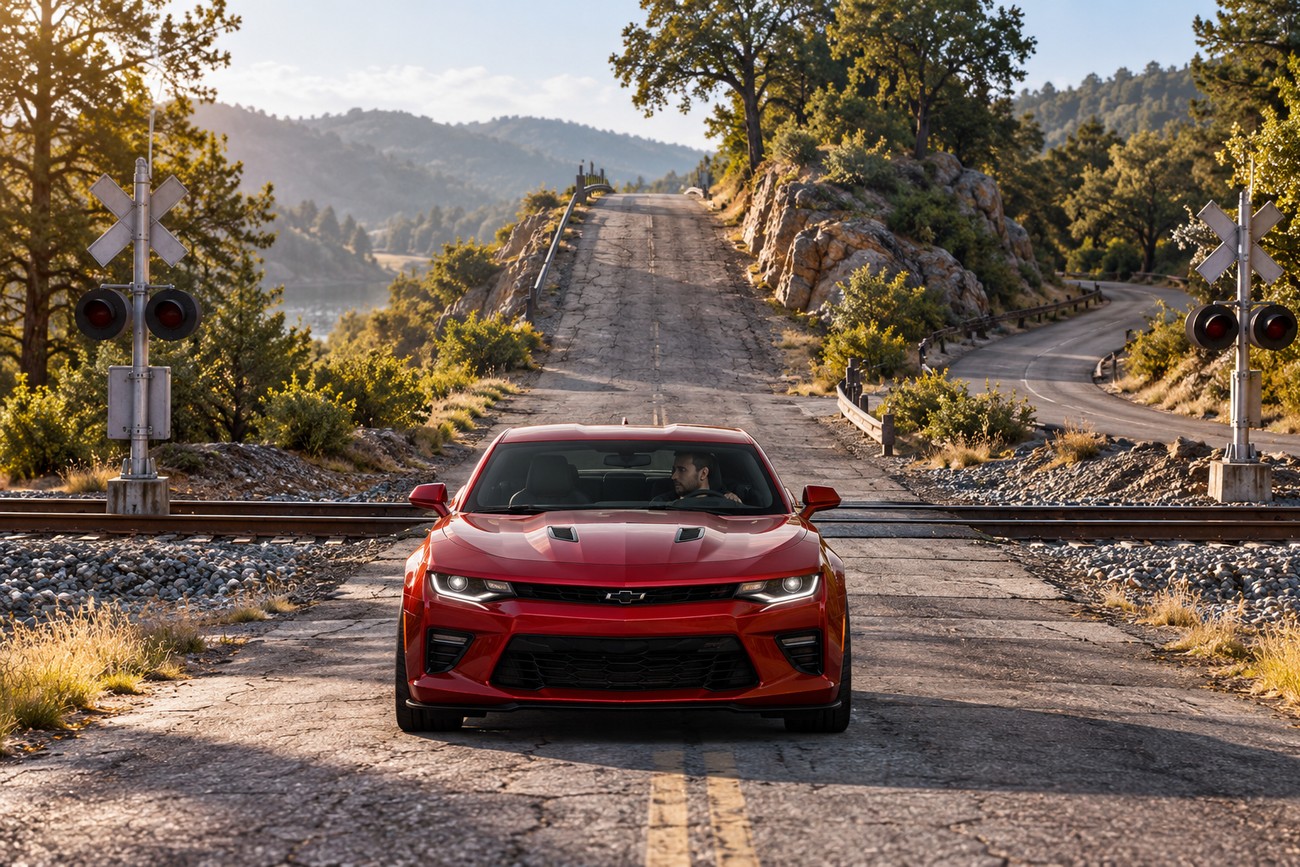
Look at the road profile while you still have room to decide against entering. A sharp rise toward the tracks or a steep drop beyond them can create clearance trouble even when the rails themselves appear level. Leave enough space on the far side to clear the entire crossing before you proceed.
If a crossing appears unsuitable for your Camaro, use another route. Do not stop on the rails to inspect the surface, reverse into traffic to try again, or swing diagonally across lanes to gain clearance. Those maneuvers can create a more serious hazard than a scraped bumper.
Signals and gates take priority over protecting the car. Do not drive through, under, or around a closed or moving crossing gate, and do not rush a warning signal to avoid waiting. Active warning devices do not eliminate crossing risk, so check that you can clear the crossing before entering when it is lawful to proceed.
No single speed or entry angle is a guaranteed cure for a difficult road profile. Assessing the approach before entry gives you a choice; discovering the clearance problem while the car is on the tracks may leave you with only the emergency response.
Frequently asked questions
A scrape, a stall, and a car caught on the crossing can feel similar at first, but they call for different follow-up once everyone is safe. Crossing rules also vary by vehicle category and state. The answers below clarify those distinctions without changing the immediate priority: if the car cannot clear the tracks, get everyone out and away.
What can cause a Camaro to stall on railroad tracks?
An engine stall means the engine has stopped running; a car that is physically caught on the crossing may still have a running engine but be unable to move. From the driver’s seat, either situation may initially feel like the car will not move. The cause cannot be established from that sensation alone, and neither situation warrants staying in the car if it cannot clear the tracks.
Which vehicles must stop at a railroad crossing even when no train is visible?
Some vehicle categories, such as certain buses and hazardous-material carriers, have mandatory railroad-crossing stop requirements even when no train is visible. The applicable rule depends on vehicle type and state law. Do not assume that the same mandatory-stop rule applies to every passenger Camaro; follow the signs, signals, and rules that apply where you are driving.
How can I report a crossing that repeatedly scrapes low cars?
Record the crossing’s location from a safe place, including the road name and any identifying information on the crossing sign. Report the recurring road-profile concern to the relevant road authority or railroad, describing where cars appear to make contact without standing on the tracks to inspect it. This is separate from an immediate obstruction: if a vehicle cannot clear the crossing, get everyone out and away, call 911, and use the Emergency Notification System sign to identify the crossing when available.







