
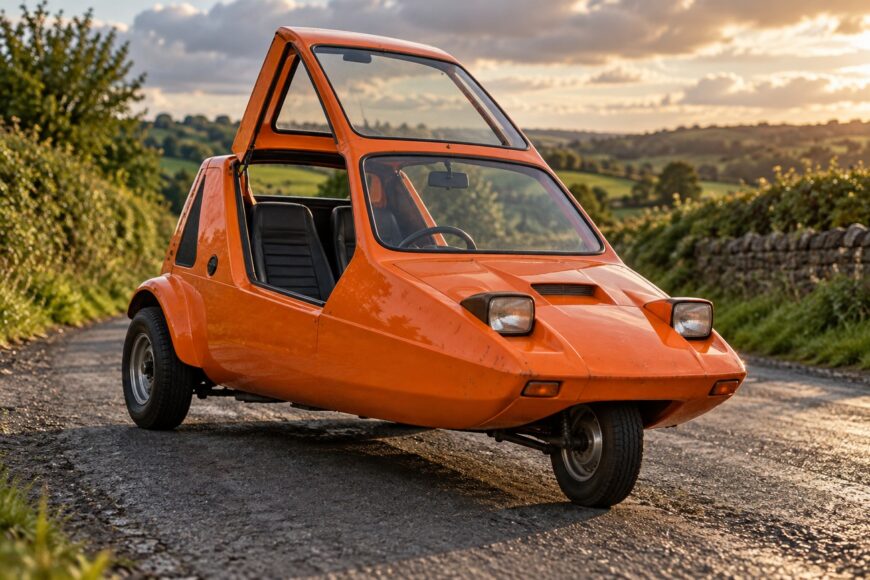
The Bond Bug remains one of the most recognizable British vehicles ever given a registration plate: a bright orange wedge with a lifting canopy, a single front wheel, and proportions closer to a cartoon prop than a conventional automobile. Its shape was genuinely innovative for 1970, and its light weight gave a small engine enough work to do. That visual charm, however, can conceal a demanding ownership proposition.
The Bug is an engineered, usable three-wheeler with real period performance, yet it offers little comfort, weather protection, luggage space, or crash protection. Parts can be difficult to source, and a glossy fiberglass shell may hide serious corrosion underneath. It makes sense as a collector, show, and short-trip machine; it becomes a poor bargain when treated as an ordinary daily car.
- What the Bond Bug Really Was
- Bond Bug Versions and the Numbers That Matter
- What It Is Like to Drive a Bond Bug
- The Ownership Problems Hidden by the Orange Body
- How to Buy and Restore the Right Bond Bug
- Myths, Market Appeal and the Bond Bug’s Real Legacy
- Frequently asked questions
- What is a Bond Bug worth?
- What was the top speed of a Bond Bug?
- Why is it called a Bond Bug?
- How many Bond Bugs were built?
What the Bond Bug Really Was
Production ran from 1970 to 1974. The design came from Bond, while series production followed the takeover of the company and was carried out by Reliant/Sharp’s Commercials. That history matters because the Bug belongs to the British microcar and three-wheeler tradition, even though its styling was more adventurous than the utilitarian machines that preceded it.
Its layout was simple and distinctive: two seats, rear-wheel drive, one front wheel, and two rear wheels. The body used a wedge-shaped fiberglass shell mounted on a ladder or box-section frame. Instead of conventional doors, occupants entered through a forward-lifting canopy, a feature that saved side structure and made the car instantly recognizable.
The Bond Bug was a licensed microcar, with a full four-cylinder engine and automotive transmission. Calling it a toy or an ordinary motorcycle misses the engineering and legal category of the vehicle. It was built for road use, with a car-like driving position and running gear, although its narrow track, low weight, and three-wheel layout demand more sympathy than a normal four-wheeled car.
Its appeal was always niche. The Bug had the visual impact of a much more expensive specialist vehicle, but it was never mass urban transport in the modern practical sense. The compact dimensions and low running burden suited short journeys and leisure use, while the limited cabin, basic weather protection, and unusual handling kept it firmly in enthusiast territory.
Bond Bug Versions and the Numbers That Matter
All versions used the same basic concept, but the 700ES deserves particular attention from buyers. The engine specification, power output, and reported performance are often simplified in advertisements, so the figures below separate confirmed version differences from data that varies between technical sources.
| Version or specification | Relevant details |
|---|---|
| 700 | Reliant 701 cc inline-four petrol engine, OHV, Zenith carburetor, liquid cooling; 29 hp |
| 700E | Same 701 cc OHV four-cylinder layout and 29 hp output; equipment and trim specification differ from the basic 700 |
| 700ES | Up to 31 hp through a higher-compression cylinder head; the most significant version for originality and collector interest |
| Top speed | Commonly reported as 75–76 mph, approximately 120–122 km/h; some references give 126 km/h |
| Dimensions | Approximately 2794 mm long, 1397 mm wide, and 1270 mm high, with a 1956 mm wheelbase |
| Reported weight | Figures range from 394 kg to 396–407 kg, depending on the technical source and specification quoted |
The differences in top-speed figures should not be treated as proof that every Bug reaches the highest number. Period road-test conditions, gearing, engine tune, driver weight, and later reference conventions all affect the result. A correctly adjusted carburetor and ignition system can make a greater practical difference than an optimistic specification sheet suggests.
The 700ES is important because its higher-compression cylinder head gives it up to 31 hp, rather than the 29 hp associated with the 700 and 700E. Buyers should verify the engine and head specification instead of accepting an ES badge or a painted engine bay as evidence. Surviving cars are frequently assembled from mixed components.
What It Is Like to Drive a Bond Bug
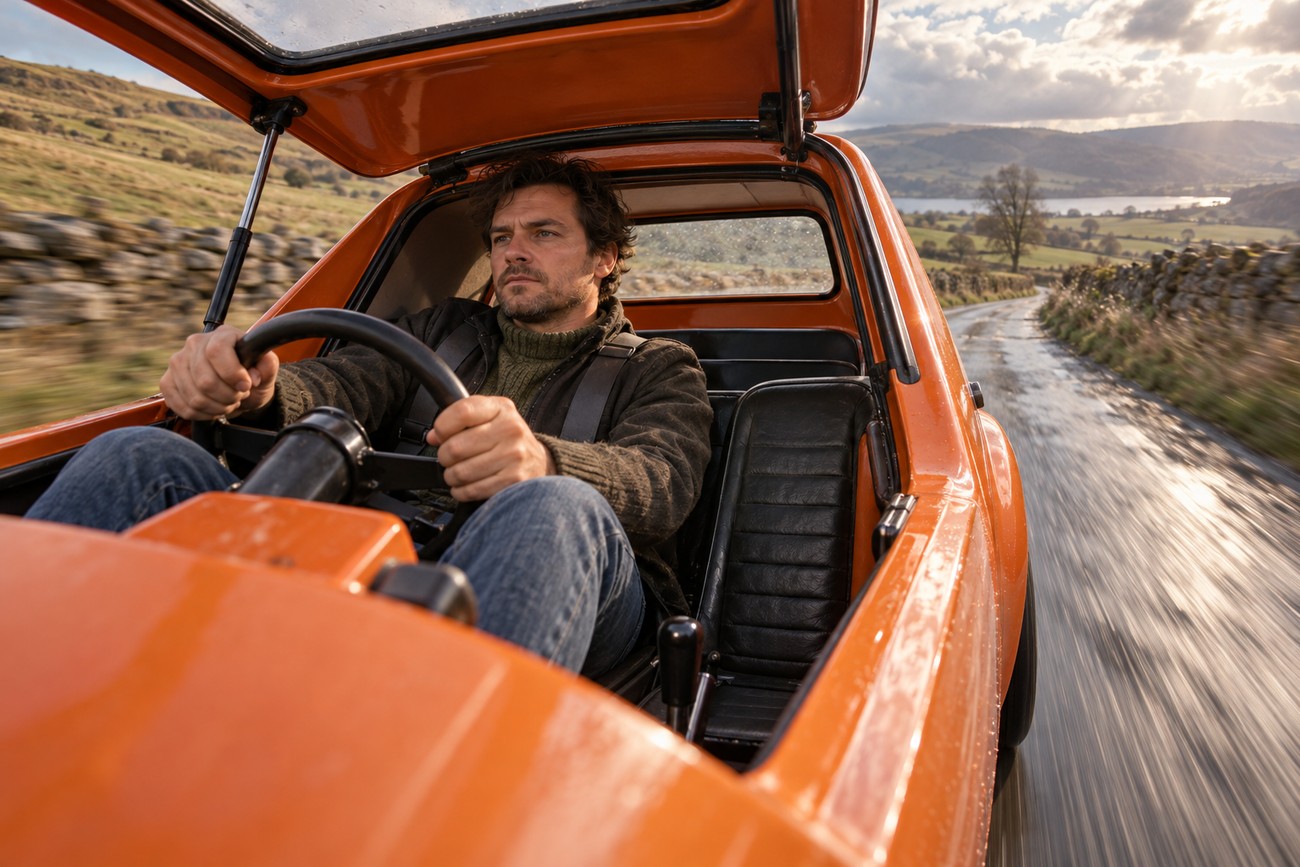
The first impression is lightness. With a mass reported between 394 kg and 396–407 kg, the Bug responds quickly to modest throttle input, and its 701 cc four-cylinder engine feels adequate for a vehicle of this size. It has enough performance to feel lively on secondary roads, while the low seating position and open visual relationship with the road create a strong sense of speed.
The suspension is the price of that character. Owners regularly describe the ride as kart-like, with impacts transmitted directly into the cabin. Broken pavement, expansion joints, and rough rural roads can become tiring over a surprisingly short distance. The Bug is enjoyable when the road is smooth; on poor surfaces, its charm becomes a physical test.
Space is equally limited. Taller drivers and passengers may struggle with the seating position, legroom, and canopy clearance, while luggage capacity is minimal. Entry requires lifting the front canopy and climbing into the cabin, an awkward procedure in rain or beside another car in a tight parking space. Water ingress, wind noise, and droughts can further reduce its appeal outside dry weather.
The three-wheel layout does not mean that a sound Bug constantly overturns. With correct suspension, sound tyres, and appropriate inputs, stability is acceptable. Crosswinds, road grooves, and abrupt braking or steering can make the car nervous, especially at higher speeds, so smooth control matters more than trying to drive it like a conventional four-wheeler.
The Ownership Problems Hidden by the Orange Body
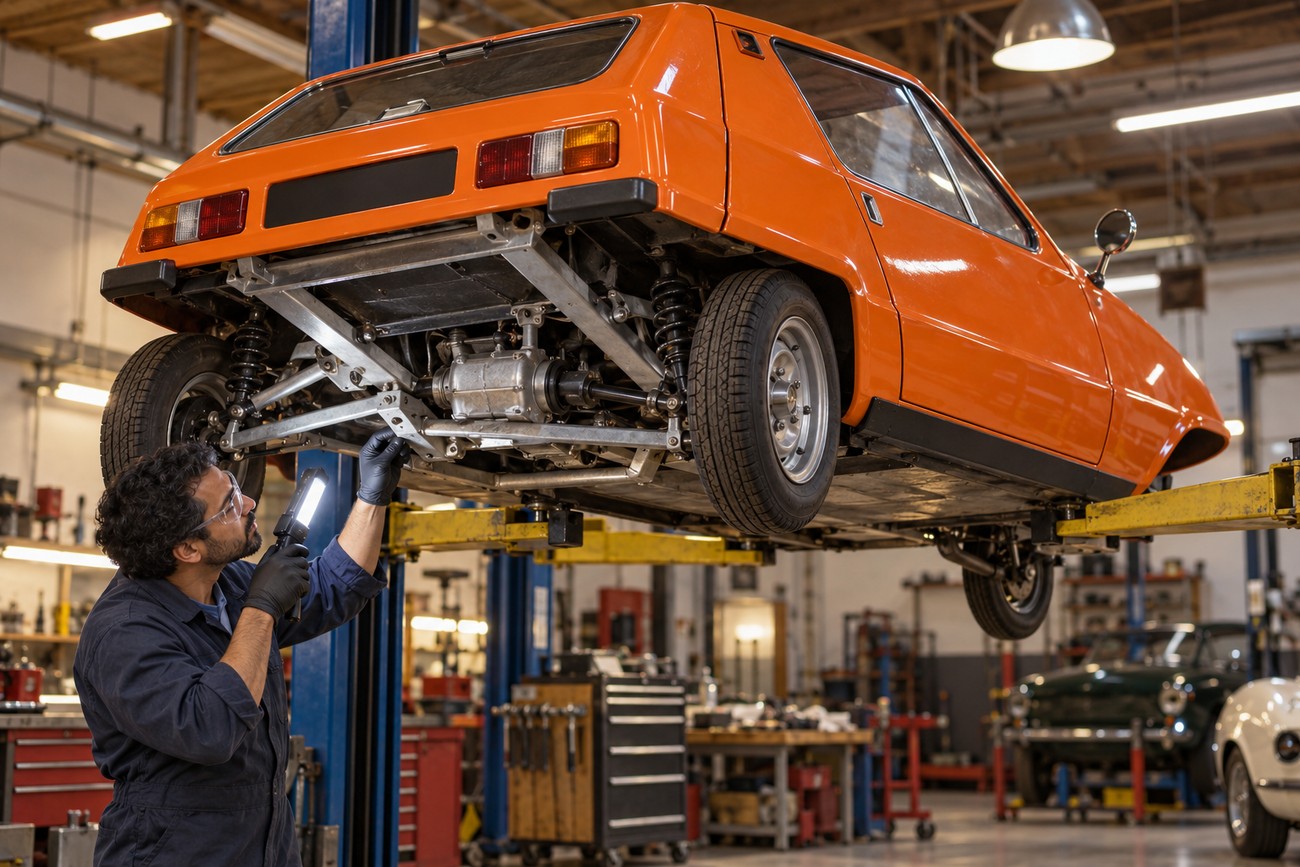
Fibreglass does not rust, which is one reason a Bond Bug can look remarkably presentable after decades. The material also hides the condition of the structure beneath it. A clean orange shell can sit over a badly corroded ladder or box-section frame, and the serious work may only become visible after panels, trim, or mechanical components are removed.
The front structure deserves particular scrutiny because the single wheel carries steering, braking, and much of the driver’s confidence in the car. Bearing play, damaged mounting points, poor geometry, or an unsuitable tyre can produce vague or nervous handling. Cosmetic restoration without structural inspection is one of the quickest ways to turn an attractive purchase into a major welding project.
Weather sealing is another commonly underestimated weakness. The forward canopy can leak around its seals and hardware, while wind noise and droughts are normal concerns even on a well-presented example. The small liquid-cooled engine is also sensitive to neglect: a blocked radiator, weak cooling system, or incorrectly set ignition can lead to overheating.
Passive safety is limited by the period design. Thin panels, little crash structure, and the absence of modern restraint and electronic safety systems leave occupants substantially less protected than those in an ordinary car of a similar age, let alone a modern vehicle. That limitation should shape where and how the Bug is driven. An all-weather daily routine exposes its compromises in comfort, sealing, reliability, and accident protection very quickly.
How to Buy and Restore the Right Bond Bug
Start underneath, even if the bodywork looks excellent. Inspect the complete frame for corrosion, previous welding, distorted sections, and repairs that have been covered by paint or underseal. Pay particular attention to areas around suspension and steering mounts, because structural weakness there can affect both safety and the cost of returning the car to the road.
The single front wheel needs a methodical check. Look for bearing play, damaged or unevenly worn tyre tread, incorrect wheel alignment, and looseness in the steering or suspension joints. A test drive should include gentle braking, a straight-line check, and a cautious assessment of how the Bug responds to road grooves and wind. Any nervousness deserves investigation rather than dismissal as an unavoidable feature of three wheels.
Treat the fiberglass shell as cosmetic until the frame, front-wheel bearings, and steering geometry have been inspected. Verify the cooling system, ignition settings, and Zenith carburetor before judging whether an example is genuinely slow.
Engine assessment should include cold starting, cooling-system behavior, oil condition, and evidence of overheating. The Zenith carburetor and ignition timing have a major effect on throttle response and usable performance, so a poorly running car may need careful setup rather than a more radical engine. A warm engine that idles well in a driveway has not necessarily proved itself under load.
Check the canopy hinges, catches, seals, glazing, and surrounding fiberglass for previous repairs. Correct replacement parts can take time to find, and unsuitable components may compromise sealing or handling. Specialist clubs and classic-car forums are valuable because they connect owners with the right specifications, suppliers, and repair methods; generic parts that happen to fit are not always safe substitutes.
Originality should be judged carefully. An original 700ES specification, including its higher-compression cylinder head, has greater collector significance than a standard-looking car carrying an unverified badge. Radical tuning may make a Bug more entertaining for one owner while reducing its future appeal and making resale harder. A sympathetic restoration with documented work is usually a stronger proposition than an extensively modified car advertised as “improved.”
Myths, Market Appeal and the Bond Bug’s Real Legacy
The Bug was not a children’s toy. It was a licensed microcar with a 701 cc four-cylinder engine and automotive transmission, designed for road use. Its compact appearance and unusual access system encourage jokes, yet the mechanical package is a serious small-car solution shaped by tax, weight, packaging, and the three-wheeler market.
The idea that every Bond Bug is dangerously unstable is also too crude. A correctly maintained example can be acceptably stable when driven with smooth steering and braking. Its real dynamic compromises are harsh suspension, sensitivity to crosswinds and road grooves, and the need for a driver to respect the different load and grip behavior of three wheels.
Power and speed claims need equal caution. The 700 and 700E produced 29 hp, while the 700ES produced up to 31 hp through its higher-compression cylinder head. Top speed is commonly reported as 75–76 mph, approximately 120–122 km/h, although some references give 126 km/h. Those figures describe different sources and conditions, rather than a universal promise made by every surviving Bug.
The strongest market appeal lies in character, condition, and evidence of correct restoration. Many cars contain mixed replacement components, so a claim of complete originality needs supporting detail. The right owner values the design, accepts short-trip limitations, and is prepared to maintain a niche vehicle; the wrong owner buys the orange silhouette expecting inexpensive, weatherproof everyday transport.
Frequently asked questions
The Bond Bug’s value, performance, name, and production history all need to be considered in context. Condition, specification, and maintenance can matter more than appearance alone. The following answers summarize the key points without treating published figures as guarantees for every surviving car.
What is a Bond Bug worth?
Value depends more on structural condition and specification than on orange paint or visual presentation. An original 700ES specification, a sound frame, correct front-end components, documented restoration work, and credible provenance generally strengthen a car’s position. A poor frame, improvised parts, or hidden corrosion can outweigh an attractive fiberglass shell.
Non-standard tuning should be assessed carefully. It may improve performance for a particular owner while reducing collector appeal and making future maintenance more difficult. There is no responsible single figure without inspecting the car and comparing it with current specialist-market evidence.
What was the top speed of a Bond Bug?
The commonly reported figure is 75–76 mph, approximately 120–122 km/h. Some later references give 126 km/h, which may reflect different test conditions, version assumptions, rounded conversions, or reference-data conventions.
Actual performance depends heavily on engine condition, Zenith carburetor adjustment, ignition timing, tyre condition, road, and load. The higher figure should therefore be treated as one published reference rather than a guaranteed result for every 700, 700E, or 700ES.
Why is it called a Bond Bug?
“Bond” identifies the Bond marque, whose design was taken into series production after the company was acquired by Reliant/Sharp’s Commercials. “Bug” describes the model’s compact, distinctive character and memorable appearance.
The name is neither a technical classification nor a safety feature. The vehicle remains a licensed microcar and three-wheeler with a full four-cylinder engine and rear-wheel drive.
How many Bond Bugs were built?
The documented production period is 1970–1974, and the model is generally described as a relatively small, niche production vehicle. That status is clear even without presenting an exact build total.
An exact number should be quoted only from a verified production record. Surviving-car counts, registry totals, and estimates can describe what remains today, but they do not automatically establish how many were originally built.







