
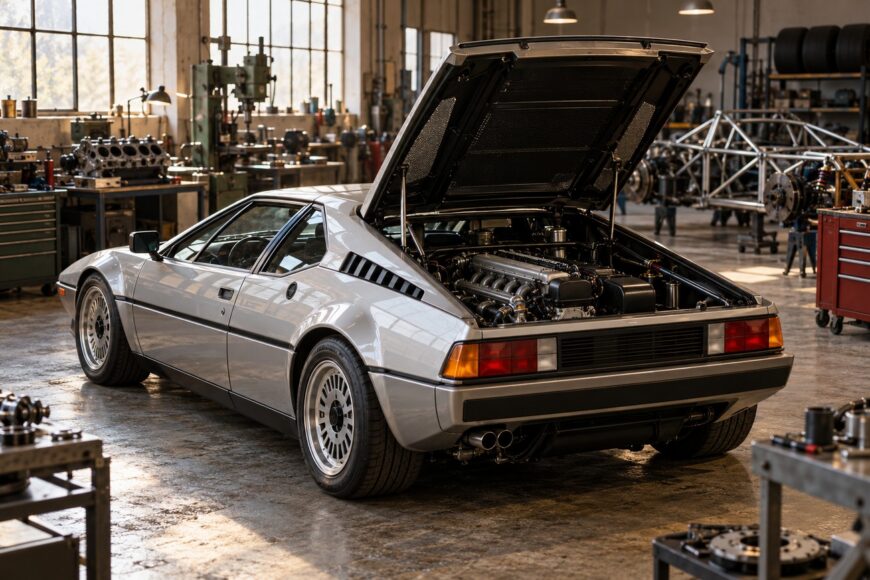
BMW’s first M road car was a mid-engine supercar shaped by Lamborghini’s involvement, yet Lamborghini did not build the finished production car. That apparent contradiction defines the BMW M1 better than the usual badge-and-poster mythology. BMW needed a road-going machine for racing homologation, chose an Italian-led production plan, then had to rescue the project when that plan began to fail.
The result was technically important and historically awkward. Built from 1978 to 1981 in a total run of 456 cars, the M1 combined BMW Motorsport engineering with Italian-influenced styling and a distributed manufacturing process. Its reputation is deserved, but ownership is less glamorous: parts are scarce, restoration requires specialist judgment, and the low, tight cabin reflects a competition brief more than everyday grand touring.
- Why BMW Built the M1 as a Homologation Supercar
- Lamborghini Helped Start the Project—but Did Not Build the M1 Alone
- Engineering, Design, and the M88/1 Road-Car Formula
- Road M1 and Procar: Similar Name, Different Mission
- The Hidden Cost of Owning a BMW M1
- BMW M1 Myths That Distort Its Real Legacy
- Frequently asked questions
- How much is a BMW M1 worth today?
- Which BMW can beat a Lamborghini?
- Which car is called the poor man’s Lamborghini?
Why BMW Built the M1 as a Homologation Supercar
The M1 was created to satisfy FIA homologation rules rather than as a conventional luxury GT. BMW Motorsport wanted a purpose-built mid-engine car to support a racing program, while the regulations required at least 400 road-going examples before the competition version could qualify. That threshold turned a racing ambition into a costly production obligation.
Production ran from 1978 to 1981, and BMW ultimately built 456 M1s. The number was only slightly above the required minimum, which shows how limited the business case was. This was BMW Motorsport/M GmbH’s first road car, and its unusual layout and small-volume construction made it a project with little connection to the company’s regular sedan and coupe production.
Homologation also explains why the M1 can feel compromised when judged as a conventional road car. Its body, packaging, and mechanical specification were shaped by the need to create a credible competition base. The road version had to function on public roads, but it did not need to offer the space, visibility, refinement, or production economy expected from a mainstream BMW.
Lamborghini Helped Start the Project—but Did Not Build the M1 Alone
BMW initially contracted Lamborghini as a production partner. Lamborghini had relevant experience with low-volume exotic cars and was expected to help turn the M1 concept into a viable series-production machine. This is the source of the enduring “BMW with Lamborghini underneath” story, although it describes only part of the project.
Lamborghini then suffered manufacturing and financial problems, putting the program’s schedule and completion at risk. BMW abandoned the arrangement and reorganized the work through several outside companies. The body and final assembly were divided among contractors including Italdesign and Baur, rather than being completed at one Lamborghini factory.
That production history matters when the car is described today. Lamborghini’s role was concentrated in the early project and did not continue through complete series production. The finished M1 was therefore not a Lamborghini carrying a BMW badge; it was a BMW Motorsport homologation car whose development and manufacture passed through a complicated international supply chain.
Engineering, Design, and the M88/1 Road-Car Formula
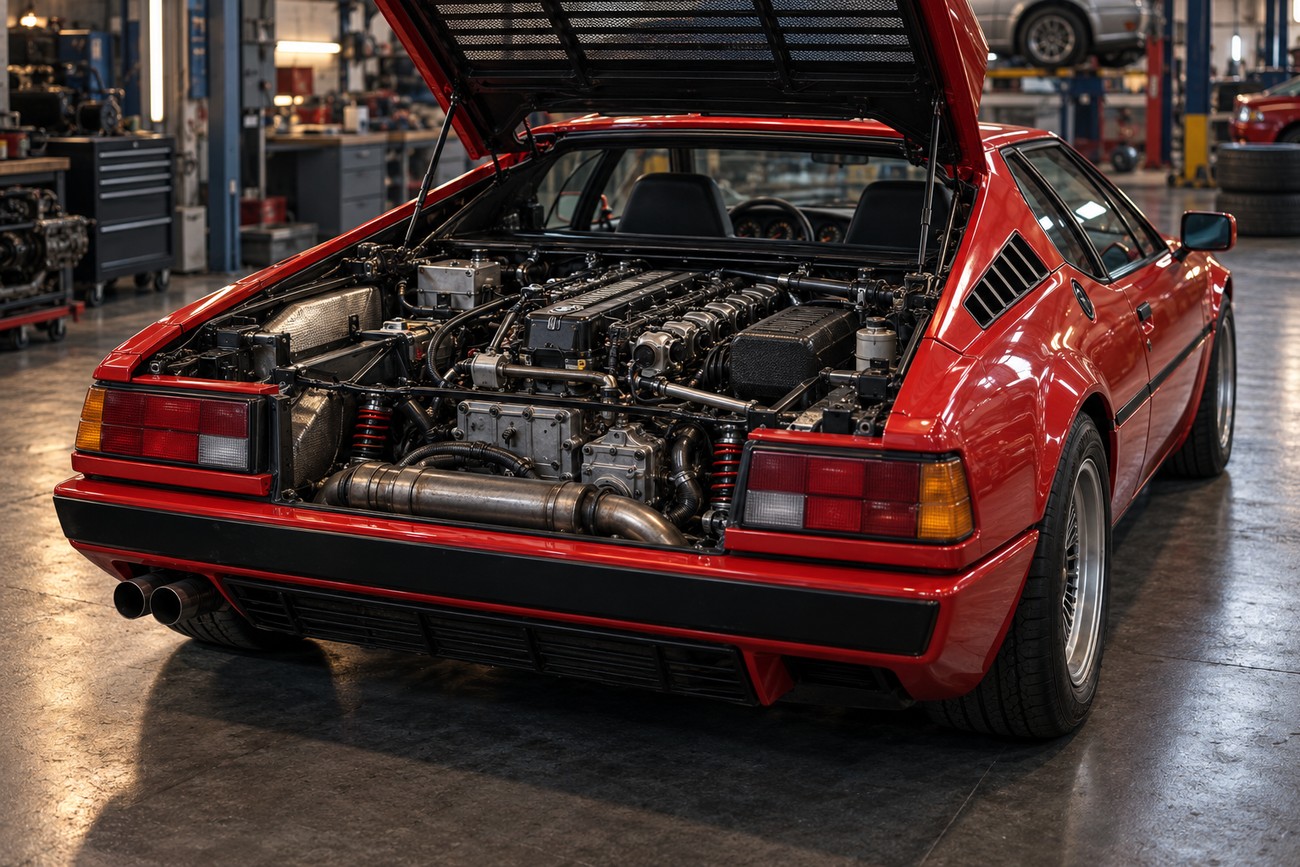
The M1’s defining engineering decision was its mid-engine layout. It was the only series-production mid-engine BMW of its period, placing the power unit behind the occupants to support the balance and packaging required for a racing-derived supercar. That layout also contributed to the cramped cabin, limited rearward visibility, and specialized service demands.
The road car used the 3453 cm³ M88/1 inline-six. Its documented output was 277 hp and 330 Nm, with a claimed top speed of 265 km/h. These figures describe the road-going M1 and should be kept separate from the more highly developed racing derivatives that carried the same basic identity.
The shape is often reduced to “Italian styling,” but its design lineage is more specific. The M1 was connected to the BMW Turbo/E25 and the work of Paul Bracq, while Italdesign helped develop the production form. Its character came from the combination of BMW’s straight-six engineering, a mid-engine chassis, and Italian-influenced body design, rather than from Lamborghini authorship alone.
Road M1 and Procar: Similar Name, Different Mission
The road M1 and the Procar versions shared a name and a basic concept, but they served different missions. The road car existed partly to satisfy FIA homologation requirements, which meant producing a usable public-road machine in sufficient numbers. Procar cars were racing derivatives built around a much more demanding competition brief.
The road version used the M88/1 rated at 277 hp and 330 Nm. Racing versions received a different level of engine development and competition equipment, so their specifications and behavior should not be transferred automatically to a standard road M1. A road-car buyer who expects every M1 to feel like a full race car is importing the Procar’s reputation into the wrong specification.
This distinction also affects historical descriptions and sales inspections. A car’s identity depends on its chassis history, equipment, and originality, not simply on the M1 name. The road model is significant precisely because it made BMW’s racing ambition legal and tangible, even though it remained a limited, specialized road car rather than a detuned Procar in every respect.
The Hidden Cost of Owning a BMW M1
With only 456 examples built, an M1 has a high ownership threshold. Parts, service knowledge, and restoration expertise are limited, and work that would be routine on an ordinary BMW can become a specialist investigation. The distributed production history adds another complication: body components, trim, mechanical parts, and repairs must be assessed for correctness as well as condition.
The cabin reinforces the car’s competition-derived character. Seating is low, the interior is tight, and visibility is restricted compared with a conventional BMW coupe. Those traits may suit a collector who accepts the car on its original terms, but they can disappoint someone expecting relaxed long-distance comfort from a prestigious road-going GT.
Before estimating restoration work, specialists first reconcile the chassis numbers, body history, trim, and engine identity. On a car assembled through several contractors, an apparently correct part or repair still needs authentication.
Provenance should therefore be treated as a mechanical issue, not paperwork decoration. A buyer should verify chassis numbers, restoration history, and originality before judging the asking price or planning improvements. Treating the M1 as an ordinary BMW can produce expensive surprises, especially when an apparently minor correction requires rare parts and knowledge of how the car was originally assembled.
BMW M1 Myths That Distort Its Real Legacy
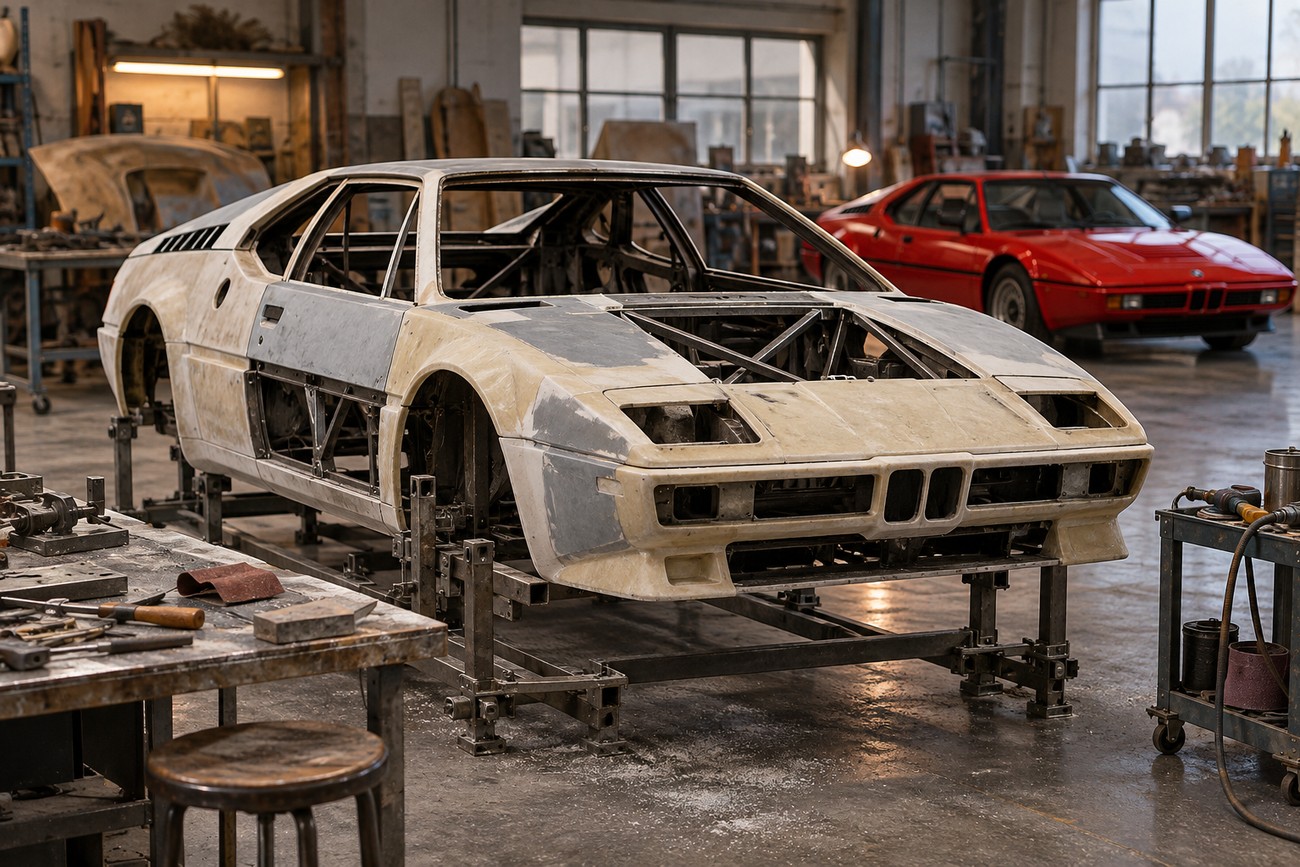
The first myth is that Lamborghini built the whole car. Lamborghini was the initial contracted production partner, but the company’s production and financial problems ended that arrangement. BMW then organized a distributed process involving Italdesign, Baur, and other contractors, so no single Italian factory completed every M1 from start to finish.
The second myth concerns performance. A road M1 was not identical to a Procar, and its M88/1 road specification was 277 hp with 330 Nm. Racing derivatives had a different level of engine development and equipment. Confusing the two creates inaccurate expectations about both performance and originality.
Mass figures are also reported inconsistently. One source gives approximately 1.3 tonnes, while other listings state 1,600 kg; the basis of measurement is unclear, so neither figure should be presented as a definitive universal value. The safer conclusion is that published specifications need context, just as the M1’s legend needs context.
That legend reflects genuine engineering achievement and the dramatic failure of the original production partnership. The M1 was BMW’s first road car from Motorsport/M GmbH, a rare mid-engine BMW, and a homologation obligation made real. It was also a complex compromise whose story is more interesting—and more accurate—than the simplified Lamborghini connection.
Frequently asked questions
The BMW M1 is easiest to understand when its collector value, racing history, and road-car specification are kept separate. These distinctions also matter when assessing a particular example.
How much is a BMW M1 worth today?
There is no responsible single universal price for a BMW M1. Condition, originality, provenance, documented restoration, and specification have a greater bearing on value than the badge alone. A well-documented original car and a heavily altered example may occupy very different parts of the collector market.
Inspection should begin with the chassis number, engine identity, body history, and restoration records. Because only 456 cars were built and production was distributed among several contractors, authenticity and completeness can affect the assessment as much as visible cosmetic condition.
Which BMW can beat a Lamborghini?
No universal answer exists without naming the Lamborghini, the BMW, the test conditions, and the era. Acceleration, top speed, gearing, traction, and road surface can change the result, while comparisons across decades are especially misleading.
The M1’s importance does not depend on winning a modern drag race. Its significance lies in being BMW Motorsport/M GmbH’s first road car, the only series-production mid-engine BMW of its period, and a road-going homologation machine with a documented 277-hp specification.
Which car is called the poor man’s Lamborghini?
“Poor man’s Lamborghini” is a casual nickname applied to various more affordable cars with exotic styling rather than a precise technical category. It does not accurately describe the BMW M1’s origin or status.
The M1 was a genuine FIA homologation project and a rare collector car, developed through BMW Motorsport and a complicated contractor network. Its Lamborghini connection concerns the early production plan, not a cheaper Lamborghini formula or a complete Italian-built car.







