
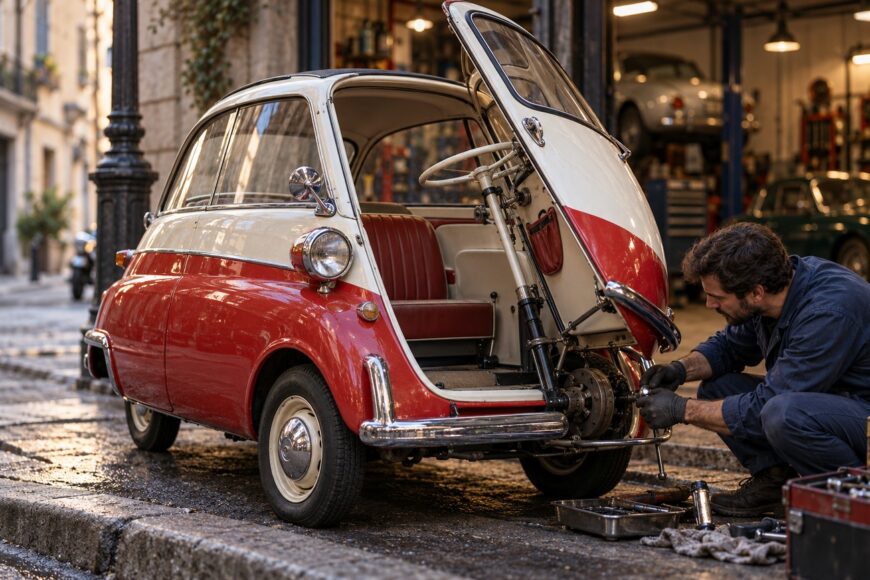
The BMW Isetta looks like a small cabin that has been rolled forward onto four wheels. Its entire front section becomes the entrance, allowing the driver and passenger to step out through the nose when a conventional side door would be blocked by a neighboring car. That clever arrangement suited crowded streets and tight parking spaces with unusual efficiency.
The same design creates the central ownership tension. The Isetta is an ingenious urban machine, not a miniature modern car. Version differences matter, while neglected brakes, fragile cooling, scarce body parts, and the distance between historical advertising and present-day crash expectations can turn a charming purchase into a demanding restoration.
- Why the Isetta’s Front Door Mattered—and What It Did Not Solve
- BMW Isetta 250 vs. 300: The Specifications That Change Expectations
- What the Isetta Feels Like in Real City Use
- What to Inspect Before Buying or Restoring an Isetta
- The Restoration Traps Hidden Behind Simple Mechanical Design
- The Safety Myth: A Front Door Is Not a Crash Cell
- Is a BMW Isetta Practical to Own Today?
- Frequently asked questions
- How much is a BMW Isetta worth today?
- Who made the original Isetta?
- How many BMW Isettas are left?
Why the Isetta’s Front Door Mattered—and What It Did Not Solve
The forward-opening door made sense in a city where parking space was scarce. The body is about 2.29 m long, and the driver sits close to the front of the car, so the nose can be positioned near a curb or wall while occupants still have a practical exit route. The steering column moves with the door, clearing the opening as it swings forward.
BMW’s door lock passes through a dead-center position intended to resist opening during braking. That detail is more significant than the door’s novelty: a large moving panel at the front of a tiny car needs a secure latch, sound hinges, and correctly adjusted stops. A worn mechanism can make the famous feature inconvenient or unsafe to use.
Access in a confined space should be separated from crash protection. The door may help you leave a parked car, but it does not give the Isetta the frontal-impact structure, restraint systems, or energy management expected from a contemporary automobile.
Inspect the whole opening rather than testing the latch alone. Hinge wear, steering-column movement, stops, the lock, and the opening seal all affect whether the door works as intended. Damage or distortion at the front can remove the practical advantage that originally made the layout so useful.
BMW Isetta 250 vs. 300: The Specifications That Change Expectations
The two principal BMW versions use related motorcycle-derived engineering, but their badges should not be treated as interchangeable. The engine specification affects performance expectations, replacement parts, and the way a restoration should be documented.
| Version | Displacement | Power and rated speed | Historical top speed | Cooling and practical meaning |
|---|---|---|---|---|
| Isetta 250 | 247 cm³ | 12 hp at 5,800 rpm | 85 km/h claimed | Air-cooled single-cylinder four-stroke engine derived from the BMW R25 motorcycle design; suited primarily to urban use |
| Isetta 300 | 298 cm³ | 13 hp at 5,200 rpm | 50 mph, approximately 80 km/h | Air-cooled single-cylinder four-stroke engine derived from the BMW R25 motorcycle design; the larger engine does not make the car a modern high-speed vehicle |
The figures are modest even by the standards of small classic cars. Historical material lists a gross weight of 580 kg, yet the available power remains only 12 hp for the 250 and 13 hp for the 300. That combination explains the Isetta’s deliberate pace and its sensitivity to hills, wind, passengers, and mechanical condition.
The 250’s 247 cm³ engine and the 300’s 298 cm³ unit have different specifications, so engine parts, internal components, and service assumptions should be checked against the actual car. A “universal” order based only on the BMW badge can create expensive compatibility problems.
What the Isetta Feels Like in Real City Use
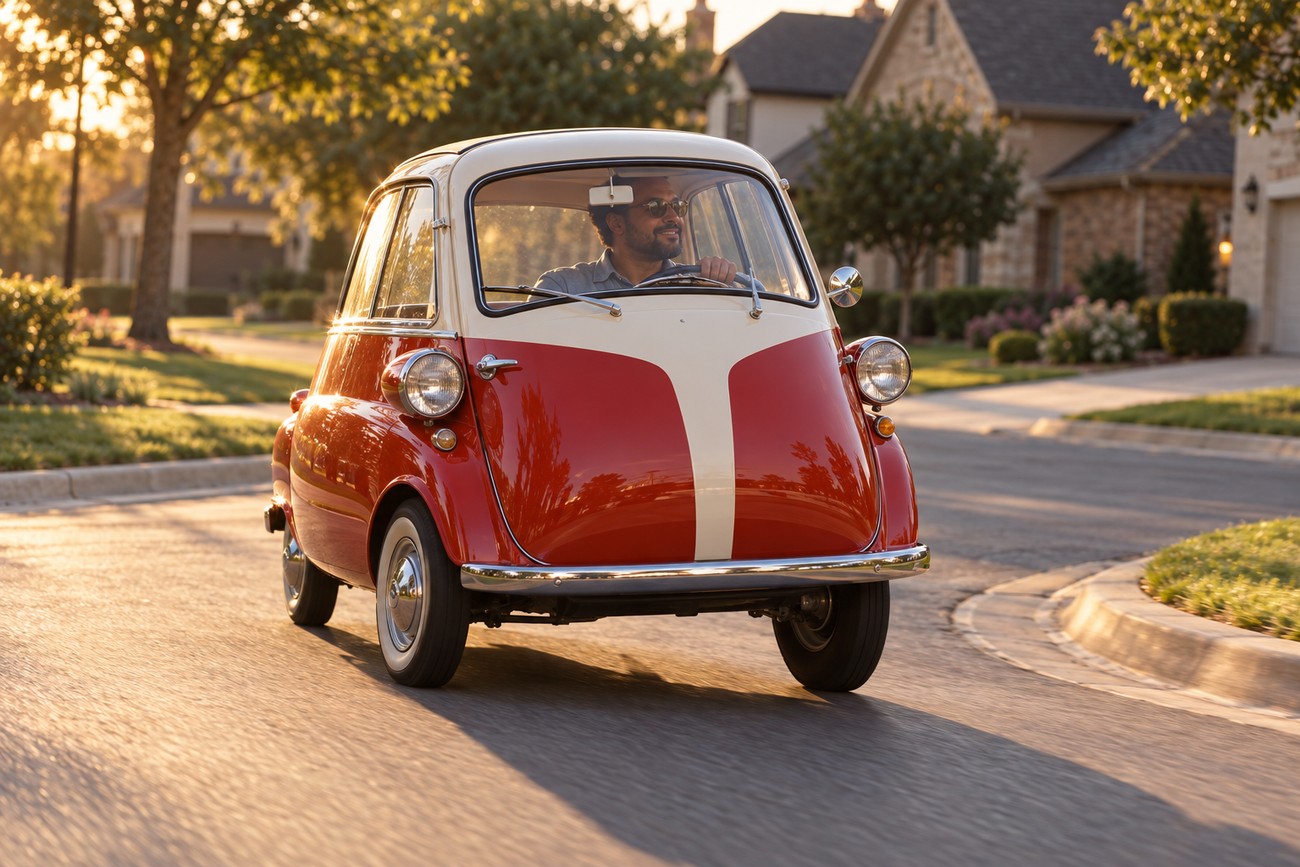
The Isetta was designed primarily for urban mobility. Its short body, high seating position, and small footprint make low-speed streets and local errands its natural territory. Steering inputs and visibility feel unlike those of a modern hatchback because you sit high over a narrow, specialized chassis.
The narrow rear track is central to the car’s character. It helps keep the body compact, but it also changes the driver’s sense of balance and stability compared with a modern car. Careful cornering, sensible speeds, and smooth inputs matter more than the small dimensions might suggest.
The claimed 85 km/h for the Isetta 250 is a historical maximum-speed specification, not a safe modern cruising recommendation. The Isetta 300’s listed 50 mph, approximately 80 km/h, carries the same limitation. Reaching a period specification on a suitable road does not make regular use on fast contemporary roads sensible.
In practice, the car is happiest on local routes where traffic allows generous spacing and other drivers can see its unusual proportions. A long journey may be possible with preparation, but the Isetta’s low power, limited safety margin, and historical braking and suspension design make it a poor choice for routine high-speed travel.
What to Inspect Before Buying or Restoring an Isetta
Begin with mechanical health rather than paint. Check compression, listen for abnormal crankshaft and connecting-rod noise, and establish whether the engine has been rebuilt correctly. The crankshaft and aluminum connecting-rod assembly require careful inspection; specialist guidance reports steel replacement solutions, but the frequency of failures should not be overstated without broader evidence.
The cooling fan deserves an immediate functional test. Because the engine is air-cooled, a failed fan can cause rapid overheating and serious engine damage. A beautiful engine bay proves little if the fan, drive arrangement, or surrounding airflow has been neglected.
Cooling and braking deserve priority over paint during an initial inspection. A non-standard master cylinder can also signal that future parts matching will be difficult, especially when the car’s original configuration has not been documented.
Stored cars need particularly careful brake inspection. Cylinders may seize, leaking fluid may contaminate the linings, and old hoses can compromise operation even when the drums and wheels look presentable. Identify the master-cylinder configuration before ordering parts; an earlier repair using a non-standard component can affect the entire maintenance plan.
Examine the front door as a working system. Check the hinges, steering-column movement, stops, lock operation, and opening seal. From underneath, inspect oil leaks around the rear-suspension seals and chain-case connections, since dry seals in these areas should not be assumed on a long-unused car.
The Restoration Traps Hidden Behind Simple Mechanical Design
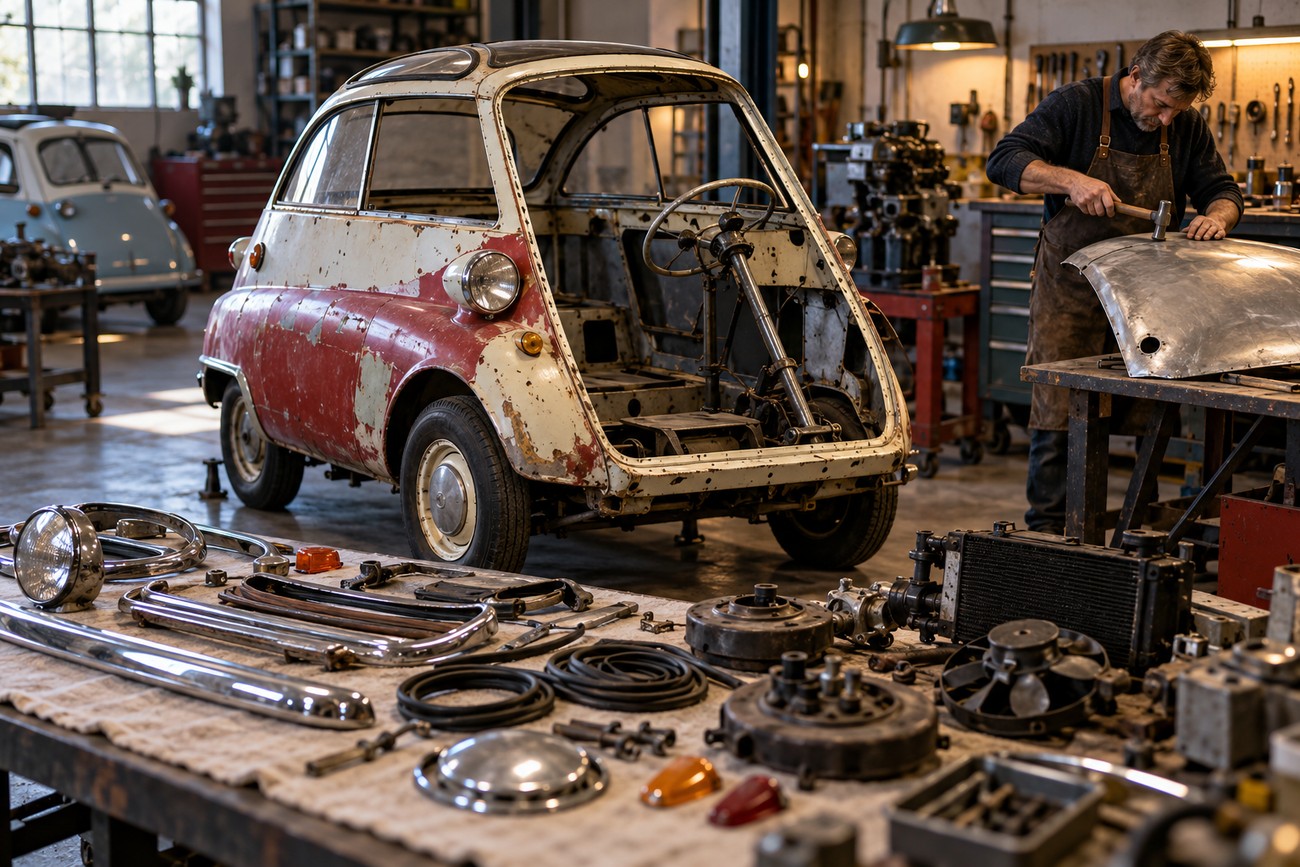
Basic mechanical layout does not guarantee a simple restoration. The engine may be accessible and understandable, while original chrome, body panels, seals, and selected brake components can be difficult to source. Some parts must be restored, adapted carefully, or fabricated rather than bought from a current catalog.
The bubble-shaped body is a particular risk. Curved panels and the distinctive roof and window structure can require specialist repair or hand fabrication, and poor work is difficult to disguise under paint. A project that appears complete from a distance may still need substantial metalwork around the opening, glazing, seals, and mounting points.
Cosmetic work should follow a parts and mechanical assessment, not lead it. Price the rare body and trim items, confirm the 250 or 300 specification, and identify the brake and suspension configuration before committing to paint. Otherwise, a freshly finished shell can conceal an unfinished drivetrain and a costly shortage of essential components.
The Safety Myth: A Front Door Is Not a Crash Cell
BMW promotional material presented the front door as safe in an accident, and the locking arrangement was designed to resist opening during braking. That historical claim describes one aspect of the mechanism. It does not establish protection equivalent to a modern passenger compartment.
Modern safety analysis identifies inadequate frontal-impact protection as a major limitation. The Isetta’s small size, historical structure, and city-oriented design leave little margin in a collision with a larger contemporary vehicle. The door’s movement and access advantage cannot substitute for a modern crash structure, restraint system, and impact-management design.
This distinction matters during ownership decisions. A driver may enjoy the Isetta on quiet local roads while still recognizing that a frontal collision remains a serious risk. Defensive driving, route selection, visibility, and avoiding fast traffic are essential parts of using the car responsibly.
The door should therefore be described accurately: it is an ingenious access solution with a secure historical locking concept, not a crash cell. Treating the advertising language as a modern safety rating is one of the most dangerous ways to misunderstand the car.
Is a BMW Isetta Practical to Own Today?
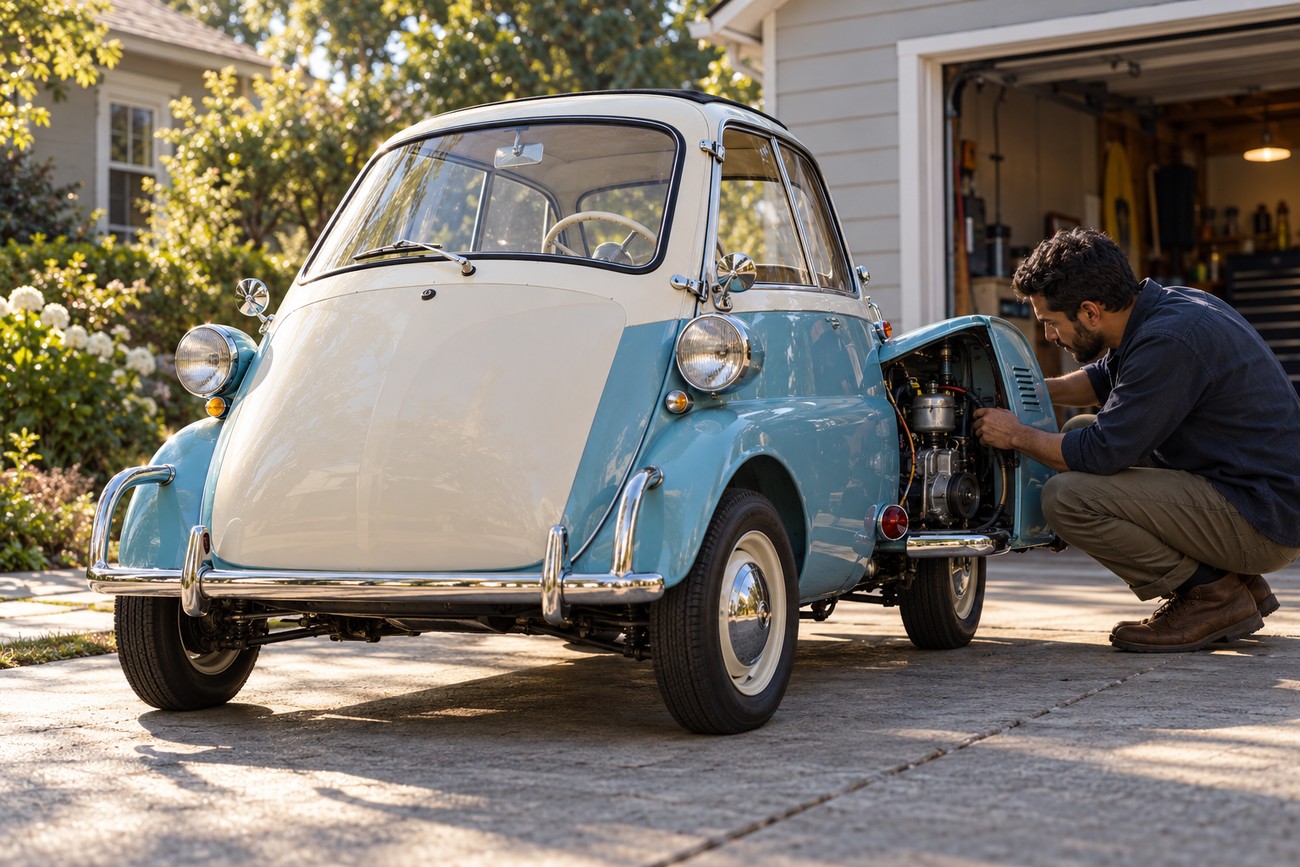
A BMW Isetta can work well as a slow urban classic, display vehicle, or occasional local runabout. Its small footprint makes short trips distinctive and manageable, provided the route suits its speed and the car is mechanically sound. It is poorly matched to regular use on fast roads, where the historical top-speed figures say little about modern traffic safety.
Reliability depends more on maintenance quality and parts planning than on the apparent simplicity of the design. Sound cylinders, hoses, linings, and the correct master-cylinder configuration matter even though the car is light. Low mass does not make a failed brake component or damaged tire harmless.
Ownership also requires version discipline. The 250 and 300 should be identified before ordering engine, brake, or suspension parts, and scarce trim may need specialist repair or fabrication. A realistic budget includes inspection, parts research, and corrective work rather than assuming that a running engine means the restoration is nearly finished.
The best example is an honest, well-documented car used within its limits. A neglected Isetta can still be rewarding, but its charm should be evaluated alongside the condition of the brakes, cooling system, door structure, underside, and hard-to-source bodywork.
Frequently asked questions
How much is a BMW Isetta worth today?
There is no universal value because condition, originality, completeness, restoration quality, and regional demand can change the result substantially. A complete, correctly restored car is assessed differently from a running project, an incomplete shell, or a modified example with uncertain history.
Inspectors should separate cosmetic appeal from usable value. Missing chrome, curved body panels, seals, correct mechanical parts, and sound brakes may cost more to resolve than an attractive paint finish suggests. Comparable cars in the same market and specification provide a better guide than a single advertised figure.
Who made the original Isetta?
Iso SpA created the original Isetta. BMW later produced its own version under license and developed it with BMW-specific engineering, including the air-cooled single-cylinder engines derived from the BMW R25 motorcycle design.
This distinction helps with research and parts identification. An early Iso-based history and a BMW-built car may share the bubble-car concept while differing in mechanical details, production records, and restoration requirements.
How many BMW Isettas are left?
No single authoritative worldwide count of surviving BMW Isettas exists. Records may count cars that are registered, roadworthy, stored, incomplete, or reduced to project shells, and those categories are not interchangeable.
For a buyer, the documented condition of the individual car matters more than an uncertain global total. Chassis identity, originality, completeness, restoration evidence, and the availability of scarce body and trim parts provide a more useful picture of its significance and future workload.







