
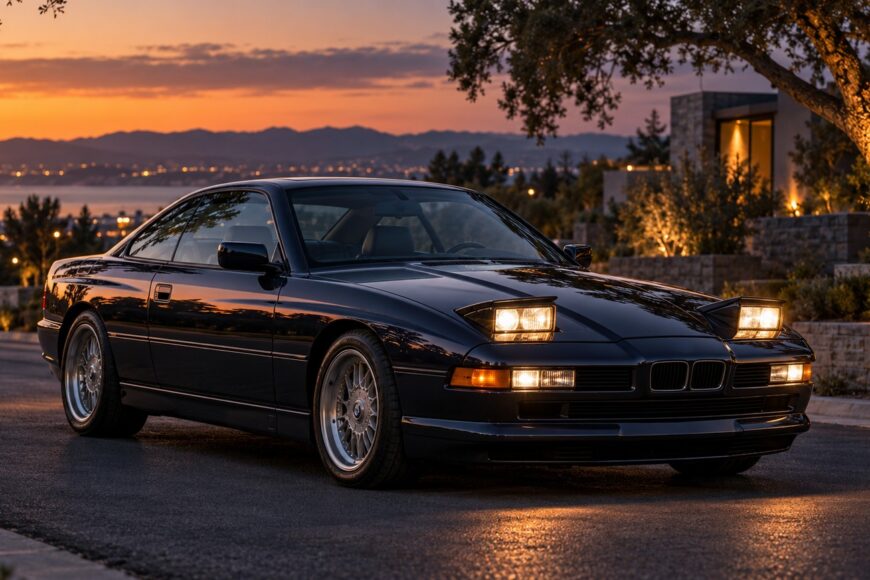
The BMW E31 remains one of the most striking V12 grand tourers of its era: low, wide, technically ambitious, and defined by retractable headlights. Its appearance suggests a supercar, yet its real brief was quieter and more demanding—covering long distances quickly, securely, and with a high level of refinement.
That appeal is inseparable from age-related cost. A used E31 can bring expensive V12 servicing, complex electrical faults, tired suspension, deteriorated seals, and scarce original parts. The difficult part is often finding a sound example rather than finding an attractive one.
- What the BMW E31 Really Is: A Grand Tourer, Not a Supercar
- BMW E31 850i and 850Ci: The Numbers Buyers Keep Misreading
- Pop-Up Headlights Are a Design Feature With a Maintenance Bill
- The Real Cost of Owning an E31 V12
- How to Inspect an E31 Before You Buy
- Which E31 Experience Are You Actually Buying?
- Frequently asked questions
- Why is the BMW 8 Series E31 so cheap compared with its original image?
- How much does a BMW E31 cost?
- What BMWs had pop-up headlights?
What the BMW E31 Really Is: A Grand Tourer, Not a Supercar
Built from 1989 to 1999, the E31 was the first generation of the BMW 8 Series. It is a two-door, four-seat coupe with proportions that still make modern sports cars look compact: 4,780 × 1,855 × 1,340 mm, a 2,684–2,685 mm wheelbase, and 140 mm of ground clearance.
Those dimensions explain much of its character. The long body, broad track, and substantial cabin create a sense of stability at speed, while the rear seats make the car more useful than a strict two-seater. The E31 feels designed for sustained travel rather than short bursts through congested city streets.
Calling it a BMW supercar is understandable, especially with the V12 and pop-up headlights, but it sets the wrong expectations. The E31 is a grand tourer: fast, composed, and comfortable over distance. Its weight and size are part of the experience, and they also mean that it will not feel as agile in town as its dramatic styling may suggest.
That distinction matters during a test drive. A healthy E31 should feel settled and substantial, with smooth power delivery and a refined cabin. It should not be judged solely by steering sharpness or launch acceleration; worn suspension, brakes, and tires can make any example feel clumsy and disconnected.
BMW E31 850i and 850Ci: The Numbers Buyers Keep Misreading
Published 850i and 850Ci figures vary by year, market, specification, and transmission. The following values are useful reference points, provided they are treated as specification figures rather than guarantees of real-world performance or economy.
| Specification | Commonly published figure |
|---|---|
| Engine | 4.988-liter V12 |
| Power | 296 hp or 300 hp, depending on year, market, and specification |
| Torque | 450 Nm |
| Drivetrain | Rear-wheel drive |
| 0–100 km/h | 6.8 or 7.4 seconds, depending on year, market, and transmission |
| Top speed | 250 km/h |
| Combined fuel economy | 10.4 l/100 km |
| City fuel economy | 19.8 l/100 km |
| Transmission availability | Six-speed manual and four-speed automatic; later automatic configurations depend on modification and market |
The difference between 296 hp and 300 hp does not automatically indicate a bad source. Published specifications can change with market requirements, production year, measurement conventions, and equipment. The same applies to the quoted 0–100 km/h time of 6.8 or 7.4 seconds.
Transmission choice changes the way the car feels as much as the headline numbers suggest. A manual car can feel more involving, while an automatic version emphasizes smooth progress and relaxed touring. Buyers should confirm the exact specification from the vehicle identification details and service records rather than relying on a generic online listing.
The 10.4 l/100 km combined figure is a commonly published reference, not a promise for ownership. Traffic, short journeys, mechanical condition, driving style, and the V12’s displacement can push real-world consumption higher. Fuel economy should be part of the budget, not a reason to reject a healthy car or excuse a poorly maintained one.
Pop-Up Headlights Are a Design Feature With a Maintenance Bill
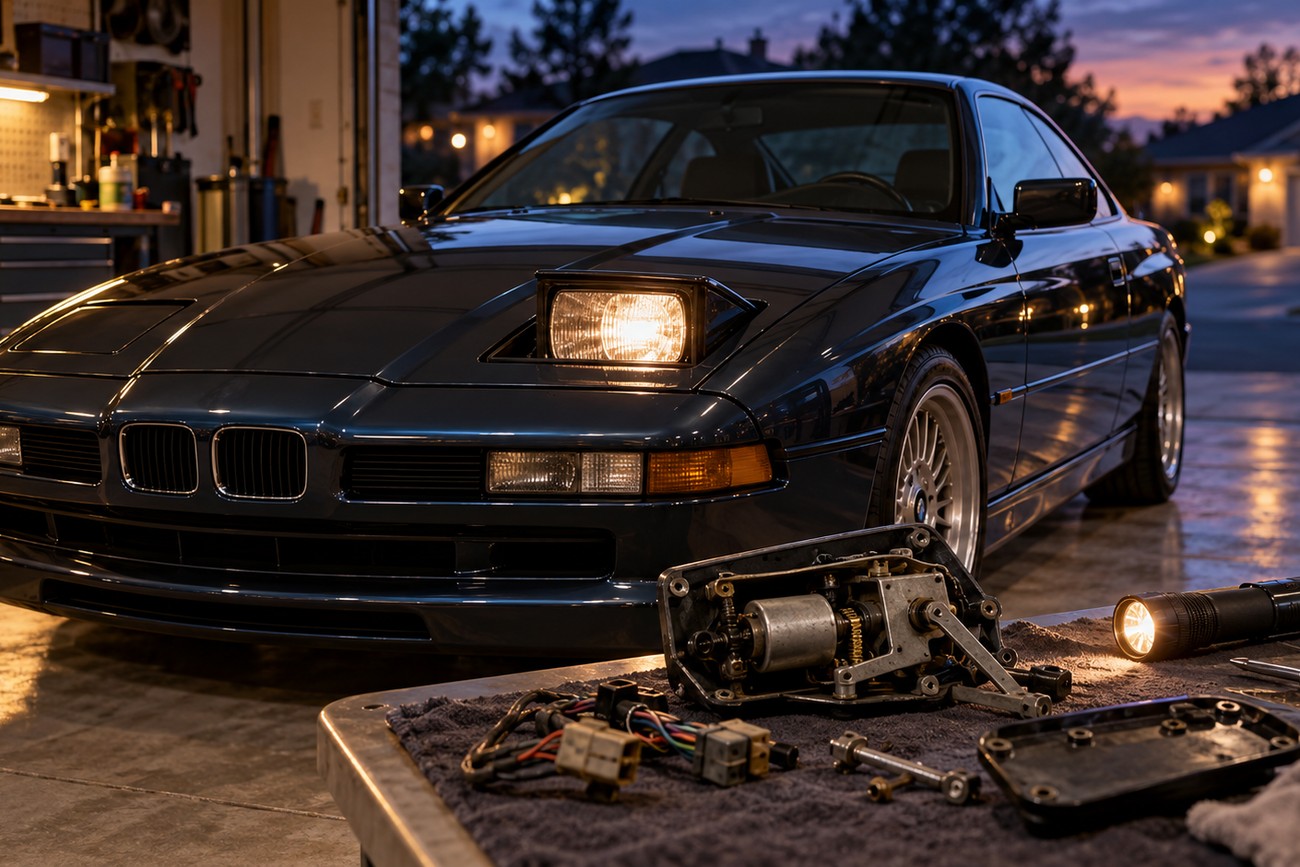
The retractable headlights give the E31 its clean, low nose and remain central to its identity. With the lamps lowered, the front end is visually smooth; raised, they turn the car into an unmistakable product of its period. Their appeal is both stylistic and functional, since the closed units reduce visual clutter and preserve the wedge-like profile.
Decades later, the mechanism is another aging system to inspect. Motors, linkages, wiring, connectors, and associated electrical components can deteriorate even when the car has covered little mileage. A headlight that moves slowly, stops unevenly, fails intermittently, or requires repeated switch operation deserves investigation before purchase.
Repeated operation matters more than a single successful demonstration: an aging headlight system may work once and still reveal weak motors, poor connections, or inconsistent switching when cycled several times.
The same principle applies to the power windows, central locking, and instrument cluster. Small electrical faults can become persistent ownership irritations, and tracing them may require more time than replacing an obvious mechanical part. A buyer should operate every switch, lamp, gauge, and locking function with the engine running and the car at rest.
Pop-up headlights should therefore be judged as working mechanical systems, not decorative equipment. Their condition will not determine the entire value of an E31, but it can reveal how carefully the previous owner maintained the car’s less visible electrical and mechanical details.
The Real Cost of Owning an E31 V12
The V12’s smoothness is one of the strongest reasons to choose an 850i or 850Ci, but it also defines the maintenance burden. Many consumables and servicing operations involve a double set of components, and access can be labor-intensive compared with a comparable V8 coupe. Expensive parts and specialist work are familiar complaints among owners for good reason.
Engine faults are only one part of the calculation. Vacuum lines, rubber components, wiring, connectors, cooling-system components, seals, and aged plastics can all create work. A V12 that starts and idles well may still need substantial recommissioning if these supporting systems have been neglected.
V12 diagnosis requires the whole aging system to be considered: vacuum lines, connectors, cooling, seals, and previous repairs can create running faults that are not caused by the engine itself.
Cooling-system condition deserves particular attention because the car’s driving character changes quickly when temperature control, hoses, or related components are no longer dependable. Suspension and brakes matter just as much on the road. A visually excellent E31 with tired dampers, worn bushes, or neglected brakes can feel heavy and vague rather than composed.
Interior plastics and seals deteriorate with time rather than mileage alone. A low-mileage car that spent years stationary may therefore need more work than a regularly used, carefully serviced example. The published combined figure of 10.4 l/100 km also needs context: real-world fuel use is often higher, particularly in city driving or when the mechanical condition is poor.
The sensible budget includes an initial period of sorting and inspection. Treating the purchase price as the full cost of ownership is how a promising E31 becomes an unwanted project. A car with clear records and consistent previous repairs can be financially wiser than a cheaper example with an attractive odometer reading.
How to Inspect an E31 Before You Buy
Begin with the service history and the quality of previous repairs. Look for evidence of regular maintenance, cooling-system work, transmission servicing, electrical diagnosis, and replacement of age-sensitive components. A coherent repair history often tells you more than the odometer, because previous workmanship can determine whether later repairs are straightforward or complicated.
Inspect the body from underneath, then examine the areas around the glass and wheel arches. Corrosion, poor repairs, and hidden damage can be expensive to correct, especially when the exterior has been prepared for sale. Panel alignment, inconsistent finishes, damaged seals, and traces of water ingress should be treated as evidence requiring further inspection rather than dismissed as cosmetic details.
Test every electrical function, including the pop-up headlights, power windows, central locking, instruments, lighting, and warning systems. Check the transmission for correct engagement and smooth behavior, and monitor the cooling system during a fully warmed test drive. A short, cold demonstration can conceal faults that appear only after the car has been operating normally.
Assess suspension and brakes separately from the engine. Uneven tire wear, steering vibration, poor body control, pulling under braking, or excessive noise can indicate deferred work. The car may still look exceptional in photographs while these systems make it unpleasant and potentially unsafe to drive.
Finally, confirm parts availability before committing to a project. Original components can be difficult to source, and aftermarket substitutes do not always match the original fit, function, or appearance. Rarity may improve an E31’s appeal, but it does not guarantee easy resale, cheap recommissioning, or a ready supply of replacement parts.
Which E31 Experience Are You Actually Buying?
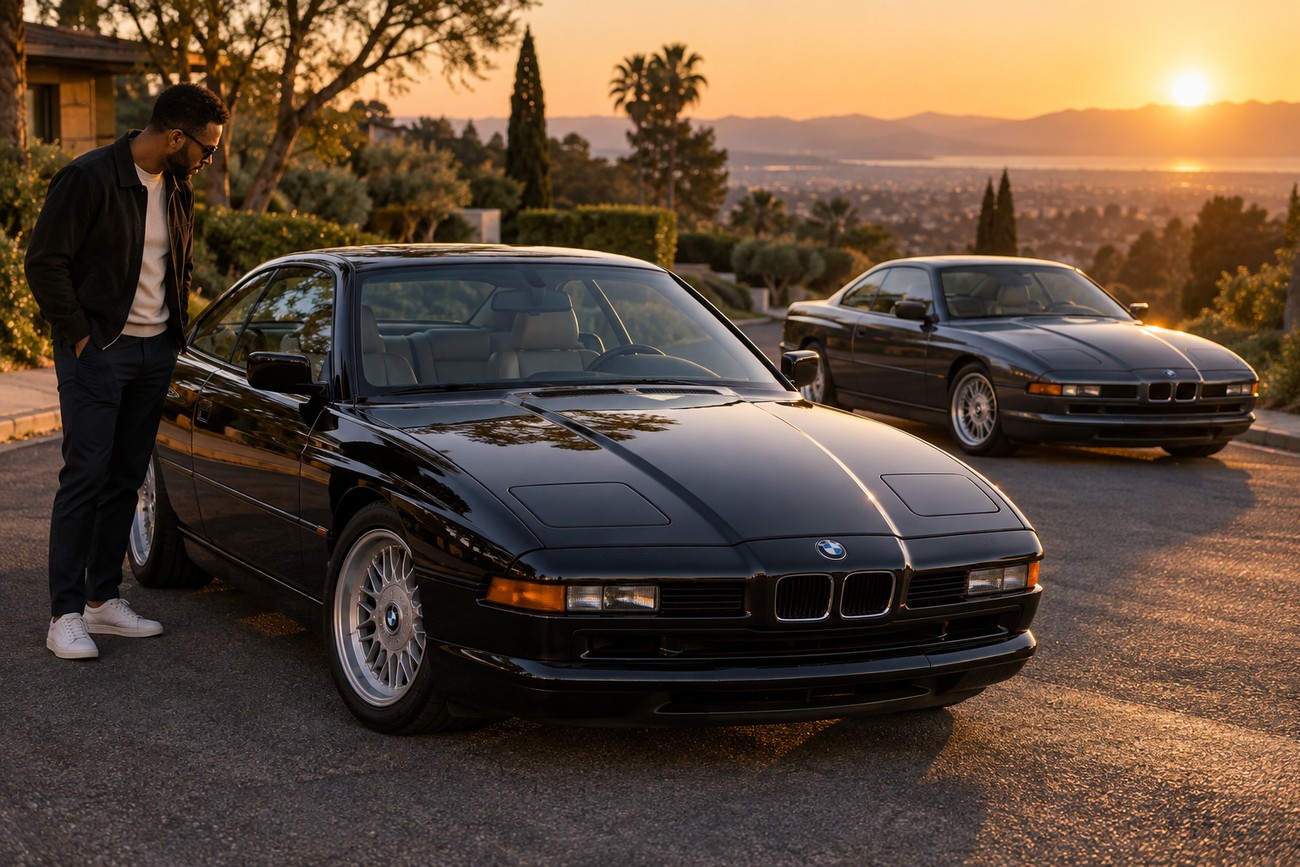
The 850i and 850Ci offer the V12 version of the E31 experience, with effortless acceleration and a particularly smooth long-distance character. The 840Ci and later versions can differ in driving feel, equipment, and ownership cost. The right choice depends on whether your priority is the V12’s character, simpler running costs, a particular transmission, or a specific market configuration.
Exact modification matters. Year, market, transmission, wheels, interior, headlights, and trim can change both the way the car presents and the way collectors judge it. Originality is especially important when comparing two cars with similar mechanical condition; altered wheels or an incomplete interior may reduce collector appeal even if the changes suit personal taste.
Later or less complex versions should not be treated as automatically inexpensive. They still carry the E31’s age-related risks: rubber components, wiring, seals, plastics, suspension, brakes, and cooling-system parts. A well-kept example in any specification is usually a better proposition than a neglected car chosen solely for its badge or engine layout.
The right buyer wants an aristocratic grand tourer for stable, comfortable long-distance travel and accepts that some examples are recommissioning projects. The E31 can be deeply rewarding when its systems work together, but it is a poor match for someone seeking effortless daily transportation with minimal maintenance involvement.
Frequently asked questions
Why is the BMW 8 Series E31 so cheap compared with its original image?
The E31 can be inexpensive to buy because its buyer pool is smaller than its visual prestige suggests, while deferred maintenance can be substantial. A striking body and a rare badge do not remove the cost of V12 servicing, electrical diagnosis, suspension work, cooling-system repairs, or aged seals.
Rarity can also make ownership harder. Scarce original parts and limited specialist knowledge may extend repair times, reducing resale liquidity. A well-documented, original, correctly specified car can attract strong interest, but rarity alone does not make every E31 easy to sell.
How much does a BMW E31 cost?
There is no useful universal price without knowing the car’s condition, specification, originality, market, transmission, and deferred maintenance. Two E31s with similar mileage can require completely different budgets if one has sound repairs and the other has corrosion, electrical faults, tired suspension, or neglected cooling components.
Evaluate the car as the purchase price plus recommissioning risk. Service records, body condition, originality of the wheels, interior, headlights, and trim, and the exact 850i, 850Ci, 840Ci, or later configuration provide a more reliable valuation framework than rarity or appearance alone.
What BMWs had pop-up headlights?
The E31 is one of the best-known BMWs with retractable headlights, and the feature is closely associated with its late-1980s and 1990s design. Its headlights form part of the car’s low, clean front-end treatment and are a major reason the coupe remains visually distinctive.
Before buying, assess them through repeated operation rather than a single demonstration. Check movement speed and symmetry, listen for abnormal mechanical noise, and inspect related wiring, connectors, switches, and electrical functions. The headlights should be treated as an aging mechanical system with maintenance needs, not merely as a styling feature.







