
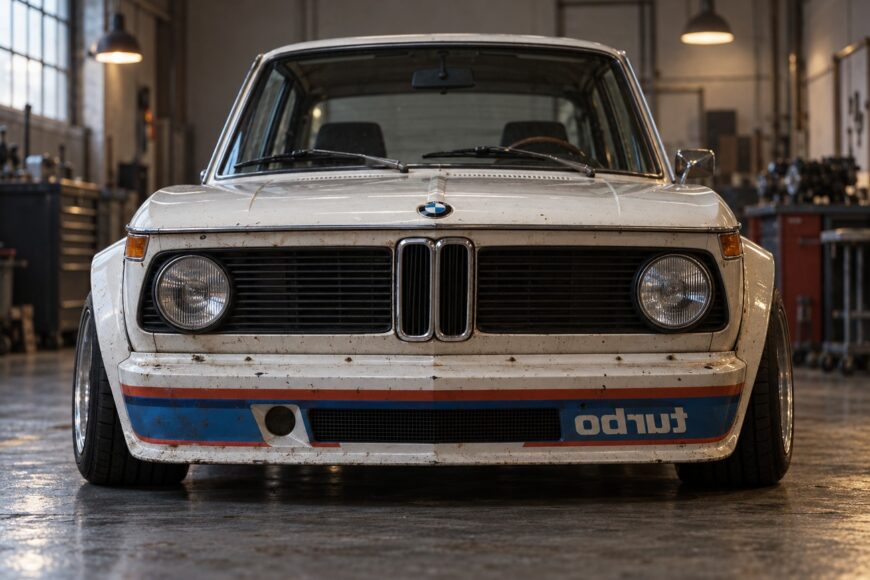
Across the front spoiler of the BMW 2002 Turbo, the word “turbo” looked backward to someone standing in front of the car. Its intended audience was farther up the road: the mirrored inscription was designed to read correctly in the rear-view mirror of a vehicle ahead. That made the lettering a road-facing message rather than a styling flourish viewed only at a standstill.
Authenticating that message is harder than recognizing it. Surviving cars have been repainted, spoilers have been replaced, and replica lettering can reproduce the reversed word. A photograph may establish that a car wears mirrored lettering while revealing little about the age of the graphic or the spoiler beneath it.
- Why the BMW 2002 Turbo Used Mirrored Lettering
- What the Front Spoiler Reveals About Originality
- The Restoration Mistakes That Change the Car’s Identity
- How to Judge a Mirrored Turbo Spoiler Before Buying or Restoring
- What Is Certain—and What Remains Disputed
- Frequently asked questions
- How rare is a BMW 2002 Turbo?
- How much is a BMW 2002 Turbo worth today?
- How much horsepower did the BMW 2002 Turbo have?
- Which BMW 2002 model is the most desirable to collectors?
Why the BMW 2002 Turbo Used Mirrored Lettering
Produced in 1973–1974, the BMW 2002 Turbo used a mirrored “turbo” inscription intended to read correctly in the rear-view mirror of a vehicle ahead. Read directly from the front, the letters look reversed. The arrangement makes sense from the viewpoint of the driver the inscription was meant to reach.
The message sat on a prominent front spoiler, an aerodynamic element that also shaped the 2002 Turbo’s distinctive bodywork. Together with the widened arches, it gave the car a broader, more assertive face than a standard 2002. The graphic drew attention to the feature that made this version unusual: it was BMW’s first series-production European turbocharged model.
Visibility was still conditional. The height of the spoiler, the distance between cars, and the angle of the mirror all affected how clearly the word appeared. A modern photograph taken from above the nose can make the lettering seem oddly placed, even when the intended viewing angle explains it.
What the Front Spoiler Reveals About Originality
Mirrored lettering alone does not prove factory originality. A convincing assessment considers typography, dimensions, placement, construction, finish, fit, and provenance together. Replicas can reverse the word as readily as an original graphic; differences in letter proportions or position may be more revealing.
The spoiler itself deserves equal scrutiny. Its profile and mounting geometry must suit the 2002 body, and its edges and attachment points should be inspected rather than inferred from a frontal photograph. A compatible-looking part may be a later replacement or a replica, even if its lettering closely resembles a documented example.
Age can complicate the evidence. Fading may weaken a surviving graphic, while a repaint or renewed decal may make an older spoiler look unexpectedly crisp. Several rounds of repair can leave a mixture of old construction and new finish, so the age of one element cannot safely be assigned to the whole assembly.
The Restoration Mistakes That Change the Car’s Identity
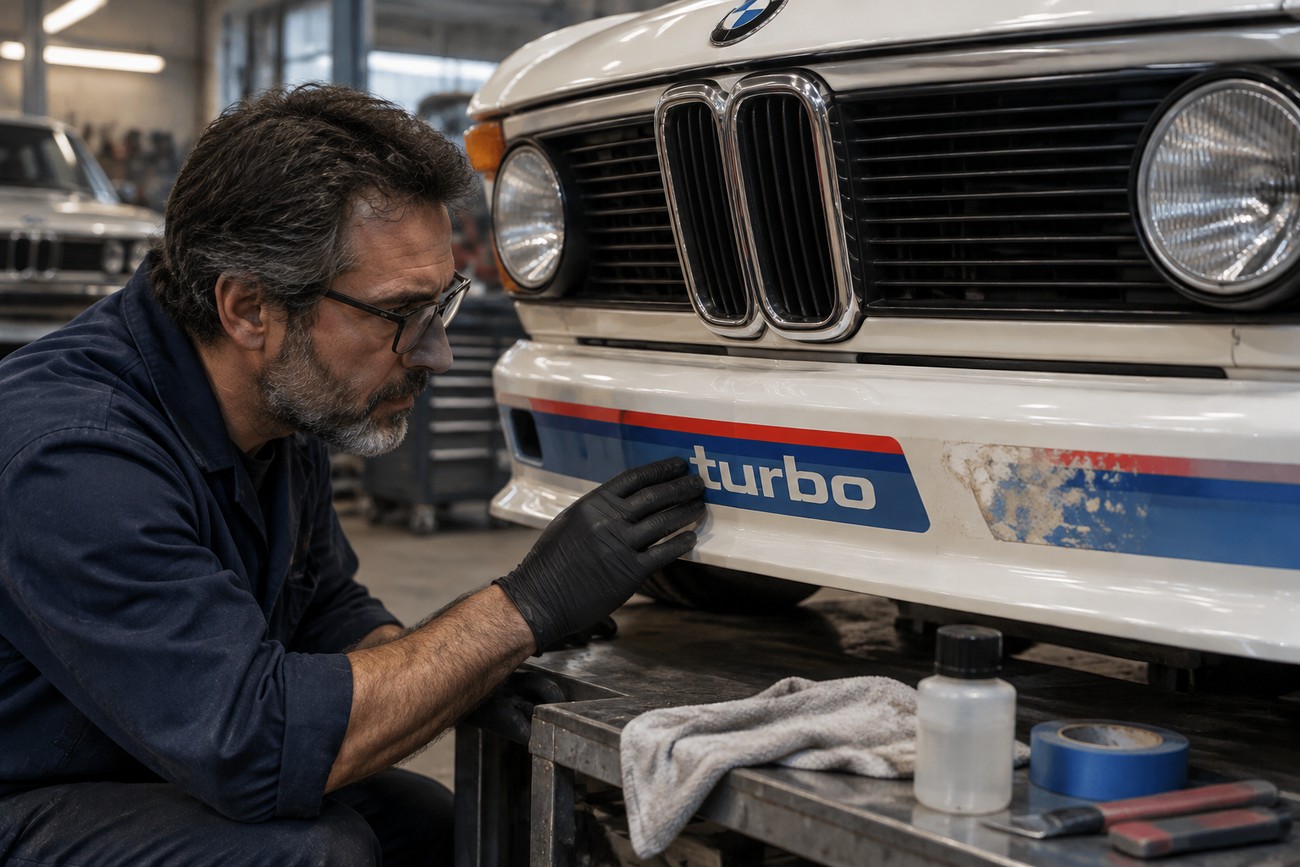
Applying a normally readable “turbo” inscription changes the period presentation: it will read backward in the mirror for which the mirrored graphic was intended. A subtler error is a reversed word drawn in a modernized type style. Letter shape, scale, spacing, and how far the graphic extends across the spoiler all affect the result.
Stripping and repainting before documenting the surface can remove evidence of earlier decals, paint layers, and repairs. That evidence may be untidy, yet it helps distinguish a surviving treatment from a later interpretation. Fresh paint cannot restore a history that was never recorded.
Fit is another place where appearance can mislead. A spoiler may look persuasive in a carefully cropped auction image while sitting poorly against the body or relying on altered mounting points. Marketing photographs can also conceal a replacement part behind polished paint and a correctly reversed word; neither establishes its origin.
How to Judge a Mirrored Turbo Spoiler Before Buying or Restoring
Start with close, level photographs of the entire front, both spoiler ends, the lettering, and the mounting areas. Ask for views taken at spoiler height as well as slightly above it. Camera height and angle can change the apparent spacing and position of the mirrored word, so a single dramatic three-quarter image is a weak reference.
Compare letter forms and placement with documented period photographs or well-documented reference cars rather than generic internet images. Check the spoiler’s edge shape, fasteners, paint transitions, and fit against the body in person where possible. These observations are most useful when considered together.
Ask the seller for records that connect the part and its finish to the car, including earlier photographs or restoration documentation where available. Treat descriptions such as “original turbo spoiler” as claims to verify. Visual similarity is evidence, but provenance and physical inspection are needed before making a confident attribution.
What Is Certain—and What Remains Disputed
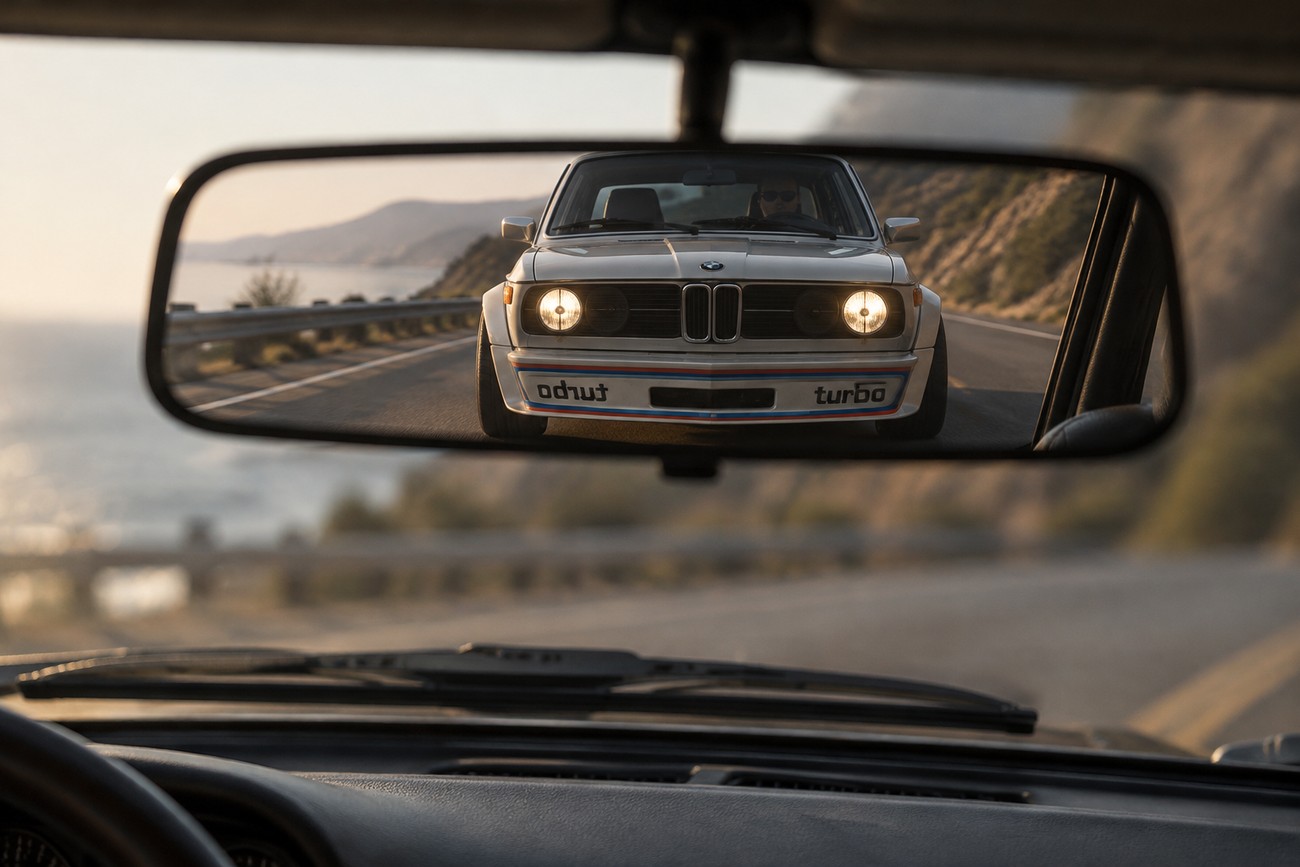
BMW 2002 Turbo production ran from 1973 to 1974, and the model’s run was limited and short-lived. Its quick withdrawal is commonly discussed in the context of the oil crisis and concerns about the image of a conspicuously powerful car. Exact production totals vary across sources, so one unsupported figure should not carry an originality argument.
The purpose of the mirrored inscription is clear: it was intended to read correctly in the rear-view mirror of a vehicle ahead. The surviving evidence is less tidy on whether every car, across markets and subsequent ownership histories, received an identical spoiler and graphic treatment. Replacement parts and restorations make present-day comparisons especially difficult.
Some specialist discussions raise the possibility that lettering on certain cars was dealer-applied or added later. That remains a reported view, not a rule to apply to every example. For an individual car, documented history and the physical evidence on its spoiler matter more than a blanket claim about all surviving 2002 Turbos.
Frequently asked questions
The mirrored inscription is one part of the 2002 Turbo’s appeal, but it does not determine rarity, performance, or value on its own. Those judgments depend on the car as a whole and on the quality of its documentation. The distinctions below are useful when comparing surviving examples.
How rare is a BMW 2002 Turbo?
The BMW 2002 Turbo was a limited-production model built during 1973–1974. Exact totals vary among references, so a single number without a clear source is less useful than documentation for the car being examined. Its ownership history, surviving components, and recorded restoration work help establish what remains of a particular example.
How much is a BMW 2002 Turbo worth today?
There is no reliable single value for every BMW 2002 Turbo. Documented provenance, a drivetrain consistent with the car’s records, restoration quality, condition, and originality of scarce trim all affect an assessment. Completed sales provide firmer market evidence than asking prices, which show what sellers hope to receive rather than what buyers paid.
How much horsepower did the BMW 2002 Turbo have?
Factory output was 170 PS, approximately 168 hp, at 5,800 rpm, with approximately 240 N·m of torque. PS and mechanical horsepower are different units, which accounts for the two power figures. An individual car’s present output may differ after decades of use or modification.
Which BMW 2002 model is the most desirable to collectors?
The 2002 Turbo is generally treated as the most historically significant and collectible performance version of the 2002 range. Its limited run, status as BMW’s first series-production European turbocharged model, and distinctive spoiler and widened arches give it significance beyond the mirrored lettering. Within that group, condition and convincing originality still distinguish one car from another.







