
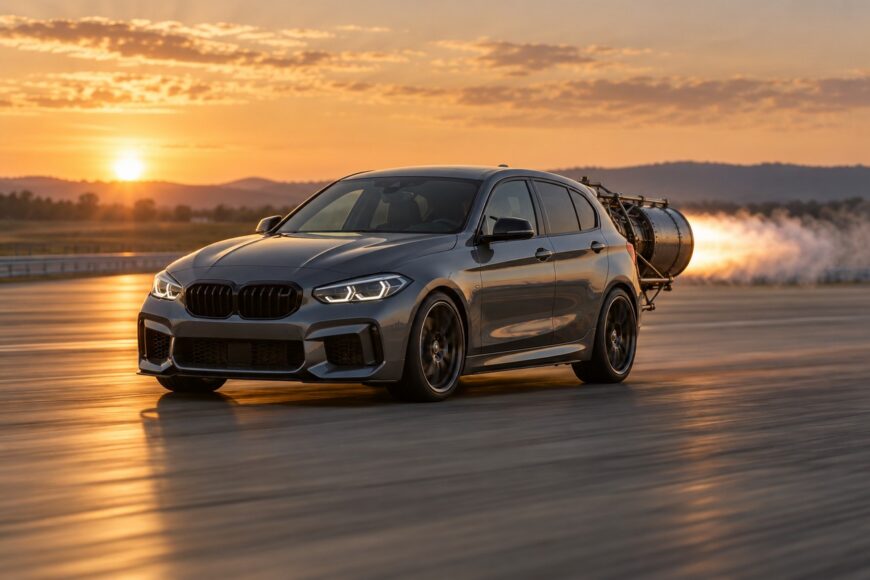
Fitting a rocket booster to a BMW 1 Series makes the idea of beating its quoted top speed easy to picture. A short burst of thrust could push the car beyond the figure listed for a production model, at least in principle. The difficult part is determining how much speed the car would gain before the burn ended, the road ran out, or the vehicle reached a limit that the engine never had to face.
The BMW 1 Series F70 M135i xDrive has a quoted top speed of up to 250 km/h. That is a production reference for a specific configuration, not a certified limit for a rocket-modified car. A booster could briefly exceed 250 km/h, but the result would not automatically be safe, repeatable, or suitable as a new top-speed claim.
Thrust alone cannot provide a credible final number. Booster mass, propellant flow, thrust, burn duration, aerodynamic drag, gearing, tires, stability, and available run length all matter. A brief acceleration burst and a speed the car can safely sustain or shed are different engineering problems.
- The short answer: faster than 250 km/h is possible, not predictable
- What a rocket adds—and what fights it at speed
- Short burn versus sustained burn: what changes
- The limits a top-speed calculation can miss
- What it would take to make a speed claim credible
- Frequently asked questions
- What’s the fastest current BMW 1 Series?
- What’s the fastest BMW 1 Series?
- What BMW goes 200 mph?
- What is the fastest rocket-powered car?
- Which years of the BMW 1 Series should I avoid?
The short answer: faster than 250 km/h is possible, not predictable
The F70 M135i xDrive provides a useful baseline because BMW quotes a top speed of up to 250 km/h for that version. Adding rocket thrust could, under suitable conditions, raise the car’s speed above that figure for a short period. It does not follow that every booster would do so, or that the car would remain controllable once it got there.
No defensible numerical result is possible without the booster mass, propellant flow, thrust, burn duration, and course conditions. The car’s starting speed also matters, as does the amount of road available before and after the burn. A heavy booster with modest total impulse could produce less useful speed than a lighter system with lower peak thrust but a longer burn.
BMW’s stated vehicle mass convention also needs care. It includes 90% fuel and a 75 kg driver and may exclude some options, so it must not be confused with dry mass or the mass of a booster-equipped car. Adding the hardware and propellant changes both the total mass and the way the chassis carries its loads.
The brochure speed is therefore a reference point rather than an answer. A short impulse might produce a measured peak above 250 km/h, while the same car could lack the stability, braking capacity, or repeatability needed to call that speed a usable maximum.
What a rocket adds—and what fights it at speed
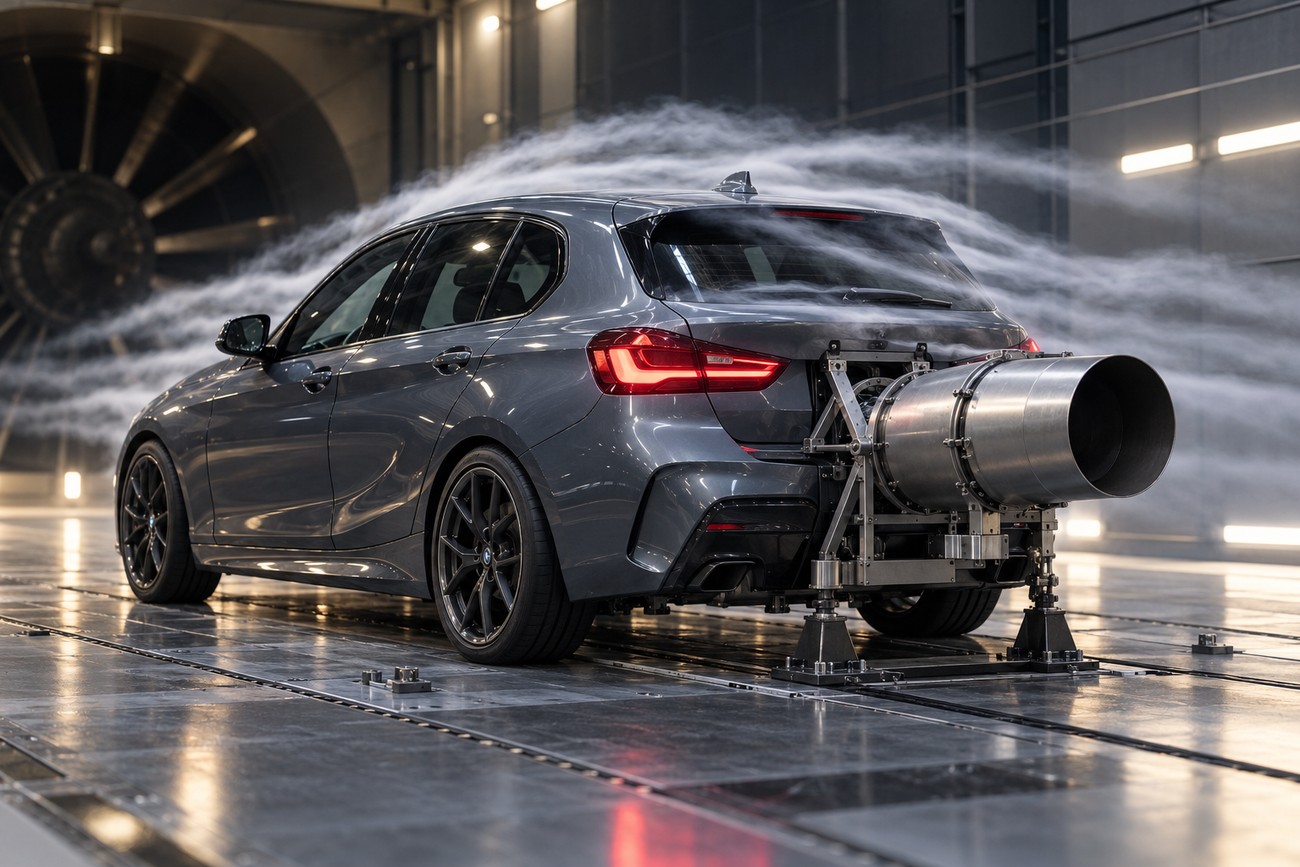
A rocket produces thrust by accelerating exhaust gases in the opposite direction. In a simplified model, approximate thrust is described by F = ṁvₑ, where ṁ is the propellant mass flow and vₑ is effective exhaust velocity. The booster’s instantaneous contribution to acceleration is approximately F/m before opposing forces are included.
That last qualification is crucial. The car must also overcome aerodynamic drag, rolling resistance, drivetrain effects, and any uphill gradient in the course. Peak thrust describes one moment; total impulse, I = ∫F dt, describes how much push is delivered over the burn. For a speed estimate, the second quantity is often more informative.
Air resistance rises rapidly with speed. The usual expression is D = ½ρCDAv2, where air density, drag coefficient, and frontal area determine the drag force. If those factors remain unchanged, drag at 250 km/h is approximately 1.56 times its value at 200 km/h, so a booster spends an increasing share of its thrust simply fighting the air.
The Tsiolkovsky equation gives an idealized velocity increment from effective exhaust velocity and the ratio of initial to final mass. It is useful for estimating the booster’s theoretical contribution, especially because the car becomes lighter as propellant is consumed. It does not by itself predict the car’s final speed, because it omits the full effects of air resistance, road length, stability, drivetrain behavior, and the car’s existing engine.
That distinction also prevents a common mistake: treating thrust in newtons as though it were an equivalent engine-power figure. Power depends on force and velocity, while a rocket’s thrust, mass flow, and operating duration can vary throughout the burn. A large initial force may create a dramatic burst without providing enough total impulse to sustain acceleration at high speed.
Short burn versus sustained burn: what changes
The following comparison keeps the outcomes qualitative because the required booster specifications are unknown. The F70 M135i xDrive’s quoted 250 km/h remains a production reference, while each modified scenario depends on its mass, impulse, and course.
| Scenario | Potential speed gain | Uncertainty | Mass change | Aerodynamic exposure | Stopping demands |
|---|---|---|---|---|---|
| Unmodified BMW 1 Series | Bound by the selected version’s engine, gearing, tires, aerodynamics, and quoted production specification | Relatively defined for a standard configuration, although real conditions still affect the result | No booster propellant is consumed | Drag continues to rise sharply as speed increases | Within the design envelope of the production configuration, subject to conditions and maintenance |
| Short booster burn | May create a brief increase above the quoted 250 km/h, but the amount cannot be predicted from the car’s brochure figures | High, because peak thrust, alignment, burn duration, and available run length dominate the result | Propellant mass changes quickly during the impulse, altering acceleration and balance | A short exposure may still create substantial drag and thermal loading at high speed | Braking begins after a high-energy acceleration event, with no booster assistance during the stop |
| Longer booster burn | Offers more potential total impulse, but drag and structural limits consume an increasing share of it | High, with greater sensitivity to heating, stability, fuel management, and course conditions | The vehicle becomes lighter as propellant is consumed, while the center of mass may shift | Extended high-speed travel increases drag, heat, vibration, and exposure to instability | Requires substantially more distance and thermal capacity to slow the vehicle safely |
The limits a top-speed calculation can miss
A booster adds more than a source of forward force. Its mounts transfer loads into the body, and the extra hardware changes vehicle mass, center of gravity, and potentially the distribution of weight between the axles. The hot exhaust can also damage bodywork, nearby components, or the road surface if the installation does not control its plume.
The thrust line matters as much as the thrust value. If it does not pass through the vehicle’s center of mass in the intended direction, it creates a pitching or yawing moment. A small alignment error can therefore alter the attitude of the car, change the loads on the tires, or initiate a directional movement that the driver has little time to correct.
Peak thrust is incomplete information unless its line of action is checked against the vehicle’s center of mass. A force that looks acceptable in a spreadsheet can become a stability problem when it produces a pitching or yawing moment.
Direct rocket thrust does not have to pass through the driven tires, so it is incorrect to treat tire traction as the only path for transferring booster force to the road. Tire grip remains essential for steering, stability, and braking. If the tires are unloaded by pitch, overheated, or operating beyond their available grip, added thrust may lead to a loss of directional control rather than useful, controllable speed.
Engine gearing and rev limits are also different from the limits on a rocket-propelled vehicle. A rocket can continue pushing after the engine and transmission have reached their normal speed range, but the driveshafts, suspension, wheel bearings, tires, body mounts, and aerodynamic balance still face new loads. The quoted 250 km/h for the F70 M135i xDrive does not certify a rocket-modified car at that speed.
Stopping is a separate part of the problem. Kinetic energy rises with the square of speed, while braking depends on tire grip, brake temperature, surface condition, and the available distance. A car that gains speed quickly can reach a state in which the standard brakes overheat or the tires lose grip before the car stops safely.
What it would take to make a speed claim credible
An ideal calculation starts with a defined vehicle mass, booster mass, propellant load, mass-flow history, effective exhaust velocity, thrust curve, drag area, rolling resistance, drivetrain behavior, and starting condition. It can estimate an ideal velocity increment and then model opposing forces. Even a careful calculation remains a model rather than evidence that a real car can achieve the predicted speed.
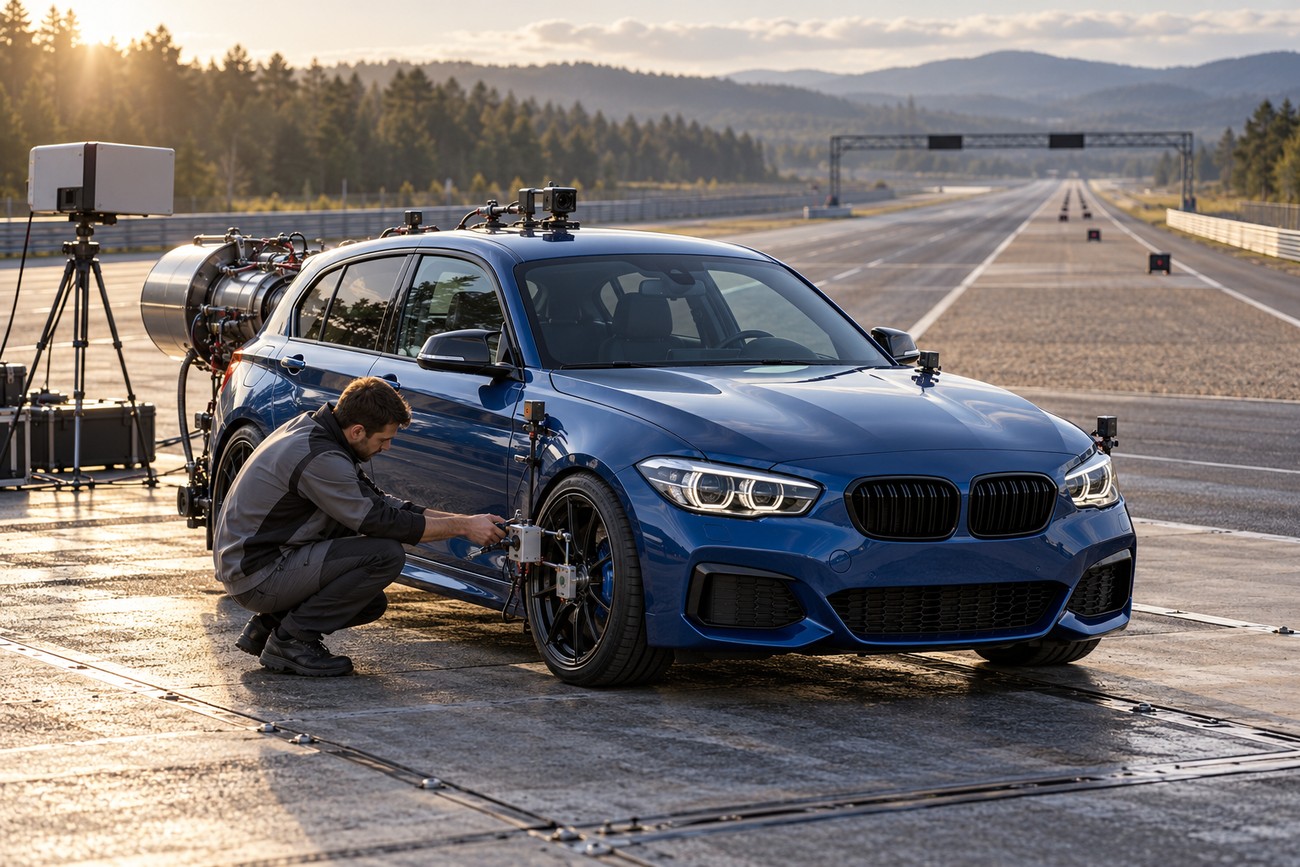
A simulated run adds a defined course, weather assumptions, surface condition, vehicle configuration, and a time history for acceleration and braking. It can reveal whether the available road is long enough and whether the car would encounter a stability or thermal limit. The simulation is only as credible as its assumptions, particularly the thrust direction and aerodynamic data.
A measured result requires an independent speed measurement, a clearly documented vehicle configuration, and repeatable conditions. Course length, wind, temperature, tire state, fuel and propellant load, and the point at which speed is recorded can all affect the result. A single peak reading is not the same as a safely sustainable or repeatable top speed.
The practical verdict is narrow. A rocket booster could briefly push an F70 M135i xDrive beyond its quoted 250 km/h, but neither the magnitude of that increase nor a safely achievable maximum can be established from BMW’s brochure figures. Without the booster specifications and a controlled, properly instrumented test environment, any precise headline number would be speculation rather than engineering.
Frequently asked questions
What’s the fastest current BMW 1 Series?
The F70 M135i xDrive is the performance reference in the current BMW 1 Series range, with a quoted top speed of up to 250 km/h. That figure applies to the specified production version and should not be extended automatically to every F70 model or every equipment configuration.
It also describes a production car, not a modified vehicle with a rocket booster. A modified car might record a higher peak speed, but that would require separate evidence and would not change BMW’s quoted production specification.
What’s the fastest BMW 1 Series?
The answer depends on whether “fastest” means the highest quoted top speed, the quickest acceleration, or the fastest example from any generation. For the current F70 range, the M135i xDrive is the relevant top-performance model, with a quoted top speed of up to 250 km/h.
Older 1 Series generations used different engines, drivetrains, and performance specifications, so a single claim for every 1 Series requires a defined comparison. A rocket-modified car belongs to a separate category and cannot be ranked from production data alone.
What BMW goes 200 mph?
Two hundred miles per hour is approximately 322 km/h, which is substantially above the quoted 250 km/h for the F70 M135i xDrive. That makes the F70 1 Series an unsuitable basis for a factory 200-mph claim; a tuned or specially prepared BMW would need its own verified specification and test result.
Conversion alone does not establish performance. A speed claim at that level also needs a reliable measurement, a defined vehicle configuration, and evidence that the car remained stable and could stop under controlled conditions.
What is the fastest rocket-powered car?
A historic benchmark is a purpose-built rocket-powered land-speed car such as the Blue Flame, rather than a modified road hatchback. Such vehicles are designed around a controlled land-speed course, dedicated propulsion, specialized structure, and high-speed stability requirements.
That comparison does not provide a prediction for a BMW 1 Series. A road car retains its original packaging, tires, suspension, body structure, and braking constraints, while a purpose-built land-speed vehicle is engineered around the propulsion system from the beginning.
Which years of the BMW 1 Series should I avoid?
There is no responsible universal list of years to avoid without specifying the generation, engine, transmission, market, maintenance history, and intended use. Reliability and ownership risk can vary within the same model year, so a documented inspection is more useful than a blanket rule.
For a purchase decision, check the vehicle’s service records, accident history, recalls, drivetrain behavior, cooling system, tires, brakes, and evidence of modifications. A rocket conversion would introduce an entirely separate set of structural, thermal, legal, and safety concerns beyond normal used-car evaluation.







