
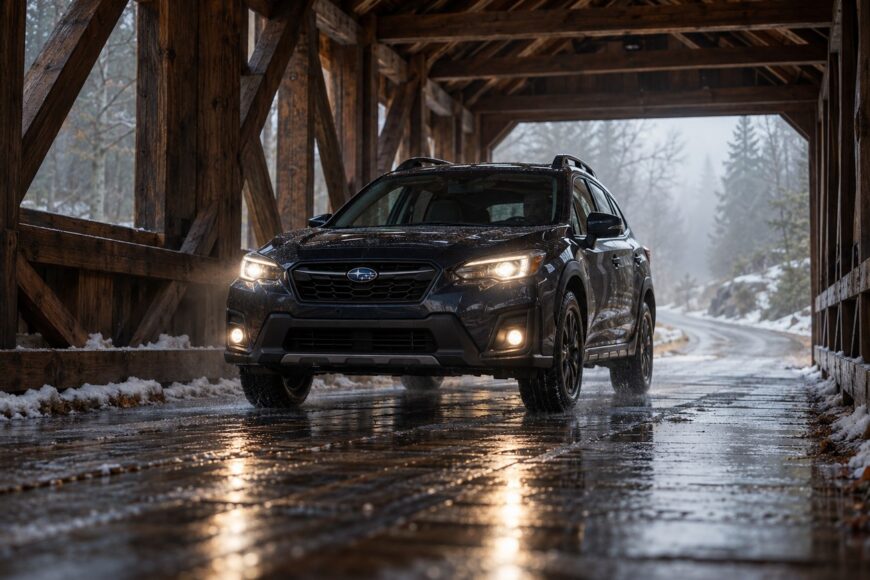
A covered bridge can look merely wet while your Subaru suddenly loses grip. Black ice is a thin, nearly invisible layer of ice that often looks like wet asphalt, especially in shade, fog, or weak light. The first warning may be a light movement at the rear, a sudden ABS response, or a steering wheel that no longer feels connected to the road.
Subaru AWD can help the car get moving and distribute engine torque, but it cannot create braking or cornering grip. The safest response is controlled preparation: slow before the bridge, straighten the wheels, and make every steering, throttle, and brake input smooth and small.
- Why a Covered Bridge Can Be Icy When the Road Looks Wet
- What Subaru AWD, ABS, and ESC Can—and Cannot—Do
- How to Cross a Covered Bridge Without Losing Control
- The Mistakes That Turn a Slick Bridge Into a Crash
- Frequently asked questions
- When should you worry about black ice?
- At what temperature do you get black ice?
- What should you do if your Subaru hits black ice?
Why a Covered Bridge Can Be Icy When the Road Looks Wet
Bridge and overpass surfaces can cool from above and below, so they often freeze earlier and thaw later than ordinary road surfaces. The structure loses heat to the air around it, while the road beside it may retain warmth from the ground. This is why a bridge can be slippery even when the approach feels normal.
A covered bridge adds another layer of risk. Its roof reduces solar warming, and the shade inside helps ice persist. Fog, light rain, or melting snow can leave a thin film of moisture that freezes on the colder surface. The result may still resemble ordinary wet pavement.
The road surface can be below 0°C while the reported air temperature is slightly above 0°C. There is no need for severe frost before a bridge becomes hazardous. Local moisture, wind, shade, and the temperature of the bridge structure can matter more than the general forecast.
The first few meters, joints, and entry or exit transitions deserve particular attention. Grip may change quickly from dry to wet to icy, and the covered section can remain frozen longer than the road outside. Treat the appearance of water as uncertain whenever the bridge is shaded or the weather is close to freezing.
What Subaru AWD, ABS, and ESC Can—and Cannot—Do
Subaru AWD can improve propulsion and torque distribution, especially when starting or climbing. That benefit is easy to mistake for overall ice safety. AWD does not shorten braking distance on black ice and does not guarantee cornering grip when the tires are sliding sideways.
At 30–40 mph (50–65 km/h), stopping distance on black ice may increase several-fold compared with dry pavement. ABS generally helps you retain steering control during hard braking, while ESC can help manage a developing skid. Neither system can create traction beyond the physical limit of the road surface.
Rear wheels may lose grip first under acceleration. Hard braking or abrupt steering can overwhelm all four tires at once, even if the engine is delivering power smoothly. Electronic intervention may feel like pulsing, tugging, or delayed response, which can confuse a driver into making larger corrections.
Use these systems as a safety net, not as permission to maintain normal speed. Their job is to help preserve control after grip begins to disappear; your job is to avoid spending that limited grip suddenly.
How to Cross a Covered Bridge Without Losing Control
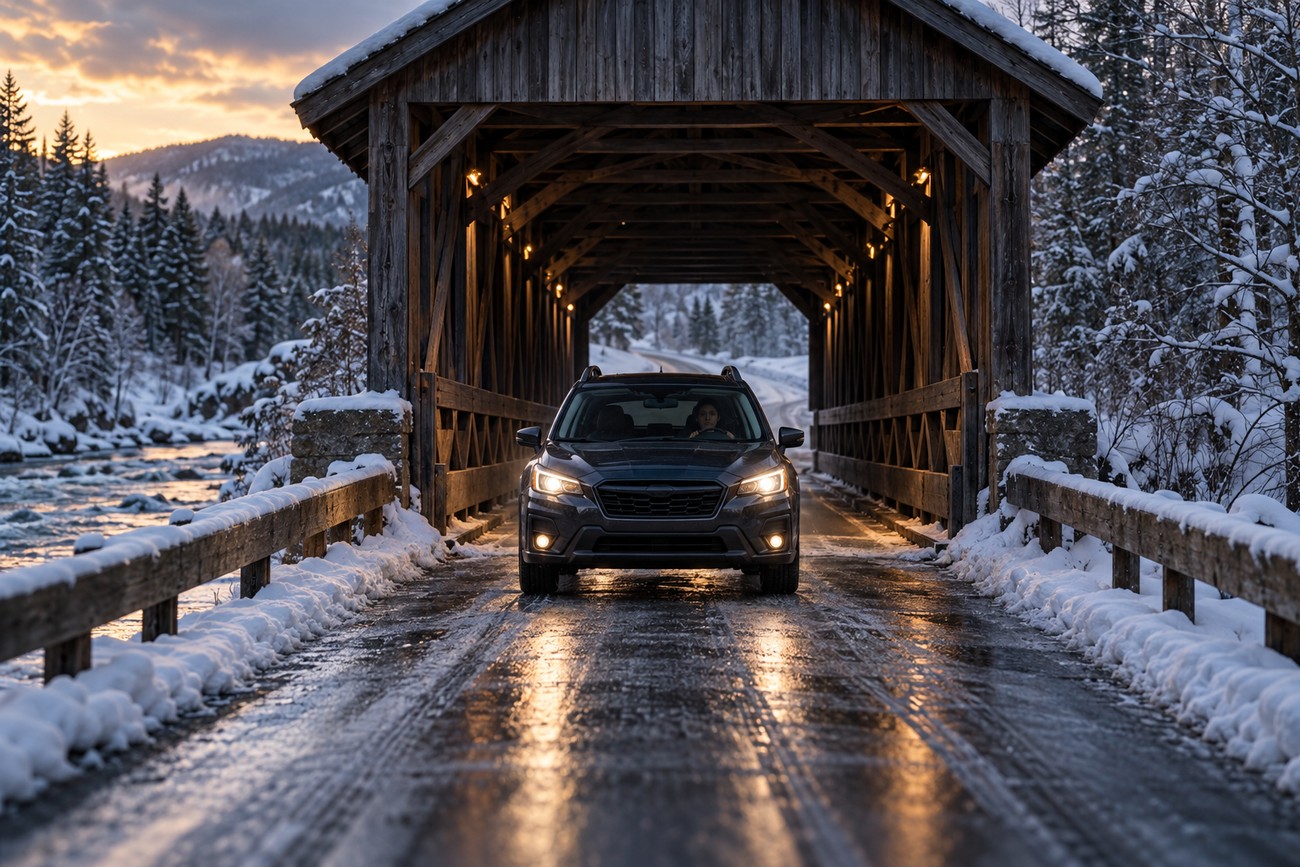
Reduce speed before the entrance, while the tires still have predictable grip. Finish most braking on the approach, straighten the wheels, and leave a large space from the vehicle ahead. Enter at a moderate speed that you can maintain without chasing the accelerator or brake.
Keep both hands steady and look through the bridge toward the intended path. Use minimal steering, throttle, and braking. A steady input gives the tires the best chance to share their limited grip; accelerating hard to “get across” can make the rear wheels lose traction first.
Enter with the wheels already straight and hold one calm, steady input rather than chasing small ESC or steering corrections as grip changes.
Expect uneven traction at joints, shaded patches, and the first and last meters of the covered section. Do not react to every small sensation with a new steering movement. If the car begins to slide, ease off excessive throttle or braking, keep the correction small, and look where the vehicle should go.
Wait for grip to return before making a larger adjustment. Avoid turning the wheel sharply or stamping on the brake. Once the tires regain contact, slow further in a straight line and increase the space around the car before continuing.
The Mistakes That Turn a Slick Bridge Into a Crash
Entering at normal road speed is the common starting error. A surface that looks wet is not proof that it is free of black ice, and the driver may discover the problem only after braking or changing direction. Speed should be reduced before the bridge, not after the car begins to slide.
Another mistake is correcting with the wheels turned. A sudden brake application, throttle lift, or steering input can exceed the available grip on the icy section. AWD may still propel the car, but it cannot prevent sideways movement or shorten the stopping distance.
ABS and ESC improve control, yet they cannot overcome the physical limit of black ice. After a scare, driving excessively slowly can create pressure from following traffic and lead to a rushed maneuver. Choose a controlled speed, keep a clear escape space, and avoid letting traffic dictate abrupt actions.
Before entering, use this short checklist:
- Slow down while the road is still predictable.
- Straighten the wheels before the entrance.
- Leave extra distance ahead and avoid passing or overtaking on the bridge.
- Hold a moderate, steady speed with gentle inputs.
- Be ready for changing grip at joints, shade, and the exit.
Frequently asked questions
Black ice is difficult to judge from appearance alone. A simple risk screen is more reliable than waiting for visible ice, especially around bridges and shaded roads.
When should you worry about black ice?
Worry about black ice near bridges, shaded pavement, fog, recent moisture, and conditions close to freezing, even when no ice is visible. A wet-looking surface may be a thin frozen film, and the bridge surface can be colder than the surrounding road.
Reduce speed before these areas and avoid sudden inputs. Extra caution is also sensible at night or in poor light, when reflections can make frozen pavement look like water.
At what temperature do you get black ice?
There is no single air-temperature cutoff that guarantees or rules out black ice. It forms when the road surface reaches freezing, and the surface can be below 0°C while the measured air temperature is slightly above 0°C.
Bridge and road-surface temperature can matter more than the reported air temperature. Shade, moisture, and the bridge structure may keep the pavement frozen after nearby roads have thawed.
What should you do if your Subaru hits black ice?
Avoid sudden braking and throttle, keep the steering correction small, and look toward the path you want the car to follow. If the car is accelerating into a slide, ease off the throttle; with ABS, maintain firm, steady brake pressure rather than pumping the pedal, and avoid panic corrections.
Wait for stable traction to return before changing direction or speed again. Once the car feels planted, create extra space and reduce speed in a straight line before continuing.







