
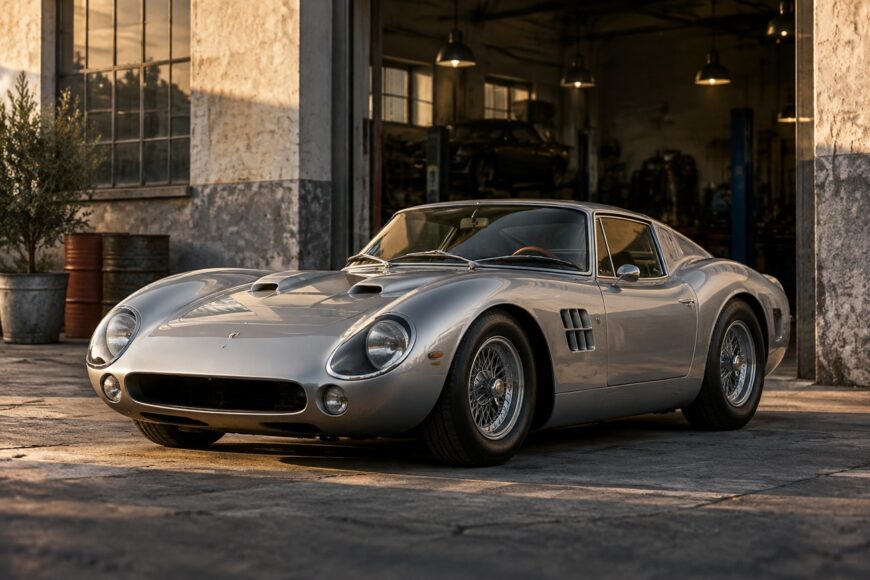
Giotto Bizzarrini helped create the Ferrari 250 GTO, then built a low Italian GT around an American Chevrolet V8. The 5300 GT Strada reads like an answer to his former employer: a fast, purposeful coupe shaped by an engineer who knew what made a front-engined Ferrari work.
“Revenge” captures the rivalry, though it should not be mistaken for a documented personal vendetta. Today, the Strada presents a different challenge. Its scarce parts, hand-built details, and blurred boundary with competition cars make any surviving example harder to assess than its Chevrolet engine might suggest.
- From Ferrari’s 250 GTO to Bizzarrini’s own GT
- An Italian shape built around an American V8
- The Strada’s performance, without inflated numbers
- Strada versus Corsa: where the legend changes
- What the low-slung layout costs an owner
- Buying and restoring one without erasing its identity
- Frequently asked questions
- How many Bizzarrini 5300 GT Stradas were made?
- What determines the value of a Bizzarrini 5300 GT Strada?
- What is the value of a Bizzarrini 5300 GT?
From Ferrari’s 250 GTO to Bizzarrini’s own GT
Bizzarrini was a Ferrari engineer who contributed to the 250 GTO, one of the marque’s most consequential competition cars. His work belonged to the engineering side of its reputation: the relationship between power, weight, chassis layout, and a body shaped for speed. That background gives the later Strada its edge as a Ferrari rival.
He left Ferrari after the company’s 1961 upheaval and later established Bizzarrini S.p.A. Describing the 5300 GT as revenge is compelling shorthand, but the engineering is more revealing than a supposed feud. Bizzarrini pursued a low, powerful grand tourer using the components and layout he judged suitable, rather than following Ferrari’s formula.
Original 5300 GT Strada production dates approximately from 1964 to 1968 and remained small-scale. Exact totals deserve caution because road cars, competition specifications, and later changes are not always separated consistently. For a buyer or historian, the useful question is therefore which chassis a claim describes, rather than how often a rounded production figure appears in print.
An Italian shape built around an American V8
The Strada is a two-seat, rear-wheel-drive coupe with its V8 mounted behind the front axle. That front-mid-engine position put a substantial powerplant farther back within the wheelbase, supporting Bizzarrini’s handling priorities. It also helped define the long, low form that makes the car recognizable at a glance.
Power came from a Chevrolet 327 CID small-block V8, displacing approximately 5.3–5.4 liters. The American engine was a practical choice: it offered substantial output without requiring a bespoke Italian V8. Its presence is central to the Strada’s character, even though familiar engine parts do little to simplify repairs to its unique chassis or body.
The body design is credited to Giorgetto Giugiaro at Bertone, while the chassis engineering is associated with Bizzarrini. That design credit should not be stretched into a claim that Bertone built or finished every individual body. On a hand-built car, construction history needs evidence tied to the chassis.
At approximately 4.37–4.39 m long and 1.73–1.76 m wide, the coupe occupies a compact footprint for its performance. Its height is approximately 1.11 m, with a wheelbase around 2,450 mm. Those proportions explain both the striking silhouette and some of the compromises awaiting anyone who has to enter it or work beneath its skin.
The Strada’s performance, without inflated numbers

Published road-car output is approximately 350–365 hp. For a Strada, a plausible weight range is approximately 1,150–1,250 kg, although the specification and condition of an individual car matter. These are useful period road-car guides, not verified measurements for every survivor.
Road-car performance is generally given as approximately 0–100 km/h in 6–6.4 seconds and a top speed of 266–275 km/h. Such figures describe an exceptionally quick GT of its era. They should still be read as published estimates, because gearing, tune, and the standard of an individual car can affect a result.
The frequently quoted 1,800 lb, about 816 kg, is disputed as a general Strada weight. Treating it as typical makes the road car appear dramatically lighter than the plausible range supports. Likewise, about 290 km/h appears in Corsa-specification or dealer claims; it is not an established universal Strada top speed.
Specifications also become muddled when a road car is described using figures from a competition build or a later engine modification. A credible description identifies the particular chassis and its configuration before quoting a number. That discipline makes the car no less impressive; it makes comparisons meaningful.
Strada versus Corsa: where the legend changes
Strada denotes the road-going 5300 GT. A car built or prepared to competition specification, one with documented competition history, and a road car converted later are distinct propositions. Their equipment and stories cannot safely be folded into a single set of “5300 GT” figures.
Claims of more than 400 hp should not be applied to every Strada; published road-car output is approximately 350–365 hp. The same boundary applies to speed: approximately 266–275 km/h is the published road-car range, while about 290 km/h is not an established universal Strada figure. A modified engine or race-oriented setup needs its own description.
The Ferrari comparison is strongest as an engineering contrast. Bizzarrini’s car paired Italian chassis thinking and a low coupe body with a Chevrolet V8, arriving at a different answer to the problem of building a fast GT. That does not, by itself, establish a victory over a particular Ferrari on road or track.
Competition-linked specification can influence collectability, but only when records support the history of the individual chassis. A later conversion may be interesting and capable without being equivalent to a car with documented period competition connections. For an owner, the distinction governs how the car should be described, restored, and valued.
What the low-slung layout costs an owner
The Strada’s low roof and deeply set engine reward the eye more readily than the mechanic. Getting into the cabin can be awkward, especially for taller occupants, and access to the front-mid-mounted V8 and nearby components is restricted. A task that sounds straightforward because it involves a Chevrolet small-block may take considerable work in this installation.
Limited ventilation and the engine’s proximity to the cabin can make a long drive hot and noisy. These are part of the road car’s competition-bred feel, rather than signs that every example is defective. A prospective owner should experience the cabin on a meaningful drive instead of judging comfort from a static inspection.
Suspension condition deserves equal attention. High-speed stability depends strongly on correct geometry and sound components; wear or poor adjustment can make the car feel nervous and demand steering corrections. That behavior should prompt investigation, not be accepted automatically as the price of driving an old GT.
Extra engine output brings its own obligations. Hotter V8 modifications can increase demands on cooling and on a BorgWarner T-10 transmission where fitted. The sensible assessment considers the whole drivetrain and the quality of the work, rather than treating a higher power claim as an uncomplicated improvement.
Buying and restoring one without erasing its identity
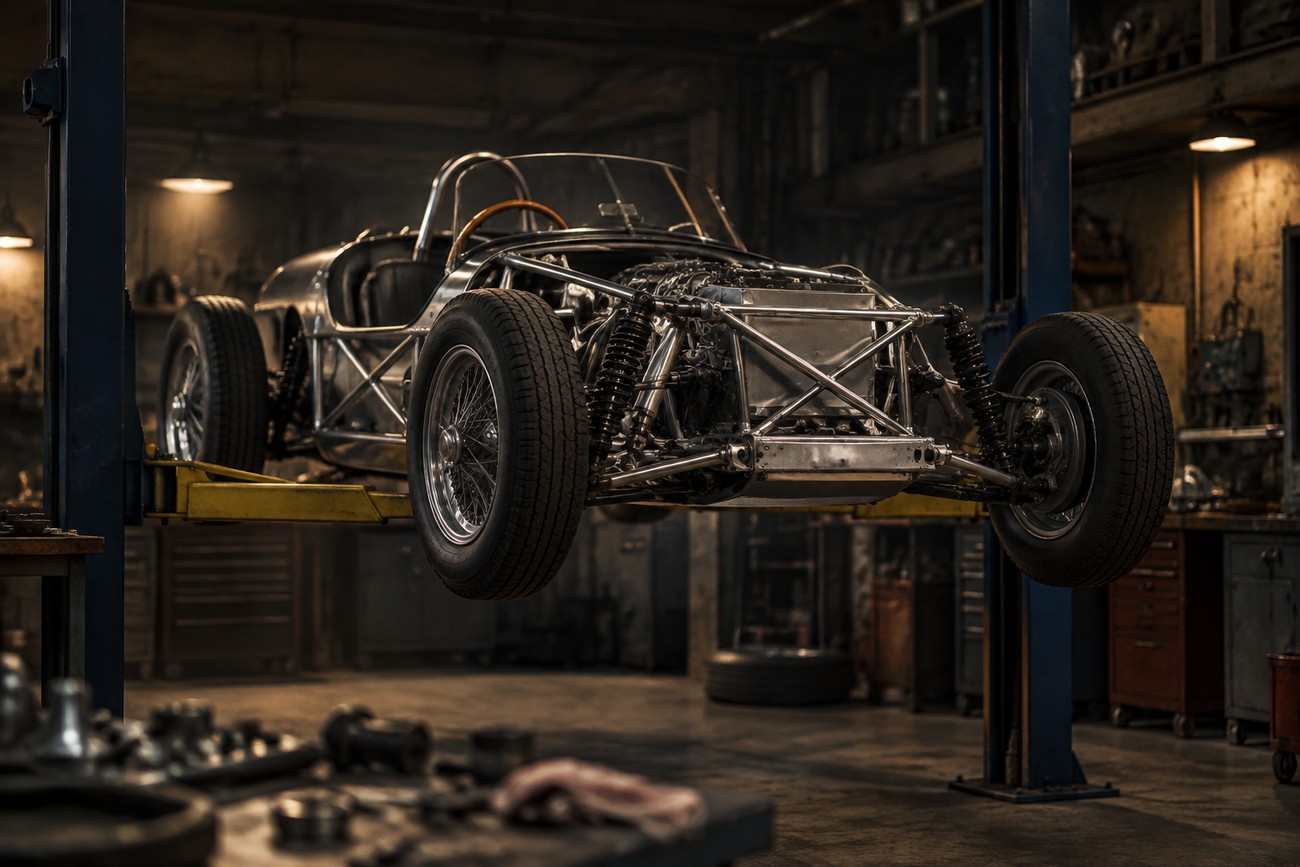
Begin with chassis identity and documented specification. Establish whether the car is an original Strada, has a supported competition connection, or has been converted later; replicas and restomods make appearances alone unreliable. Period records and a consistent account of subsequent work matter more than an attractive label in a sale listing.
Next, inspect the frame and suspension mounting points for corrosion, distortion, and past repairs. Then examine the bodywork and glass with replacement in mind: original panels and glazing are scarce, and some suspension and steering parts are specific to the model. Readily available Chevrolet engine components cannot offset a major problem elsewhere in the car.
Record chassis measurements, engine position, and suspension geometry before replacing mounts or altering the drivetrain. An apparently minor change can affect handling while making the earlier configuration harder to reconstruct.
Hand-built variation makes photographs, measurements, and part identifiers valuable restoration records. They help distinguish an original detail from a later repair and give the next specialist a reliable starting point. Any claim that a particular body was built or finished by Bertone should likewise rest on evidence for that chassis, not on the model’s design attribution.
A marque-experienced specialist can assess the Italian structure and running gear alongside the American V8. Before committing to extensive work, an owner should also establish how replacement parts and repairs will be documented. Restoring a usable car matters, but undocumented substitutions can obscure the originality that makes a rare Strada worth preserving.
Frequently asked questions
Answers about production and value depend on defining the car precisely. “5300 GT” can cover different specifications and histories, while a Strada’s identity rests on its individual chassis and records.
How many Bizzarrini 5300 GT Stradas were made?
The original Strada was built in small numbers approximately from 1964 to 1968, but the evidence here does not establish a definitive road-car total. A precise count requires a defined chassis register and a clear rule for including or excluding Corsa cars and later conversions. Without those boundaries, apparently conflicting totals may be counting different things.
What determines the value of a Bizzarrini 5300 GT Strada?
Value depends on verified chassis identity, specification, originality, condition, and documented history. An appraisal should examine restoration records and relevant comparable sales rather than begin with an unsupported headline price. Specialist valuation and insurance may be appropriate because an ordinary classic-car classification can miss distinctions that materially affect a rare Italian GT.
What is the value of a Bizzarrini 5300 GT?
There is no responsible single value for a “5300 GT” without identifying the car and its specification. A road Strada, a documented competition-linked example, and a later conversion may call for different comparisons. A useful valuation starts with the chassis and its records, then accounts for condition, originality, and the quality of any restoration.







