
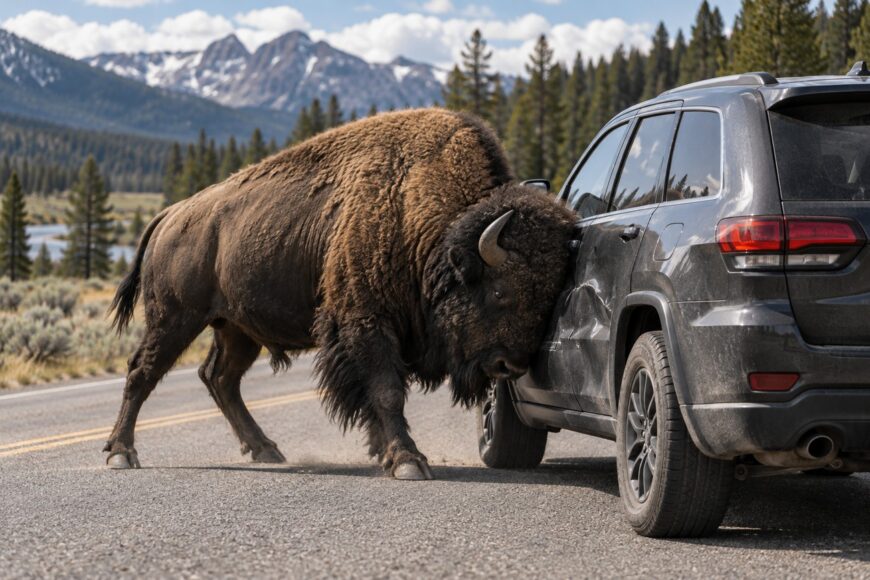
A video showing a bison head-butting a Jeep Grand Cherokee can look like an absurd traffic incident. The important lesson is more serious: a vehicle does not create a guaranteed safety boundary around people or wildlife. Bison may treat a car as an obstacle to push, strike, or move rather than as a wall they must avoid.
The individual video may not establish the animal’s identity, the exact location, or what happened before the recording began. The practical problem is clear, however. When a bison is close to a Yellowstone road, continuing forward, stopping, honking, or trying to retreat can each have consequences if the driver misreads the animal’s movement.
- What the Yellowstone bison-and-Jeep encounter shows
- Why a calm-looking bison can become dangerous
- What drivers should do when a bison approaches
- The mistakes that make a bison encounter worse
- Frequently asked questions
- What happened to the guy who was hit by a bison in Yellowstone?
- What animal injures the most people in Yellowstone?
- What should visitors do after a bison hits a vehicle?
What the Yellowstone bison-and-Jeep encounter shows
A bison striking a Jeep is not a harmless animal stunt. Yellowstone’s official minimum distance from bison is 25 yards (23 meters), including when the animal is beside a road or appears relaxed. That distance gives the animal room to move and gives visitors time to respond before a close encounter becomes physical.
Yellowstone materials describe a bison attack with the terms toss, headbutt, and gore. A bison may use its head or body against a vehicle, especially when the vehicle blocks its route or is already too close. Damage to the car can be the visible result, but the larger risk is that people may leave the vehicle, approach the animal, or become trapped beside it.
Vehicle metal is not the safety boundary. Create distance before a bison reaches the car instead of waiting to learn whether the animal will make contact.
The scene also shows why a viral clip should not be treated as a complete incident report. It may show the impact while omitting the approach, the warning signs, and the choices that placed the vehicle there. Those missing details matter more than the spectacle of the headbutt.
Why a calm-looking bison can become dangerous
Bison often appear slow and unconcerned, but appearance is a poor measure of risk. A calm animal may still react when people or vehicles enter its path, and a sudden change in direction can bring it toward a person or vehicle. Visitors should not test how close it will come or wait for a clearer sign of aggression.
Warning signs include head shaking, a fixed stare, pawing, bellowing, and a raised tail. A raised tail or sideways display is a warning signal, not a playful gesture. A bluff charge can stop short of contact and still create a dangerous close encounter, particularly for anyone standing outside a vehicle.
The bison’s direction of travel matters as much as the measured distance. An animal moving toward people or a car requires an immediate change of position, even if it has not yet crossed the 25-yard boundary. Turn away from the animal’s path rather than holding position to see whether it changes course.
That does not mean every bison near a road is attacking. It means the visitor’s decision should be based on space, movement, and warning behavior rather than on a reassuring first impression. The safest response is to increase distance early, before the animal has to choose between going around the vehicle and confronting it.
What drivers should do when a bison approaches
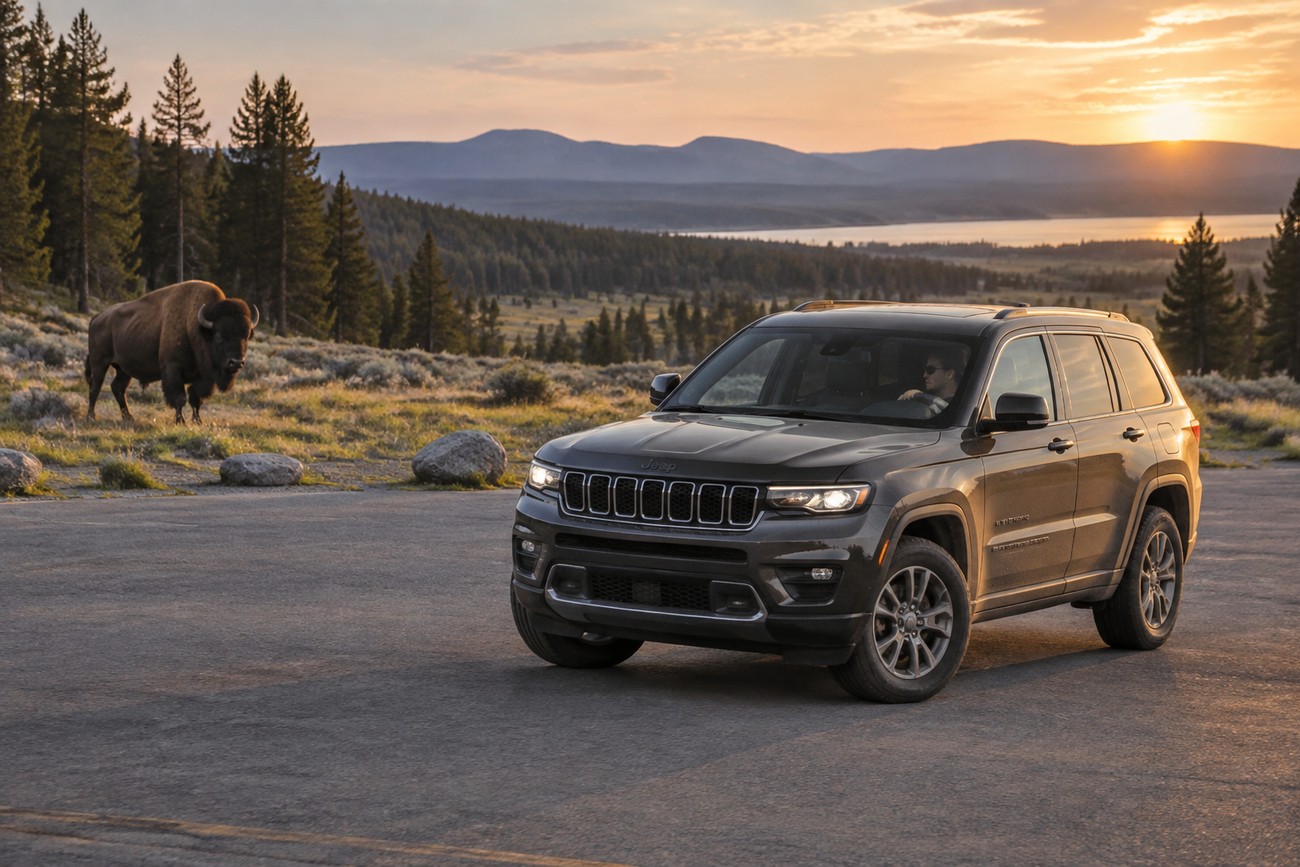
If a bison is near the road, remain in the vehicle and avoid crowding it. Stop or wait with as much space as possible, then move only when the route is clear. On park roads, the guidance is to wait, drive slowly, and not honk or pressure the animal.
If a bison comes within 25 yards (23 meters), turn around and leave; do not stand still and wait for it to move. If there is room to reverse or change direction safely, do so without sudden acceleration. Do not try to pass between the bison and the road, another vehicle, or a trail edge.
Traffic can make this harder. A line of vehicles may leave the driver feeling unable to move, but the queue does not make close proximity safe. Leave space for a retreat, follow ranger directions, and avoid adding pressure by edging forward behind the animal.
If the bison follows, retreat while using bear spray in the direction of movement and seek cover behind trees or a vehicle. Bear spray is a last-resort measure during continued pursuit, never a substitute for distance. It should not encourage anyone to approach, wait for contact, or leave a vehicle unnecessarily.
After the animal has moved away, report the conflict to Yellowstone rangers, even if the event appears minor and no one is injured. A report can help staff identify a recurring problem near a road, parking area, or viewing location.
The mistakes that make a bison encounter worse
The first common mistake is stopping for a close photograph or video. A bison that seems indifferent may turn, accelerate, or react to a person’s movement. The second is assuming the car is invulnerable and stopping close enough that the animal can reach the doors, hood, or side panels.
Honking and aggressive acceleration are also poor ways to clear a bison. Honking can startle or pressure the animal, while sudden movement can make the vehicle part of the confrontation. Drivers should wait, move slowly, and allow the bison to keep its route.
Visitors sometimes try to pass between the animal and the road or trail, especially when a traffic jam narrows the available space. That can cut across the animal’s route and place people in its path. Remaining still after head shaking, a fixed stare, pawing, bellowing, or a raised tail is another avoidable error; warning behavior should trigger retreat.
Viral clips can make repeated park warnings look like comedy because they compress a dangerous encounter into a few seconds. The absence of visible injury in a clip proves little about the risk or the missing circumstances. Any animal conflict should be reported to Yellowstone rangers, including one involving only vehicle damage or a frightening near miss.
Frequently asked questions
Short videos often leave out the date, road, and events before the camera started. The answers below separate confirmed Yellowstone safety guidance from claims about a particular viral recording.
What happened to the guy who was hit by a bison in Yellowstone?
A reliable answer requires a named primary report identifying the date, location, and person involved. Viral retellings may combine separate bison incidents, so an article should not confirm an individual’s outcome, injuries, or exact sequence from an unattributed video alone.
Readers can verify the claim through Yellowstone or National Park Service statements and reputable reporting that cites them. Regardless of the outcome in one clip, the safety rule remains the same: keep at least 25 yards (23 meters) from bison and leave if one comes closer.
What animal injures the most people in Yellowstone?
A single ranking can mislead because totals depend on the period studied and the reporting method. The immediate safety point is more useful: bison are a recurring visitor-safety concern, and they can cause severe injuries even when they initially look calm.
Yellowstone’s animal rules reflect that risk. Bison require a minimum distance of 25 yards (23 meters), while the minimum distance from bears, wolves, and cougars is 100 yards (91 meters). Visitors should follow the relevant distance rule rather than rely on a general ranking.
What should visitors do after a bison hits a vehicle?
Remain inside if possible and do not approach the bison to inspect the damage. Create distance only when it is safe to do so, and avoid stopping roadside where the animal can still reach the vehicle or people.
Once separated from the animal, notify Yellowstone rangers about the conflict, even if no one appears injured. Rangers need accurate reports of animal-vehicle encounters to respond to hazards and reinforce safe behavior in the area.







