
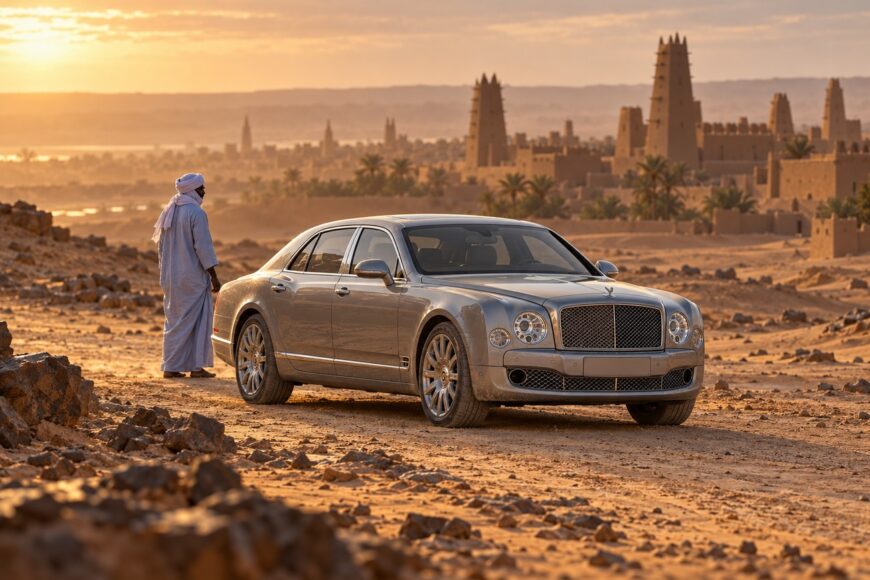
Crewe-built luxury and Saharan sand make an arresting pairing. The Bentley Mulsanne offers a hand-finished cabin, a large twin-turbocharged V8, and the visual authority of an expensive limousine; Timbuktu’s surrounding tracks demand traction, clearance, repairability, and disciplined logistics.
There is no robust official evidence confirming widespread or regular Bentley Mulsanne taxi use in Timbuktu. The reported taxi may represent a rare route, a promotional project, an isolated vehicle, or a media image. Either way, the central conflict remains clear: prestige and power do not remove the constraints of rear-wheel drive, road-focused geometry, fuel supply, parts access, and downtime.
- The Timbuktu Bentley Story: Documented Taxi or Luxury Myth?
- What the Mulsanne Brings to the Desert Route
- Why Saharan Sand Exposes the Mulsanne’s Design Limits
- The Operating Costs Hidden Behind the Luxury Badge
- Common Sand-Driving Mistakes With a Mulsanne
- What a Viable Timbuktu Taxi Would Need Instead
- Verdict: A Memorable One-Off, Not a Desert-Taxi Formula
- Frequently asked questions
- Why was the Bentley Mulsanne discontinued?
- How can you verify a claim that a Mulsanne was used as a Timbuktu taxi?
- What should happen if a Mulsanne sinks into soft sand?
The Timbuktu Bentley Story: Documented Taxi or Luxury Myth?
The phrase “Bentley Mulsanne taxi in Timbuktu” should be treated cautiously. No reliable public record establishes a regular fleet or sustained commercial operation of Mulsannes as taxis in the city. A photograph or anecdotal report may show that one car reached the region, but it cannot prove normal taxi use.
A single vehicle could have completed a carefully selected route under favorable conditions. It might also have been used for a promotional journey, a private transfer, or a one-off demonstration. Those possibilities are materially different from operating a daily passenger service over seasonal desert tracks.
The environment itself changes the meaning of any reported journey. Roads and tracks around Timbuktu are affected by rain, wind, fuel availability, and parts logistics. A car may manage one trip when support vehicles, prepared routes, and spare supplies are available, then prove uneconomic or fragile as a repeat taxi.
The most defensible conclusion is therefore limited: a Mulsanne may have appeared on a Timbuktu-related route, but regular commercial use remains unconfirmed. The story is attractive because it contrasts European limousine craftsmanship with the Sahara; its operational evidence is much weaker than its visual appeal.
What the Mulsanne Brings to the Desert Route
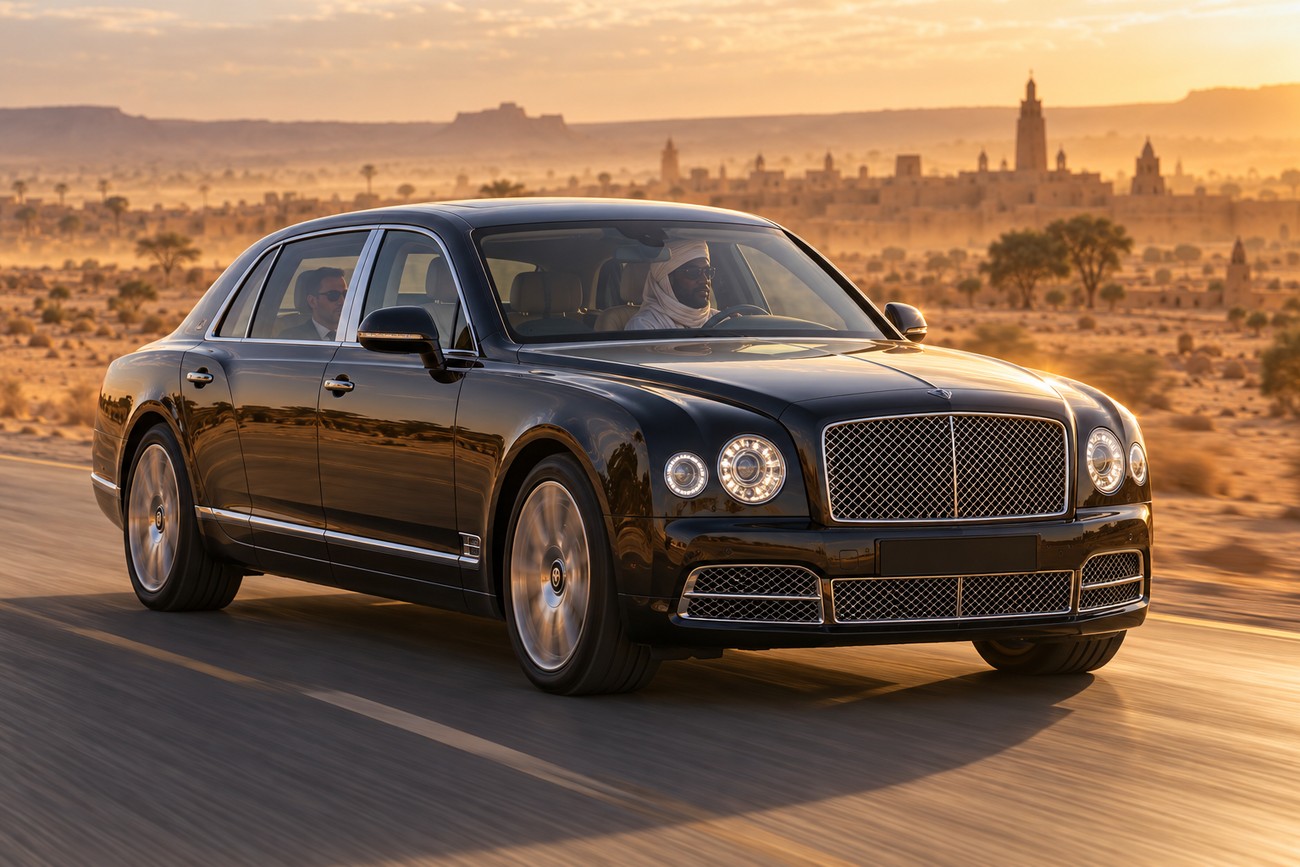
The Mulsanne’s genuine strengths are substantial on a suitable road. Its 6.75-liter twin-turbocharged V8 delivers strong low-speed torque, while late versions reached approximately 505 hp and 1,020 Nm of torque. That reserve can make highway cruising and loaded road travel effortless.
Passengers would also gain a quiet, spacious cabin with a level of seating comfort rarely associated with ordinary transport. For a ceremonial transfer or a carefully managed visitor experience, that atmosphere may have real value. Luxury can influence how a journey is perceived, even when it contributes nothing to traction.
Power, however, does not turn a road sedan into a desert vehicle. Torque must reach the ground through the available tires, and the car must maintain forward motion without digging itself into soft terrain. Excess output can simply make wheelspin more violent when grip is poor.
There is also a supply problem. Bentley ended Mulsanne production in 2020, and no new series-production Mulsannes are being made. Every desert-bound example is therefore an older, increasingly specialized asset whose condition, support network, and parts pipeline matter as much as its original specification.
Why Saharan Sand Exposes the Mulsanne’s Design Limits
A Mulsanne typically weighs approximately 2.6–2.7 tonnes, depending on version. That mass helps it feel planted on pavement, but it increases the load carried by each tire on loose ground. Once the surface gives way, the car can sink faster and require more recovery effort.
The drivetrain adds a major limitation. The Mulsanne is rear-wheel drive and was not offered with all-wheel drive. On firm tracks, that may be manageable; on soft sand, the driven rear tires can lose traction while the front axle contributes no drive force to pull the car forward.
Its clearance and geometry were designed for roads rather than regular ruts, rocks, dunes, or sand ridges. A hidden depression after wind or rain can bring the underside into contact with the ground. Once the belly is supported by sand, engine power is rarely the solution.
Factory tires and suspension settings prioritize asphalt comfort rather than low-pressure sand driving. Lower pressure can increase the tire’s footprint and improve flotation, but the original wheel-and-tire setup is not automatically suitable for that treatment. Incorrect pressure, sharp terrain, or aggressive steering can damage a tire or cause it to unseat.
The suspension’s ability to absorb a smooth road surface is another mismatch. Repeated impacts from corrugations, rocks, and uneven tracks transmit stress into wheels, suspension components, bodywork, and electronics. A comfortable ride on pavement does not demonstrate durability under continuous desert shock loads.
The Operating Costs Hidden Behind the Luxury Badge
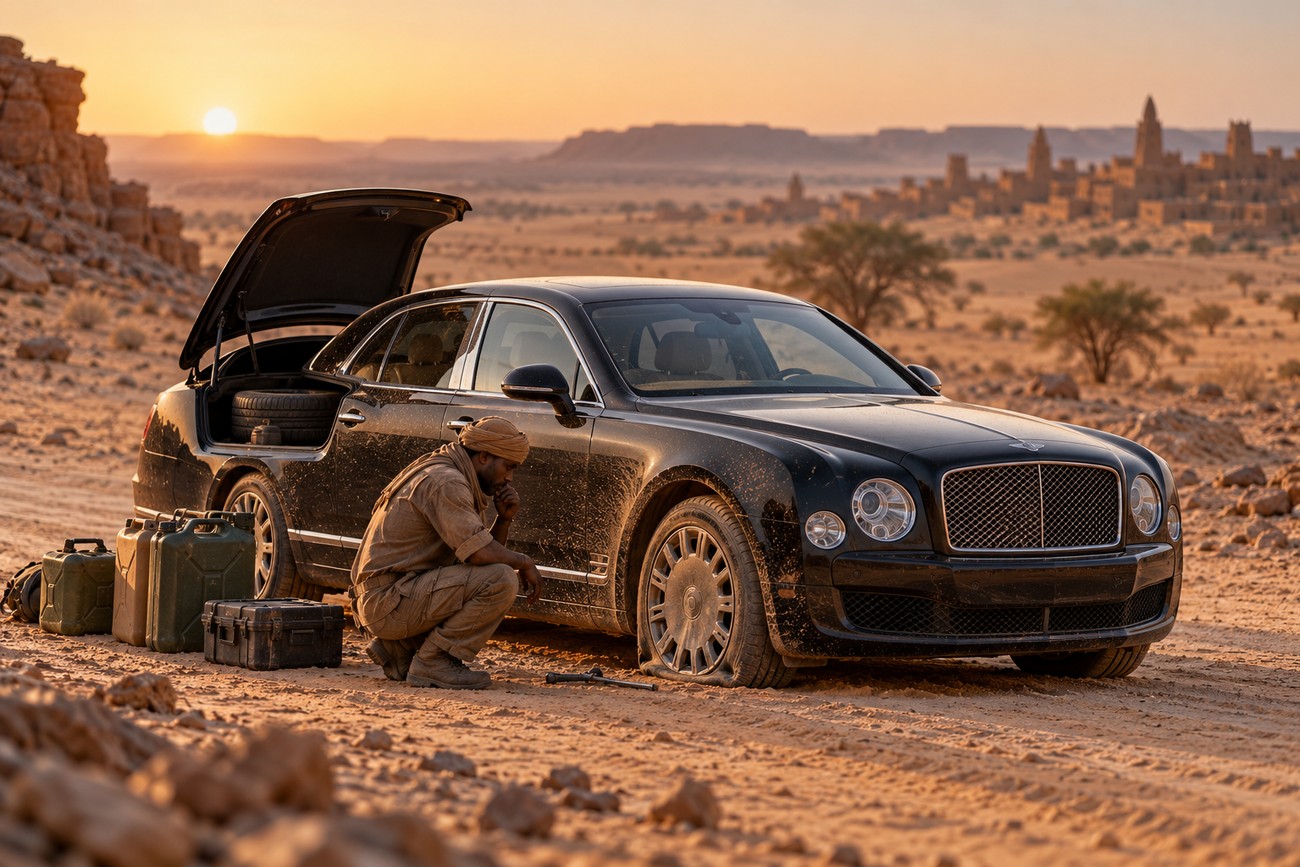
A taxi operator measures the Mulsanne by completed trips and days available for work. Fuel consumption is a major disadvantage on remote routes, where supply may require advance planning and long detours. A vehicle that needs frequent fuel stops also exposes the business to delays and greater logistical dependence.
Tires, suspension parts, and bodywork can be unusually expensive to replace after a desert incident. A puncture or sidewall cut is inconvenient for any vehicle; on a low-volume luxury sedan, the correct replacement may be difficult to source. Recovery can also damage expensive underside or suspension components if the vehicle is pulled from an unsuitable point.
Desert ownership is priced through filters, oils, tires, recovery equipment, and parts delays before anyone calculates the purchase price. A vehicle that sits immobilized while a specialist component travels across several supply routes can cost more through lost work than through the original repair.
Dust and heat widen the risk. Filters require careful attention, while slow travel in high temperatures can stress the brakes, transmission, tires, climate systems, and electronics. Original diagnostics may be unavailable locally, and parts delays can turn a manageable fault into prolonged downtime.
For a taxi, one major failure can erase a week of revenue or more, depending on the route and repair delay. That is why the real desert ownership cost is driven heavily by maintenance supplies, specialist support, recovery, and logistics rather than by the badge alone.
Common Sand-Driving Mistakes With a Mulsanne
The first mistake is treating status as capability. A prestigious sedan remains a heavy rear-wheel-drive sedan, even if its engine is powerful and its interior is exceptionally well finished. Sand rewards traction, suitable tire pressure, smooth throttle control, and retained momentum more than peak power alone.
Driving on soft sand at standard road pressure can reduce flotation and make the tires cut into the surface. Lowering pressure may help, but it requires experience, a way to monitor pressure, and a plan for reinflation before returning to firmer ground. Excessive lowering without control increases the risk of tire damage or unseating.
Wheelspin is another common failure path. Abrupt throttle inputs dig holes beneath the driven tires, remove the momentum needed to cross soft sections, and increase heat in the drivetrain and tires. Smooth inputs and early decisions are safer than trying to overpower a developing bog.
Preparation must include reserves for fuel, water, time, communication, and recovery. A route that looks short on a map may become slow after wind, rain, or surface changes. Heat also places additional stress on brakes, transmission, tires, climate systems, and electronics, so a successful departure does not guarantee a safe return.
What a Viable Timbuktu Taxi Would Need Instead
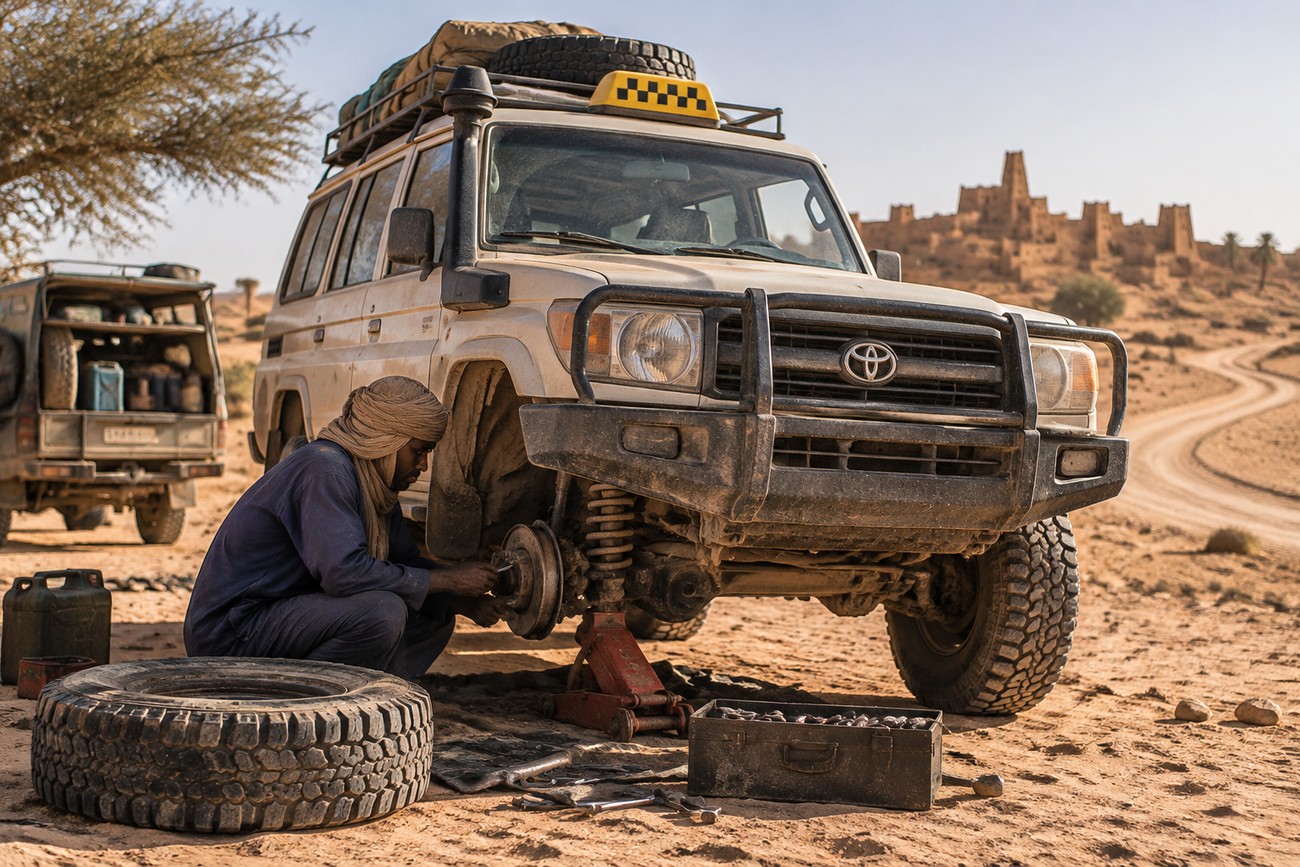
A viable desert taxi should be selected around the route rather than the badge. The key characteristics are simple repairs, accessible parts, suitable clearance, flexible tire options, heat tolerance, and a recovery plan that local operators can actually use. These features protect revenue more effectively than headline engine output.
Local preference for simpler, more repairable vehicles can therefore be economically rational. Reliability away from paved roads depends on construction, tires, clearance, and service support rather than price. A vehicle that can be repaired with available tools may return to work sooner than a more luxurious car awaiting specialist diagnostics.
Passenger comfort still matters, particularly on long transfers, but it cannot compensate for poor recovery options or long parts delays. A taxi that offers a superior cabin yet spends extended periods immobilized is commercially weaker than a less prestigious vehicle that completes scheduled journeys.
The Mulsanne could make sense for a controlled, exceptional transfer where the route is firm, support is close, and the vehicle’s presentation is part of the purpose. It is a poor default choice for regular desert taxi work because the operating environment magnifies every weakness in clearance, traction, tires, and service logistics.
Verdict: A Memorable One-Off, Not a Desert-Taxi Formula
The headline contains a striking image, but a Mulsanne is a heavy rear-wheel-drive luxury sedan intended primarily for paved roads. Its 6.75-liter V8 can provide impressive performance, yet engine power cannot overcome unsuitable tires, pressure, weight distribution, and surface conditions.
A carefully selected route under exceptional conditions may be completed. That outcome would demonstrate the skill of the driver, the preparation behind the trip, or the firmness of the track at that moment. It would not prove that the model is suitable for regular Saharan taxi work.
The more useful distinction is between spectacle value and commercial suitability. A Bentley can create a memorable passenger experience, but a working taxi must control fuel use, downtime, recovery risk, and parts access. Those requirements favor a vehicle designed around serviceability and rough-road endurance.
Until dated route records, operator documentation, and evidence of repeated service establish otherwise, the Timbuktu Mulsanne should be described as an unverified or exceptional case. Crewe luxury may cross Saharan sand; it does not make the sand forgiving.
Frequently asked questions
The Mulsanne’s production history helps explain why any desert example would now require careful support. Verifying its reported use also requires stronger evidence than a single image. If the car becomes immobilized, recovery and damage prevention matter more than engine power.
Why was the Bentley Mulsanne discontinued?
Bentley ended Mulsanne production in 2020 as part of its model-lineup transition. The end of production does not mean every existing Mulsanne stopped operating: used examples can still be driven, maintained, and transported across long distances.
How can you verify a claim that a Mulsanne was used as a Timbuktu taxi?
Look for dated photographs, registration records, operator documentation, and evidence identifying the route and vehicle. Stronger proof would show repeated passenger service over time, rather than a single image or an untraceable caption.
It is also useful to distinguish a private transfer, promotional journey, and commercial taxi operation. Those categories can look identical in a photograph but imply very different evidence and operating demands.
What should happen if a Mulsanne sinks into soft sand?
Stop wheelspin immediately and avoid escalating throttle. Continuing to spin can dig the driven tires deeper, build heat, and increase the risk of drivetrain or tire damage.
Assess the surface, reduce load where practical, and use suitable recovery support with safe attachment points. Tire-pressure changes should be made carefully and monitored; a heavy sedan may require professional recovery rather than repeated attempts to drive out under its own power.







