
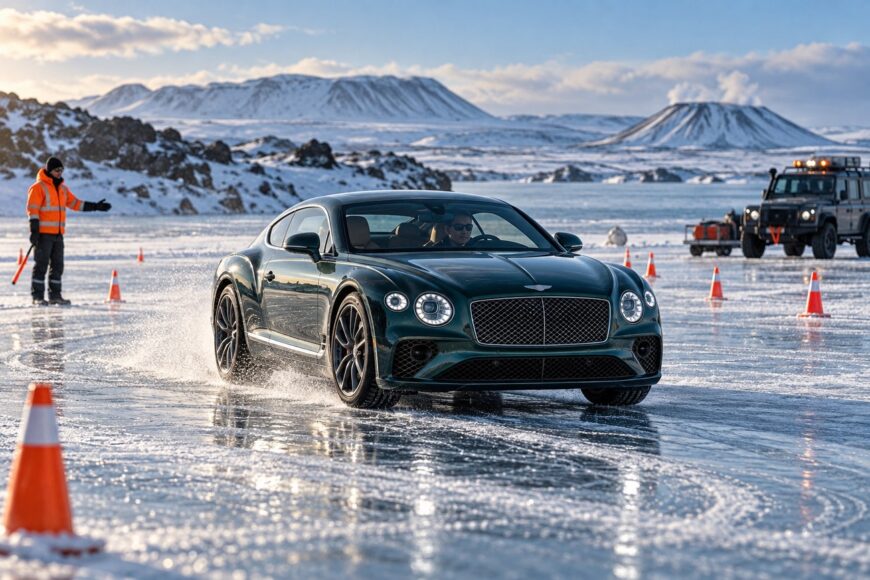
A Bentley Continental GT on Icelandic ice is an arresting combination: a long-legged grand tourer, a hybrid powertrain, and a landscape that strips driving down to grip, balance, and judgment. Lake Mývatn makes a compelling setting, though no specific race, route, or permission to drive on its ice is verified here.
The central distinction is simple. All-wheel drive can help the Continental GT move away cleanly, but it cannot make summer tires suitable for bare ice, certify an unassessed lake surface, or authorize an improvised route. A properly organized session needs a checked course, supervision, and a controlled place to manage a slide. Public roads demand caution; apparently frozen water is not an authorized route.
- The appeal—and the boundary—of driving a GT on ice
- Why the Continental GT feels capable before it runs out of grip
- The tire choice that matters more than horsepower
- How to drive a prepared ice course without chasing speed
- Lake Mývatn access, ice safety, and Icelandic road rules
- Preparing the car and crew for the costly parts of a mistake
- Frequently asked questions
- What should I do if the car breaks down on the way to Mývatn?
- What should I inspect after driving on ice and gritted roads?
- What is the average lifespan of a Bentley Continental GT?
- How much does a Bentley oil change cost?
- Which Bentley Continental GT is the fastest?
The appeal—and the boundary—of driving a GT on ice
A prepared ice course gives the Continental GT room to demonstrate its chassis without turning a public road into a test track. The route should be defined, assessed, and operated with supervision, recovery arrangements, and enough open space to manage a mistake. Those conditions shift the focus from chasing speed to learning how the car communicates at low grip.
The visual drama of Mývatn can obscure the practical boundary. An apparently frozen lake is not evidence of safe ice, and a road beside it does not automatically provide access to the surface. Open water, cracks, changing weather, and local restrictions must be assessed by the organizer and relevant authorities, rather than by a driver looking across the shoreline.
The Continental GT’s all-wheel drive makes acceleration reassuring, especially when the car is leaving a slippery start. It does not overcome tire-limited braking distances or lateral sliding on ice. A managed course therefore matters more than the promise of performance: it gives you a place to reduce speed early, explore balance progressively, and recover without involving oncoming traffic or roadside hazards.
Why the Continental GT feels capable before it runs out of grip
The current-generation Continental GT pairs a 4.0-liter turbocharged V8 with an electric motor; power figures depend on the Continental GT version. That combination delivers a smooth, immediate response that suits a grand tourer, yet the same immediacy can make a low-grip surface feel more forgiving than it is. A small pedal movement may demand more grip from the tires than expected.
All-wheel drive assists acceleration; it does not overcome tire-limited braking or lateral grip on ice. The car can leave a corner or icy start with composure and still arrive at the next braking zone carrying too much speed. Once the tires are overloaded, stability systems can manage the vehicle’s path only within the grip available beneath them.
Mass adds another layer to the experience. A heavy GT can feel settled over a rough surface and less vulnerable to a crosswind, but that mass also increases the energy that must be dissipated during braking. Immediate electric torque can provoke wheelspin before the driver has fully registered the change from packed snow to bare ice.
The most useful lesson is therefore about timing. Gentle inputs give the tires a chance to work, while abrupt throttle, steering, or braking asks the chassis to correct several forces at once. The car’s refinement can delay the sensation of trouble; when the slide becomes obvious, the available recovery space may already be smaller than it appears.
The tire choice that matters more than horsepower
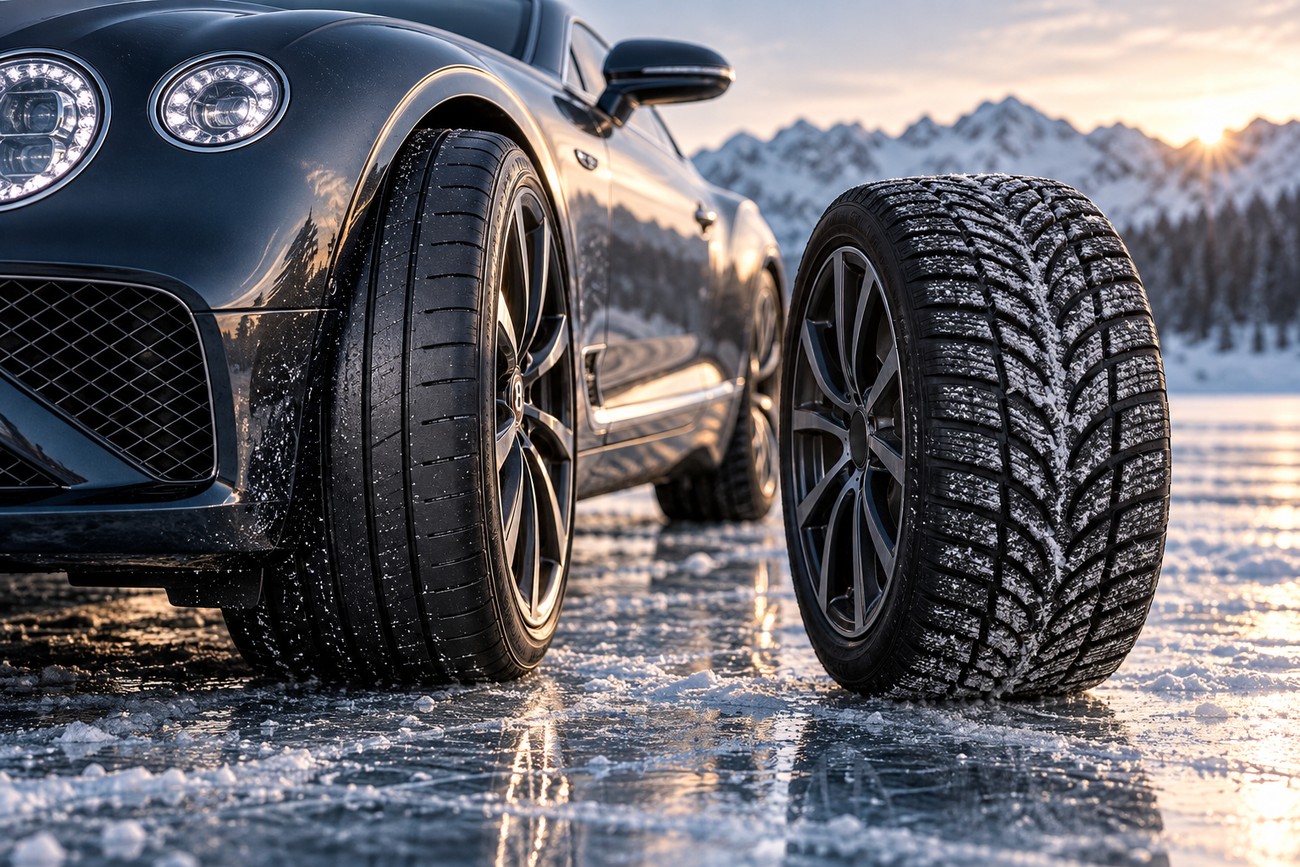
Standard Pirelli P Zero tires are high-speed summer tires, even when approved for the Continental GT. Cited current-version sizes include 275/35 R22 front and 315/30 R22 rear, but these are not specifications for every GT. Their construction and compound are intended for conditions where a summer performance tire can generate heat and grip, rather than for cold, polished ice.
Pirelli offers Bentley-approved winter options, including Winter Sottozero, but fit depends on model year, wheel size, load rating, and Bentley approval. A tire that mounts to a rim is not automatically approved for a particular Continental GT. Studs can improve grip on bare ice, although they may be less suitable on clear asphalt, and compatibility with a specific GT is unconfirmed by the available information.
Large 21–22-inch wheels and low-profile tires leave limited protection against hidden ruts and impacts. Check pressures cold against Bentley’s specified values; lowering them by guesswork can compromise the tire and wheel rather than creating useful grip. The right winter compound, tread design, temperature range, and approved fitment matter more than the engine’s output.
How to drive a prepared ice course without chasing speed
Start with smoothness. Reduce speed before the turn, use measured steering, and apply the throttle progressively once the car is aligned. The aim is to keep the tires within a narrow working window, because a sudden input can consume the available grip before the driver has time to respond.
Ice rarely offers one consistent surface. Packed snow, bare ice, and wet asphalt can appear within the same session, with each transition changing braking and cornering behavior. Treat every change as a new condition and leave a margin for the surface you cannot see beneath spray, snow, or glare.
Hard braking or a sudden throttle release in a turn transfers weight quickly and can unsettle the car. The result may be a front push, a rear-axle slide, or both as the surface changes. Controlled corrections are easier when the driver looks through the corner, keeps hands and feet deliberate, and avoids trying to rescue an error with a larger input.
A supervised, authorized ice course is the suitable place to learn those responses because it provides defined boundaries and operational support. A public road has traffic, drainage edges, poles, ditches, and no guaranteed run-off. Its posted speed limit is a legal ceiling, not an ice-driving target, and it should never be treated as permission to test the car’s limits.
Lake Mývatn access, ice safety, and Icelandic road rules
Access to Lake Mývatn ice must be confirmed by the organizer and relevant authorities. A responsible plan should cover the course layout, ice assessment, open water, cracks, weather limits, supervision, and evacuation. None of those conditions can be established safely from the shore or inferred from a frozen-looking surface.
Iceland prohibits driving outside designated roads and tracks, so lake access must not be assumed. A private event, a public road, and an apparently open area on the lake are separate matters. Do not follow tire marks or another vehicle onto an unmarked surface without clear authorization and a documented safety plan.
For winter conditions from 1 November to 14 April, observe applicable winter tire requirements, including a minimum tread depth of 3 mm; check current official guidance before traveling. Studded tires are permitted during the winter season and, outside that period, only when actual road conditions warrant them. They are not automatically compulsory for every journey.
Keep headlights on during daylight, respect road closures and weather warnings, and stop only in a safe, designated place. Wind, snowfall, and visibility can change quickly around Mývatn. A road that was manageable on departure may become unsuitable later, while a legal maximum speed says nothing about the grip available on ice.
Preparing the car and crew for the costly parts of a mistake
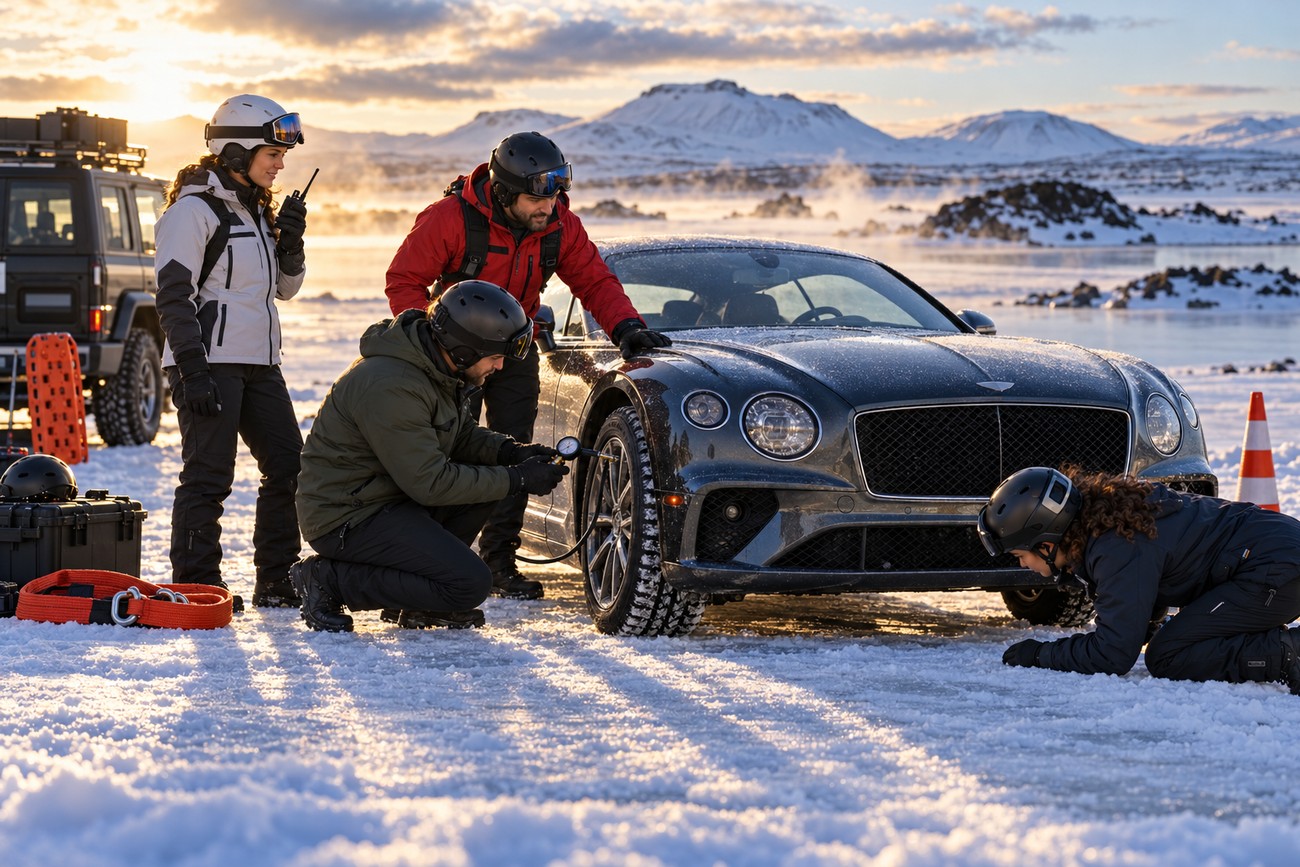
Before leaving, confirm the approved winter wheel-and-tire assembly for the exact car. Check the model year, wheel size, load rating, and Bentley approval, then inspect the rims, sidewalls, lower bodywork, and underbody for existing damage. Cold pressures should be recorded against Bentley’s specified values rather than adjusted by intuition.
Agree on the session’s safety equipment and support before the first run. Helmets, a support vehicle, communications, and a recovery plan are sensible items for an organized course, but the organizer must confirm what is required and supplied. Recovery is easier when the vehicle, access route, and stopping areas have already been identified.
On public roads, check closures and forecasts immediately before departure and keep cruise control off on slippery surfaces. The car’s ability to move does not prove that the route is safe to continue. If visibility deteriorates or a road closes, stop or turn back where permitted and safe rather than relying on the GT’s traction.
After a drive on ice or gritted roads, allow time for a careful inspection before the return journey. Look for packed ice around the wheels, cuts or bulges in the tires, bent rims, debris behind the bumpers, and impact marks beneath the car. A low-profile tire can suffer damage from a hidden rut without producing an immediate warning on the road.
Frequently asked questions
These questions cover breakdowns, post-drive checks, and broader Continental GT ownership. If a problem occurs on the road, prioritize a safe stop and professional assistance. For maintenance costs and performance comparisons, use information specific to the car and its version.
What should I do if the car breaks down on the way to Mývatn?
Move only as far as necessary to reach a safe stopping position, switch on the required lights, and avoid standing in the traffic lane or beside an exposed edge. Share the vehicle’s location with roadside assistance and the event organizer, using coordinates or a clear landmark if visibility is poor.
Confirm in advance that assistance covers Iceland, the intended route, and recovery of a large Bentley. Do not attempt an improvised repair in snowfall, high wind, or low visibility. If the road is closed or conditions are deteriorating, wait for professional recovery instructions rather than trying to continue under the car’s own power.
What should I inspect after driving on ice and gritted roads?
Check each wheel and tire for cuts, bulges, trapped stones, packed ice, and signs of a bent rim. Inspect the wheel arches, lower bumper edges, side skirts, and underbody for lodged debris or impact damage before setting out again.
Remove loose ice only when it is safe to do so, and arrange a professional inspection if the car pulls, vibrates, loses pressure, or shows an underbody warning. A visual check cannot confirm internal tire or suspension damage, so symptoms should be treated as a reason to stop and investigate.
What is the average lifespan of a Bentley Continental GT?
There is no reliable single average lifespan for every Continental GT. Service history, mileage, climate, storage, driving style, and maintenance quality have a greater effect than the badge or model year alone.
For a used example, judge condition through documented servicing, diagnostic checks, tire and brake condition, suspension inspection, and evidence of accident or corrosion repair. A specialist inspection is more useful than applying a fixed age or mileage expectation.
How much does a Bentley oil change cost?
The cost varies by market, engine and hybrid version, oil specification, filter requirements, labor rate, and whether the work is performed by a Bentley retailer or an independent specialist. A current quote should identify the exact car and the parts included.
Ask whether the service covers the required inspection, software or diagnostic checks, and disposal charges. For a hybrid Continental GT, confirm that the quote relates to the correct powertrain rather than assuming every V8 service has the same procedure or price.
Which Bentley Continental GT is the fastest?
The answer depends on the model year, body style, and whether “fastest” means top speed or acceleration. Bentley’s performance figures vary by version, so a current specification sheet is needed for a precise comparison.
Those figures do not establish suitability for ice driving. Tire approval, surface assessment, braking margin, weather, and organizer authorization remain more important than the version’s published performance.







