
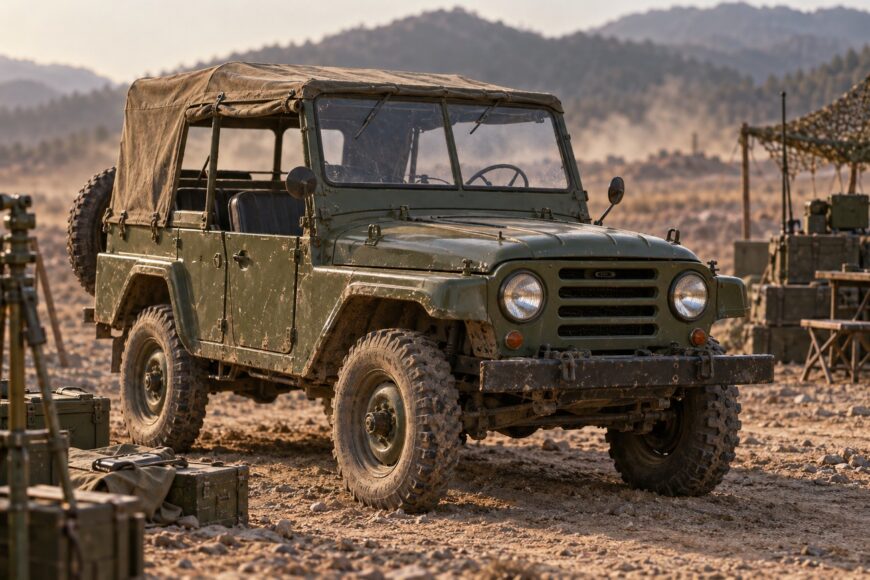
The Beijing BJ212 remains one of China’s most recognizable military-style 4x4s. Developed for the People’s Liberation Army, it combined a simple chassis, open bodywork, and selectable four-wheel drive in a vehicle intended to work away from paved roads rather than deliver modern comfort.
Its appeal is also its main complication. “BJ212” covers changing engines, factories, civilian derivatives, export versions, and later vehicles that share the name without sharing every mechanical detail. A buyer may be choosing a historical curiosity, usable low-speed off-road transport, or a restoration project whose final cost depends more on rust and parts compatibility than on the purchase price.
The military appearance provides useful context, but it does not prove originality or good condition. A sound frame, matching identification details, serviceable axles, and working brakes matter more than fresh paint, canvas, or a claimed military history.
- What the BJ212 Was Built to Do
- Classic BJ212 Design and Specifications
- BJ212, BJ2020, and the Production Timeline Problem
- What It Is Like to Own and Drive a Classic BJ212
- Buying a Used BJ212: What to Inspect First
- Classic BJ212 vs. Modern BJ212: What Actually Changed
- Frequently asked questions
- What is the Chinese Jeep equivalent?
- What are the specifications of the BAW BJ212?
- What does the BJ212’s 0.5–0.75-ton class mean?
- Why do sources disagree about when BJ212 production ended?
What the BJ212 Was Built to Do
The BJ212 was developed for the PLA in the early 1960s, with series production beginning around 1965–1966. It belonged to the light tactical vehicle class, generally described as 0.5–0.75 ton. That category reflected its intended military role and payload class rather than a universal promise about what every surviving vehicle can safely carry today.
Its duties included personnel transport, reconnaissance, communications, light towing, and equipment transport. The format suited units that needed a compact vehicle able to move people and supplies over rough tracks, with simple mechanical systems that could be maintained away from sophisticated workshops.
Calling it a “Chinese military jeep” is therefore reasonable as a description of purpose and appearance. It should not be read as the name of one fixed army specification. Government, civilian, and export vehicles could differ in engines, transmissions, body details, and equipment.
The base BJ212 had no armor protection. Its open or soft-top body offered little protection from weather and no modern passenger-cell security, so military styling should not be confused with an armored or crash-protected vehicle. The design prioritized mobility, load carrying, and field serviceability over comfort and occupant protection.
Classic BJ212 Design and Specifications
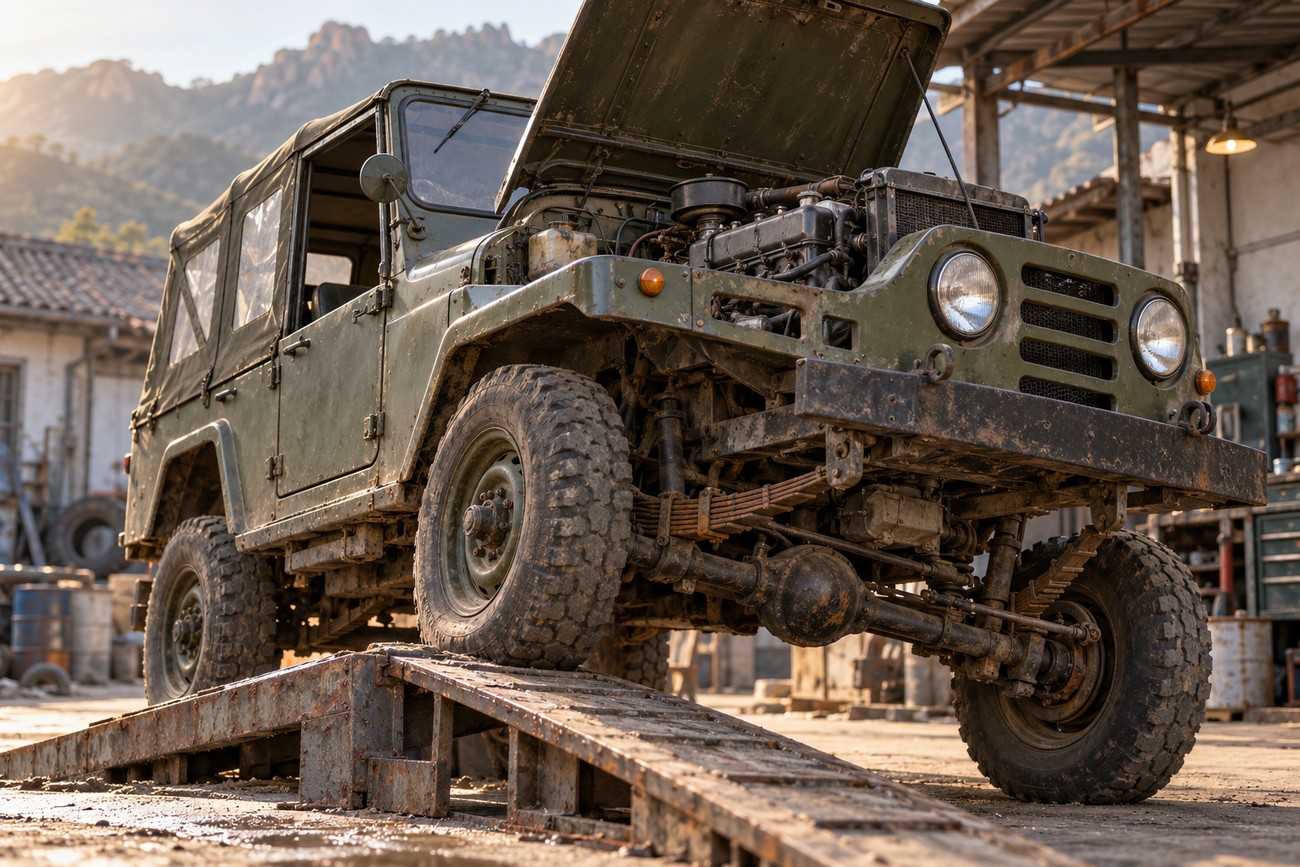
The classic layout used a separate frame, live axles, dependent leaf-spring suspension, and selectable four-wheel drive. This is a familiar formula for slow work on uneven ground: the solid axles maintain useful wheel articulation, while the frame and leaf springs tolerate substantial abuse when the vehicle is driven within its limits.
Early examples used a 2.445-liter inline four-cylinder gasoline engine producing about 75 hp. Early approximate dimensions were 4.08 m in length, 1.84 m in width, and a 2.30 m wheelbase. Those figures describe early vehicles and do not apply automatically to every later BJ212 or BJ2020.
Four- and five-speed manual transmissions appeared depending on the year, factory, and modification. That detail matters during restoration because gearbox mounts, controls, clutch parts, and transfer-case relationships may vary even when two vehicles look nearly identical.
Selectable four-wheel drive also requires correct use. On a suitable loose surface, it improves traction, but continuous use on dry, hard surfaces can load the transmission and driveline. The mechanical simplicity is helpful only when the owner understands the particular axle, transfer case, and hub arrangement fitted to that vehicle.
BJ212, BJ2020, and the Production Timeline Problem
The model name became a family label rather than a perfectly stable technical identity. Later BJ212-related versions used additional gasoline and diesel engines, including 2.0-liter variants. Civilian and export derivatives could receive different equipment, trim, and drivetrains from vehicles supplied to Chinese government services.
Production history is consequently difficult to summarize with one final date. Some sources place the end of classic BJ212 production around 1983, while others include civilian variants continuing after 1990. The disagreement partly reflects different definitions of “classic BJ212,” civilian derivatives, and later related models.
BJ212, BJ2020, and later successors are related, but they should not be treated as technically identical. A body shape or grille can survive across several generations, while the engine, axles, gearbox, electrical system, and mounting points change underneath.
For identification, inspect the VIN, identification plate, engine, axles, and transmission together. A badge or seller’s description is weak evidence. This approach also prevents the common mistake of ordering parts by engine displacement alone, since the same nominal capacity does not guarantee matching mounts or ancillary equipment.
What It Is Like to Own and Drive a Classic BJ212
A healthy classic BJ212 can be effective at low speed on rough tracks. Live axles and leaf springs cope well with uneven ground, and the compact body is easier to place between obstacles than a modern, wider SUV. Its strengths become clear during careful work over mud, ruts, and broken access roads.
Road use is a different matter. Early 75-hp versions offer modest performance and can be tiring on modern highways. Owners commonly report substantial noise and vibration, heavy steering, weak heating and ventilation, and poor sealing around the soft top. The vehicle asks for patience, mechanical sympathy, and realistic expectations about travel distance.
Live axles and leaf springs do not create modern high-speed safety. Braking, steering geometry, tires, and worn suspension parts determine how controllable the vehicle is, while the open body and basic restraints provide little margin in a serious collision. A slow off-road vehicle should be driven as one, even if a speedometer or advertisement suggests otherwise.
Use selectable four-wheel drive according to the drivetrain and surface conditions. Engaging it on loose ground can help the axles share traction; leaving it engaged on dry, hard pavement can create driveline wind-up and unnecessary transmission stress. The correct procedure varies with the exact modification, so the owner’s manual or a verified transmission layout is more reliable than a generic online instruction.
Buying a Used BJ212: What to Inspect First
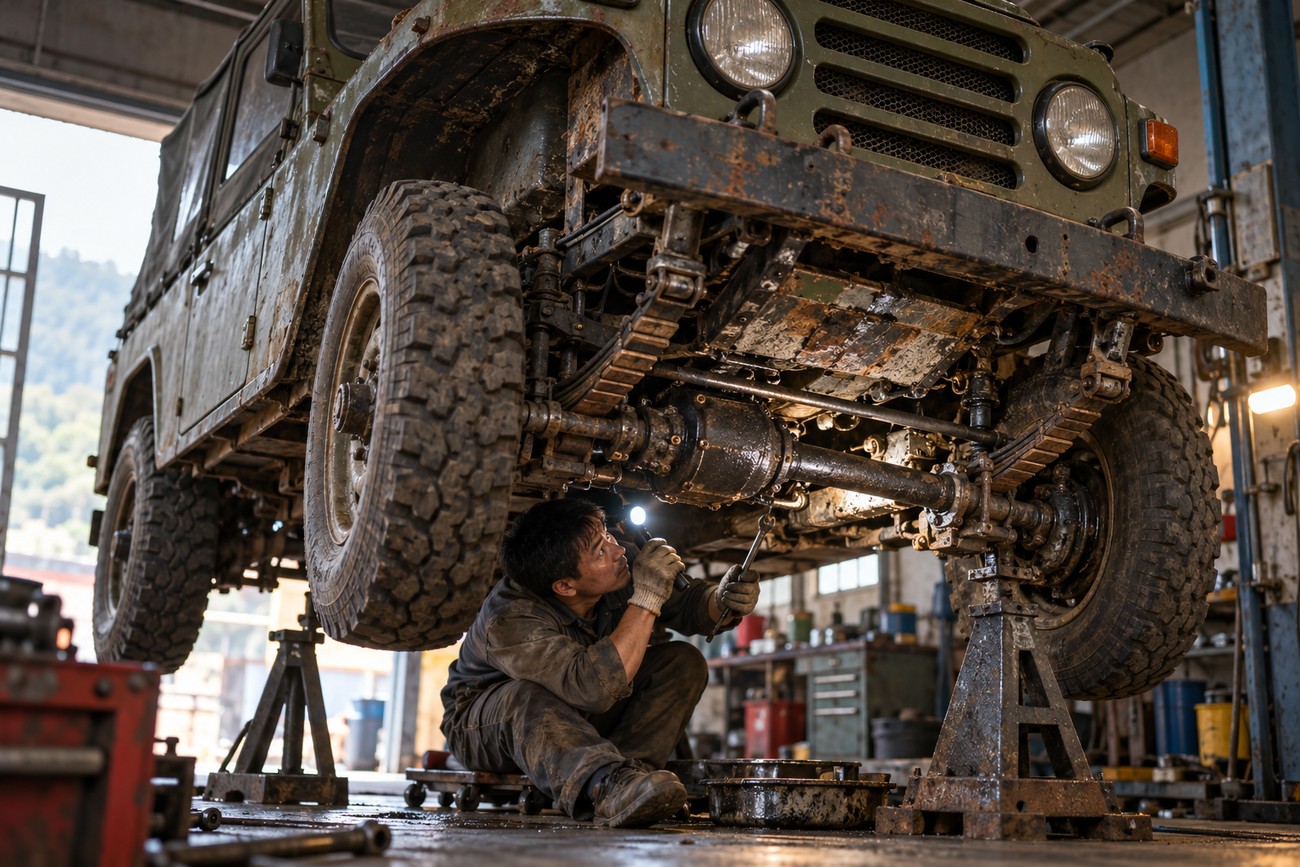
Start underneath the vehicle, not with the paint. Check frame geometry, corrosion, previous welding, floor sections, sills, body mounts, and the fittings that support the open body. Rust in a visible panel is often less important than distortion or weakened metal around suspension and body attachment points.
Next, examine the mechanical structure. Check kingpin play, axle leaks, spring condition, steering movement, and the transfer case under load. Test the brakes carefully, including the condition of lines, drums or other friction components, and the parking brake. A vehicle that looks complete can still require extensive work before it is safe to drive.
Frame geometry, kingpin and transfer-case play, and brake condition deserve priority over paint, trim, or claimed military provenance. Verify every part against the exact engine, axle, and gearbox combination.
Expect age-related problems to arrive as a chain of small repairs rather than one dramatic failure. Welding, electrical faults, hardened seals, brake work, tired springs, and drivetrain wear can expand a restoration budget quickly. Long storage, overloading, improvised repairs, and hard service may all be present in a vehicle described as “military.”
Parts support is also less uniform than the model name suggests. There is no single universal BJ212 parts catalog, and a part listed for BJ212 is not automatically compatible with BJ2020 or a later variant. Confirm the exact engine, axles, gearbox, production source, and mounting arrangement before ordering components.
A practical inspection sequence is:
- Match the VIN and identification plate with the seller’s description.
- Measure or inspect frame alignment before evaluating cosmetic restoration.
- Check kingpins, axle shafts, transfer case, steering, and brakes.
- Look for corrosion in the frame, floor, sills, body mounts, and open-body fittings.
- Identify the engine, gearbox, and axles before pricing replacement parts.
Classic BJ212 vs. Modern BJ212: What Actually Changed
The modern 2.0-liter BJ212 is a different product generation. Its advertised figures should be read as version-specific claims, not as specifications for a historical military-era vehicle.
| Item | Classic BJ212 | Modern BJ212 |
|---|---|---|
| Engine and transmission | Early vehicles used a 2.445-liter inline four-cylinder gasoline engine producing about 75 hp. Four- and five-speed manuals appeared by version. | May use a turbocharged 2.0-liter engine and an eight-speed automatic transmission. |
| Chassis context | Separate frame, live axles, leaf springs, and selectable four-wheel drive. | Different engine, mass, geometry, and transmission; it is not mechanically identical to the classic vehicle. |
| Dimensions or clearance | Early approximate dimensions were 4.08 m long, 1.84 m wide, with a 2.30 m wheelbase. | A modern version is advertised with 235 mm of ground clearance. |
| Wading claim | No universal figure applies to every classic military vehicle. | A claimed 659 mm applies to a new 2.0-liter BJ212 and does not prove classic capability. |
| Top speed context | Practical descriptions of early 75-hp vehicles are closer to about 100 km/h. | About 130 km/h may be quoted for newer or specific versions. |
The comparison explains why modern advertising can mislead owners of old vehicles. Clearance, water depth, speed, and drivetrain performance depend on the complete vehicle, including tires, seals, gearing, brakes, and condition. A historical BJ212 should be assessed on its own specification plate and mechanical state.
Frequently asked questions
The name is used across several generations, so the shortest answer is often less useful than the exact vehicle identity. The following distinctions help separate historical references from current sales descriptions.
What is the Chinese Jeep equivalent?
The usual historical answer is the Beijing BJ212, a Chinese light tactical 4×4 developed for the PLA. Its role and silhouette invite comparison with other military utility vehicles, but it is not simply a single foreign model reproduced without change.
Modern references to a BAW BJ212 may describe a different product generation. Buyers should treat the historical BJ212 and the modern BAW-branded vehicle as related nameplates, not as one universal specification.
What are the specifications of the BAW BJ212?
BAW BJ212 specifications are variant-dependent. A modern version may use a turbocharged 2.0-liter engine, an eight-speed automatic transmission, and advertised 235 mm ground clearance, while classic vehicles used different engines, manual transmissions, and older chassis details.
Request the exact year, engine, transmission, market specification, and identification data before comparing vehicles. One generic data sheet can conceal differences that affect parts compatibility, performance, and legal or practical suitability.
What does the BJ212’s 0.5–0.75-ton class mean?
It describes the vehicle’s light tactical payload category and intended role. The figure is linked to personnel, equipment, communications, light towing, and field transport rather than to a guaranteed payload for every used example.
Age, corrosion, frame repairs, springs, brakes, and previous overloading can reduce the safe working capacity of a surviving vehicle. A restored example should therefore be assessed structurally before anyone relies on its historical class label.
Why do sources disagree about when BJ212 production ended?
Different sources define the model family differently. Some place the end of classic BJ212 production around 1983, while others include civilian variants that continued after 1990.
BJ2020 references and later successors add further confusion because related vehicles may retain familiar styling or naming. The VIN, identification plate, engine, axles, and transmission provide a more useful answer for a particular vehicle than a single production-end date.







