
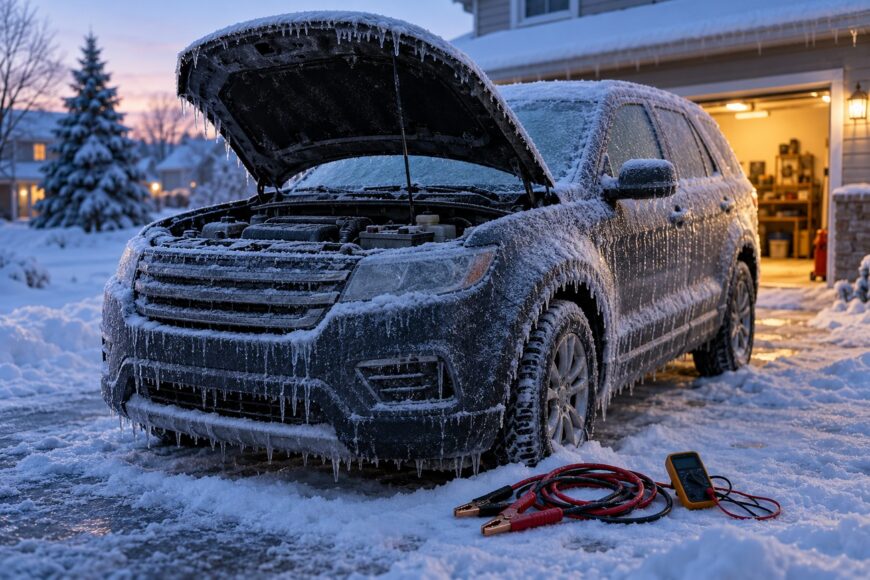
The Ford Edge worked normally the previous evening, yet after sitting outside at -20°F (-29°C), it may be completely unresponsive by morning. The cold can expose a battery that was already marginal, while a poor connection, incomplete winter charging, or an overnight electrical drain can produce the same result.
A jump-start may get the Edge moving, but it does not identify the cause. A sound diagnosis separates a battery whose cold-weather capacity has fallen from a battery being discharged by a parasitic draw, undercharging, or a module that failed to enter sleep mode.
- Why -20°F Can Kill a Ford Edge Overnight
- What Can Drain a Ford Edge While It Is Parked
- Why Short Winter Trips Leave the Battery Undercharged
- How to Diagnose the Failure Without Guessing
- What to Do When the Edge Is Dead in the Morning
- Choosing a Replacement Battery for Severe Cold
- The Winter Battery Myths That Waste Time and Money
- Frequently asked questions
- How long should a battery last in a Ford Edge?
- Why is my Ford battery draining overnight?
- My Ford Edge battery keeps dying. What could be causing this?
Why -20°F Can Kill a Ford Edge Overnight
At -20°F (-29°C), a lead-acid battery may have only about 40–60% of its room-temperature available capacity. The battery’s internal resistance also rises, so it can deliver less current to the starter precisely when the engine needs more. A battery that starts the Edge reliably in mild weather may therefore fail after one severe night without having suddenly developed a single obvious defect.
Engine oil thickens in severe cold, making the engine harder to crank and increasing starter demand. The battery must supply that heavier load while its available output is reduced. If the battery was partly charged before parking, the margin can disappear quickly during the first start attempt.
The overnight wait matters because the battery loses heat while the vehicle sits. A weak battery may still operate lights, locks, and electronics earlier in the evening, then fall below the voltage needed for the starter after hours in the cold. The same pattern can occur when a small electrical drain continues throughout the night.
Cold alone does not prove that the battery is defective. Age, previous deep discharge, a poor terminal connection, chronic undercharging, and excessive standby current can all leave the battery vulnerable. A battery can show near 12.6 volts without load and still fail when the starter demands high current.
What Can Drain a Ford Edge While It Is Parked
A modern Ford Edge continues to use some electrical power after shutdown for security, telematics, remote-start functions, and other control systems. This standby consumption is expected. The vehicle should eventually reduce its demand as its modules enter sleep mode.
A module that remains active can change a normal overnight loss into a battery-draining fault. Possible sources include an accessory, alarm, dashcam, OBD device, remote-start equipment, or a control module that does not shut down correctly. The same fault can discharge a replacement battery, so installing a new battery alone may only reset the symptom temporarily.
Service practice commonly expects standby current in the tens of milliamps after the vehicle is fully asleep. Published sources differ on one universal normal limit, and the correct interpretation depends on the vehicle’s equipment and test conditions. A current level that remains clearly higher than expected after sleep is a reason to investigate rather than assume the battery is at fault.
Cold weather can make the result appear sudden. A marginal battery may tolerate a small draw during warmer nights, then lose enough capacity at -20°F to become fully discharged. If the problem began after fitting a dashcam, alarm, trailer accessory, or OBD device, that equipment deserves early attention during the draw test.
Why Short Winter Trips Leave the Battery Undercharged
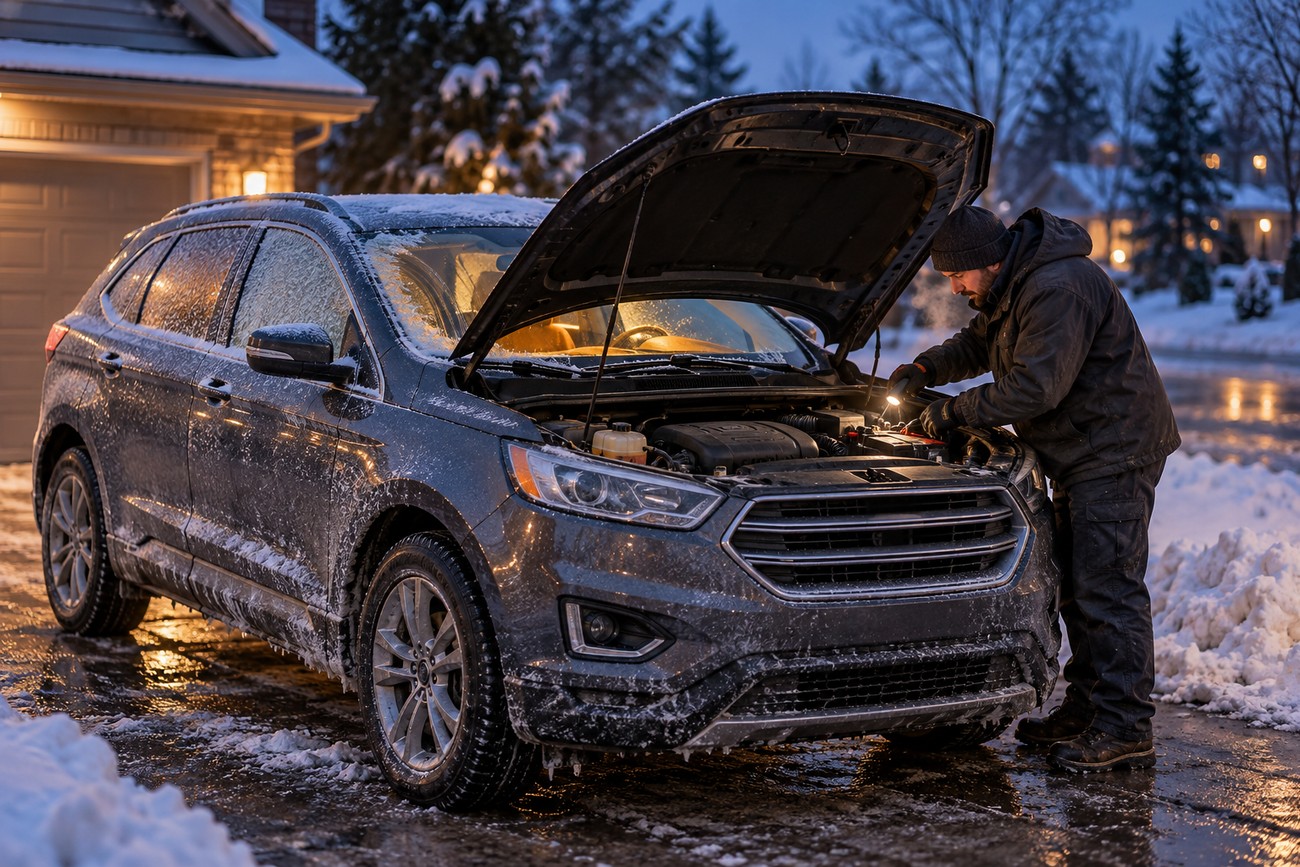
Starting the engine consumes energy, and winter accessories add to the load. Defrosters, blower motors, heated seats, heated glass, lights, and other electrical systems can use substantial power during a short drive. The alternator may replace only part of the energy used before the Edge is parked again.
A cold battery also accepts charging less effectively during the first part of a drive. This reduces the benefit of a brief trip, especially when the battery began the journey below full charge. Repeated short trips can gradually reduce the reserve available for the next cold start.
Remote starting can increase the energy deficit when it is followed by a short drive. The engine may run long enough to warm the cabin, while the subsequent trip still provides limited opportunity to restore the battery. Repeated cycles can leave the battery increasingly vulnerable without directly proving that the remote-start system is faulty.
The battery may seem to fail without warning after several days of this pattern. In reality, each partial recharge can leave less reserve for the next overnight freeze. A charger or properly selected maintainer can help restore charge during extended parking, while a vehicle-side drain still requires separate testing.
How to Diagnose the Failure Without Guessing
Begin with the physical connections before interpreting electrical readings. Inspect the battery terminals, cable ends, and engine and body grounds for looseness, corrosion, or damage. In severe cold, a connection that was marginal in warmer conditions can create enough voltage loss to prevent cranking.
| Test | What it can reveal | What it cannot prove |
|---|---|---|
| Resting-voltage check | Provides an indication of the battery’s state of charge after the vehicle has rested. | It cannot establish starting performance or confirm that the battery can deliver current under load. |
| Load or conductance test | Shows whether voltage collapses or current-delivery capability is weak during a simulated starting demand. | It cannot identify a vehicle-side electrical drain or a charging fault by itself. |
| Charging-system check | Helps assess whether the alternator and charging system are restoring energy while the engine runs. | It cannot prove that the battery can retain charge overnight. |
| Terminal and ground inspection | Finds resistance caused by loose, dirty, or damaged connections. | It cannot rule out an internal battery failure or a parasitic draw. |
| Parasitic-draw test | Measures current remaining after the Edge and its modules have entered sleep mode. | It cannot be interpreted correctly if the vehicle is still awake or the test repeatedly wakes its systems. |
A resting reading near 12.6 volts without load can indicate a charged battery, but it does not prove adequate starting capacity. Follow it with a load or conductance test to identify voltage collapse and weak current delivery. This is especially important when the battery appears normal after charging but fails again in the cold.
Every module must be allowed to enter sleep before standby current is judged. Opening a door, pressing the remote, or repeatedly disturbing the vehicle during the measurement can wake systems and create a misleading result.
Check charging performance after the engine is running, while also considering the battery’s condition and the cable connections. A charging system can appear functional while the battery remains undercharged after repeated short trips. Conversely, a healthy battery can continue to go flat if the vehicle is not restoring energy correctly.
Measure parasitic draw only after the vehicle has had time to enter its normal sleep state. Avoid opening doors or activating the remote during the test, and follow appropriate procedures for the vehicle’s electrical system. A successful jump-start only shows that external power overcame a temporary low-voltage condition; it does not prove that the battery, charging system, or standby current is healthy.
What to Do When the Edge Is Dead in the Morning
First confirm the symptoms. Check whether the key fob, interior lights, instrument display, and locks are also inactive, while avoiding repeated start attempts that can further lower the battery voltage. If the battery case is damaged, frozen, or leaking, do not attempt a jump-start.
Use a safe jump-start procedure or an external charger suitable for the vehicle and battery type. Follow the vehicle and charger instructions carefully, keep ignition sources away from the battery, and use sound cables and connections. A jump-start restores enough power to crank; it does not repair the condition that caused the discharge.
After the Edge is running, recharge the battery fully rather than judging it by whether the engine starts once. A battery that has been deeply discharged in freezing conditions may suffer lasting damage. It should then receive a load or conductance test, along with checks of charging performance and the main cables.
If the failure returns, investigate standby draw, charging performance, terminals, and grounds. A repeated overnight failure after a full recharge points toward a continuing fault or a battery that cannot retain or deliver its charge. Replacing parts before these tests can leave the original problem unresolved.
Choosing a Replacement Battery for Severe Cold
Match the Edge’s specified battery size, technology, and starting requirements. The replacement should provide the required CCA, with enough cold-cranking capability for the local climate and the vehicle’s operating conditions. A smaller or lower-rated battery can reduce the starting margin even when it physically fits.
AGM batteries generally handle cycling and cold better than conventional flooded batteries. Both types still lose capacity in severe cold, and either can be damaged by deep discharge or chronic undercharging. Battery technology improves the reserve and durability available for the application; it does not eliminate the effects of temperature.
Rated CCA does not guarantee real-world starting performance from an aged, discharged, damaged, or very cold battery. Installation quality matters as well, because a loose terminal or poor ground can imitate a battery failure. Confirm that the connections are clean and secure after replacement.
A new battery can also die overnight if an electrical drain, poor connection, or charging problem remains. Test the vehicle after installation when the original failure involved repeated discharge. Otherwise, the new battery may only conceal the fault until the next severe freeze.
The Winter Battery Myths That Waste Time and Money

Myth: a 12.6-volt resting reading means the battery is healthy. Reality: that reading can indicate charge without showing how the battery behaves under starting load. Use a load or conductance test when the Edge cranks slowly, clicks, or becomes unresponsive in the cold.
Myth: a new battery fixes every overnight failure. Reality: a parasitic draw, poor ground, or charging problem can discharge a new battery as well. If the symptom returns after replacement, test the vehicle rather than installing another battery.
Myth: the alternator fully recovers every short winter trip. Reality: starting and heavy electrical loads may consume more energy than a short drive replaces, especially while the battery is cold. Review the usage pattern and recharge the battery when repeated short trips leave it undercharged.
Myth: one cold-weather failure is harmless. Reality: a single overnight failure can be an early sign of a hidden draw, a module that does not sleep, or a battery with little remaining reserve. Record what happened, recharge the battery, and test the cause before the next severe freeze.
Frequently asked questions
The questions below address battery life, overnight discharge, and repeated failures in a Ford Edge. The answers focus on testing the battery, charging system, connections, and standby current. Cold weather can expose any of these conditions.
How long should a battery last in a Ford Edge?
There is no reliable single lifespan promise for every Ford Edge battery. Replacement decisions should consider cold-weather exposure, driving pattern, repeated deep discharge, electrical equipment, and the results of a proper battery test.
A battery that still starts the vehicle in mild weather may have insufficient reserve for severe cold. Test results and the battery’s ability to retain charge provide better guidance than age alone, particularly after an overnight failure.
Why is my Ford battery draining overnight?
An overnight drain can come from a module that remains awake, an accessory such as a dashcam or OBD device, security or remote-start equipment, or a charging problem that leaves the battery partly depleted before parking. Cold weather can expose the issue by reducing the battery’s available capacity.
The useful evidence is a correctly timed standby-current measurement after the Edge has fully entered sleep mode. The vehicle must remain undisturbed during the test so doors, remotes, and other activity do not wake its systems.
My Ford Edge battery keeps dying. What could be causing this?
Likely causes include a weak battery, repeated short-trip undercharging, poor battery or ground connections, charging-system problems, and excessive standby current. Repeated deep discharge can also reduce the battery’s ability to hold a charge, especially after exposure to freezing conditions.
Start with the condition of the battery and its connections, then verify charging and check for a draw after sleep. A replacement battery is appropriate only when testing supports it or the existing battery has failed; it will not correct a fault elsewhere in the vehicle.







