
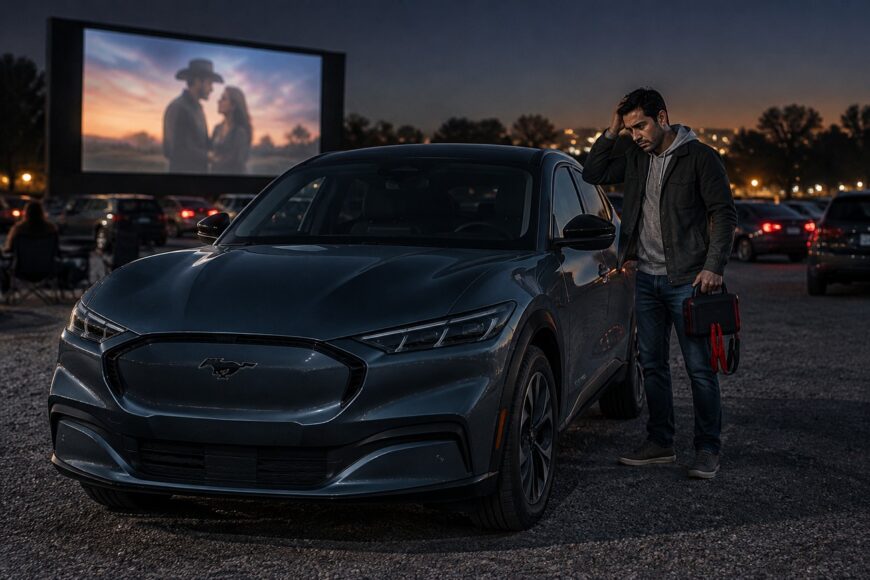
The movie ends, and your Ford Mustang will not unlock, start, or release its parking brake. At a drive-in, prolonged radio use and other electrical loads can leave you with too little 12V power to leave, even though the car worked normally when you arrived.
The distinction matters most in a Mustang Mach-E: its high-voltage traction battery is separate from the 12V battery that supports access and vehicle controls. A discharged 12V battery can leave a Mach-E unresponsive despite charge remaining in the traction battery. Checking the battery beforehand and knowing the correct recovery procedure are safer than guessing how long the radio will last.
- Why a Mustang Can Die During a Drive-In Movie
- How Long Can a Mustang Run at a Drive-In?
- How to Watch a Drive-In Movie Without Killing the Battery
- What to Do When the Mustang Is Dead at the End of the Film
- Common Drive-In Battery Mistakes and Myths
- If the Mustang Starts Again, Do Not Assume It Is Fixed
- Frequently asked questions
- What if my Mustang starts after a jump but warning messages or electrical glitches remain?
- Why can a replacement Mustang battery keep dying at drive-ins?
- How can I watch a drive-in movie without killing the battery?
- Why does my Mustang battery keep dying?
Why a Mustang Can Die During a Drive-In Movie
A drive-in turns an ordinary stop into an extended period of electrical use. The radio may be joined by displays, exterior lights, climate control, and devices charging from the car. ACC or ON can keep more systems active than you intended, while an aging 12V battery may have little reserve left after the film.
In a gasoline Mustang, insufficient 12V power may leave the starter unable to turn the engine reliably. In a Mach-E, the separate 12V battery can prevent unlocking and leave the vehicle unresponsive; the charge shown for the high-voltage traction battery does not rule out that failure. Symptoms and access procedures vary by model and year, so use the vehicle’s own manual rather than assuming every Mustang behaves alike.
A radio that still works does not prove the battery has enough reserve for a restart. Lower-demand accessories can operate while a weak battery is already struggling with the next, more demanding step. Below approximately 12.0 V is a warning sign for reliable starting or restarting, though a single reading is not a complete battery-health test.
How Long Can a Mustang Run at a Drive-In?
There is no dependable movie-length limit for using a Mustang’s electrical accessories while parked. Some owners report that about 2 hours in a waiting or accessory state is manageable; others lose power before the film ends. Those accounts describe individual cars and loads, not a safe runtime specification for yours.
Battery age and condition matter as much as the clock. A battery that has recently started the car without trouble can still have limited reserve, particularly if it is aging or an unexpected load is present. Leaving the vehicle in ACC or ON, keeping a screen lit, or charging devices changes how much power the evening uses.
Occasionally starting a gasoline Mustang for a short spell does not guarantee enough charge for the final restart. Likewise, briefly powering a Mach-E should not be treated as proof that its 12V system will remain stable. If the battery’s condition is uncertain, plan to use another way to hear the film rather than testing its limit from the driver’s seat.
How to Watch a Drive-In Movie Without Killing the Battery
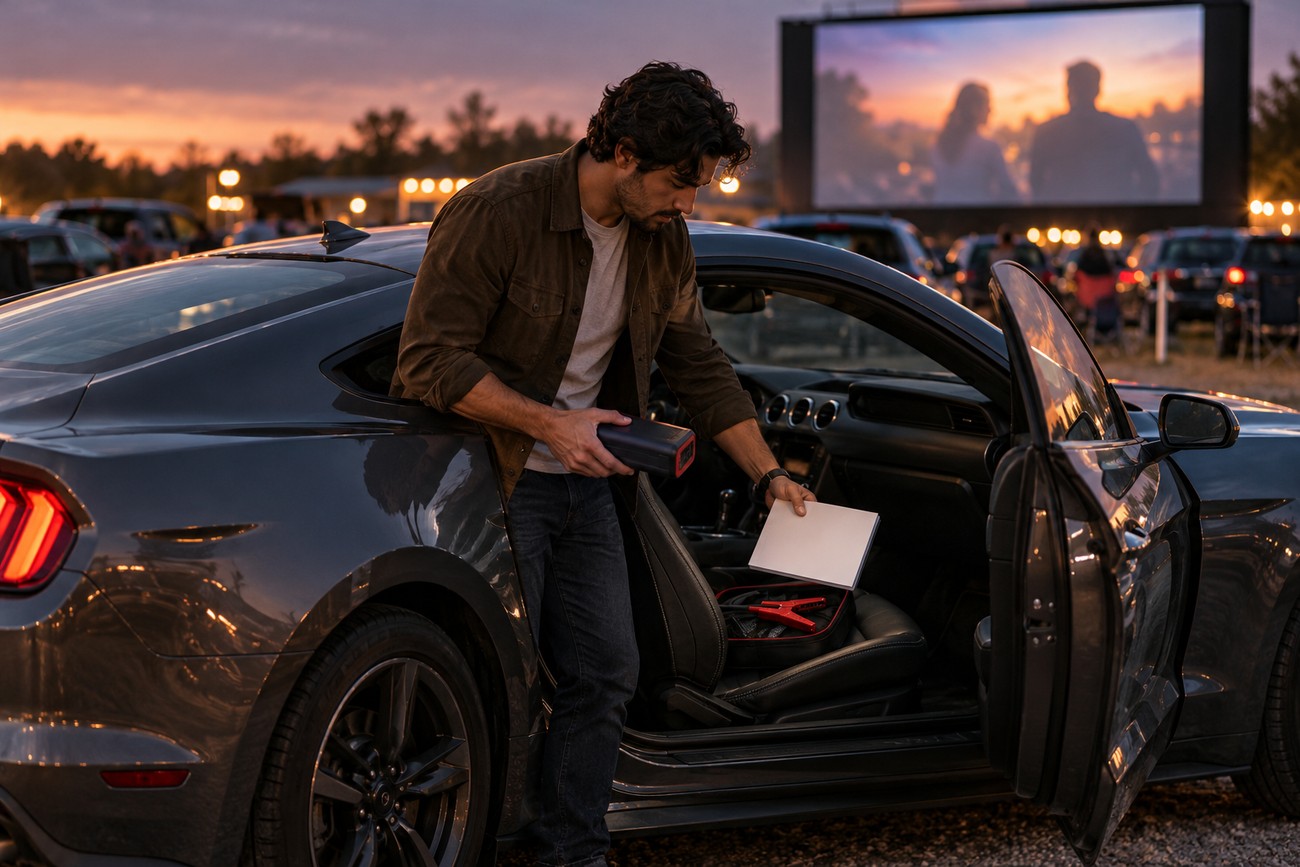
Before leaving, take any recent slow cranking, battery warning, or unexplained electrical behavior seriously. Have a suspect 12V battery checked rather than hoping it will last one more evening. Bring a suitable portable jump starter if you have one, and locate the model-specific external-power points in the owner’s manual while the car is still working.
At the theater, decide how you will hear the audio before the film begins. If you must use the car radio, select the least power-hungry state that actually works for your model and minimize time in ACC or ON. Check that exterior lights, unnecessary displays, climate control, and device chargers are off; do not assume a dark-looking cabin means every load has stopped.
Park where assistance can reach the vehicle if needed, without obstructing other viewers or exit lanes. Some drive-ins may have jump equipment, but availability is not guaranteed, and staff may be unable to help with a model-specific procedure. Keep your phone charged independently if possible so a dead car does not also leave you unable to call for help.
What to Do When the Mustang Is Dead at the End of the Film
First, make the area safe and check what still responds. A car that unlocks but will not start calls for a different check from a Mach-E that will not unlock or power up at all. Avoid repeated start attempts and tell theater staff if the stationary car will block the exit; arrange roadside assistance if you lack the correct equipment or instructions.
For a gasoline Mustang, follow the jump-start procedure and designated connection points in the manual for its specific model and year. Keep people clear of moving vehicles, and never improvise connections at a crowded drive-in. If a jump starter’s instructions conflict with what you can safely identify on the car, stop and request trained help.
For a Mach-E with a discharged 12V battery, Ford identifies dedicated external-power connection points beneath the front-right bumper cover. Accessing them is part of the model-specific recovery procedure, particularly when the car will not unlock. Follow the exact manual instructions for opening the cover and connecting the source; do not substitute a connection to the high-voltage system.
Ford’s Mach-E procedure calls for keeping both the vehicle and external source powered for at least 3 minutes before disconnecting. A Mach-E with a discharged 12V battery may also need a booster battery or external power to release its electric parking brake. Do not force the brake or attempt to move the car while it remains engaged; if the specified procedure cannot be completed safely, let roadside assistance handle recovery.
Common Drive-In Battery Mistakes and Myths
A charged EV traction battery does not make the Mach-E immune to a dead 12V system. The separate 12V battery can still leave the vehicle unable to unlock or respond. Treating the displayed driving range as a measure of 12V health misses the system most likely to strand you in this situation.
A few seconds of engine operation in a gasoline Mustang is not a reliable recharge plan. Briefly powering a Mach-E is also not equivalent to Ford’s minimum 3-minute external-power step during its recovery procedure. That step is an instruction for the immediate procedure, not a promise that an unhealthy 12V battery has been fully charged.
Neither a working radio nor an owner’s report of two comfortable hours in ACC establishes a safe limit for your car. Accessory load, battery condition, and the selected power state can all differ. A successful jump gets you moving only if the vehicle then operates normally; it does not identify why the battery ran down.
If the Mustang Starts Again, Do Not Assume It Is Fixed
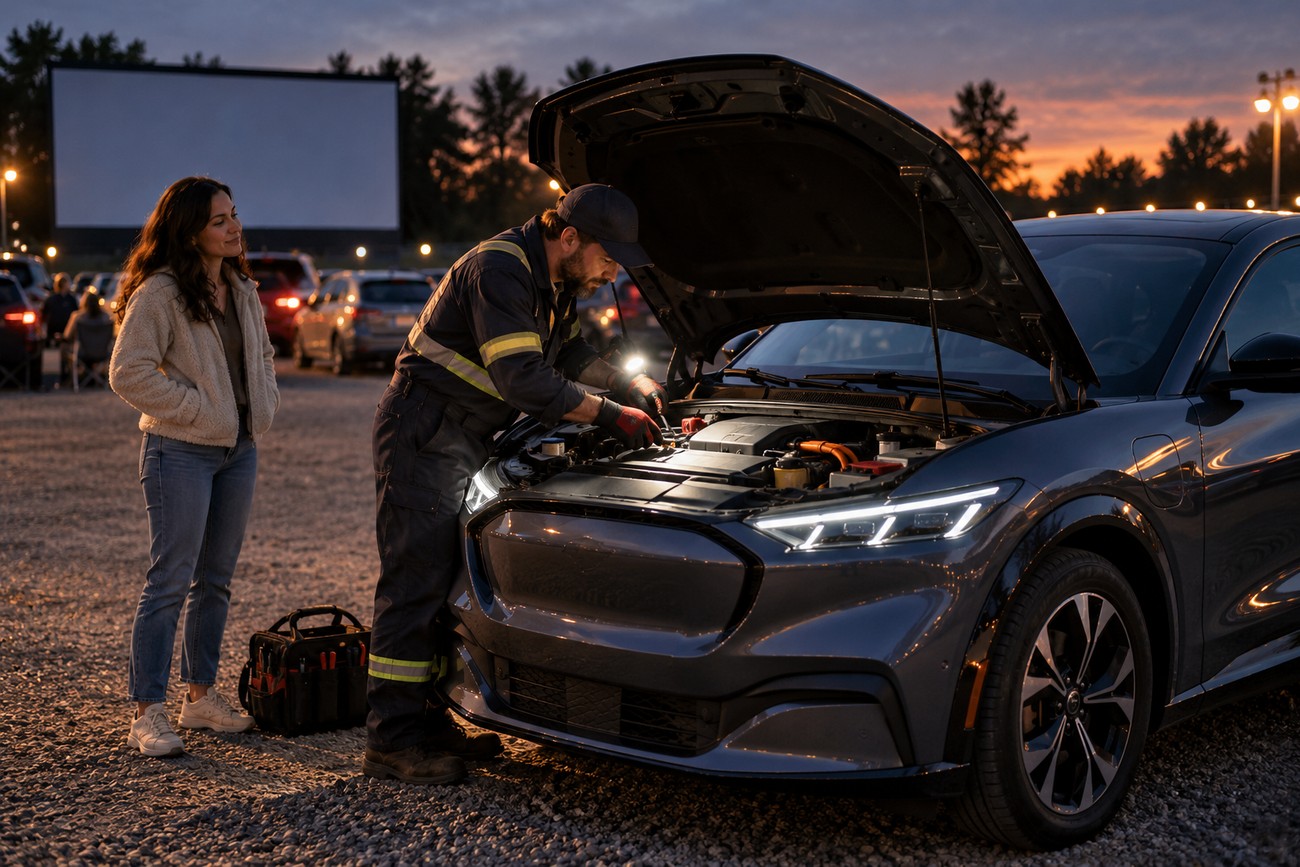
After a jump, pause before setting off. Confirm that the vehicle responds normally, the parking brake releases as intended, and warning messages have cleared or been assessed. If controls remain erratic, critical warnings persist, or the car cannot be moved safely, request roadside assistance rather than trying to drive through the fault.
Have the 12V battery’s condition and charging behavior checked, especially if the failure seemed sudden. An aging battery can perform normally until a long accessory session exposes its reduced reserve. Possible parasitic loads also deserve investigation when the battery loses power after parking, even if another jump appears to solve the immediate problem.
Partial recovery can be misleading: electrical glitches or messages may persist after external power is applied. Roadside assistance may need to follow a model-specific power reset or disconnection procedure, while a service diagnosis can determine whether a battery, charging issue, or continuing load caused the failure. Repeated jumps are a way out of a stranded moment, not a substitute for finding the fault.
Frequently asked questions
The safest next step depends on whether the car is operating normally after recovery or still showing signs of an electrical fault. For any jump-start, use the designated points and instructions for your exact Mustang; the Mach-E’s 12V system is separate from its high-voltage traction battery.
What if my Mustang starts after a jump but warning messages or electrical glitches remain?
Do not treat a temporary start as a clean bill of health. If steering, braking, vehicle controls, or other essential functions seem abnormal, stop in a safe place and request professional assistance. If the car otherwise operates normally, arrange a prompt 12V battery and electrical-system check, and report exactly which messages appeared before and after the jump.
Why can a replacement Mustang battery keep dying at drive-ins?
A new battery can still run down if the underlying demand has not changed. Check how long the car remains in ACC or ON, what stays powered during the film, and whether an unexpected load continues after shutdown. A service check should also assess charging behavior and possible parasitic draw before assuming the replacement battery itself is defective.
How can I watch a drive-in movie without killing the battery?
Set up the audio with the least vehicle power use your model permits, and turn off avoidable lights, climate control, displays, and chargers. If you can listen through a separate, independently powered radio, you can leave the car fully off. Otherwise, start with a healthy 12V battery, know the model’s recovery points, and avoid treating any reported runtime as a guarantee.
Why does my Mustang battery keep dying?
Repeated failures can point to a weak or aging 12V battery, a charging problem, or an electrical load that persists while the car is parked. Drive-in accessory use may reveal a problem that was already developing rather than being its only cause. Ask for battery testing and an electrical-system diagnosis, and note when the failures happen; repeated jump-starts alone will not establish the cause.







