
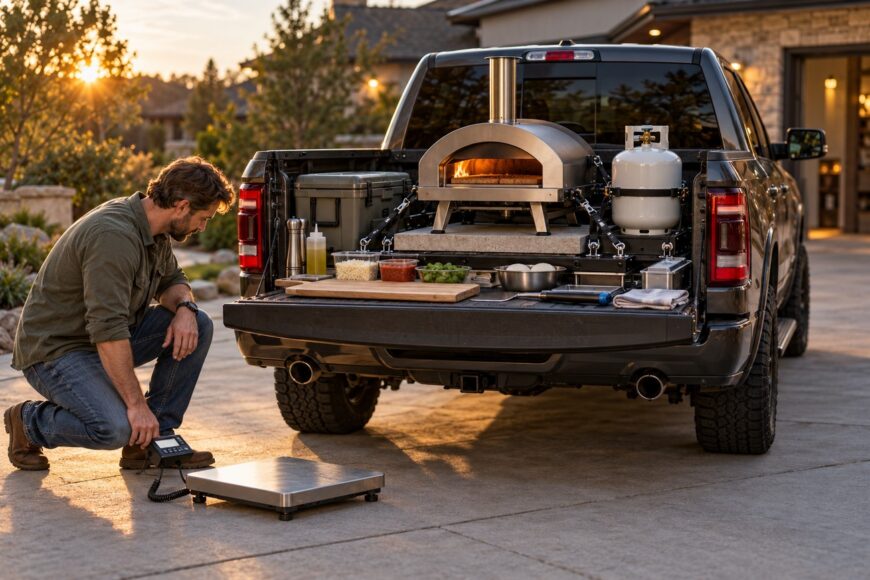
Baking pizza from the bed of a Ram 1500 can turn a campsite, tailgate, or remote work site into a capable outdoor kitchen. The truck provides a stable platform for a heavy oven, preparation space, and fuel, while the open bed makes serving easier than carrying a freestanding setup over uneven ground.
The practical conflict appears once the equipment is loaded. The oven, stone or deck, fuel cylinder, mounting hardware, passengers, fuel, and other gear all compete for payload. Heat, wind, combustion gases, and shifting cargo add risks that a simple portable-oven setup can conceal. A workable installation therefore depends on repeatable loading, controlled heat, and safe operation rather than on reaching a high temperature once.
- Can a Ram 1500 Safely Carry a Truck-Bed Pizza Oven?
- Heat Protection, Ventilation, and Propane Safety in the Bed
- Propane vs. Wood-Fired Ovens for a Ram 1500
- Designing a Usable Oven Layout in the Ram 1500 Bed
- How to Get Even Pizza Results Outdoors
- The Mistakes and Hidden Costs Owners Discover Later
- A Practical Pre-Bake and Drive-Away Checklist
- Frequently asked questions
- What is the two-hour rule for pizza after it comes out of the oven?
- Which mode should you use to bake pizza in a conventional home oven if the truck setup is unavailable?
- How should you store pizza dough and toppings during a truck-bed bake?
Can a Ram 1500 Safely Carry a Truck-Bed Pizza Oven?
A Ram 1500’s size does not determine how much pizza equipment it can carry. Payload commonly ranges from about 700 to 1,500+ kg, depending on configuration, so the relevant figures are the specific truck’s GVWR and GAWR. Check the vehicle’s door-jamb label, owner documentation, and applicable loading information before choosing the oven or designing a mount.
Calculate the complete working load. Include the oven, stone or deck, fuel cylinder, mounting hardware, passengers, fuel, ingredients, tools, coolers, and every other item carried in the truck. The available payload is reduced by all of these items together, and a heavy oven can consume a substantial share before cooking equipment is added.
Axle loading matters alongside the total vehicle weight. A layout that stays within the overall payload can still place excessive load toward one end of the bed or one side of the truck. Keep the assembly as balanced as practical, follow the truck’s GVWR and GAWR limits, and avoid assuming that a broad bed automatically provides adequate capacity.
The oven and cylinder must be restrained against movement during braking and cornering. Use attachment points and restraints suitable for the equipment, then check that the load cannot slide, tip, or pull against a fuel connection. A loose stone, cylinder, or oven becomes a heavy moving object during an emergency stop.
Heat Protection, Ventilation, and Propane Safety in the Bed
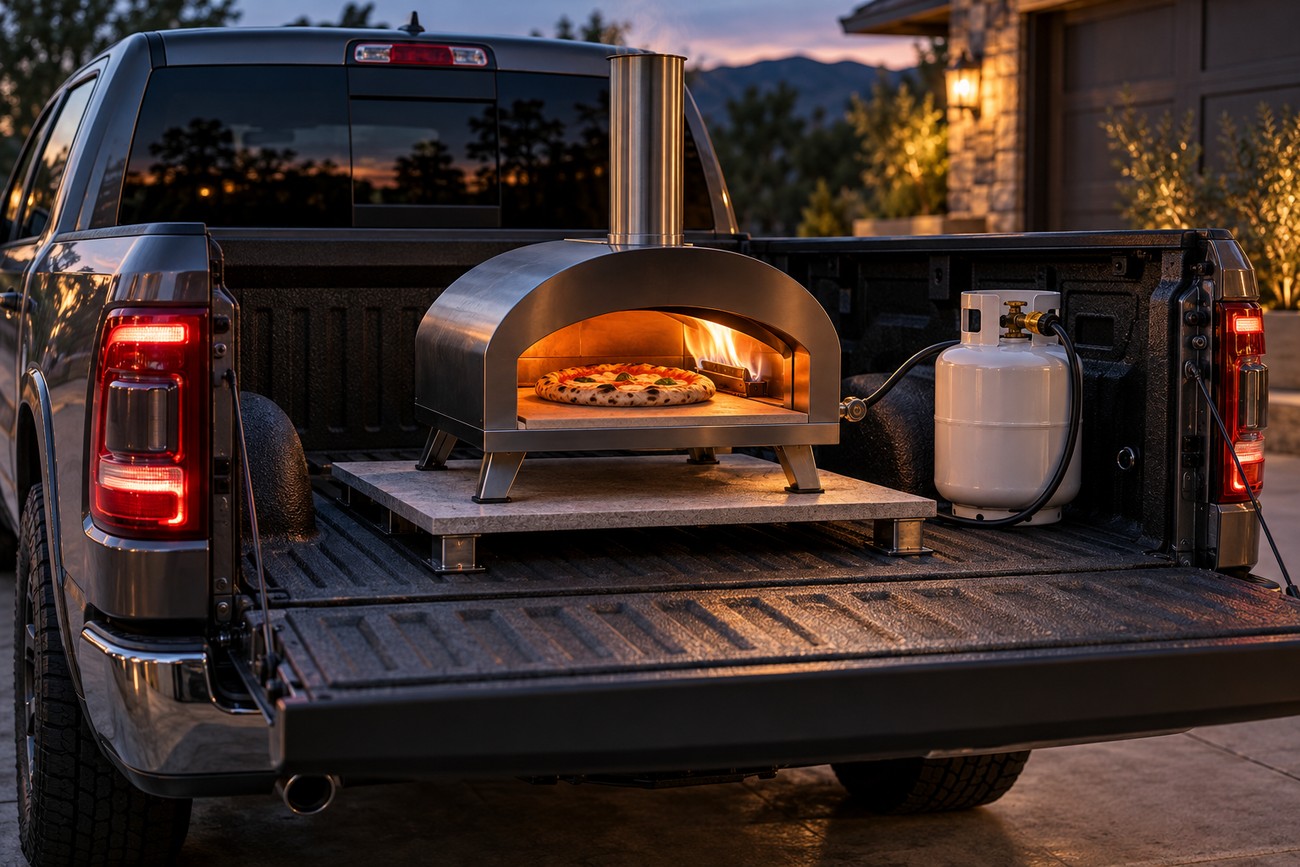
Heat protection begins underneath and around the oven. Use a suitable noncombustible heat shield and maintain the clearance specified by the oven maker from paint, plastic, rubber, wiring, bed liners, fuel components, and other vulnerable parts. Do not infer a universal clearance number; the required spacing depends on the appliance, its support arrangement, and the surrounding materials.
Heat can travel through the oven base, supports, radiant surfaces, and hot exhaust. The bed may feel acceptable at the start of a bake and become substantially hotter during a series of pizzas. Inspect the area after the first controlled heating session, looking for softened liners, discoloration, damaged coatings, or heat reaching components outside the intended cooking zone.
Heat shields need an air gap and a stable support arrangement to work as intended; laying a sheet of metal directly on a hot bed surface can transfer heat rather than remove the hazard.
Open-bed operation improves air movement, yet it does not eliminate carbon monoxide or localized overheating risks. A fuel-fired oven in a partially enclosed or poorly ventilated space can accumulate carbon monoxide, especially around bed covers, canopies, walls, or nearby structures. Keep the cooking area open, remain alert to changing wind conditions, and include carbon monoxide awareness in the operating plan.
For propane, keep the cylinder upright, secured, leak-free, and fitted with a serviceable valve. Inspect the hose, regulator, and connections before lighting, follow the appliance instructions, and keep the cylinder away from hot surfaces and vulnerable truck components. Tie-down straps alone do not make an installation safe: the system also needs heat protection, appropriate clearance, ventilation, and leak control.
Propane vs. Wood-Fired Ovens for a Ram 1500
Most portable truck-bed pizza ovens use propane, while wood-fired models use firewood. Both can reach about 400–500°C on the stone or deck, but their handling demands differ in an open truck bed.
| Consideration | Propane oven | Wood-fired oven |
|---|---|---|
| Startup | Generally straightforward once the cylinder and connections are ready. | Requires firewood, ignition, and time to establish a suitable fire. |
| Heat control | Flame adjustment is usually more direct and repeatable. | Heat depends on fuel size, fire position, airflow, and ember management. |
| Wind response | Side wind can destabilize the flame and increase heat loss. | Wind affects airflow, flame behavior, ember movement, and heat retention. |
| Fuel handling | The cylinder must remain upright, secured, leak-free, and away from heat. | Firewood must be stored securely, with embers and hot ash controlled. |
| Cleanup | Usually involves flour, food residue, and grease. | Adds ash, embers, soot, and more demanding grease cleanup. |
| Repeated baking in a truck bed | Often easier to regulate between pizzas, provided the oven and cylinder are safely arranged. | Can provide strong heat, though fire management and cleanup add workload. |
Propane is often easier for repeated baking because the flame can be reduced or increased without moving fuel inside the oven. Wood can suit cooks who value fire management and are prepared to handle ash and embers in the truck environment. Neither fuel is universally safer; the installation, ventilation, fuel storage, and operator discipline determine the main risk.
Wind deserves attention with either option. A side gust can disturb the flame, strip heat from the oven, and lengthen recovery between pizzas. Place the truck where wind exposure is limited without creating a confined or poorly ventilated cooking space.
Designing a Usable Oven Layout in the Ram 1500 Bed
The most practical location depends on loading and unloading access, rather than on centering the oven alone. Leave a usable route for ingredients, a safe working position for the peel, and clear access to the tailgate, tie-down points, fuel connections, and cylinder valve. The best cooking position can be inconvenient if every tray or bag must pass around a hot appliance.
Keep the hot zone away from plastic, rubber, wiring, paint, and sensitive bed components. Consider where exhaust and radiant heat travel when the tailgate is open, closed, or partially used as a work surface. A layout that looks acceptable from above can still direct heat toward a side panel, fuel area, or electrical component.
Side wind can destabilize the flame and increase heat loss in an open bed. Orient the oven and the truck so the working side remains accessible while the appliance has some protection from direct crosswind. Avoid improvised windbreaks that enclose the combustion area or interfere with ventilation.
A fixed or semi-fixed oven can restrict the tailgate, bed, fuel area, and mounting points. It also makes ordinary truck use less convenient and turns removal into a heavy handling task. Treat the installation as a cooking assembly that needs a deliberate storage and unloading plan, rather than as a grab-and-go accessory.
How to Get Even Pizza Results Outdoors
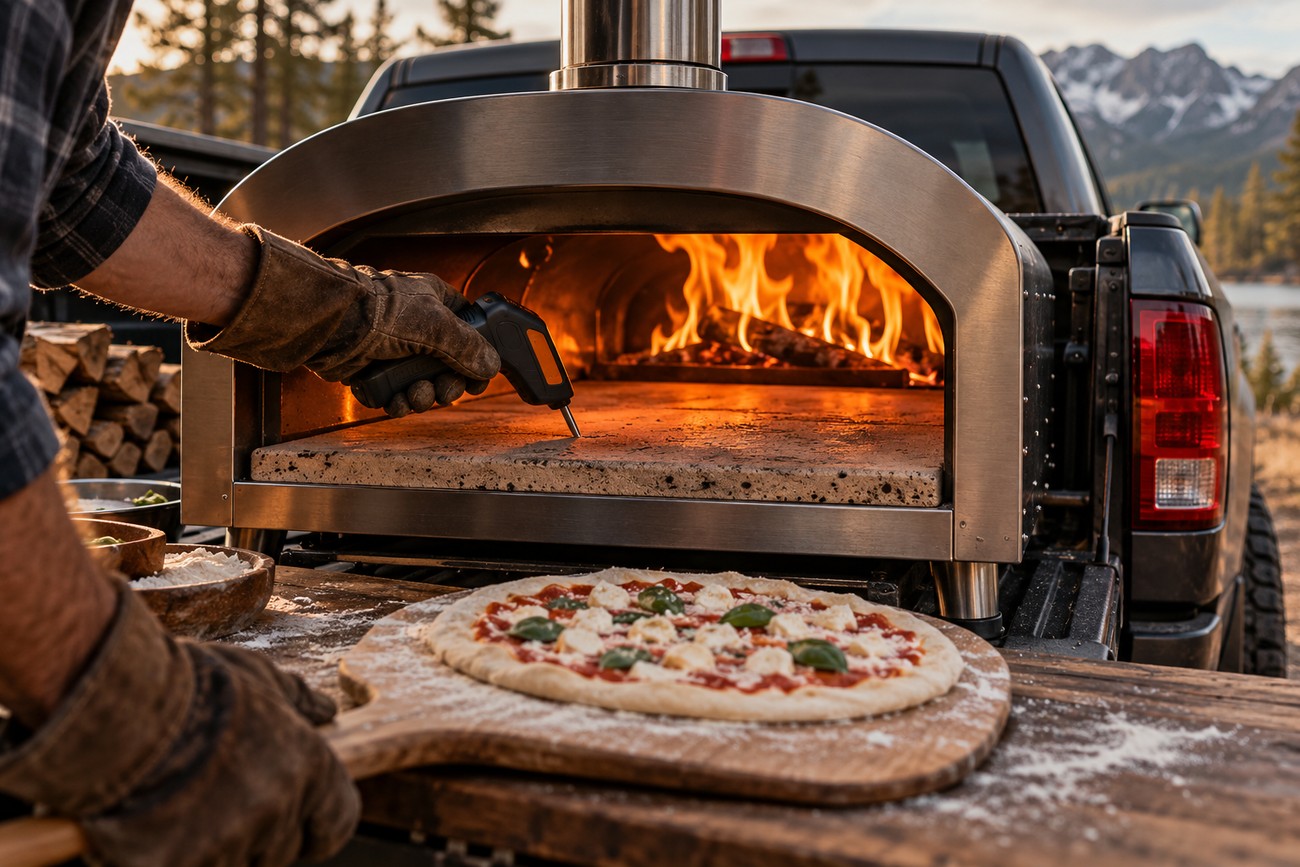
Start by fully preheating the stone or deck, then verify the baking surface separately from the oven’s air temperature. A hot-looking flame or a high air reading does not prove that the deck has reached a useful baking condition. Pizza commonly bakes on a stone or deck around 400–500°C, but the correct working point depends on the dough, topping load, and oven design.
Charge the stone with heat before launching the first pizza. Use a surface thermometer or the oven maker’s recommended method where appropriate, and allow for the stone’s thermal mass. A thin or lightly supported deck may respond quickly but recover differently from a heavier stone, so the first bake should be treated as a calibration rather than a final judgment.
After the deck is charged, reducing the flame often gives better control than holding maximum power; judge the bake by the bottom and the top heat together, then turn the pizza as needed.
Manage the flame throughout the bake. The top may brown quickly while the bottom remains pale, or the stone may be hot enough to scorch the base while the upper heat is insufficient. A controllable lower flame, suitable dough moisture, and timely turning help balance these two cooking surfaces.
Expect the stone or deck to lose noticeable heat during a series of pizzas. Later pizzas may rise less, develop pale bottoms, or require longer baking even though the oven air still feels hot. Allow recovery time, adjust the flame without chasing the highest displayed temperature, and rotate or turn each pizza according to the oven’s hot spots.
Maximum temperature alone does not guarantee better pizza. Stable deck heat, upper heat, dough moisture, topping quantity, and handling speed determine the result together. A repeatable sequence usually produces better food than repeatedly pushing the burner or fire to its peak.
The Mistakes and Hidden Costs Owners Discover Later
Inadequate heat protection is one of the most expensive early mistakes. Bed liners can soften, coatings can discolor, and nearby plastic, rubber, or wiring can suffer damage when the oven is used repeatedly. A heat shield should be selected and supported as part of the installation, with clearances based on the oven maker’s instructions and the truck’s materials.
Payload planning also fails when owners count only the oven body. The stone, cylinder, hardware, passengers, fuel, ingredients, and other cargo must be counted together against the truck’s GVWR and GAWR. A truck that feels stable on a short drive can still be overloaded or poorly balanced.
Wind creates a second set of problems. It increases heat loss, makes the flame less stable, and can raise fuel use compared with expectations for sheltered cooking. Wood adds ash and ember cleanup, while either fuel can leave grease and flour in the bed unless the work area is protected and cleaned after cooling.
Permanent mounting can reduce access to the bed, tailgate, fuel area, and attachment points. Heat damage or nonstandard mounting may also complicate warranty discussions involving the bed or electrical systems. Before drilling, wiring, or modifying the truck, document the proposed installation and check the vehicle and appliance requirements.
A Practical Pre-Bake and Drive-Away Checklist
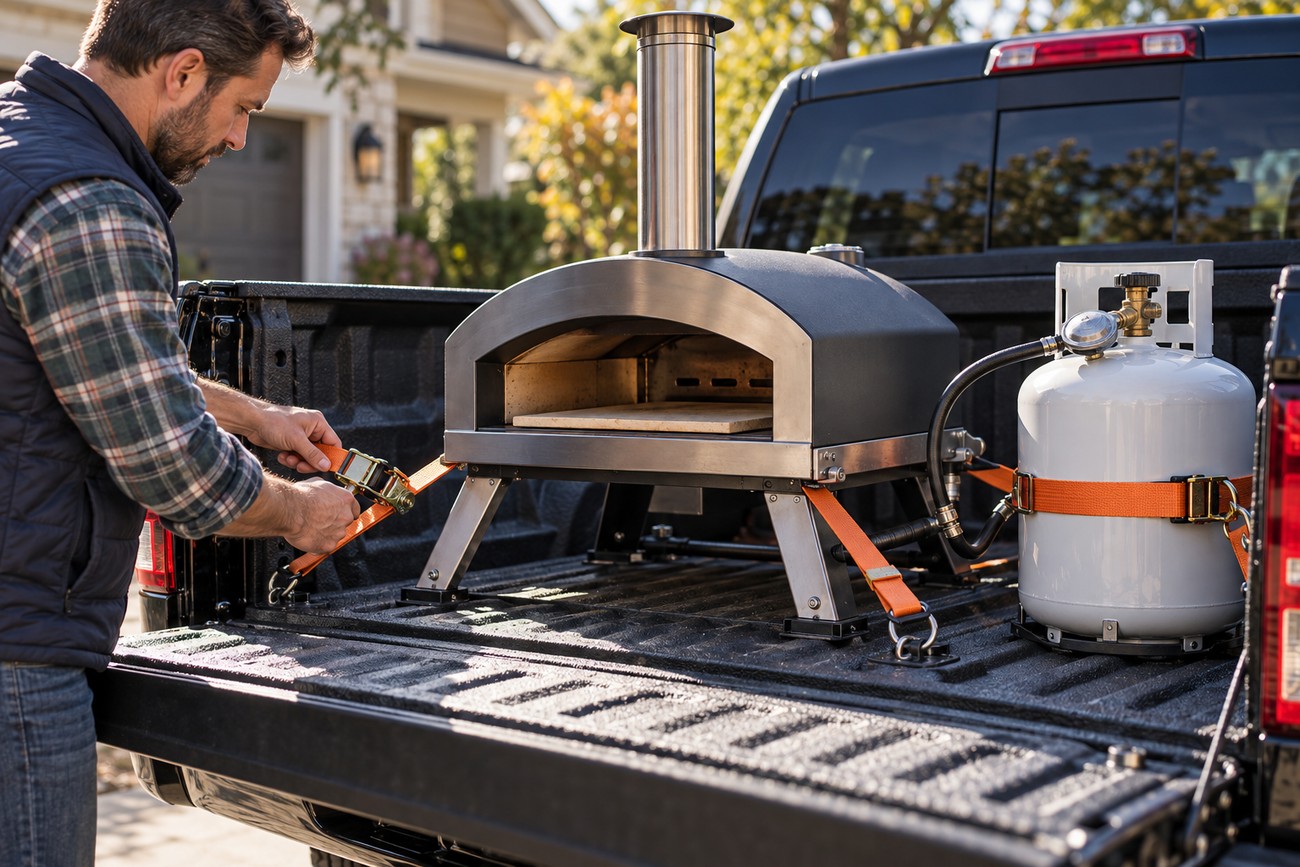
Before driving, confirm the complete load against the specific truck’s GVWR and GAWR. Check that the oven, stone or deck, cylinder, hardware, passengers, fuel, and other cargo are included in the calculation. Secure the oven and cylinder so they cannot move during braking or cornering, and keep the cylinder upright with a serviceable valve and no signs of leakage.
Before lighting, inspect the hose, regulator, fittings, and burner area. Confirm that the heat shield is correctly positioned, vulnerable truck components have appropriate clearance, and the bed remains open enough for combustion and exhaust. Remove loose packaging, combustible debris, and items that could fall against the hot oven.
During baking, monitor the surface temperature, flame behavior, wind, and the condition of the surrounding bed. Use a controllable flame rather than maximum power throughout, and allow the stone or deck to recover between pizzas when the bottoms begin to pale. Keep ingredients and tools arranged so you do not reach across hot surfaces or disturb the fuel connection.
After shutdown, allow the oven, stone, ash, and metal supports to cool before handling, covering, loading, or returning the truck to ordinary use. Check for grease, flour, ash, heat damage, and shifted equipment, then clean the bed and secure or remove the assembly for transport. A cool-down check can reveal problems that are invisible while the oven is operating.
Frequently asked questions
The answers below cover food safety, home-oven alternatives, and ingredient storage for outdoor pizza baking. They also address practical steps that help maintain food quality while the truck-bed oven is in use.
What is the two-hour rule for pizza after it comes out of the oven?
The two-hour rule means perishable pizza and toppings should generally not remain at room temperature for longer than two hours before refrigeration or disposal. In conditions above 32°C, the limit is generally one hour. Heat from the oven does not by itself keep a finished pizza safe once it is sitting on a tray, tailgate, or serving table.
Warm outdoor conditions can shorten the safe holding window, especially for meat, dairy, and other perishable toppings. Serve smaller batches, use insulated food containers where appropriate, and refrigerate leftovers promptly rather than relying on the truck bed or a covered box to control temperature.
Which mode should you use to bake pizza in a conventional home oven if the truck setup is unavailable?
Use the hottest conventional bake setting allowed by the home oven, with a preheated baking steel, stone, or heavy tray positioned according to the equipment instructions. A dedicated outdoor oven concentrates stronger top and deck heat, so a home oven usually needs a longer preheat and a different bake duration.
Fan-assisted mode can improve heat circulation and browning, but it may dry the surface or brown toppings before the base is ready. Test both conventional and fan-assisted settings with the same dough and toppings, then choose the mode that gives the best balance between a baked bottom and properly finished toppings.
How should you store pizza dough and toppings during a truck-bed bake?
Keep dough covered so wind, dust, and direct heat do not form a dry skin. Store prepared toppings in closed food containers, shaded from the oven and exhaust, with cold foods kept in a properly chilled cooler or other suitable cold-storage system.
Organize ingredients in the order of use and keep raw ingredients separate from finished pizza. Avoid leaving cheese, meat, or other perishable toppings beside the hot oven while waiting for the next bake; the bed can become a warm holding area even when the air temperature feels moderate.







