
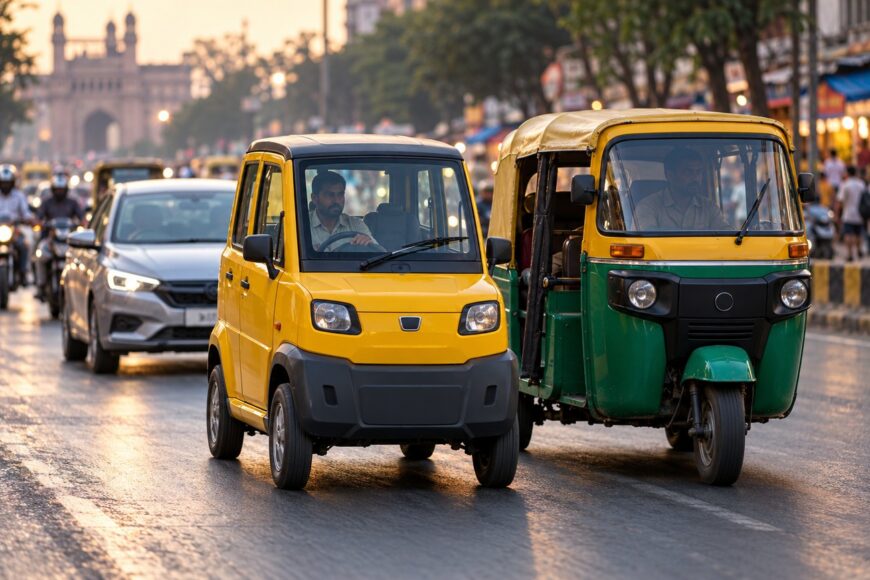
The Bajaj Qute looks like a covered, car-like replacement for an autorickshaw, yet it remains a lightweight four-wheeled quadricycle with different limits. That distinction affects speed, crash protection, payload, comfort, registration, and the roads on which you can legally use it.
The main buying risk is treating a low purchase price or a familiar model name as proof of full passenger-car capability. Qute specifications vary by market, and petrol, CNG, LPG, and diesel references cannot be combined into one universal profile. A sensible assessment therefore starts with the exact vehicle, its documents, and the work it must perform every day.
For short urban routes, the Qute can offer weather protection, four wheels, and easy maneuvering in places where a conventional car is cumbersome. Its compromises become more serious with highway travel, four adults, steep roads, repeated hard braking, or a collision with an ordinary car.
- What the Bajaj Qute Is—and What It Is Not
- Bajaj Qute Specifications: Engine, Size, Payload, and Range of Versions
- How the Qute Performs in Real City Use
- Safety, Braking, and the Quadricycle Trade-Off
- Ownership Risks: Loading, Parts, Service, and Market-Specific Equipment
- Common Buying Mistakes and the Right Use Case
- Bajaj Qute Verdict: A Covered Rickshaw Alternative, Not a Small Car
- Frequently asked questions
- How much does the Bajaj Qute cost?
- What is the price of a new Bajaj Qute in India?
- How much does a new Bajaj Auto rickshaw body cost?
What the Bajaj Qute Is—and What It Is Not
The Bajaj Qute is a four-wheeled quadricycle designed mainly for short urban trips and enclosed passenger work. Its role is closest to a covered alternative to an autorickshaw: it gives passengers a roof, doors, and a car-like cabin while keeping the vehicle narrow and mechanically simple.
That role does not make it equivalent to a conventional passenger car. A quadricycle has a different legal and technical category in many markets, with separate rules for speed, licensing, registration, insurance, and road access. Those rules vary by country, so a Qute that is practical on city streets may be restricted from particular highways or high-speed routes.
The distinction also matters in a crash. The Qute’s low mass reduces the energy required for urban operation and helps keep running demands modest, while it gives the vehicle less mass advantage when it meets a conventional car. Its four seats describe the available seating positions; they do not promise the space, acceleration, braking performance, or protection associated with a small hatchback.
The Qute name covers market-specific versions with different powertrains, equipment, and legal documents. Buyers should therefore compare the actual vehicle identification number, identification plate, certificate of conformity, and local registration papers rather than relying on a brochure from another country.
Bajaj Qute Specifications: Engine, Size, Payload, and Range of Versions
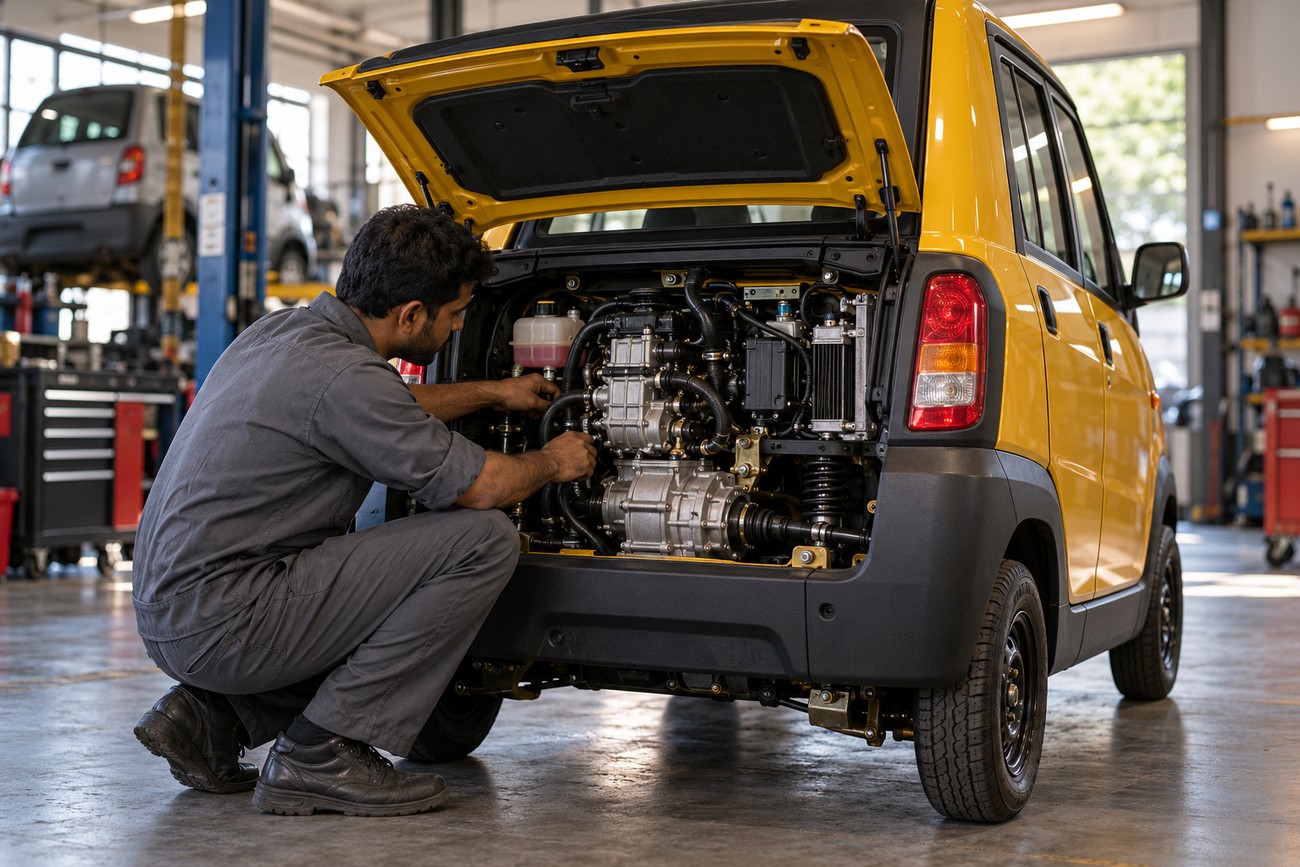
The cited petrol specification uses a 216.6 cc, single-cylinder, liquid-cooled engine producing 9.9 kW and 19.6 Nm. It drives the rear wheels through a five-speed manual transmission. The claimed top speed is 70 km/h, which places the vehicle firmly in an urban-transport role rather than a general-purpose long-distance role.
Official specifications from other markets describe different powertrains. A CNG version is listed with a 236.2 cc engine and 6.9 kW, while a diesel version is listed with a 470.5 cc engine and 6.24 kW. Market availability and equipment vary, so these figures should not be used to estimate the performance of a petrol Qute.
For the cited petrol version, the dimensions are 2752 × 1312 × 1652 mm. The 1925 mm wheelbase and 3.5 m turning radius explain its usefulness in dense streets and tight loading areas. The vehicle has four claimed seats, a steel monocoque, independent suspension, and 180 mm drum brakes on both axles.
The cited curb weight is 449 kg. A European brochure lists a gross vehicle mass of 749 kg, implying approximately 300 kg of payload for that specific configuration. That figure includes occupants, luggage, and relevant equipment, and it should not be transferred automatically to another market or fuel system.
Fuel-tank information requires particular caution. Official market pages list 8 liters, while some advertising cards cite approximately 30 liters or appear to describe another modification. Verify the fuel capacity, permissible mass, and equipment against the VIN, vehicle identification plate, local certificate, and registration documents before calculating range or operating cost.
How the Qute Performs in Real City Use
The 3.5 m turning radius is a genuine practical advantage. The Qute can turn into narrow lanes, position itself at crowded curbs, and maneuver through dense urban layouts with less shuttling than a conventional car. Its narrow body also makes short passenger routes easier to operate where parking and traffic space are limited.
Performance changes quickly with load. Owners report weak acceleration when the cabin is full, on inclines, or with the air conditioning operating. The claimed 70 km/h ceiling also leaves little margin for fast traffic, and route suitability depends on local speed limits and quadricycle access rules rather than on the vehicle’s ability to reach a particular speed.
The small single-cylinder engine, short gearing, and thin sound insulation contribute to noticeable noise and vibration. The light body can feel sensitive to crosswinds, while the suspension may feel harsh over uneven surfaces. These traits are manageable on short city runs, though they become tiring when the vehicle is used as a substitute for a small car on longer journeys.
Four seats are useful for urban shuttle work, yet four adults may find the cabin tight, especially around legroom and shoulder space. Owners also report compromises involving sealing, demisting, and heating in rain and cold; the exact experience depends on the market and trim. A buyer should inspect the actual vehicle in poor weather conditions where possible, rather than assuming all Qute versions have identical cabin equipment.
Safety, Braking, and the Quadricycle Trade-Off
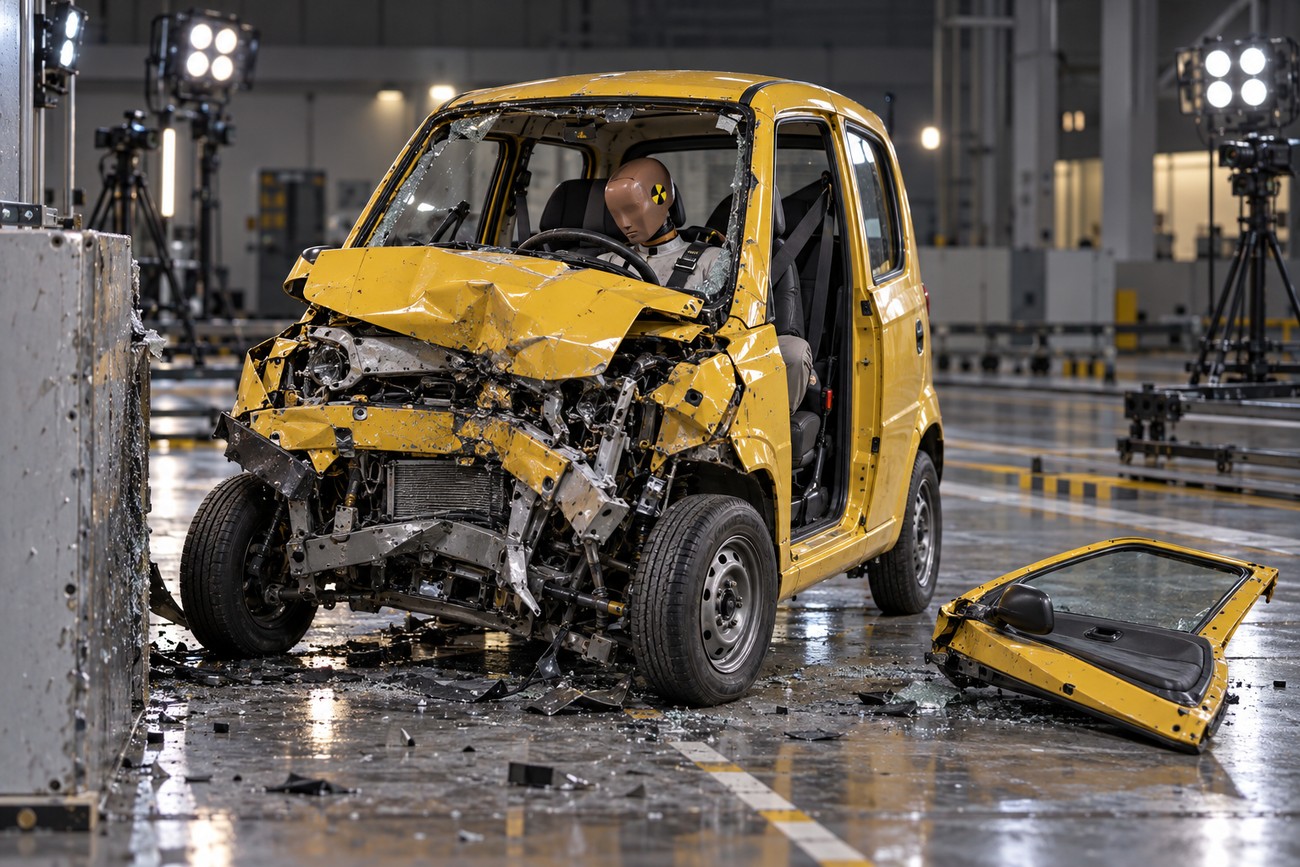
Safety is the clearest corrective to the small-car assumption. The Qute has a steel monocoque, but structural material alone does not establish strong crash protection. Occupant restraints, airbags, body stability, impact compatibility, and the performance of the particular tested version all matter.
Euro NCAP tested the Qute in 2016 and awarded it one star. The test reported no airbags, an unstable body structure in the frontal impact, and door detachment in the side impact. Those findings describe a serious limitation in the tested vehicle; they should not be converted into a prediction of every possible collision, though they are highly relevant when comparing the Qute with a conventional passenger car.
The Qute’s low mass helps explain its economical urban concept, while it reduces the mass advantage in a collision with a heavier ordinary car. A narrow, light vehicle also gives the driver less physical margin when a road layout mixes slow quadricycles with faster traffic. Local rules may reduce that exposure by limiting where the Qute can operate, but legal access is not the same as crash equivalence.
The vehicle uses 180 mm drum brakes on both axles. Drum brakes are simple and inexpensive to maintain, yet they shed heat less effectively during repeated hard braking than many more substantial passenger-car systems. Overloading, downhill driving, and frequent stop-and-start work therefore deserve attention during a test drive and service inspection.
A responsible decision treats the one-star result as a material ownership factor, alongside route speed and traffic mix. The Qute may make sense for controlled urban passenger work where maneuverability matters greatly. It is harder to justify where frequent high-speed travel, mixed traffic, or maximum occupant protection is central to the job.
Ownership Risks: Loading, Parts, Service, and Market-Specific Equipment
Payload must be calculated from the actual vehicle documents. The 749 kg gross vehicle mass and 449 kg curb mass imply approximately 300 kg for the cited configuration, yet payload, equipment, and legal limits vary by version and market. Occupants, baggage, fuel-system hardware, and accessories all consume that allowance.
Overloading has several effects at once: acceleration becomes weaker, braking distances can increase, steering response changes, and the light body may feel less settled on uneven roads or in wind. The usable range can also fall because the engine works harder. Loading four adults and a substantial amount of luggage should therefore be treated as a performance and handling calculation rather than simply counting the seats.
Technicians verify the vehicle plate and local certificate before ordering parts or quoting payload because identical Qute branding can conceal different engines, body fittings, fuel systems, and legal masses.
Outside regions with strong sales, owners may face limited body-panel availability and fewer specialized service centers. Independent evidence is insufficient to establish the frequency of specific engine or gearbox failures, so broad claims about reliability should be treated cautiously. Parts access and diagnostic support are more practical risks to investigate before purchase.
CNG ownership depends on more than fuel price. Check filling-station coverage, cylinder inspection requirements, and the space or mass taken by the gas system. For any imported Qute, inspect seat belts, glazing, windows, heater, body panels, registration, insurance, and local homologation; confirm that the actual equipment matches what the local authority requires.
Common Buying Mistakes and the Right Use Case
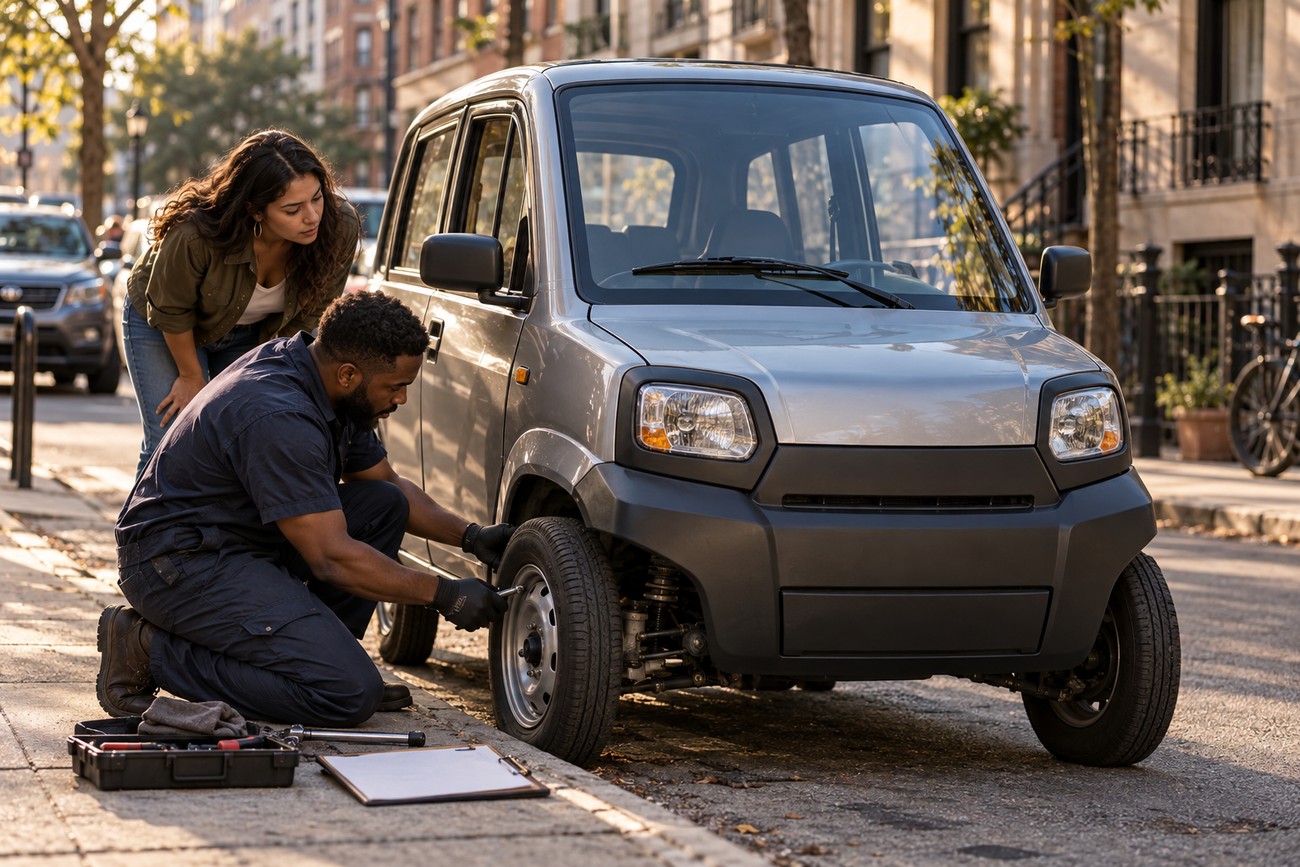
The most damaging mistake is buying the Qute for highway work because it has doors and a car-like driving position. The petrol version’s claimed top speed is 70 km/h, and local rules may impose additional restrictions. A route that looks short on a map can still be unsuitable if it includes fast traffic, steep grades, or long periods outside a dense city.
Sticker price is another incomplete comparison. Registration, insurance, servicing, parts, fuel access, permits, and legal restrictions can materially change the cost of ownership. A Qute should be compared with an autorickshaw for urban utility, while a comparison with a small car must account for safety, comfort, road access, and the different legal category.
Promotional specifications can also create a false sense of certainty. Petrol, CNG, LPG, and diesel references describe different configurations, and fuel-tank figures can conflict between market pages and advertising cards. Before paying, compare the advertised data with the VIN, vehicle identification plate, certificate of conformity, local registration documents, and actual permissible mass.
The defensible use case is short urban shuttle work with modest loads, frequent tight turns, and a strong local parts and service network. High-speed travel, heavy loading, long-distance journeys, and safety-sensitive passenger work call for a more capable vehicle unless local regulations and operating conditions clearly support the Qute.
Bajaj Qute Verdict: A Covered Rickshaw Alternative, Not a Small Car
The Qute’s genuine strengths are easy to identify. Compact dimensions, a 3.5 m turning radius, four-wheel enclosure, rear-wheel drive, and a simple mechanical layout can work well on crowded city routes. For an operator moving passengers short distances, those qualities may be more valuable than the space and speed of a conventional car.
The compromises are equally concrete: a claimed 70 km/h maximum speed, weak loaded performance, engine noise, limited cabin comfort, and light-vehicle sensitivity to wind and rough surfaces. The one-star Euro NCAP result adds a substantial safety concern, especially when the vehicle shares roads with ordinary cars.
The correct comparison depends on the job. Against an autorickshaw, the Qute can offer a more enclosed passenger environment and a four-wheel layout in routine urban use. Against a small hatchback, it remains a different proposition in legal status, crash protection, performance, and long-distance comfort.
Buy only after confirming the exact market version, route restrictions, passenger and payload needs, service access, and documents. If the route is short, the load is controlled, and the buyer accepts the crash-test result, the Qute can be a rational specialist tool. It should not be treated as a universal replacement for a conventional passenger car.
Frequently asked questions
How much does the Bajaj Qute cost?
There is no single globally valid Qute price. The payable amount depends on the market, powertrain, equipment, taxes, registration, insurance, delivery, and any commercial permit requirements.
Ask the seller for a written quotation that identifies the exact version and includes taxes, registration, insurance, delivery, warranty terms, and required local equipment. An advertised factory or showroom figure may exclude several of these items, so an on-road quotation is the more useful comparison.
What is the price of a new Bajaj Qute in India?
This article does not provide a verified current India retail price. Request a quotation from an authorized local source and confirm whether the vehicle is currently available for the intended registration and use.
Advertised or archived figures may describe an earlier version, exclude taxes and registration, or omit insurance, delivery, and commercial-use charges. The final payable cost should be checked against the vehicle configuration and the applicable local documents.
How much does a new Bajaj Auto rickshaw body cost?
A new autorickshaw body is a separate component and is not the same product as a complete Bajaj Qute. Its price depends on the body design, materials, labor, supplier, and whether the quotation covers fitting, paint, glazing, seats, and other equipment.
Before comparing offers, provide the supplier with the vehicle or chassis details and request an itemized quotation. Registration and inspection requirements may also affect whether a replacement body can legally be used for commercial operation.







