
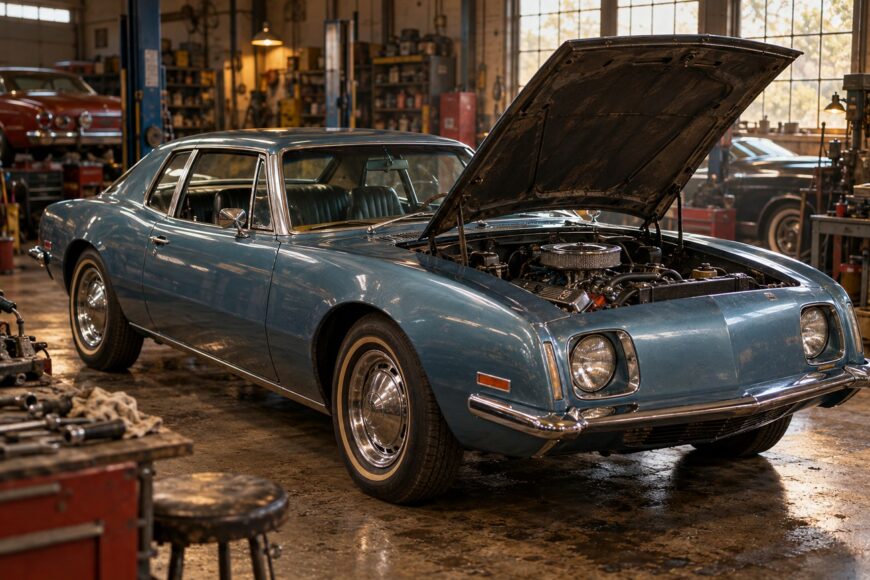
Studebaker stopped building the Avanti, yet the design continued as the Avanti II. That apparent contradiction explains both the car’s appeal and much of its difficulty: the later model preserved the original fiberglass body concept and Studebaker-derived frame while moving into a separate continuation story with changing General Motors powertrains.
Avanti II is therefore more than a Studebaker Avanti with a new badge. It is a hybrid of an inherited chassis and body design, Chevrolet and later GM mechanical components, and small-volume production. For a buyer, the central task is separating historical continuity from mechanical identity, factory specification, and restoration quality.
- When Studebaker Stopped, the Avanti Did Not
- Avanti II vs. Studebaker Avanti: What Actually Changed
- The Engine Is Easier to Recognize Than the Car
- The Fiberglass Body Can Hide an Expensive Car
- What Ownership Is Like When GM Parts Meet Avanti-Specific Hardware
- How to Judge an Avanti II Without Buying the Myth
- Frequently asked questions
- Was the Studebaker Avanti a good car?
- How many Studebaker Avantis are left?
- How much is a Studebaker Avanti worth today?
- What is the biggest difference between an Avanti and an Avanti II?
When Studebaker Stopped, the Avanti Did Not
Studebaker’s original Avanti had a short and unusual production life. Approximately 1,200 were built in 1962, fewer than 4,600 in 1963, and 809 in 1964 is the commonly accepted figure, although some registries cite 807 for the final year. Those numbers describe a rare car before the continuation story even began.
After Studebaker ended Avanti production, the Altman brothers launched Avanti II in 1965. The new company retained the Avanti’s design concept and fiberglass body continuity, allowing the distinctive shape to survive after the original manufacturer had left the passenger-car business. Avanti II should therefore be understood as a continuation model produced under a different industrial and commercial arrangement, rather than as a factory Studebaker model.
That distinction matters because low production volume affects more than collector interest. Factory records, component changes, and option information can be incomplete, while later repairs may have erased evidence of the car’s original specification. A surviving Avanti II may preserve the correct body design but carry a replacement engine, altered wiring, non-original trim, or a transmission from a different period.
Rarity also provides no automatic proof of originality or value. An uncommon car can be incomplete, badly repaired, or assembled from parts over several decades. Conversely, a well-documented car with a coherent history may be more useful to a serious buyer than a superficially attractive example with no records.
Avanti II vs. Studebaker Avanti: What Actually Changed
The two cars share a strong visual and structural lineage, but their specifications should not be treated as interchangeable. The original Avanti used a 109-inch wheelbase and measured approximately 192.4 inches long and approximately 70.3 inches wide. Avanti II retained the Studebaker Lark-based frame concept, with modifications required for a taller Chevrolet V8.
| Area | Original Studebaker Avanti | Avanti II |
|---|---|---|
| Production context | Built by Studebaker in the early 1960s | Launched in 1965 by the Altman brothers after Studebaker ended Avanti production |
| Frame and body | Studebaker-based chassis with the original fiberglass Avanti body | Studebaker Lark-based frame concept and fiberglass body continuity, modified for later mechanical equipment |
| Engine families | Studebaker V8 engines, including naturally aspirated R1 and supercharged R2 versions | Early Chevrolet 327-cubic-inch V8 applications, followed by GM 400, 350, and 305 applications |
| Power context | About 240 hp for the naturally aspirated R1 and 289 hp for the R2 are commonly cited | Early 327 output was stated at about 300 hp; exact output depends on the engine and its specification |
| Hood line | Original front-end rake and lower visual relationship between hood and nose | The taller Chevrolet V8 raised the hood line and removed the original visual rake of the front end |
| Transmission | Manual gearboxes and a three-speed automatic were used | Equipment varied by year and must be checked on the individual car |
| Identification | VIN, factory tags, engine specification, and period records | VIN, tags, build date, engine and component codes, transmission, and supporting records together |
The hood-line change is one of the most useful visual clues. The taller Chevrolet V8 required altered under-hood packaging, and the resulting height changed the front-end stance. A car that looks broadly like an original Avanti can therefore reveal its generation through the relationship between the hood, nose, and engine compartment.
The table also shows why a single “Avanti specification” is misleading. Early Avanti II cars used a Chevrolet 327-cubic-inch V8, often described as Corvette-sourced, with stated output of about 300 hp. Later cars used GM 400, 350, and 305 applications, but exact transition boundaries require the car’s year and documentation.
Transmission details deserve the same caution. The original Avanti used manual gearboxes and a three-speed automatic, while Avanti II equipment changed by year. A seller’s description, a familiar engine casting, or a replacement gearbox cannot establish the factory configuration on its own.
The Engine Is Easier to Recognize Than the Car
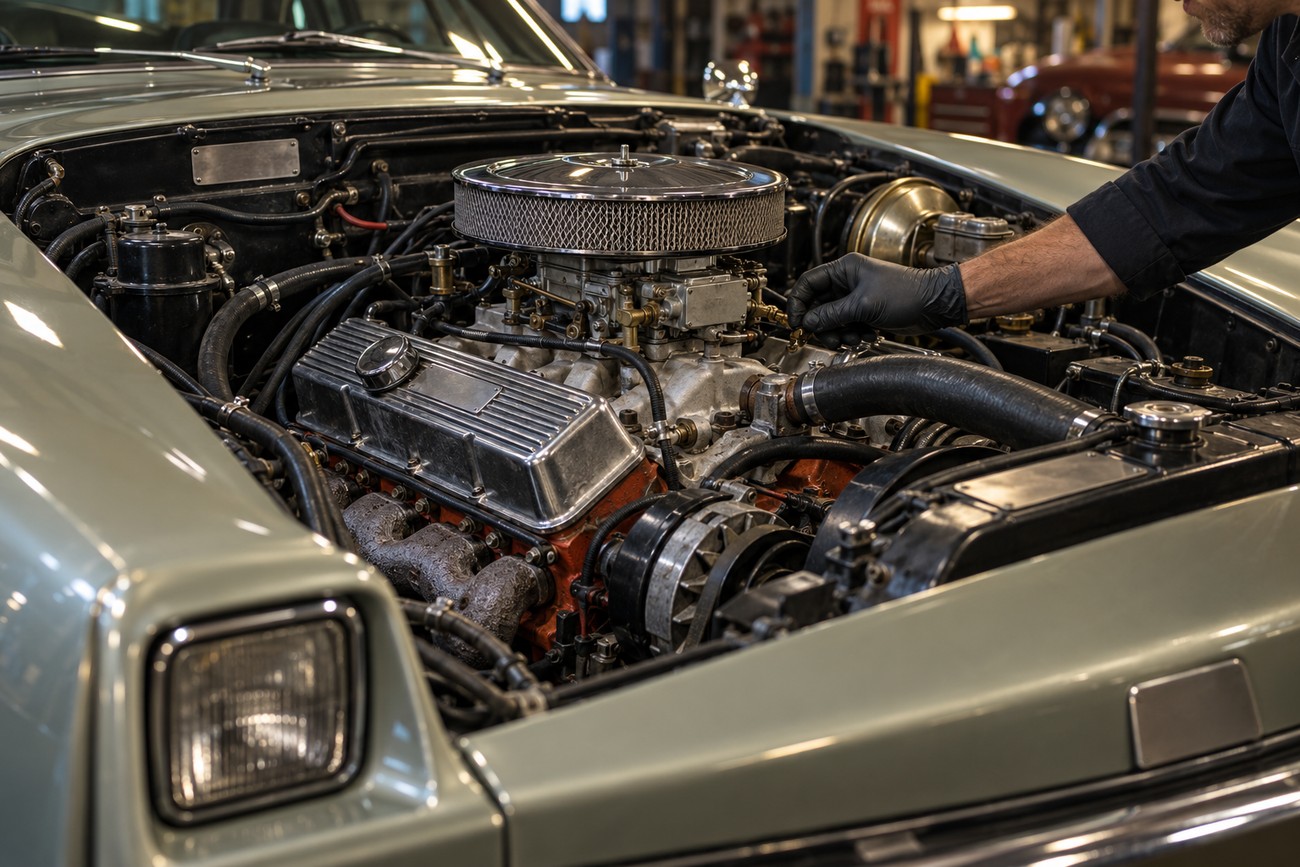
A Chevrolet or GM engine is usually easier to identify than the Avanti around it, but that does not make it a complete identification tool. Early Avanti II cars are often described as “Corvette-powered,” yet that phrase identifies an engine relationship more readily than it establishes an exact Corvette specification or a precise power output.
The engine sequence is best stated cautiously: early 327 applications were followed by GM 400, 350, and 305 applications. A buyer should compare the VIN, factory tags, build date, engine code, block, cylinder heads, carburetor, compression-related components, exhaust, accessories, and transmission. Supporting records such as invoices and photographs can clarify whether the present engine belongs to the car or replaced an earlier unit.
Power claims need similar discipline. For the original Studebaker Avanti, about 240 hp is commonly cited for the naturally aspirated R1 and 289 hp for the R2. Advertising and secondary writing sometimes blur those versions and quote more than 290 hp without explaining the configuration. Those figures should not be transferred to an Avanti II simply because both cars share a name and a general body shape.
The stated output of about 300 hp for the early Chevrolet 327 is useful historical context, not a dyno result for every surviving car. Actual power depends on engine code, heads, carburetion, compression, exhaust, tuning, and condition. A 327 with Corvette associations may have been rebuilt, fitted with different parts, or installed with accessories specific to the Avanti package.
The most reliable identification method is cumulative. The VIN and factory tags establish the car’s identity, the build date narrows its production context, and the engine and component codes test whether the hardware fits that context. Club registries, invoices, photographs, and repair records can then explain discrepancies that a casting number alone cannot.
The Fiberglass Body Can Hide an Expensive Car
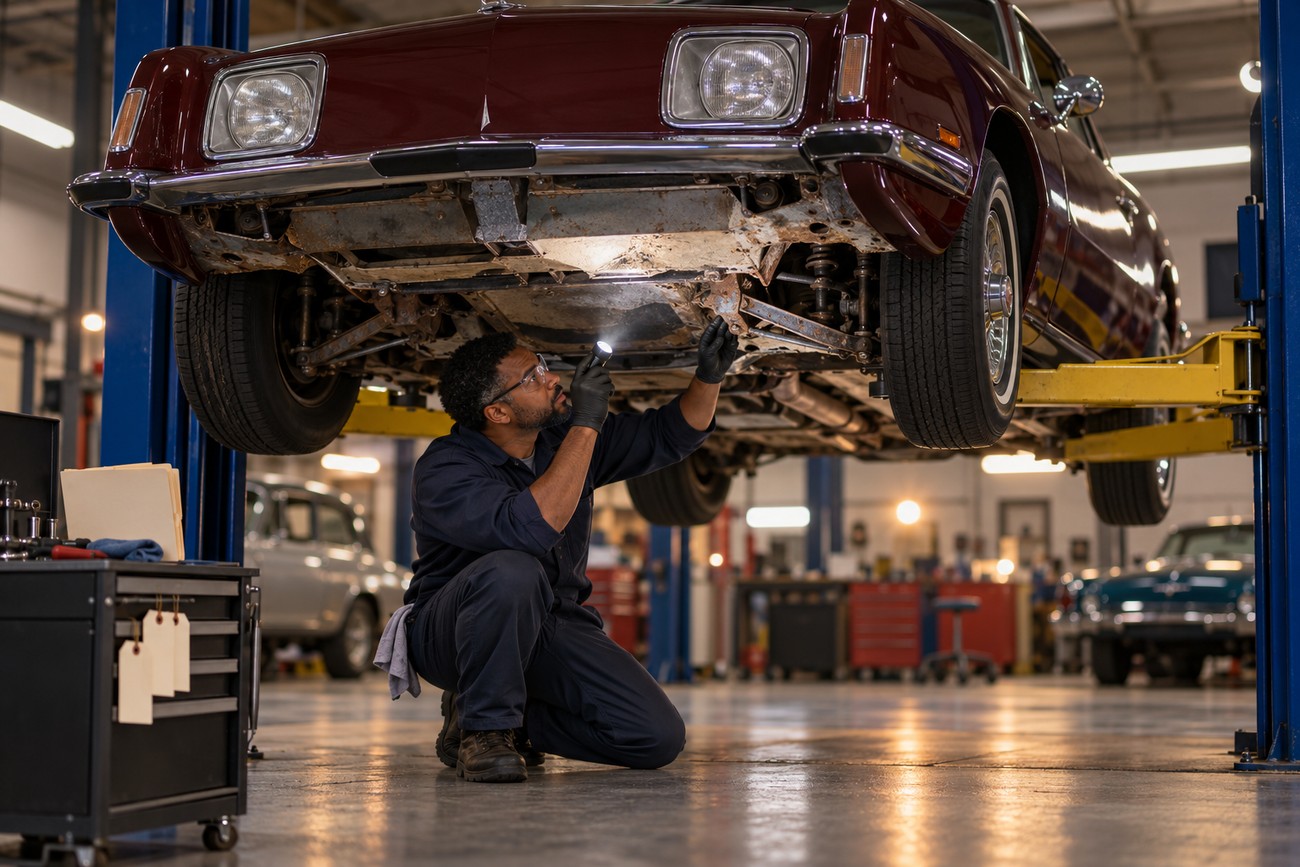
Fiberglass changes the inspection process. A smooth, glossy body can conceal cracks, poorly repaired impact damage, distorted mounting areas, and problems where the body attaches to the frame. The shell must be inspected separately from the structure beneath it, because clean paint says little about the condition of the frame, floors, or attachment points.
Particular attention belongs around doors, windshield and rear glass openings, hinges, latches, bumpers, trim, and body mounts. Uneven gaps may reflect accident damage, movement in a mount, poor previous repair, or an adjustment problem rather than simple cosmetic wear. The Studebaker Lark-based frame and its later modifications deserve a full examination from below, including corrosion, repairs, cracks, and evidence of loads being carried through damaged areas.
Paint should be the last thing that earns confidence. Authenticate the car, inspect the frame and floors, and examine the mounts and fiberglass attachment points before spending time admiring the finish or decoding the engine.
Unique body, glass, interior, and trim parts can be scarce. Club networks, specialist dismantles, and custom repair may be necessary, especially for pieces that do not interchange with ordinary Studebaker or GM components. A missing molding or damaged glass item can create more delay and expense than a familiar mechanical service.
The interior often determines whether a low-priced car is genuinely affordable. Original panels, upholstery, decorative pieces, and fittings are specific to the Avanti environment, and restoration labor can be substantial. Buying a project because its fiberglass looks straight, then pricing the glass, chrome, dashboard parts, wiring, and interior afterward, is a common way to turn an apparent bargain into the more expensive choice.
Electrical faults also deserve their own inspection rather than being blamed on the GM engine. Aged wiring, poor connectors, unreliable instruments, and improvised earlier repairs are recurring ownership concerns. The car may start and run while still needing a careful electrical overhaul, and no visual inspection of the engine can establish the quality of the rest of the harness.
What Ownership Is Like When GM Parts Meet Avanti-Specific Hardware
The GM V8 is a practical advantage in one limited sense: basic engine knowledge, service information, and some internal parts are more familiar to many shops than those for a wholly unique power unit. That advantage ends where the Avanti installation begins. Access can be restricted by the body and frame, and a standard Chevrolet procedure may not account for the space available around the engine.
Mounts, cooling, exhaust, wiring, and ancillary components may be specific to the Avanti installation. A Chevrolet 327, 400, 350, or 305 does not make every surrounding part a standard GM replacement. Before ordering components, the owner should confirm the actual engine, its mounting arrangement, radiator and hose layout, exhaust routing, accessory drive, and transmission.
This is also why “upgrade” is not a complete description of a repair. A modern component can be useful if its geometry, clearance, attachment method, and loads suit the original frame and installation. A part that fits the engine but changes suspension alignment, stresses a fiberglass mount, or interferes with the hood can create a new problem while solving an old one.
Interior restoration follows a different logic. Familiar GM mechanical parts do not make original Avanti panels, upholstery, decorative trim, or instruments interchangeable with ordinary Chevrolet or Studebaker pieces. Owners who plan a sympathetic restoration should preserve the car’s specific fit and finish, while owners choosing modifications should document them clearly for the next buyer.
How to Judge an Avanti II Without Buying the Myth
Start with identity and paperwork. Compare the VIN, factory tags, build date, engine and transmission, and visible component codes rather than accepting the seller’s model-year description. A club registry, invoice file, period photograph, or repair record can explain why the present car differs from an assumed factory specification.
Next inspect the frame, floors, mounts, and fiberglass attachment points before assessing paint or engine sound. Look for corrosion, deformation, cracked fiberglass, poorly bonded repairs, and signs that the body has shifted relative to the chassis. The frame must be judged as its own structure, because the shell can appear presentable while its supporting areas require major work.
Mechanical inspection should cover the installation rather than the engine family alone. Check cooling, exhaust clearance, mounts, transmission, steering and brake components, wiring, instruments, and access for future service. The available material does not support reliable frequency claims about steering, brake, or overheating failures, so a condition report is more useful than a generic reputation.
Finally, inventory completeness. Missing glass, trim, interior parts, chrome, or original fittings can be difficult to replace, and specialist labor may exceed the apparent savings on a cheap project. A documented, complete car can be financially safer than a cheaper example with uncertain identity and a long list of absent parts.
The right car depends on the buyer’s purpose. Someone seeking Studebaker originality will weigh the original chassis and powertrain differently from someone who values Avanti design continuity and easier access to GM engine expertise. Avanti II makes sense as a historically interesting hybrid, provided its Studebaker-derived structure, changing GM components, and restoration history are understood together.
Frequently asked questions
These questions clarify the distinction between the original Studebaker Avanti and the later Avanti II. They also address production history, valuation, and the details that help identify an individual car.
Was the Studebaker Avanti a good car?
The Studebaker Avanti was a distinctive and ambitious car, especially for its design, performance aims, and fiberglass construction. Its low-volume setting also meant that it did not have the production scale or uniform support associated with a mainstream model.
That reputation should be separated from the condition of any surviving example. A well-preserved or properly restored Avanti can demonstrate the original concept clearly, while a neglected car may have structural, electrical, interior, and parts-supply problems that say more about decades of ownership than about the design itself.
How many Studebaker Avantis are left?
There is no single dependable survivor number established by the supplied evidence. Club registries and owner records help locate cars, but coverage is incomplete, entries may be outdated, and a listing does not prove that a vehicle remains complete, operational, or roadworthy.
The original production totals provide a better historical baseline than a claimed survivor count: approximately 1,200 in 1962, fewer than 4,600 in 1963, and 809 in 1964 is the commonly accepted figure, with some registries citing 807. Those figures describe production, not the number of intact cars today.
How much is a Studebaker Avanti worth today?
Value depends first on which car is being assessed: an original Studebaker Avanti and an Avanti II are related, but they do not share one universal specification or market identity. Documentation, body and frame condition, completeness, engine authenticity, interior quality, and the standard of restoration all affect the result.
A rare badge cannot compensate for damaged mounts, missing glass, an incomplete interior, or an undocumented replacement engine. Conversely, a coherent history and high-quality work can make a car more useful to a buyer even when it is not perfectly factory-original. Current valuation requires comparison with cars of the same generation, condition, specification, and documentation.
What is the biggest difference between an Avanti and an Avanti II?
The biggest practical difference is the powertrain and its installation. Early Avanti II cars used a Chevrolet 327-cubic-inch V8, often described as Corvette-sourced, and the taller Chevrolet engine raised the hood line and removed the original visual rake of the front end.
The manufacturing context changed as well. Avanti II continued the Studebaker-derived frame and fiberglass design under the Altman brothers after Studebaker ended production, with later GM 400, 350, and 305 applications. Badges alone are therefore insufficient; the hood line, engine details, VIN, tags, and records provide a more dependable identification.







