

The Autozam AZ-1 looks like a mid-engine miniature supercar made real: a two-seat coupe, rear-wheel drive, and gullwing doors lifted above a body barely longer than many city cars. That visual promise is genuine, but its performance is modest, its cabin is severely cramped, and its unusual parts can be difficult to source.
The ownership choice is therefore clear. You are buying an extraordinary lightweight driver’s car with real engineering character or accepting a demanding niche vehicle that needs careful inspection, specialist knowledge, and realistic expectations. The AZ-1 rewards commitment far more readily than casual enthusiasm.
- Why the Autozam AZ-1 Still Feels Special
- Autozam AZ-1 Specifications at a Glance
- How the AZ-1 Drives in the Real World
- The Ownership Problems Hidden Behind the Gullwing Doors
- What to Inspect Before Buying an AZ-1
- Who Should Own an Autozam AZ-1?
- Frequently asked questions
- How much does an Autozam AZ-1 cost?
- How rare is the Autozam AZ-1?
Why the Autozam AZ-1 Still Feels Special
The Autozam AZ-1 was a Suzuki-developed two-seat kei sports coupe sold by Mazda under the Autozam brand. Its base production period ran from October 1992 to February 1994, during the short era when Japanese manufacturers explored highly focused kei sports cars. The car was built for the Japanese market with right-hand drive.
Its mid-engine, rear-wheel-drive layout gives the AZ-1 a serious technical identity beneath its small dimensions. The engine sits behind the cabin, keeping the nose light and placing the driven rear wheels close to the power source. That arrangement makes the car responsive to steering, throttle input, and changes in weight distribution.
The gullwing doors are also more than decorative theater. They suit the very low body and help the car stand out, although they introduce hinges, gas struts, seals, alignment checks, and space requirements that conventional doors avoid. They also make entry and exit less graceful in tight parking spaces or beside high curbs.
Calling the AZ-1 a tiny supercar is useful only as a description of its drama. Its 64-hp engine does not provide supercar acceleration, and its limited power becomes obvious on highways. The appeal lies in low mass, direct responses, and the sense that every control input matters.
Autozam AZ-1 Specifications at a Glance
The figures show how tightly the AZ-1 fits the Japanese kei-car formula while retaining a focused sports-car layout.
| Specification | Autozam AZ-1 |
|---|---|
| Engine | Suzuki F6A inline-three, DOHC, 12 valves, turbocharged |
| Displacement | 657 cm³ |
| Power | 64 hp at 6,500 rpm |
| Torque | 85 Nm at 4,000 rpm |
| Transmission | Five-speed manual |
| Drivetrain | Mid-engine, rear-wheel drive |
| Length | 3,295 mm |
| Width | 1,395 mm |
| Height | 1,150 mm |
| Wheelbase | 2,235 mm |
| Weight | Approximately 720–730 kg |
| Fuel | Regular gasoline, approximately equivalent to 92 RON petrol |
| Fuel tank | 30 liters |
| Claimed economy | Approximately 18–19 km/l on the Japanese 10/15 cycle, or about 5.3–5.5 l/100 km |
| Japanese kei-car limits | Engine displacement up to 660 cm³, length up to 3.4 m, and width up to 1.48 m |
These numbers describe a very small, focused sports car rather than a comfortable grand tourer. The compact dimensions and low weight help the AZ-1 feel lively, while the small cabin, short wheelbase, and minimal sound insulation remain apparent on every longer drive.
How the AZ-1 Drives in the Real World

The AZ-1 makes the most sense on narrow, winding roads where speed is governed by corners rather than long straights. Its low mass and mid-engine balance make direction changes immediate, while the rear-wheel-drive layout gives the driver a clear connection between throttle use and chassis behavior. The car feels alive at ordinary road speeds because its responses matter more than its outright acceleration.
The 64-hp engine rewards active use of the five-speed manual transmission. You need to preserve momentum, select gears deliberately, and plan overtakes with a generous distance margin. On a highway, the same qualities become limitations: the engine works hard, and the available performance leaves little room for relaxed passing.
Weight transfer deserves respect. The central engine position can make the car feel balanced, but a short wheelbase and light body also make abrupt throttle or steering inputs noticeable. Smooth hands and measured use of the accelerator suit the AZ-1 better than hurried corrections.
Poor pavement exposes the car’s less charming side. The stiff suspension and short wheelbase transmit bumps heavily, while the low seating position, wide pillars, and limited rear and rear-quarter visibility complicate urban maneuvering. Approximately 135 mm of ground clearance also leaves the bumpers and underbody vulnerable to curbs, speed humps, and rough roads.
The Ownership Problems Hidden Behind the Gullwing Doors
Cabin size is the first practical filter. Drivers around 175–180 cm and taller may encounter serious headroom and entry problems, with the roof and door opening making the car difficult to live with even before considering luggage. The seating position is low, and climbing out beside another parked car can be awkward.
Noise is constant rather than occasional. Sparse sound insulation leaves the engine, turbocharger, transmission, and road surface clearly audible, which can be entertaining for a short drive and tiring during routine commuting. The tiny luggage area further limits the AZ-1’s usefulness as an only car.
Mid-engine access complicates ordinary maintenance. Work around the engine and turbocharger is less convenient than on a typical front-engine Mazda or Suzuki, and labor can become disproportionate to the car’s size. The turbocharged F6A also needs careful attention to cooling, oil quality, warm-up, and cool-down habits.
Door gas-strut force, hinge play, and body alignment deserve inspection before confidence in the engine inspection. A misaligned gullwing system can indicate structural damage and create an immediate safety and sealing problem.
Door hardware is a service item, not a styling detail. Worn gas struts may fail to support an open door, hinge play can alter alignment, and tired seals can allow water and wind noise into the cabin. Specific body panels, door components, and interior hardware are scarce, so a small failure may require patient searching rather than a quick catalog order.
What to Inspect Before Buying an AZ-1
Start underneath the cosmetic surface. Check the sills, door mounting points, and areas beneath plastic body panels for hidden corrosion, paying close attention to repairs that may have been concealed before import. Rust in a structural or door-related area carries greater importance than a blemish on an easily replaceable trim piece.
Open and close both gullwing doors repeatedly. They should move predictably, remain supported, and meet the body evenly without excessive force. Inspect hinge play, gas-strut condition, seal fit, and the alignment of the surrounding panels; uneven gaps may point to accident damage or body movement.
Examine the underside for contact damage caused by the approximately 135 mm ground clearance. Scraped bumpers, bent underbody components, and damaged mounting points can reveal repeated contact with curbs or speed humps. A clean exterior does not prove that the chassis has avoided hard use.
Test the cooling system, oil condition, and turbo response only after confirming that the engine reaches normal operating behavior without signs of overheating. Look for evidence of unrecorded boost or turbo modifications. Poorly judged tuning can increase the risk of overheating, detonation, and engine failure in the turbocharged F6A.
Track history deserves separate attention. An auction car can present polished paint while carrying a tired suspension, engine, or turbocharger underneath. Even minor crash damage can become financially serious because original body panels and specialized door hardware are difficult to replace; the repair bill may be driven by parts scarcity rather than by the visible size of the damage.
Who Should Own an Autozam AZ-1?
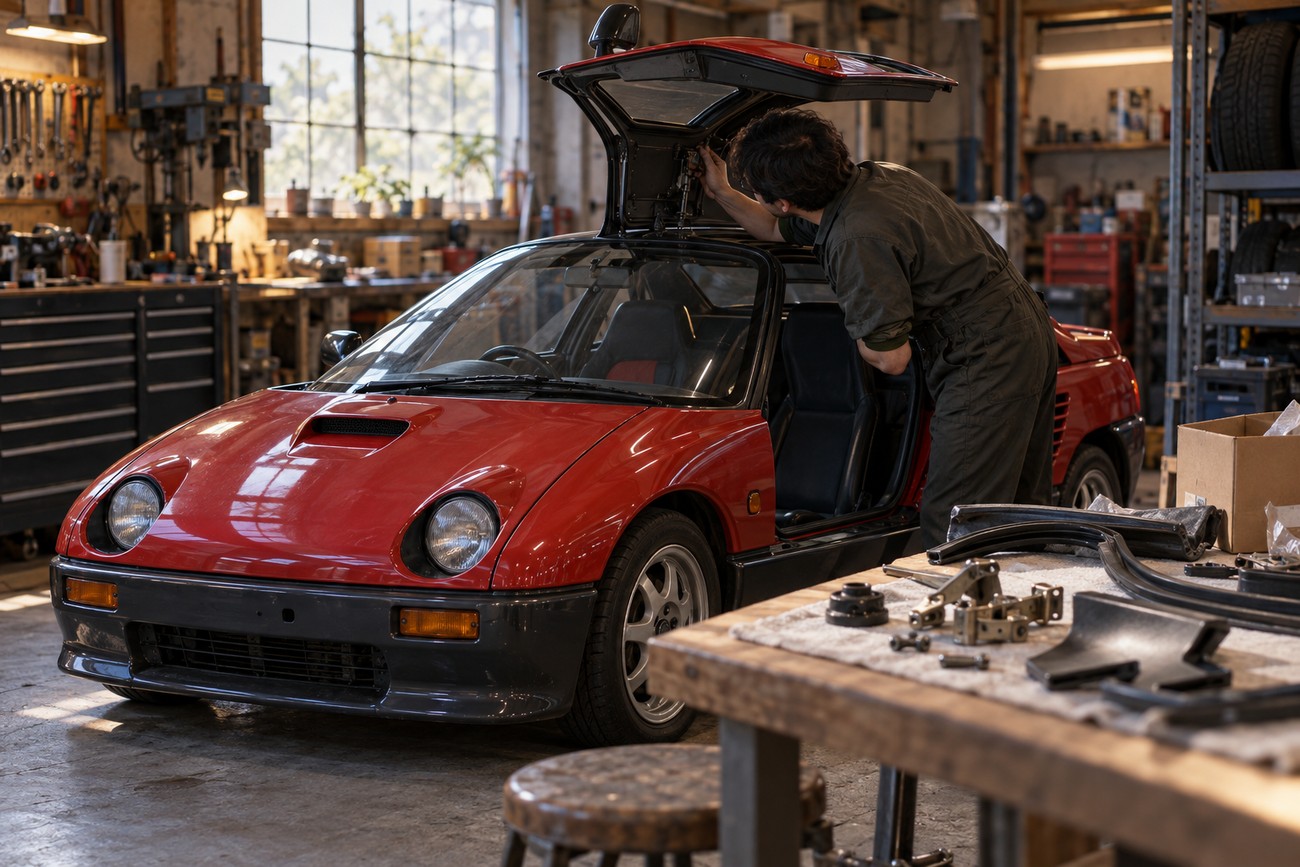
The right owner sees the AZ-1 as a specialist weekend, collection, or enthusiast car. It suits tight winding roads, short recreational drives, and occasional track use, where its low mass and unusual balance can be enjoyed without demanding comfort. Original, well-documented examples deserve particular care because improvised exterior modifications can reduce collector appeal.
A daily driver faces a harsher reality. Noise, stiff suspension, limited luggage space, poor rear visibility, low clearance, and difficult entry can turn ordinary commuting into a repeated compromise. The car’s small size helps in some urban situations, but its sightlines and gullwing doors can make parking maneuvers more demanding than expected.
Right-hand drive may also create registration or certification problems in some countries, especially where older imported vehicles or unusual door designs receive additional scrutiny. Those requirements should be confirmed before purchase rather than treated as a paperwork detail after the car arrives.
Ownership becomes substantially easier when you have access to specialist mechanics, parts networks, and knowledgeable owner clubs. The AZ-1 is a niche sports car, not a simple low-cost kei commuter, and its value depends as much on condition, originality, and support infrastructure as on the badge.
Frequently asked questions
How much does an Autozam AZ-1 cost?
There is no single reliable figure without live market data. AZ-1 values depend heavily on originality, corrosion, documented history, mechanical condition, door hardware, and the likely cost of sourcing scarce body parts.
A car with attractive paint may still be a poor purchase if its gullwing alignment, seals, engine, turbocharger, or suspension require major work. Compare the complete condition and repair exposure rather than relying on a generic model label or asking price.
How rare is the Autozam AZ-1?
The base AZ-1 is rare, but the published production total is disputed. Japanese catalogues and Auto Mail.ru cite 3,858 cars, while Drom cites 4,392.
Those different figures may reflect different counting methods or production definitions, so rounded rarity claims are safer than presenting one number as definitive. In practical terms, the limited population explains why original body panels, door hardware, and trim can be difficult to replace.







