
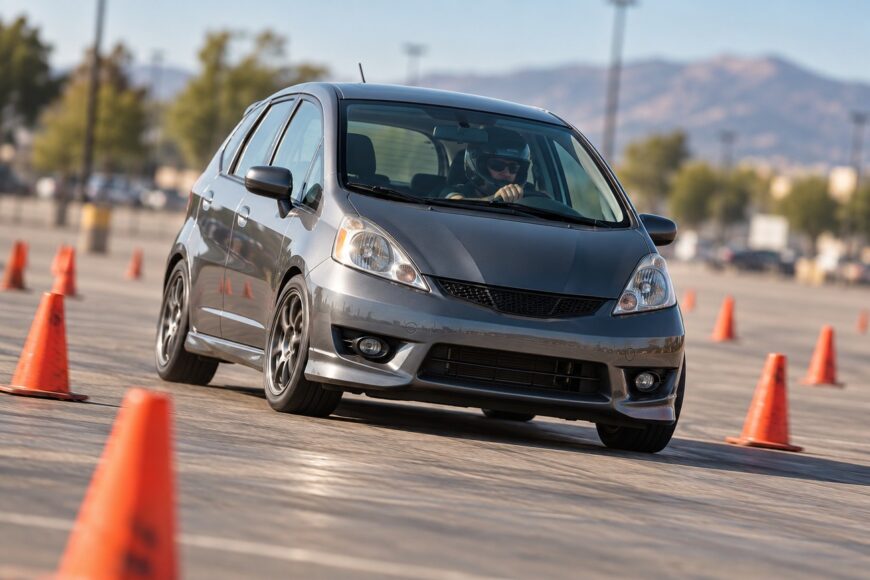
A small, low-powered hatchback seems an unlikely autocross weapon. The Honda Fit has modest straight-line performance, yet its compact footprint, low mass, and responsive chassis can make it genuinely quick on a technical course. The useful comparison is with other amateur autocross cars, where direction changes, braking, and momentum often matter more than horsepower.
The real question is whether those strengths outweigh the Fit’s CVT heat risk, soft brakes, body roll, and limited grip. A healthy 1.5-liter manual is usually the clearest enthusiast choice. A CVT or hybrid can still be usable in the right event format, but it demands a more careful assessment of cooling, maintenance, and consistency.
- Why the Honda Fit Feels So Good on an Autocross Course
- Powertrains: Manual 1.5, CVT, or Hybrid?
- The Fit’s Real Weak Points Under Repeated Runs
- A Sensible Autocross Preparation Plan
- How to Drive a Slow Fit Quickly
- Classes, Practicality, and Running Costs
- Common Mistakes and the Honest Verdict
- Frequently asked questions
- What year of Honda Fit should you stay away from for autocross?
- Why is the Honda Fit still popular with autocross drivers?
- Why do people love the Honda Fit so much?
- What is the weakness of Honda Fit?
Why the Honda Fit Feels So Good on an Autocross Course
The Fit’s dimensions suit a course built from cones. It is approximately 3.95–4.0 m long, 1.695 m wide, and has a 2530 mm wheelbase. Most versions weigh approximately 1050–1150 kg, so the car carries less inertia into braking zones and needs less time to change direction.
That low mass helps compensate for the naturally aspirated engine’s modest output. The car may lose ground on a long straight, yet a short slalom rewards the ability to brake late, rotate cleanly, and return to the throttle without moving a large amount of weight. A low center of gravity and responsive steering give the Fit a lively response to small inputs.
Typical suspension uses MacPherson struts at the front and a semi-independent rear beam or De Dion-type layout. This is a relatively simple arrangement, and its reactions are easy to read. It also limits fine adjustment compared with a more sophisticated multi-link chassis, so the Fit’s predictable behavior comes with a narrower tuning window.
Different generations and trims do not handle identically. Tire size, damping condition, alignment, transmission, and factory calibration all affect the result. Still, the basic formula remains attractive: a compact front-wheel-drive car that communicates weight transfer clearly and can be placed accurately between cones.
Powertrains: Manual 1.5, CVT, or Hybrid?
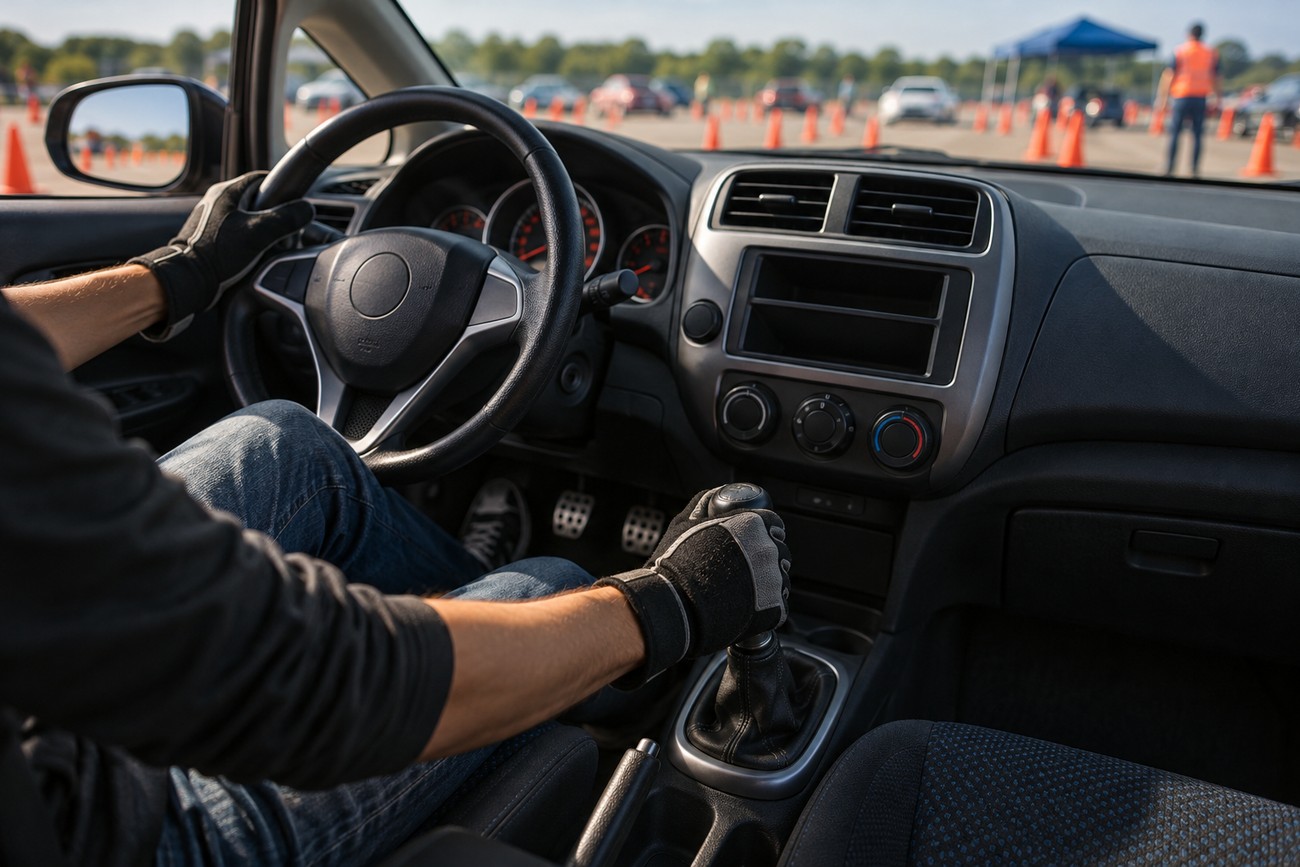
Fit engines in this range are naturally aspirated 1.3–1.5-liter units producing approximately 98–132 hp. Peak power arrives at approximately 6000–6600 rpm, so the driver has to keep the engine revving when the course allows it. Short bursts of low-rpm driving leave the car feeling slower than its specifications suggest.
A 1.5-liter manual is usually the simplest autocross choice. The driver controls gear selection, engine braking, and clutch engagement directly, while the drivetrain avoids the heat-management problem associated with repeated CVT launches. A manual car still needs a healthy clutch, cooling system, and brakes, but its event-day behavior is easier to predict.
Manual, CVT, and automatic transmissions are available depending on version. Some CVT cars offer S, L, or pseudo-sport modes that alter throttle and ratio response, and those settings can make the car more usable on a short course. Cooling and maintenance reduce risk, although they do not erase the fact that repeated full-throttle starts and stop-start running increase CVT heat and wear.
Hybrid versions add rear battery mass and system complexity. That can make balance and servicing less predictable under autocross load, even though the hybrid may be economical in daily use. A CVT or hybrid is therefore a format-dependent decision: occasional short runs with careful monitoring are different from repeated aggressive launches throughout a full event.
The Fit’s Real Weak Points Under Repeated Runs
The most serious concern for a CVT Fit is consistency. Heat can build during repeated runs, and drivers have reported altered or spreading ratio behavior, fluid odor or discoloration, and possible limp mode. A car that feels fine on a single test run can become difficult to judge once temperatures rise.
Brakes create a similar gap between an entertaining stock car and a dependable event car. Stock components can heat quickly, develop a soft pedal, and experience noticeable fade after repeated aggressive runs. Performance brake pads, fresh fluid, and a careful inspection usually provide more useful consistency than an immediate search for extra engine power.
Rising CVT temperature and a changing brake pedal deserve attention before alignment experiments or tire upgrades. A car that cannot repeat its braking points and power delivery will hide the effect of every chassis change.
Body roll is another obvious limitation. Standard suspension can feel playful on ordinary tires, then become the main obstacle after fitting more capable rubber. A light front end and narrow stock tires can also produce front-end understeer on corner entry, especially when the driver carries too much speed into the turn.
The rear beam limits fine camber and toe adjustment without custom fabrication. That makes the Fit less flexible than a dedicated sports platform, particularly when a driver wants to tune the rear axle around different tires or surfaces. Ground clearance of approximately 135–150 mm suits asphalt autocross, while rough or broken gravel-style use can expose the car’s limited clearance and suspension travel.
Inside, the car can be tiring during a full day. High engine revs, tire noise, and suspension sounds are more noticeable in a compact hatchback, and the stock seats may provide limited lateral support during rapid transitions. Those issues do not make the Fit slow, but they can reduce driver precision as the event continues.
A Sensible Autocross Preparation Plan
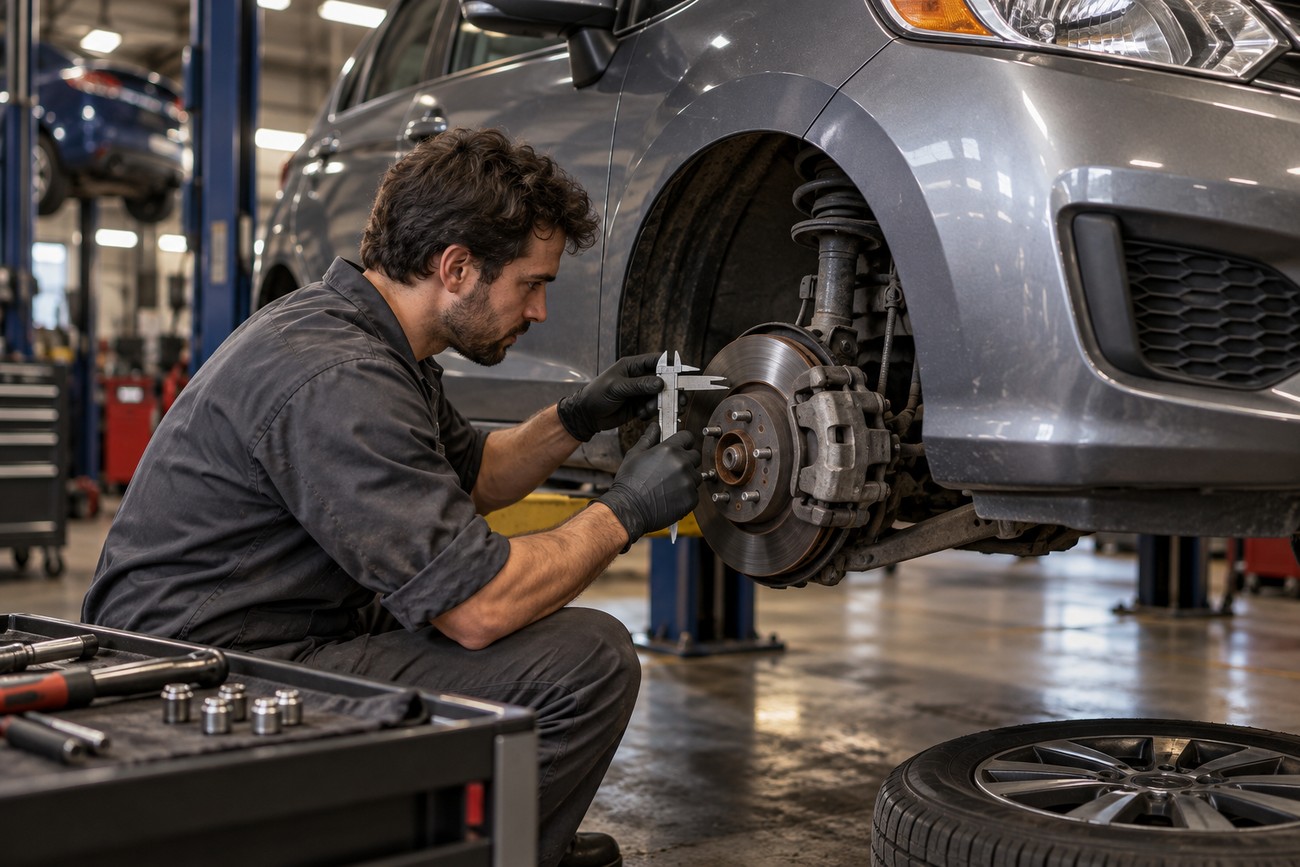
Start with inspection rather than parts. Check the engine, transmission, cooling system, wheel bearings, suspension joints, dampers, and tire condition. CVT cars deserve particular attention to service history, fluid condition, and any evidence of overheating, because a neglected transmission can turn a low-cost project into an expensive recovery.
Refresh the consumables next. A practical baseline includes healthy fluids, more aggressive brake pads, fresh brake fluid, and correctly adjusted tire pressures. Inspect the rotors and hoses, verify that the pedal remains firm, and remove the assumption that factory road-car pressures are automatically suitable for a cone course.
Choose tires after the brakes and maintenance are ready. Wider, high-grip tires can expose body-roll, damping, and brake weaknesses, while producing little time gain from an unbalanced setup. A sound tire with a usable sidewall and carefully tested pressure can teach more than the most expensive rubber fitted without a plan.
Moderately stiffer springs and dampers can reduce roll and improve precision without requiring major power. The goal is controlled weight transfer, not a suspension so stiff that the front tires lose contact over surface changes. Because the rear axle has limited adjustment, alignment changes should be measured and tested rather than copied from another car.
Driver fit is part of preparation. Stock seats may allow the driver to move during a rapid transition, which makes steering and pedal inputs less consistent. Where the car allows it, manage stability-control and traction-control settings carefully; intervention after minor wheelspin can cut power at the exact moment the car needs acceleration.
How to Drive a Slow Fit Quickly
The Fit’s approximately 98–132 hp rewards momentum. Smooth, late braking and a tidy turn-in usually produce a better run than charging into the corner and waiting for the front tires to regain grip. Excessive entry speed creates understeer, consumes the available road, and leaves the engine pulling from a poor exit position.
Keep the naturally aspirated engine near its useful rev range, with peak power arriving at approximately 6000–6600 rpm. That may require accepting more engine noise and selecting a lower gear earlier than you would on the street. In a CVT version, S, L, or pseudo-sport modes can change ratio and throttle response, so each setting should be tested against the course rather than chosen by name alone.
Tire pressure is one of the easiest ways to adjust balance. Small changes can alter front-end bite, turn-in, and the tendency to understeer. Test one change at a time and record surface temperature, weather, and driver impressions; a pressure that helps on a cool morning may produce a different balance after repeated runs.
The Fit is an effective learning platform because its simple geometry makes changes in camber, toe, and pressure easy to feel. That feedback can be more valuable than a large modification package. The driver learns how weight transfer and tire load affect the car without excess power or excessive electronic intervention masking every mistake.
Classes, Practicality, and Running Costs
The Fit can be relevant to American SCCA-style econobox, H-Street, and Street Touring FWD contexts, depending on generation and preparation. Exact eligibility depends on the applicable rulebook, model year, equipment, and modifications. Check the current classing rules before buying parts, since a seemingly harmless change can move the car into a less favorable category.
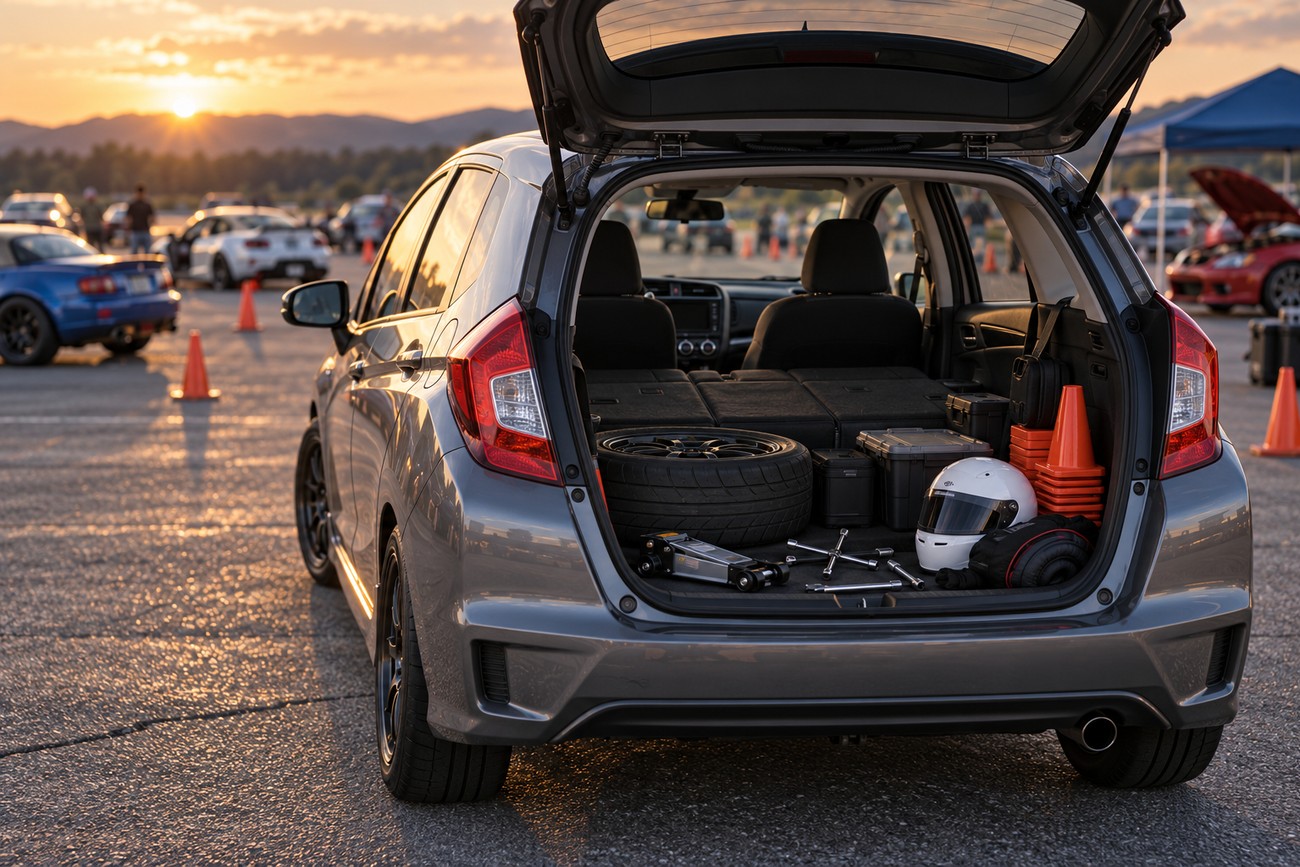
Its practical packaging matters at grassroots events. Magic Seats can carry wheels, tools, and event equipment in one hatchback, leaving the car useful during the week. That reduces the need for a trailer or support vehicle and makes regular testing easier for owners who drive to events.
Typical road fuel consumption is approximately 6–8 L/100 km, which keeps ordinary travel and practice relatively inexpensive. Fuel savings help a driver attend more events and spend more time learning. They do not remove the need to budget for brake wear, tires, fluids, and drivetrain maintenance.
Real-world amateur lap-time records for the GK5 Sport show that the platform can run consistently under load, even if it is not absolutely fast. That distinction matters: durability during a controlled event is useful evidence, while it does not prove that every Fit, especially every CVT or hybrid, will tolerate repeated full-throttle autocross use without preparation.
Common Mistakes and the Honest Verdict
The Fit is not automatically too slow for amateur autocross. Its approximately 1050–1150 kg mass can offset modest power on technical layouts, particularly when a heavier car struggles to brake and change direction. A strong driver in a well-maintained Fit can be competitive with more powerful cars that give away time in every transition.
The opposite myth is equally unhelpful: a CVT is not automatically safe for repeated racing because some versions have usable sport modes. An uninspected CVT can overheat or enter an emergency mode after repeated full-throttle runs. Service history, fluid condition, cooling, and the event format should determine the risk assessment.
- Do not begin with an unserviced CVT and assume a cooler will solve every problem.
- Do not use old budget dampers that allow excessive roll, bounce, and loss of precision.
- Do not rely on factory road-car tire pressures without testing their effect on the course.
- Do not fit oversize sticky tires before addressing brake heat, damping, and alignment.
- Do not leave traction-control intervention unmanaged when it repeatedly cuts power on corner exit.
A manual 1.5-liter Fit is a compelling learning and budget platform. It offers enough feedback to teach momentum driving, enough practicality to support regular events, and enough chassis response to remain entertaining after the novelty of low power wears off. A neglected CVT or hybrid deserves a much more cautious decision, with mechanical condition and heat management taking priority over purchase price.
Frequently asked questions
The best Fit for autocross depends on condition, transmission, class rules, and intended event schedule. These buying questions help separate a promising car from a cheap car that needs more work than expected.
What year of Honda Fit should you stay away from for autocross?
There is no universally reliable model-year blacklist for autocross. Prioritize documented CVT service, fluid condition, cooling history, brake condition, suspension wear, and overall maintenance over a year number alone.
A manual car with clear records can be a safer starting point than a newer automatic or CVT with unknown use. For any transmission, inspect how the car behaves when warm and look for evidence of neglected fluid changes or repeated overheating.
Why is the Honda Fit still popular with autocross drivers?
The used platform remains attractive because it combines simple naturally aspirated power, compact dimensions, useful cabin packaging, and low running costs. Those traits support regular participation and make the car easy to use as both an event vehicle and daily transportation.
Magic Seats add practical value, while the low mass and communicative chassis reward driver development. The Fit does not need to be the newest car to remain relevant on a technical course.
Why do people love the Honda Fit so much?
Owners value the combination of easy maneuverability, responsive steering, low operating cost, and unusually useful interior space. In autocross, the car also communicates tire and suspension changes clearly, which helps drivers improve their technique.
Its modest power keeps the focus on braking, line choice, momentum, and throttle control. That makes the Fit rewarding without requiring the speed or expense of a dedicated sports car.
What is the weakness of Honda Fit?
The main weaknesses are CVT heat sensitivity under repeated hard use, soft or fading stock brakes, body roll, front-end understeer, narrow standard tires, and limited rear-axle adjustment. Ground clearance of approximately 135–150 mm also favors asphalt over rough surfaces.
These limitations can be managed with maintenance, brake upgrades, pressure testing, and moderate suspension work. They remain important when evaluating whether a specific car will deliver consistent runs throughout an event.







