
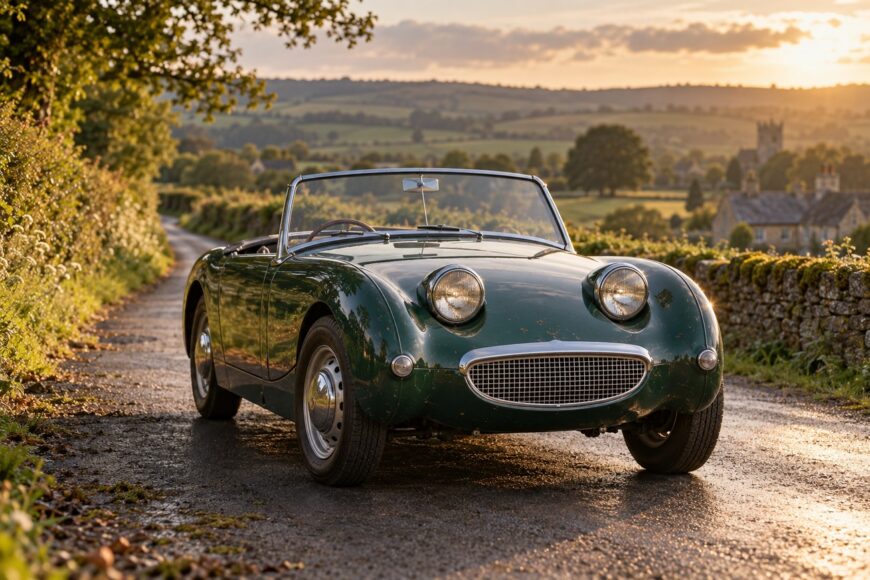
Those two raised headlights are the Austin-Healey Sprite Mk I’s defining feature. They sit above the bonnet line like a pair of alert frog’s eyes, giving the small sports car the face that made it famous. In Britain, that face earned the nickname Frogeye; in the United States, owners and the press generally called the same car a Bugeye.
The official name remains Austin-Healey Sprite Mk I, produced from 1958 to 1961. Its cheerful appearance can disguise serious ownership issues, however. The one-piece front end is costly to repair correctly, original lighting parts are increasingly difficult to source, and the approximately 43-hp engine requires patience in modern traffic. A car that looks simple can demand specialist judgment when originality and restoration quality matter.
- Why the Austin-Healey Sprite Is Called the Frogeye
- The Cost-Cutting Decision That Created the Frog Face
- What Makes a True Mk I Frogeye
- The Charming Face Has Some Serious Drawbacks
- Buying or Restoring a Frogeye: Expensive Mistakes to Avoid
- Why the Frogeye Became More Than a Joke About Headlights
- Frequently asked questions
- Why was the Austin-Healey Sprite named Sprite?
- How much is a Frogeye Sprite worth today?
- What should an owner check before insuring a Frogeye Sprite?
Why the Austin-Healey Sprite Is Called the Frogeye
The nickname is a direct description of the front-end design. The headlights rise above the bonnet rather than sitting neatly within the wings or behind a grille. Their spacing, round shape, and exposed position create an expression that resembles a frog looking forward, which made “Frogeye” an immediate and durable description in the UK.
American owners adopted “Bugeye,” a variation that describes the same visual idea. These names identify one version of the Sprite, rather than separate export models with different factory identities. In catalogs, chassis records, and formal documentation, the car is the Austin-Healey Sprite Mk I.
The distinction matters when buying one. “Frogeye” is often used loosely for any small Austin-Healey Sprite, especially in casual advertisements, yet the distinctive raised-headlight layout belongs to the Mk I. Later Sprite Mk II–IV cars have their own body designs and should not automatically be described as Frogeyes simply because they share the Sprite name.
The Cost-Cutting Decision That Created the Frog Face
The frog-like appearance was not the primary styling objective in the earliest design. Gerry Coker designed the Mk I with flip-up or retractable headlights considered as part of the original concept. A closed bonnet could therefore have produced a much smoother front when the lamps were hidden.
British Motor Corporation rejected that mechanism primarily because it added cost, complexity, and weight to an inexpensive sports car. Fixed headlights offered a simpler solution with fewer moving parts to maintain. Their elevated position also reflected requirements concerning light height and visibility, so the final arrangement was shaped by regulation as well as by production economics.
That compromise created a face with an identity far stronger than the design team may have intended. The headlights were not simply left in an arbitrary place after the mechanism disappeared; their position had to function as road lighting and satisfy applicable visibility requirements. The result combined engineering practicality with an unmistakable visual signature.
There is a useful ownership consequence in this history. The absence of retractable hardware reduces mechanical complexity and removes one possible failure point. The fixed lamps helped keep the car light and accessible, even though they introduced the water-sealing and alignment problems associated with the exposed front end.
What Makes a True Mk I Frogeye
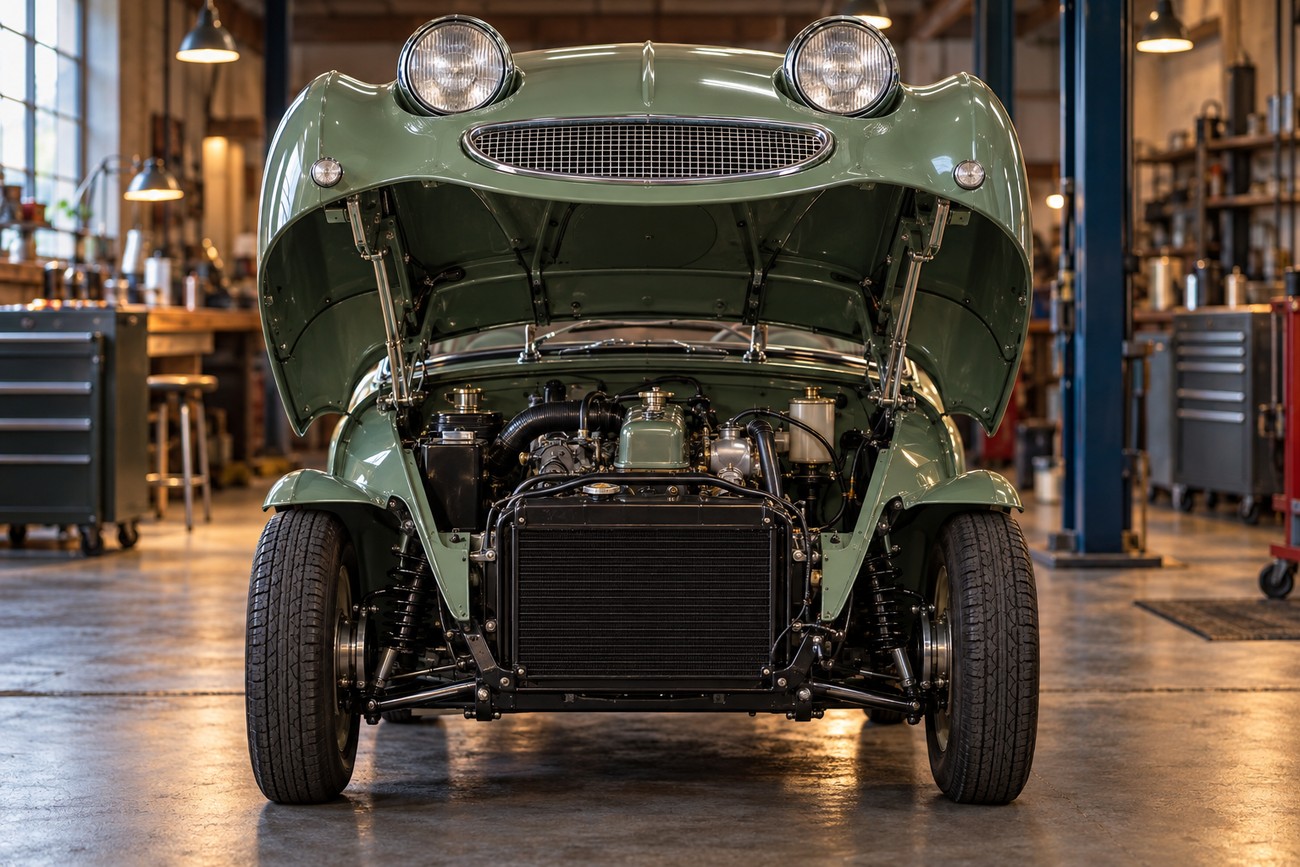
The face involves more than two round headlights. A single front-hinged panel combines the bonnet, front wings, and nose, allowing the entire front to open for engine access. This construction gives the Sprite its distinctive “mask” and makes the relationship between panel geometry and headlight position especially important.
Restorers and clubs examine small details when assessing whether a car has retained the correct Mk I character. The grille’s “smile,” the thickness of the headlight rims, the bonnet crease, and the symmetry of the two eyes all contribute to the proper appearance. Chassis and body documentation, together with early Mk I construction details, carries more weight than a convincing silhouette alone.
Later Sprite Mk II–IV cars can be modified to suggest the earlier shape, and replacement panels can imitate the outline from a distance. Their profiles, pressing quality, and headlight proportions may differ from the original. A car with a newly fabricated or substituted front can remain enjoyable to drive, while its originality and collector value may be substantially different.
Photographs can conceal these differences. A slightly incorrect grille or lamp rim may be hard to notice in a small listing image, whereas a distorted bonnet crease or uneven eye alignment becomes obvious in person. Buyers who care about authenticity should compare the body, chassis records, and construction details before treating the nickname as proof of identity.
The Charming Face Has Some Serious Drawbacks
The one-piece front is excellent for access to the engine bay, yet collision damage turns that advantage into a restoration challenge. Even a modest impact can distort a large, expensive panel. Returning the bonnet, wings, nose, hinges, and headlight mounts to their correct relationship requires careful measurement, panel work, and alignment.
Uneven headlights are an early warning sign. They may indicate a bent mounting point, a repaired nose, a replacement panel with the wrong profile, or a hinge and front-end geometry problem. Correcting the lamps alone can make the face look better temporarily while leaving the underlying structure misaligned.
Headlight symmetry is the visible result of the whole front panel’s geometry. A distorted nose can remain hidden if each lamp is adjusted separately, so the panel, hinges, and mounting points should be assessed as one system.
Water around the lamps creates another quiet risk. Moisture can corrode reflectors and wiring, while the front’s limited shielding from dirt and moisture exposes components that would be better protected on a conventional nose. Inspection should include the backs of the lamps, wiring connections, surrounding metal, and signs of repeated drying or repainting.
Raised headlights also create more aerodynamic drag than the smoother fronts of later Sprites. The effect is part of the car’s character, although it becomes relevant at sustained speed. More immediately, the approximately 43-hp original engine can feel modest in modern traffic, where acceleration, hills, and fast roads demand planning from the driver.
Buying or Restoring a Frogeye: Expensive Mistakes to Avoid
Begin by verifying that the car is a genuine Mk I rather than a later Sprite converted to resemble one. Chassis and body documentation should support the claimed identity, and the front panel should be examined for original construction, repairs, and replacement sections. Appearance alone cannot establish provenance, especially when reproduction panels are available.
Inspect the entire front before assigning value. Look along the bonnet crease, compare the headlight centers, check the grille opening, and operate the hinges while watching for movement or binding. A front that opens easily may still have poor geometry, and a fresh paint finish can conceal old collision repairs or corrosion beneath the lamps and inner edges.
Establish the symmetry and hinge geometry of the entire front panel before correcting individual headlight mounts. Adjusting the “eyes” first can conceal a distorted nose and leave the expensive structural problem for the next owner.
Original early Frogeye panels and lighting parts can be expensive and difficult to source. Visually similar reproductions may have a different eye profile, altered metal thickness, or inconsistent pressing quality. They can make a usable car presentable while reducing authenticity and complicating a later return to factory-correct appearance.
Headlight height and angle deserve a separate check. Incorrect positioning can spoil the original frog-like expression and may compromise compliance with local lighting requirements. The same applies to reflectors, bulbs, wiring, and seals: a period-looking lamp that produces poor illumination or admits water is a restoration liability.
Insurance deserves attention before the purchase is completed. A standard assessment may recognize an old sports car without allowing properly for specialist repair of its unusual front end, rare panels, or authentic lighting components. Owners should discuss agreed value, obtain a specialist appraisal where available, and retain photographs, invoices, and restoration records so ordinary replacement cost is not confused with authentic repair cost.
Why the Frogeye Became More Than a Joke About Headlights
The Mk I Frogeye was the best-selling Healey model, with approximately 48,987 examples produced. That volume helped establish a durable enthusiast community and made the car recognizable far beyond specialist circles. Its comic expression became a memorable identity rather than a temporary styling oddity.
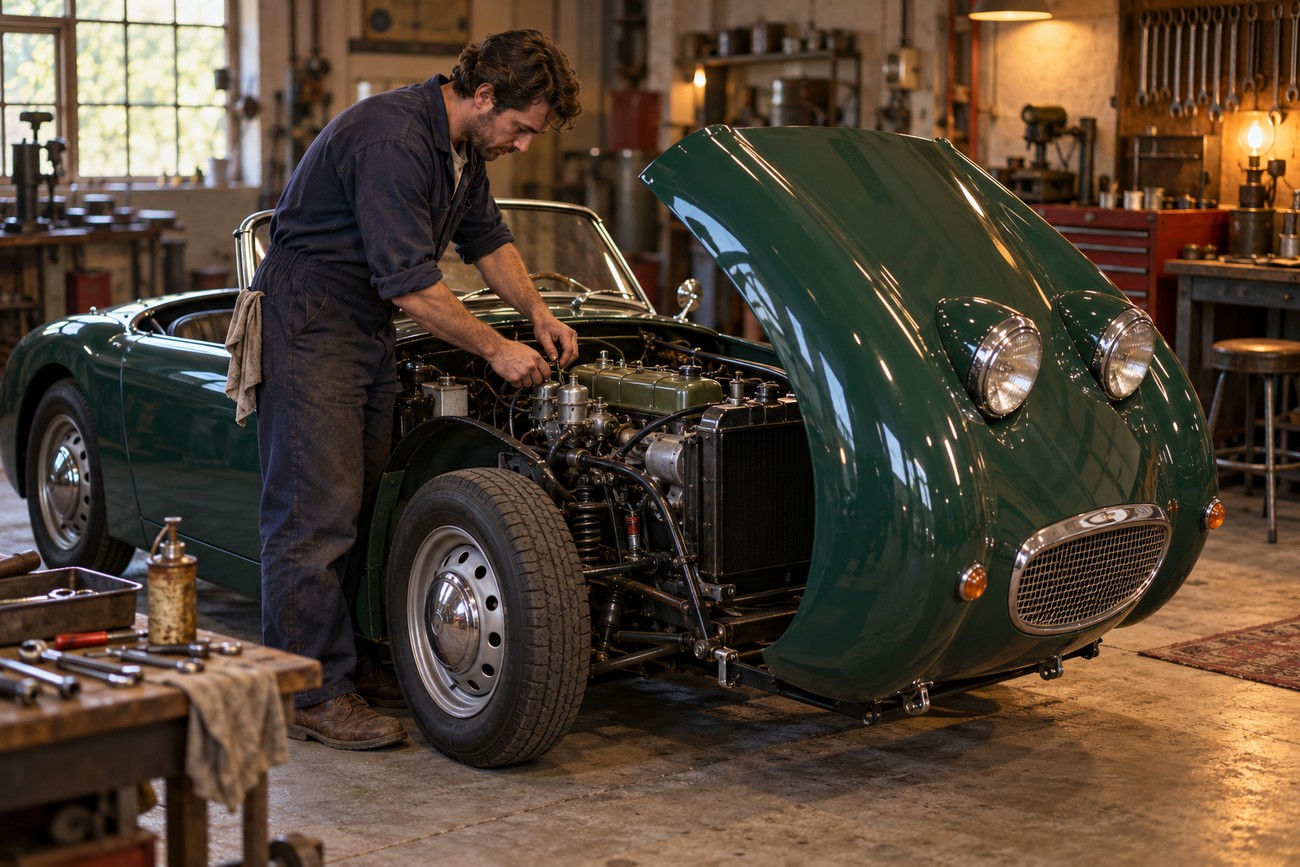
Driving appeal comes from the same simplicity that shaped the original compromise. The fixed-light arrangement avoids retractable mechanisms, the front is light, and the hinged panel gives unusually good access to the engine bay. For routine mechanical work, being able to expose the engine from above and ahead can save time and reduce frustration.
Track users also value the light front end, even though the road car’s appearance can seem almost toy-like. The small dimensions, direct mechanical character, and accessible engine bay suit owners who prioritize involvement over effortless speed. The limited power becomes less troubling in that setting, where balance and feedback matter more than keeping pace with contemporary traffic.
Its history explains the appeal. A decision made to control cost and complexity produced a shape that owners now protect with considerable care. Authentic Frogeye parts and restoration work can reach classic-premium levels, so the car’s friendly face should never be mistaken for inexpensive ownership. The best examples combine correct identity, sound geometry, usable mechanics, and documentation that explains what has been preserved.
Frequently asked questions
The Frogeye name is widely understood, but several details still cause confusion during research, buying, and insurance discussions.
Why was the Austin-Healey Sprite named Sprite?
“Sprite” is the official model name, separate from the later visual nickname Frogeye or Bugeye. The available history supports the use of Sprite as the model designation, but it does not establish one definitive, documented inspiration that explains every aspect of the name.
That distinction is useful in catalog searches and registration records. Searching for Austin-Healey Sprite Mk I will locate the formal model, while Frogeye is the enthusiast term that identifies its raised-headlight appearance in Britain. Bugeye serves the same purpose in the United States.
How much is a Frogeye Sprite worth today?
There is no single reliable value for every Frogeye. Assessment should begin with originality, chassis and body identity, the condition and geometry of the one-piece front, documentation, restoration quality, and whether the car runs and drives as represented.
A straight original panel with correct lighting details can matter more than fresh paint. Conversely, a later conversion or a car assembled with poor-quality reproduction panels may require substantial work even if it photographs well. A specialist inspection is worthwhile because front-end alignment, hidden corrosion, and authentic parts can change the valuation more than cosmetic presentation.
What should an owner check before insuring a Frogeye Sprite?
Ask how the insurer will establish an agreed value and whether the assessment recognizes specialist repair of the Frogeye front end. Provide a detailed appraisal, documented restoration work, photographs, chassis and body information, and records of rare original or reproduction front-end parts.
Clarify the difference between ordinary replacement cost and authentic repair cost. A standard body shop may price a generic repair, while restoring the correct panel profile, headlight geometry, grille details, and period components can require specialist work. Keeping the insurer informed when the car is modified or restored also helps prevent disputes over its declared condition.







