
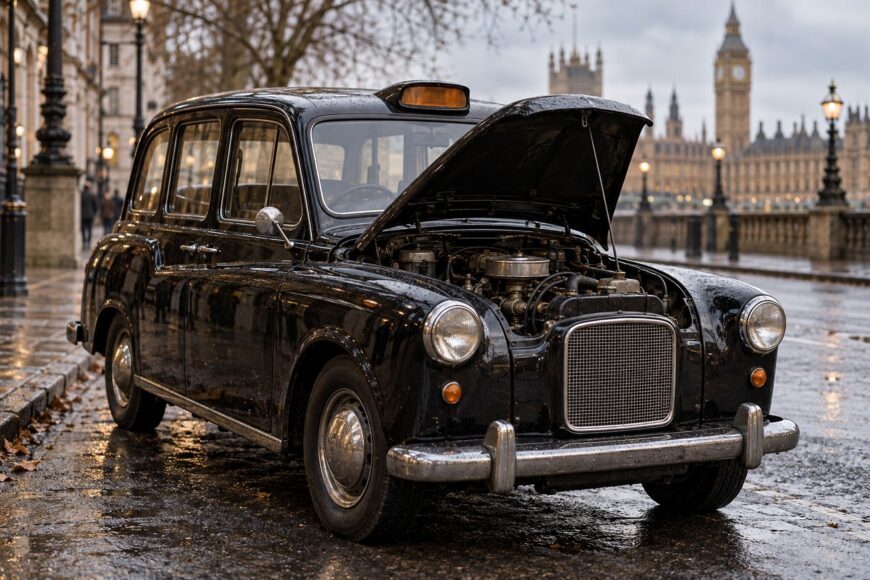
The Austin FX4 is instantly recognizable as London’s black cab, yet its familiar silhouette reveals little about the rules and mechanical decisions behind it. Its compact body was shaped around urban taxi work: a tight turning circle, clear driver visibility, a separate passenger compartment, and designated luggage space. Those features explain why the car became a cultural symbol as well as a working machine.
Buying one today requires more than recognizing the grille and paintwork. An FX4 may have been rebuilt, repainted, converted, or assembled from components belonging to different production periods. The badge, black color, and former taxi identity provide a starting point for investigation; they do not prove originality, structural condition, or permission for modern commercial use.
- What the Austin FX4 was—and who built it
- Why London’s taxi rules shaped the FX4
- Austin FX4 engines and transmissions by period
- What riding in—and driving—an FX4 is really like
- Buying an FX4: where appearance can hide expense
- A historic black cab is not automatically a working London taxi
- Frequently asked questions
- How should an occasionally driven FX4 be stored?
- What is special about a London black cab?
- What is the average salary of a London black cab driver?
What the Austin FX4 was—and who built it
The FX4 was produced from 1958 to 1997, with estimated total production exceeding 75,000 vehicles. That long production span helped fix its shape in the public mind, even as engines, transmissions, interiors, and body details changed. A late car can look closely related to an early Austin while having a different mechanical specification and history.
Production and rights passed from Austin to Carbodies and then London Taxis International. The name “Austin FX4” therefore describes a broad family of London taxis as often as it identifies a particular manufacturer or period. Cars sold under the same familiar description can differ substantially in equipment and in the quality of later repairs.
Carbodies was closely associated with the taxi’s body production and development, while later cars came under London Taxis International. This succession matters to buyers because surviving examples have often spent decades in service, followed by private ownership, restoration, or conversion. The maker listed in an advertisement may describe the car’s historical lineage rather than the company responsible for every component fitted today.
The long-lived silhouette is useful for recognition, though it is weak evidence of age. A black FX4 with a polished body may have a replacement engine, a changed gearbox, a non-original interior, or a mixture of parts from several years. Provenance, chassis and body records, and a careful comparison with the claimed specification carry more weight than an apparently authentic appearance.
Why London’s taxi rules shaped the FX4
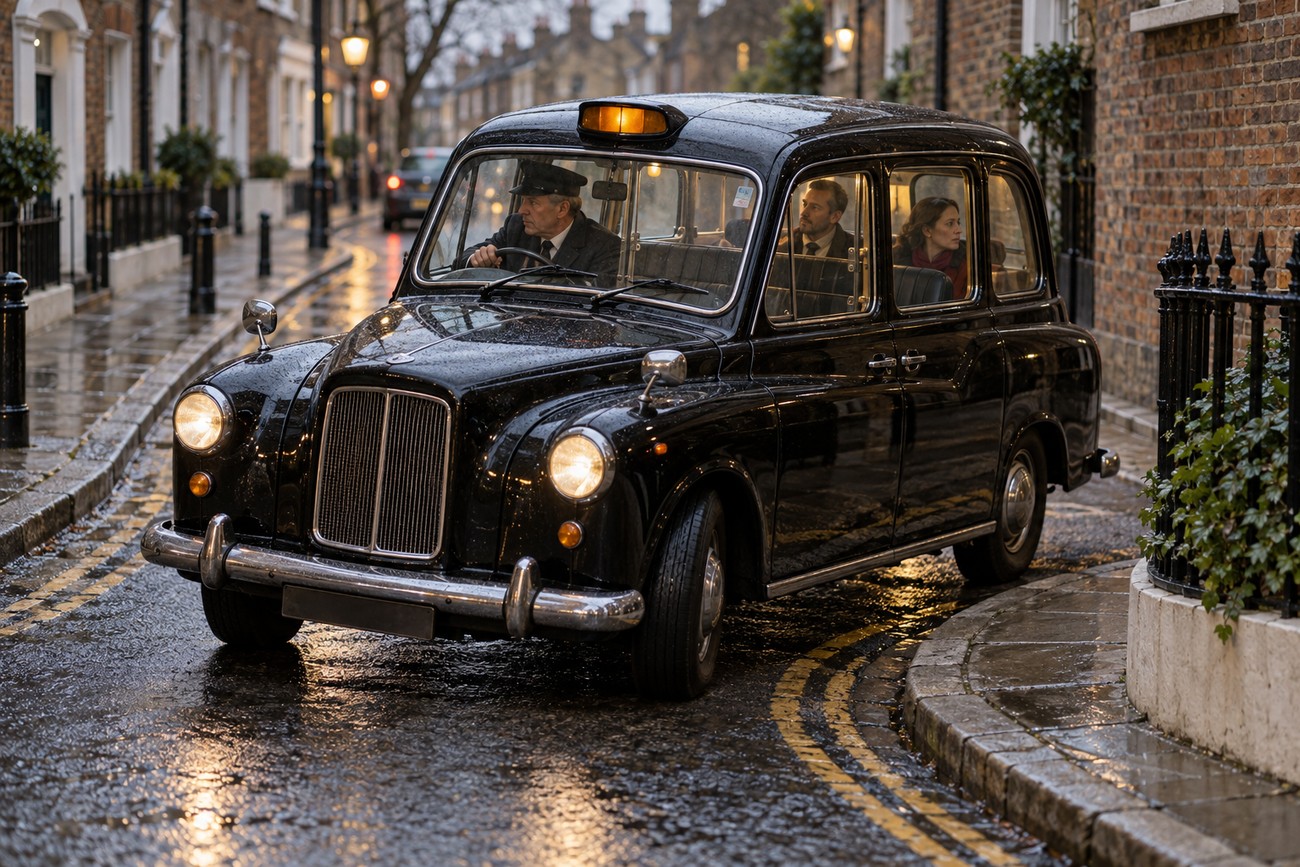
The FX4 was developed for London’s Conditions of Fitness, so its layout reflects operating rules rather than private-car fashion. The driver sits apart from the passengers, with a partition defining a distinct rear compartment. That arrangement gave passengers privacy and made the car suitable for professional taxi work.
Maneuverability was central to the design. The commonly cited 25-foot figure, or 7.62 m, refers to a curb-to-curb turning-circle diameter, not a turning radius. This distinction matters when comparing specifications: calling the figure a radius doubles the apparent space and misrepresents the practical requirement the vehicle was designed to meet.
Driver visibility, passenger access, and luggage provision were also built into the brief. The passenger compartment was separate from the driver’s area, while luggage had a designated space beside the driver rather than being treated as an afterthought. The result is a car that can feel surprisingly purposeful in a city, even though its exterior dimensions are modest by modern standards.
Those rules explain details that can otherwise seem eccentric, including the upright body, high seating position, and distinctive proportions. They also explain why a surviving FX4 should be judged as a purpose-built taxi rather than as a conventional sedan with a commercial paint scheme. Its historical logic is clearest when the complete layout remains intact.
Austin FX4 engines and transmissions by period
The table shows the principal documented powertrain milestones. It should be read as a guide to factory-era changes, since an individual FX4 may have been converted or rebuilt during its working life.
| Period or change | Engine | Transmission and buyer’s note |
|---|---|---|
| Early FX4 | 2,178 cc diesel | The early diesel is central to the original working-taxi specification. Confirm that a surviving car still has its documented engine. |
| From 1961 | Engine specification varied by car | The Borg-Warner automatic was characteristic, but a manual gearbox became available from 1961. Do not assume every car was automatic. |
| From 1962 | 2,199 cc petrol version introduced | This was a documented alternative to the diesel. A petrol car should be checked against its records and period specification. |
| From 1971 | 2,520 cc diesel replaced the 2,178 cc diesel | The larger diesel changed the engine baseline for later cars, though conversions remain possible. |
| FX4R, FX4D, and later versions | Specification depends on the individual vehicle | These versions should not be treated as mechanically interchangeable without checking the engine, gearbox, mounts, controls, and documentation. |
What riding in—and driving—an FX4 is really like
The typical layout is rear-wheel drive with a diesel engine and Borg-Warner automatic transmission, although specifications vary. For rear passengers, the partition and upright seating create a distinctive sense of space and privacy. Entry is practical for a taxi, and the cabin can feel more accommodating than the compact exterior suggests.
The driver’s experience is more demanding. Diesel noise and vibration are common complaints, while performance is modest by modern traffic standards. A Perkins-converted car has a particular reputation for noisy idling, so assess its sound and vibration from a cold start and after the engine has warmed.
Controls, steering, braking, and ventilation belong to the period in which the FX4 worked for a living. The car can be easy to place in a narrow urban street, yet its steering effort and response will feel distant from those of a modern vehicle with power assistance and electronic aids. A short drive in light traffic may conceal how tiring the car becomes during a longer journey.
The rear compartment offers historical character rather than modern refinement. Sound insulation, climate control, and passive safety reflect the vehicle’s era; passenger space should not be mistaken for contemporary protection or comfort. A well-maintained example can be pleasant at a measured pace, while a worn one quickly exposes noise, heat, fumes, and vibration that restoration photographs cannot show.
Buying an FX4: where appearance can hide expense
Begin with the identity of the car. Ask for the chassis or registration records, production date, engine and gearbox details, and evidence of major work. Check the engine, gearbox, partition, taximeter, and interior against the claimed date and documents. A black repaint, an old taxi sign, or a statement that the car is “original” is only a claim until the specification supports it.
Next, lift the carpets and inspect the floors, sills, underside, and structural or suspension mounting points. Corrosion is one of the main financial risks, and its severity depends on the individual vehicle. Pay attention to repairs hidden beneath underseal or fresh paint, because attractive bodywork can coexist with weakened floors, tired mounting areas, and extensive welding.
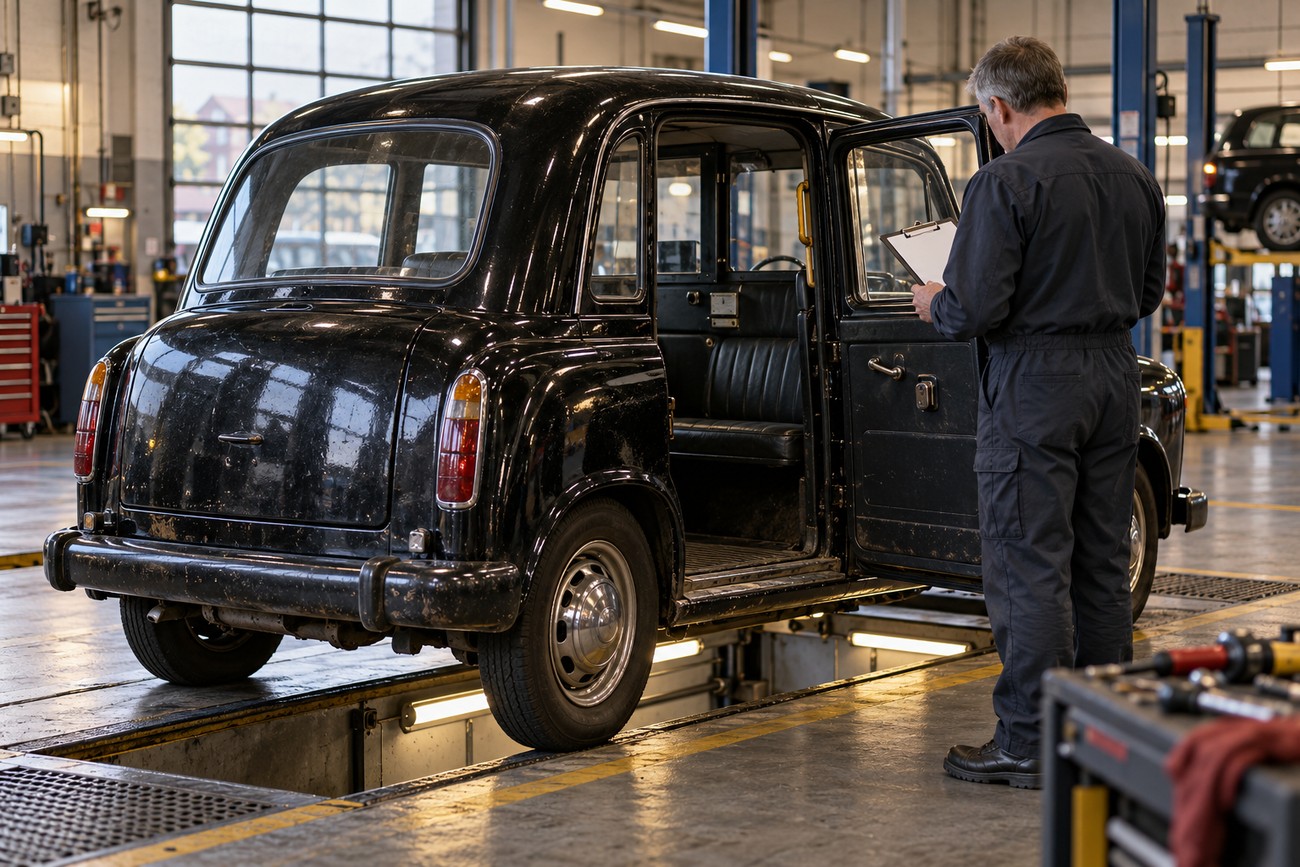
Put the car on a lift where possible. Examine the underside, suspension mountings, brake pipes, steering components, and areas where water and road dirt collect. Check door alignment and seals as well, since a tired body can admit water and create secondary damage. A clean engine bay is useful evidence of care, though it says little about the condition of hidden structure.
Test the cooling system, electrical equipment, charging system, lights, heating, and instruments. Inspect the brakes and tires for age and condition, then drive the car long enough to assess starting, temperature stability, steering, braking, and gearbox behavior. An aged automatic may shift acceptably for a few minutes and still require repair or rebuilding once warm, under load, or during repeated stops.
Budget for more than the purchase price. Brake work, tires, seals, wiring, cooling components, body repairs, and specialist labor can accumulate quickly, while parts and competent servicing may be harder to source than for more common British classics. A documented, structurally sound car with imperfect paint is usually a safer proposition than a glossy example whose underside and mechanical history remain unclear.
A historic black cab is not automatically a working London taxi
The FX4’s historic design brief and present-day taxi licensing are separate matters. A former taxi can be registered as a historic vehicle or displayed as a London cab without having permission to carry paying passengers. Commercial operation, insurance, inspection, and access to regulated roads must be checked against current requirements and the individual vehicle’s records.
Later accessibility provisions are equally specific. They do not establish that every FX4 has a modern wheelchair-carrying arrangement, suitable restraint system, or the equipment required for present-day service. The year, body configuration, modifications, and condition of the particular car all matter.
Owners considering occasional paid work should contact the relevant licensing authority before advertising or carrying passengers. Historic appearance does not confirm compliance with current Conditions of Fitness. The same caution applies to claims that a car is “London legal”: that phrase needs a current, documented basis rather than a connection to the vehicle’s former career.
Frequently asked questions
Occasional use raises practical questions about storage and returning an FX4 to the road. The black cab’s distinctive design also prompts questions about what made it suited to London taxi work. For anyone considering commercial use, driver earnings vary with the costs and arrangements involved.
How should an occasionally driven FX4 be stored?
Keep the car dry, ventilated, and protected from trapped moisture rather than sealing it under a cover while damp. Check the battery condition, tire pressures and age, coolant level, engine oil, and fuel system before storage and again before use. Periodic inspection helps catch leaks, corrosion, and electrical faults before they become larger repairs.
Before returning the FX4 to the road, test the brakes carefully at low speed and confirm that the tires, lights, steering, and cooling system are functioning. A car that has moved only a short distance during storage can still have seized or deteriorated brake components.
What is special about a London black cab?
A London black cab is distinctive because it was shaped around regulated taxi work rather than adapted from an ordinary family car. Its separate passenger compartment, luggage provision, driver visibility, and tight curb-to-curb turning-circle requirement reflect the practical demands of London streets. The black color became the dominant cultural image, though it does not prove that an individual FX4 left the factory in that color.
What is the average salary of a London black cab driver?
There is no single reliable average that applies to every London black cab driver. Earnings vary with working hours, ownership or rental arrangements, fuel and maintenance costs, demand, licensing status, and whether the driver is self-employed or works under another arrangement.
Published figures should therefore be treated as broad estimates rather than a guaranteed wage. Anyone assessing the economics of driving an FX4 commercially would need current licensing information, insurance terms, operating costs, and records for the particular vehicle before drawing a conclusion.







