
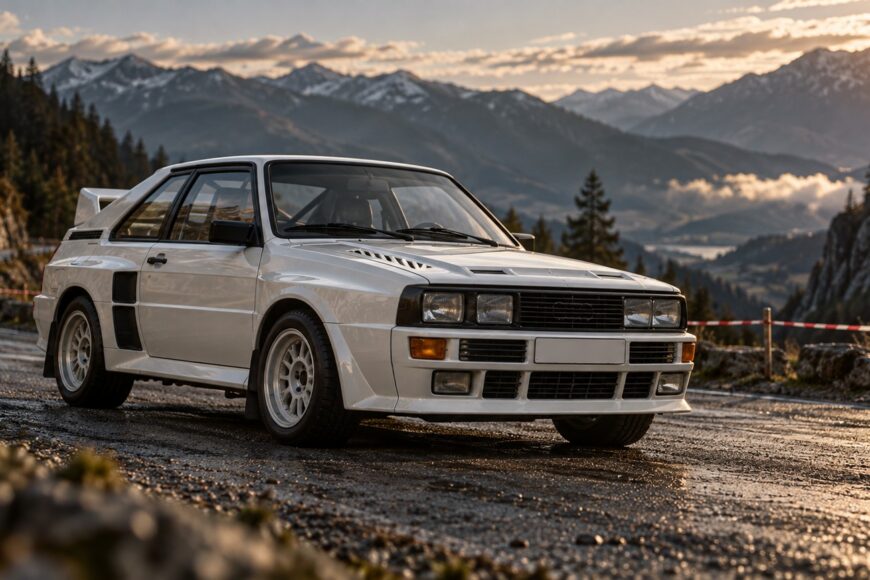
The Audi Sport Quattro carries the image of Group B’s wildest years: a short, broad Audi delivering four-wheel-drive traction and turbocharged five-cylinder power on surfaces that made ordinary sports cars look irrelevant. Its reputation is deserved, though the road car behind the legend is an old, rare performance machine with awkward ergonomics, fragile special parts, and demanding maintenance needs.
Audi shortened the Ur-quattro by approximately 320 mm to create a more responsive competition platform. That decision helped produce a formidable rally weapon, yet it also made the road car nervous on uneven roads and less forgiving when the turbo came alive. Today, the difficult questions concern identity, condition, and support as much as acceleration: many cars have been rebuilt, modified, or misrepresented, while genuine components are scarce and expensive.
- What the Sport Quattro Was Built to Solve
- Shorter, Lighter, More Powerful: The Engineering
- Road Homologation Car vs. Group B Weapon
- Why the Legend Is Hard to Drive and Harder to Live With
- Buying a Genuine Sport Quattro: Identity Before Condition
- Ownership Economics, Market Reality, and Persistent Myths
- Frequently asked questions
- What is the average price of a Group B Audi Quattro?
- Which Audi Quattro model is considered the best?
- Was the Audi Quattro made for Group B?
- How many genuine Sport Quattros are still surviving?
What the Sport Quattro Was Built to Solve
The Sport Quattro was Audi’s answer to the Group B homologation problem. Rally regulations required a road-going production basis for the competition car, and the standard Ur-quattro offered a long body and wheelbase designed around a fast grand-touring format. Simply adding power would have left the fundamental packaging and handling disadvantages in place.
Audi cut the wheelbase by approximately 320 mm and created a distinctive short-tail body. The shorter platform reduced the distance between the axles, improved the car’s ability to change direction, and made it easier to position on tight rally stages. The shape was an engineering requirement tied to Group B competition, rather than a styling exercise applied to an existing road car.
Officially, 214 road-going Sport Quattros were built for homologation. Those cars established the legal production foundation, while Audi’s competition department developed substantially different machines around it. Rally and later Pikes Peak cars received major changes to power, weight, suspension, body construction, cooling, and drivetrain calibration.
That distinction matters because the name covers several related but unequal machines. Sources describe roughly three to five major rally, Pikes Peak, and prototype evolutions, depending on which factory and development stages they include. A road homologation car may share the silhouette and basic concept with a famous race car while behaving very differently from it.
Shorter, Lighter, More Powerful: The Engineering
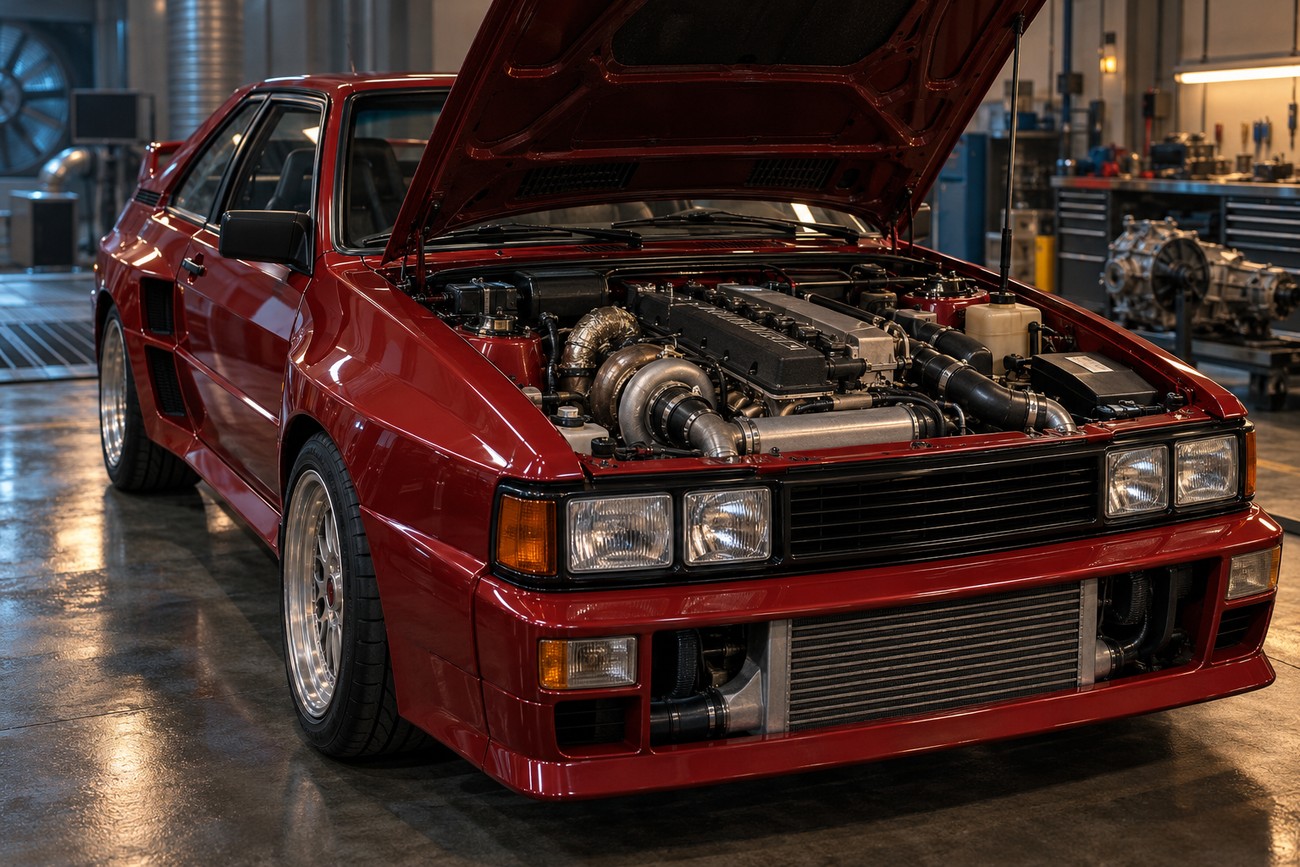
The road car used a 2.1-liter inline five-cylinder engine with a KKK turbocharger. Official road-car power is commonly given as approximately 300–306 hp, a substantial figure for the period and enough to expose weaknesses in tires, suspension settings, and driver technique. The engine’s character is defined by its uneven delivery: subdued response at low engine speed gives way to a forceful surge as boost builds.
Permanent quattro all-wheel drive provided traction through a central differential. Early versions could feature a locking arrangement, and torque distribution varied by version, so descriptions that treat every Sport Quattro as mechanically identical are unreliable. The differential setup, suspension specification, and competition calibration changed as Audi pursued more effective solutions for different surfaces and events.
Road-car weight was approximately 1,200–1,300 kg. Competition cars were extensively lightened and could approach approximately 960–1,000 kg, using composite construction and stripped interiors alongside more ambitious mechanical development. Kevlar, fiberglass, and aluminum panels were used extensively, reducing mass while creating a later ownership problem: original special panels are rare and are no longer normally produced as series components.
Competition specifications evolved to approximately 500–600+ hp according to team specifications, placing the road-engine figures in a different category. Published top-speed figures for the road car vary from approximately 250 km/h to 260+ km/h. Real-world results can be lower when engine tune, gearing, condition, and boost control are taken into account, so a single headline number should not be treated as a universal test result.
Road Homologation Car vs. Group B Weapon
The 214 homologation cars were road-going Sport Quattros, built to satisfy the production requirement and give Audi a shortened base for further development. They were not identical replicas of the most extreme rally cars. Their interiors, sound insulation, equipment, engine calibration, and suspension had to remain compatible with road use, even if the result was still far removed from a modern comfortable performance car.
A competition Sport Quattro could use extensive weight reduction, altered suspension geometry, different differentials, larger turbo hardware, and a more aggressive engine map. A Pikes Peak car followed its own priorities, including high-altitude power delivery and the demands of a hill-climb course. Prototype stages further complicate the terminology, since individual test cars often carried combinations of parts that never represented a standard factory specification.
For that reason, references to three to five major rally, Pikes Peak, and prototype evolution should be read as a classification range rather than a definitive factory catalog. Competition output reached approximately 500–600+ hp, and competition weight could approach approximately 960–1,000 kg. Those figures describe developed race machinery, not a normal road example.
The road car’s importance lies in the relationship between the two forms. It gave Audi the compact body and structural basis required for Group B, while the racing program continued to move beyond the legal production specification. Judging a road Sport Quattro by a race car’s acceleration creates unrealistic expectations and encourages damaging modifications.
Why the Legend Is Hard to Drive and Harder to Live With
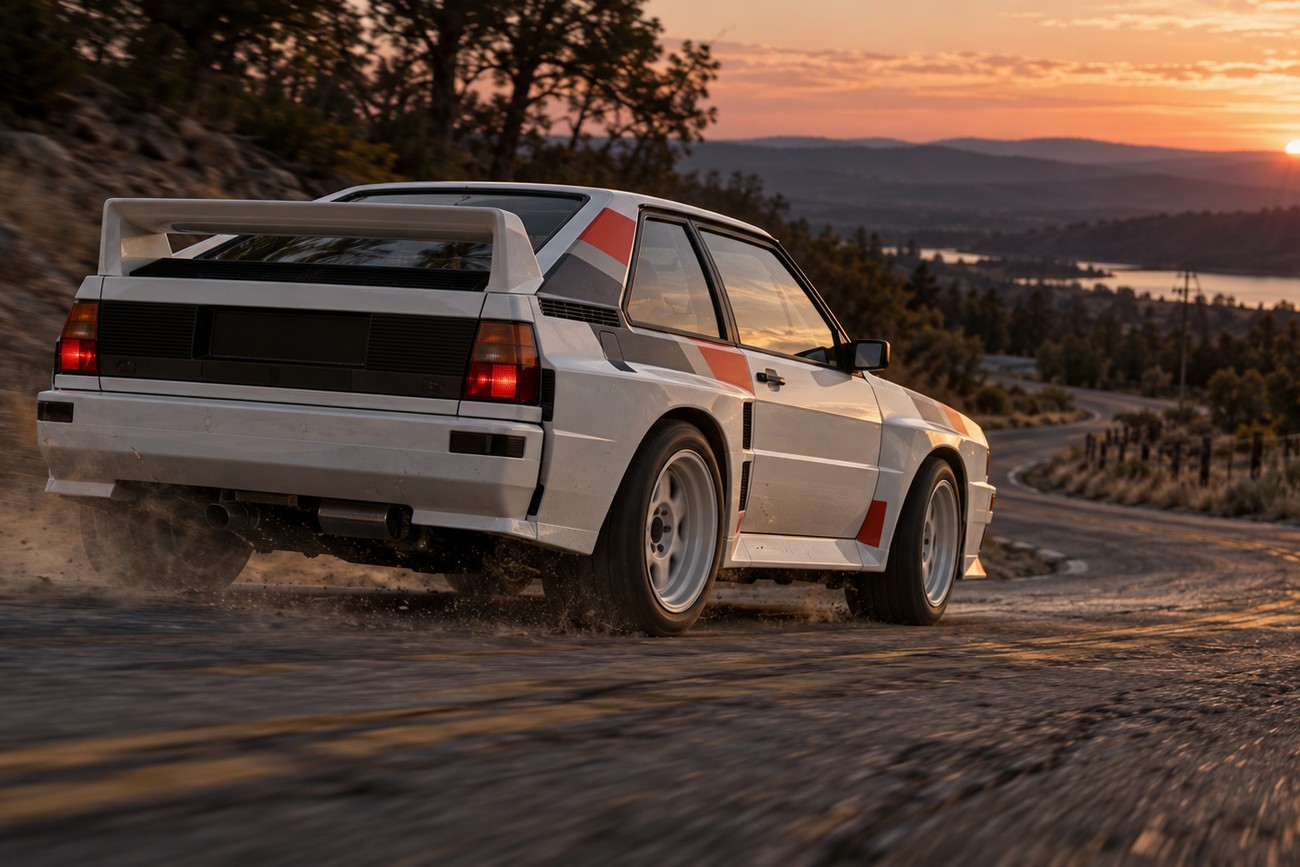
The short wheelbase improves response, yet it also reduces the car’s tolerance for poor surfaces and careless inputs. On uneven roads, the rear can feel lively, particularly when the driver lifts or changes direction while the suspension is loaded. At high speed, the same compactness that feels agile in a tight corner can make the car nervous if alignment, tires, or dampers are below standard.
Owners commonly describe pronounced turbo lag followed by a sharp increase in power. In city traffic, that delay can make the engine feel unwilling, then suddenly over-responsive once boost arrives. The effect is entertaining on a clear road and tiring in ordinary use, where smooth throttle control matters more than a dramatic shove.
Alignment and tire behavior deserve attention before extra engine power. A short-wheelbase car with incorrect toe, camber, or suspension geometry can feel dangerously overreactive even when the engine is healthy.
Ride quality is firm, cabin noise is substantial, and the driving position, pedal layout, and outward visibility show the car’s age. It lacks the isolation and predictable low-speed response expected from a current performance vehicle. Heat management adds another layer of concern: engine-bay temperatures, aging cooling components, and tired turbo systems can turn a spirited drive into a recovery exercise.
Improvised turbo or ECU modifications carry serious risk. An unverified calibration can produce detonation, overheating, and damage to pistons or the cylinder head, while cheap substitutions may compromise the car’s original character without delivering dependable reliability. Suspension geometry deserves the same discipline; ignoring toe, camber, or worn joints can make the car unpredictable long before the engine shows a fault.
Buying a Genuine Sport Quattro: Identity Before Condition
With only 214 official road cars built, identity must be established before a buyer judges paint, trim, or engine performance. The market contains restored examples assembled from multiple Ur-quattro parts, replicas, and undocumented conversions. A convincing short-wheelbase appearance is insufficient evidence of a genuine Sport Quattro.
Provenance should be tested against the car itself. Chassis details, engine-block markings, body reinforcements, spot-weld patterns, and small interior components may all help establish whether the structure and major parts belong together. These checks require period-specific knowledge, and even a specialist dealer may not recognize every relevant detail.
Original Kevlar, fiberglass, and other special body panels are difficult to replace. A repaired composite panel may look correct in photographs while hiding a poor repair, fatigue, or microcracks beneath the paint. The same inspection should look for corrosion in the metal structure, signs of accident repair, aging around mounting points, and evidence that the body has been repeatedly dismantled.
Fewer than 214 examples are believed to survive, although no single authoritative public count is established. Some were crashed, dismantled, or reconstructed, and disputed identities make a clean total difficult. A documented racing history can add considerable historical importance while reducing appeal to collectors who want an untouched road car; the right choice depends on the buyer’s purpose.
A proper inspection therefore combines documentation with physical examination. Matching numbers, original panels, and factory details may matter more to future value than a fresh restoration, especially if the restoration replaced hard-to-verify structural parts. A tired genuine car can be worth preserving, while a flawless replica should be valued and represented as a replica.
Ownership Economics, Market Reality, and Persistent Myths
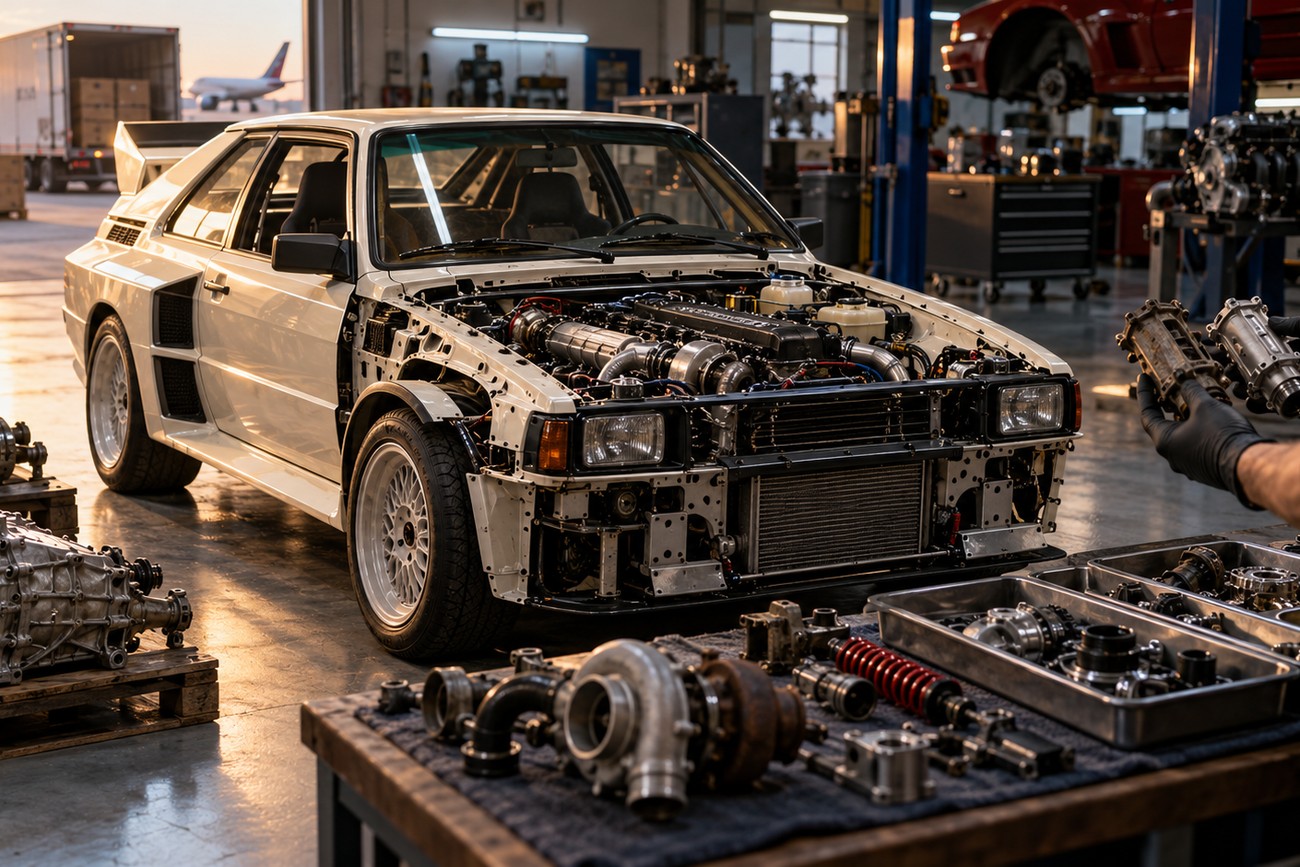
Rarity does not make the Sport Quattro a simple investment. Specialist servicing and parts sourcing can approach supercar levels, while original engine and body components create a recurring choice between matching-numbers originality and modern reliability. Few technicians combine knowledge of the period five-cylinder turbo engine, the quattro system, and the short-wheelbase chassis.
Parts searches often extend through specialist clubs, private networks, and contacts in several countries. Original composite pieces and specific mechanical components are rare, expensive, and no longer normally produced in series. Insurance and registration can also be complicated when providers do not understand the car’s value, specification, or intended use.
The market is narrow and often operates through private networks rather than transparent public listings. High asking prices do not guarantee liquidity, originality, or mechanical health. A car with uncertain provenance may attract attention yet remain difficult to insure, finance, resell, or return to an authentic specification.
The Sport Quattro suits an owner who can fund preventive maintenance, commission specialist inspections, and accept that driving it requires concentration. It rewards careful setup and mechanical sympathy more than casual use. For everyone else, the legend is easier to admire through a verified example than to keep alive in a garage.
Frequently asked questions
The Sport Quattro is often discussed as though one specification covered every road, rally, and Pikes Peak car. Its history is more layered, and that distinction affects price, authenticity, and the meaning of performance claims.
What is the average price of a Group B Audi Quattro?
There is no dependable single average price for a Group B Audi Quattro. Genuine road homologation cars, documented competition cars, replicas, and incomplete projects occupy fundamentally different markets, so provenance and condition matter more than a headline figure.
A verified original with correct structural details and a coherent history may command a premium even when it needs mechanical work. A modified or reconstructed car can look similar while carrying far greater uncertainty, and race history may increase historical importance without making the car more desirable to a collector seeking an untouched road example.
Which Audi Quattro model is considered the best?
The best model depends on the intended use. The Sport Quattro has the strongest homologation significance and the most direct connection to Audi’s short-wheelbase Group B development, while the more extreme competition derivatives are more relevant to rally or Pikes Peak history.
For regular road use, the most historically important car may also be the least forgiving choice. Competition specifications delivered more power and less weight, yet their setup, maintenance needs, and legality are different from those of a road homologation car.
Was the Audi Quattro made for Group B?
The Sport Quattro was the shortened road car built to qualify Audi’s competition development for Group B. It used a wheelbase approximately 320 mm shorter than the standard Ur-quattro and provided the production basis for later racing work.
The original Ur-quattro, the 214 road homologation cars, and later rally or Pikes Peak evolution should not be treated as one identical specification. Their power, weight, suspension, differentials, and body construction changed substantially during development.
How many genuine Sport Quattros are still surviving?
No single authoritative public survivor number is established. Fewer than the 214 official road cars are believed to survive, but crashes, dismantling, reconstructed vehicles, and disputed identities make a precise count unreliable.
Verification therefore matters more than a claimed registry total. Chassis evidence, engine markings, body reinforcements, spot-weld details, interior parts, and continuous documentation provide a stronger basis for judging authenticity than a seller’s description or a visually accurate short-wheelbase conversion.







