
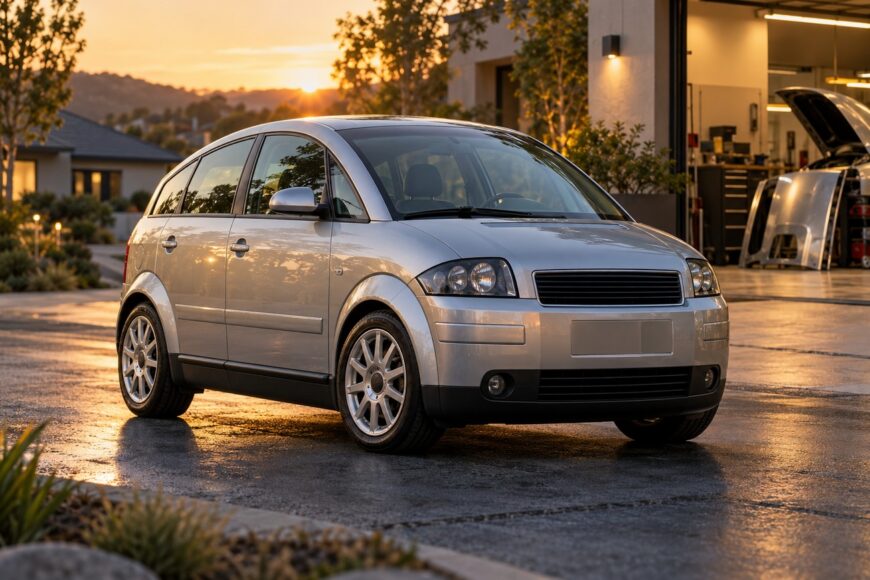
The Audi A2 was a small five-door hatchback with a construction philosophy more commonly associated with expensive luxury cars. Its aluminum Audi Space Frame body, low mass, and efficient engines promised economy without reducing the car to a basic city runabout. Yet the same engineering ambition made the A2 unusual, costly, and difficult to position in its market.
Production ran from 1999 to 2005, and the central ownership question remains relevant: do the A2’s low weight and technical originality outweigh aluminum repair complexity, age-related faults, and the sharply different running costs of its engines? The answer depends more on condition and version than on the Audi badge or the aluminum body alone.
- Why the Audi A2 Was Technically Ahead of Its Time
- ASF Aluminum Construction: The Advantage and the Repair Bill
- Audi A2 Engines: Economy Versus Complexity
- What the A2 Is Like to Live With Today
- Buying a Used Audi A2: Checks That Matter More Than Mileage
- Why Audi Discontinued the A2—and Why Enthusiasts Still Care
- Frequently asked questions
- What are the downsides of aluminum car bodies?
- What are some common issues with the Audi A2?
- What is the rarest Audi color?
- Why was the Audi A2 discontinued?
Why the Audi A2 Was Technically Ahead of Its Time
The A2 arrived when compact cars were generally engineered around inexpensive steel structures, conventional production methods, and familiar mechanical layouts. Audi instead applied the ASF, or Audi Space Frame, philosophy associated with the aluminum-bodied Audi A8 to a much smaller hatchback. That was a substantial technical undertaking for a car expected to compete in a practical compact segment.
Low mass was the foundation of the idea. A base A2 is often cited at approximately 895 kg, while the 1.2 TDI 3L weighed approximately 825 kg. Less mass reduces the energy required for acceleration and allows smaller engines and other components to do their work with less strain. Aerodynamic attention strengthened that benefit, especially on the economy-focused versions.
The commercial problem was that buyers saw a small car with a price and construction method that were difficult to explain through a conventional showroom comparison. The A2 was more ambitious than an ordinary premium city runabout, but its benefits were less visible than a larger engine or richer equipment list. It became technically respected yet commercially difficult, a pattern that helps explain why the concept did not continue in the same form.
ASF Aluminum Construction: The Advantage and the Repair Bill
The A2’s aluminum body shell was reported at approximately 153 kg with four doors and the hatch. Audi compared that figure with roughly 60% of the mass of an equivalent steel body. This reduction contributed directly to the car’s efficiency, handling response, and ability to deliver useful performance from modest engines.
Aluminum does not turn collision repair into routine bodywork. The material, joining methods, and equipment require appropriate techniques, and a workshop experienced with steel panels may not be equipped to assess or restore an A2 correctly. Even a clean-looking repair can conceal poor alignment, unsuitable fasteners, or damage around areas that are expensive to source and rebuild.
Panel gaps, fasteners, and the transition between repaired aluminum areas deserve as much attention as the paint surface. Cosmetic quality can conceal structural work that later becomes a parts-sourcing problem.
Aluminum is often associated with corrosion resistance, but that assumption says little about repair quality. A badly repaired shell can still create water ingress, fitment problems, noise, or future expense. Replacement panels and specific body components may not be available from stock, so a damaged A2 can face longer lead times and higher bills than a conventional steel-bodied hatchback.
For that reason, the body inspection should include accident history, panel alignment, evidence of refinishing, and the quality of previous structural work. The advantage of ASF is real; it simply belongs to the engineering side of ownership, while repair complexity belongs to the cost side.
Audi A2 Engines: Economy Versus Complexity
The engines create three distinctly different ownership profiles. Brochure figures describe controlled test conditions, while owner reports for some versions commonly indicate approximately 6 L/100 km in town and about 5 L/100 km on the road.
| Version | Character | Claimed economy | Reported real-world use | Ownership caution |
|---|---|---|---|---|
| 1.2 TDI 3L | Specialized ultra-economy diesel with very low mass | 2.7–3.0 L/100 km, depending on source and test cycle | Can exceed the claimed figure in traffic, with results dependent on condition and driving | Distinct, complex ownership profile; it is not simply another inexpensive diesel |
| 1.4 TDI | Light, economical diesel with stronger everyday flexibility | Approximately 4.2–5.9 L/100 km, depending on version | Owner reports for some cars describe about 6 L/100 km in town and about 5 L/100 km on the road | Age, ancillary components, and maintenance history matter more than the brochure number |
| 1.6 FSI | More performance-oriented gasoline version | Approximately 4.2–5.9 L/100 km, depending on version | Some owner reports describe approximately 6 L/100 km in town and about 5 L/100 km on the road | Do not buy it expecting every A2 to deliver diesel-like economy |
The 1.2 TDI 3L is the version most likely to attract buyers with its economy legend. Its approximately 825 kg kerb weight and claimed 2.7–3.0 L/100 km consumption are remarkable on paper, but the car’s specialized systems make it a poor choice for anyone who has no access to suitable diagnostic and repair knowledge. Low fuel use does not automatically mean low total ownership cost.
The 1.6 FSI shows why the A2 should not be described as a single-purpose economy car. It was listed at 110 hp, with approximately 9.3 seconds from 0–100 km/h and a top speed near 200 km/h. That specification gives the lightweight hatchback a substantially different character, while its cataloged consumption still needs to be separated from what an older car achieves in daily traffic.
What the A2 Is Like to Live With Today

The A2 remains easy to place in urban traffic because its exterior dimensions are compact and its low mass makes the car feel responsive with modest power. The five-door layout also gives it more everyday usefulness than a tiny three-door hatchback. Those advantages are strongest when the car is mechanically sound and used in conditions where its compact footprint matters.
Small outside dimensions do not guarantee ideal seating or loading convenience. Some owners find the driving position or access less accommodating than expected, and the body design does not make every loading task effortless. The 1.2 TDI’s approximately 825 kg kerb weight is impressive, but mass alone cannot compensate for compromises in cabin packaging.
Age changes the calculation. Rubber components, suspension parts, electrical equipment, and engine ancillaries can all require attention on a car produced between 1999 and 2005. Fuel economy also depends heavily on engine version, traffic, maintenance, temperature, and driving style; owner-reported figures above the cataloged claim are entirely plausible, particularly in city use.
Buying a Used Audi A2: Checks That Matter More Than Mileage
A pre-purchase inspection should begin with the body and its history, even if the advertised mileage looks attractive. Check documented accident repairs, panel alignment, paint transitions, fasteners, and signs that structural areas have been disturbed. Aluminum panels and body components may require specialist facilities, and replacement parts can be difficult to obtain from stock.
Next, assess the suspension, steering, and rubber components for age-related deterioration. A quiet test drive is useful, but it does not replace inspection on a lift. Electrical faults should be investigated rather than treated as minor inconveniences, because diagnosis on an old, unusual car can take longer than on a common compact hatchback.
Engine ancillaries, cooling-related equipment, and transmission behavior also deserve specific attention. A specialist should listen for abnormal noises, confirm that the engine responds consistently, and examine whether previous maintenance has been performed with the correct parts and procedures. The 1.2 TDI badge and its exceptional cataloged fuel figure should never replace a mechanical inspection.
Budget for diagnosis, scarce parts, and refurbishment after purchase. Finding a genuinely sound A2 is difficult because of age, rarity, and version-specific complexity. A low kerb weight proves an engineering achievement; it does not prove low total ownership cost.
Why Audi Discontinued the A2—and Why Enthusiasts Still Care
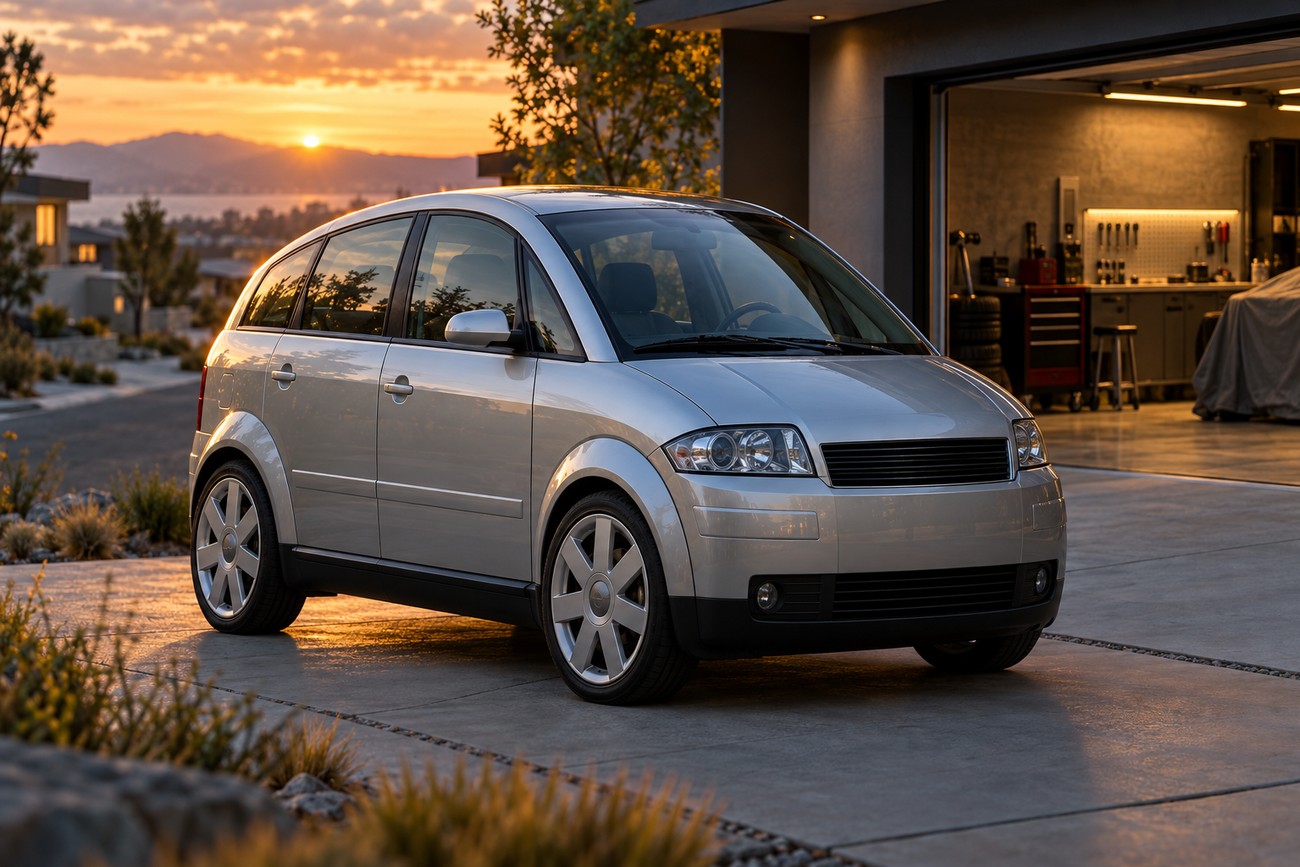
The A2’s commercial difficulty came from a mismatch between advanced construction and compact-car expectations. Customers in this segment generally wanted predictable pricing, easy repairs, and familiar value comparisons. Audi delivered low mass, efficient aerodynamics, and a distinctive aluminum structure, but those benefits were harder to demonstrate during a short showroom visit.
That makes the A2 more important as an engineering statement than as a sales success. Enthusiasts value the combination of low weight, aerodynamic efficiency, and originality rather than outright power. The car also demonstrates how a manufacturer can pursue efficiency through mass reduction instead of relying solely on a larger battery or more complex powertrain.
The later A2 e-tron project extended that idea into electric propulsion. Audi published energy consumption of 15.7–13.9 kWh/100 km and 0 g/km CO₂ for that electric version. Those figures belong to the project and should not be confused with normal production-car ownership or with the engines fitted to ordinary used A2s.
The A2 is compelling for a specialist buyer who values unusual engineering and can arrange appropriate maintenance. It is not automatically a cheap or simple classic. Condition, repair history, and engine version matter more than the aluminum body alone.
Frequently asked questions
The A2’s unusual construction raises questions beyond fuel economy. Its aluminum body, engine range, and age all affect ownership decisions. The answers below focus on the issues most relevant to buyers and owners.
What are the downsides of aluminum car bodies?
The main downside is that lower weight does not equal simpler ownership. Aluminum body repair requires compatible equipment, suitable joining and finishing methods, and technicians who understand how the material behaves. A workshop that can repair a steel panel may still lack the tools or procedures needed for a proper A2 repair.
Material compatibility also matters. Incorrect fasteners, poor isolation between materials, or an imprecise structural repair can create problems long after the paintwork looks finished. Parts availability in the experience of specialists with hands-on experience
What are some common issues with the Audi A2?
Prioritize the faults in this order: body-repair history first, then suspension and structural rubber components, electrical equipment, and engine ancillaries. A sound shell with documented repairs is a better starting point than a low-mileage car with unexplained panel work.
After those checks, evaluate the engine and transmission for version-specific behavior and maintenance quality. The car’s age means that several modest faults can appear together, making a comprehensive inspection more valuable than relying on a single mileage figure.
What is the rarest Audi color?
There is no dependable single answer across all Audi markets and model years. Production volumes, regional specifications, special-order finishes, and surviving cars can all change the ranking, so a color described as rare in one market may be less unusual elsewhere.
Color rarity should not be used as evidence of originality or value. For an A2, documented bodywork and the quality of the aluminum repair are more useful indicators than an unusual paint shade.
Why was the Audi A2 discontinued?
The A2 was discontinued because its advanced construction and unusual market position were difficult to reconcile with compact-car buyer expectations. The aluminum body and specialized engineering contributed to a cost structure that made the car harder to sell as a conventional small hatchback.
That commercial outcome does not indicate a lack of engineering ambition. The A2 solved the problems of mass and efficiency in an original way, but the benefits were less obvious to buyers than its price and repair complexity.







