
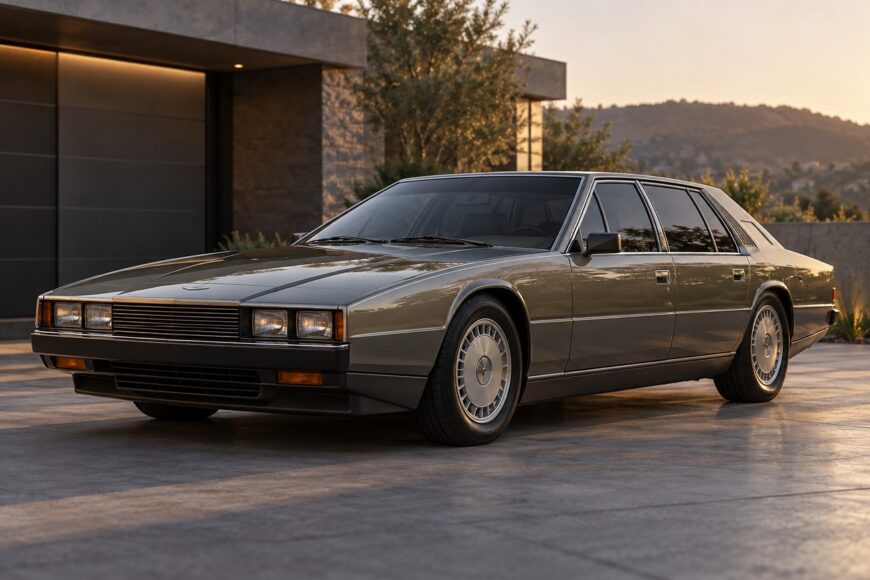
The Aston Martin Lagonda is a visual contradiction: a futuristic wedge-shaped luxury sedan whose digital dashboard can be harder to maintain than its large V8. Its low roof, sharp bodywork, and touch-sensitive controls suggest advanced engineering, while age has made the electrical system a major part of the ownership risk.
A running engine and a glowing screen do not prove that a Lagonda is sound. Specifications, display technologies, and performance claims vary by series, market, and configuration, so a buyer must identify the individual car before accepting its history or advertised figures. The central question is whether the electronics have been understood and documented, rather than merely made to work for a brief inspection.
The car therefore deserves examination as an engineering system: a full-size sedan with unusual instrumentation, a three-speed automatic, and scarce specialist support. Its design remains significant, but the purchase decision depends on how carefully its displays, switches, power supply, and repair history are assessed.
- The Wedge Was a Full-Size Luxury Sedan, Not a Sports Car
- Lagonda Performance Figures Need a Specification Check
- A Lagonda Digital Dashboard Was Not One Technology
- LED, VFD and CRT: Which Lagonda Display System Is It?
- Why a Working Screen Does Not Prove Healthy Electronics
- The Inspection Mistakes That Turn a Wedge into a Liability
- Myths About the Lagonda’s Digital Dashboard and Speed
- Frequently asked questions
- How can a buyer identify which Lagonda display system is fitted?
- Why can a Lagonda dashboard work again after the car is restarted?
- How should conflicting Lagonda horsepower and acceleration claims be written in a sales listing?
The Wedge Was a Full-Size Luxury Sedan, Not a Sports Car
The wedge-shaped Series 2 was introduced in 1976, translating Aston Martin’s luxury ambitions into one of the most radical sedans of its era. Customer production began in 1978 and ended in 1990. The long production span can make the model appear more familiar than it is, but the cars remained rare and technically specialized throughout.
Its proportions can mislead from a distance. The Lagonda is about 5.28 m long and 1.30 m tall, with a body that sits unusually close to the ground for a full-size sedan. That low profile creates visual drama, yet it says little about cornering behavior, steering feel, or braking performance.
The cited factory mass is 2,064 kg, so the car weighs over 2,000 kg before any assumptions about luggage or equipment. That mass, combined with the vehicle’s length and three-speed automatic, places it firmly in the grand-luxury sedan category. A buyer expecting the responses of a lightweight sports car may find the driving experience more deliberate than the styling suggests.
Approximately 645 Lagondas were produced across the entire 1974–1990 generation. That figure covers the generation as a whole, rather than the wedge-shaped Series 2 alone. It also explains why parts availability, technical familiarity, and comparable cars can be limited even when the model attracts substantial attention.
Lagonda Performance Figures Need a Specification Check
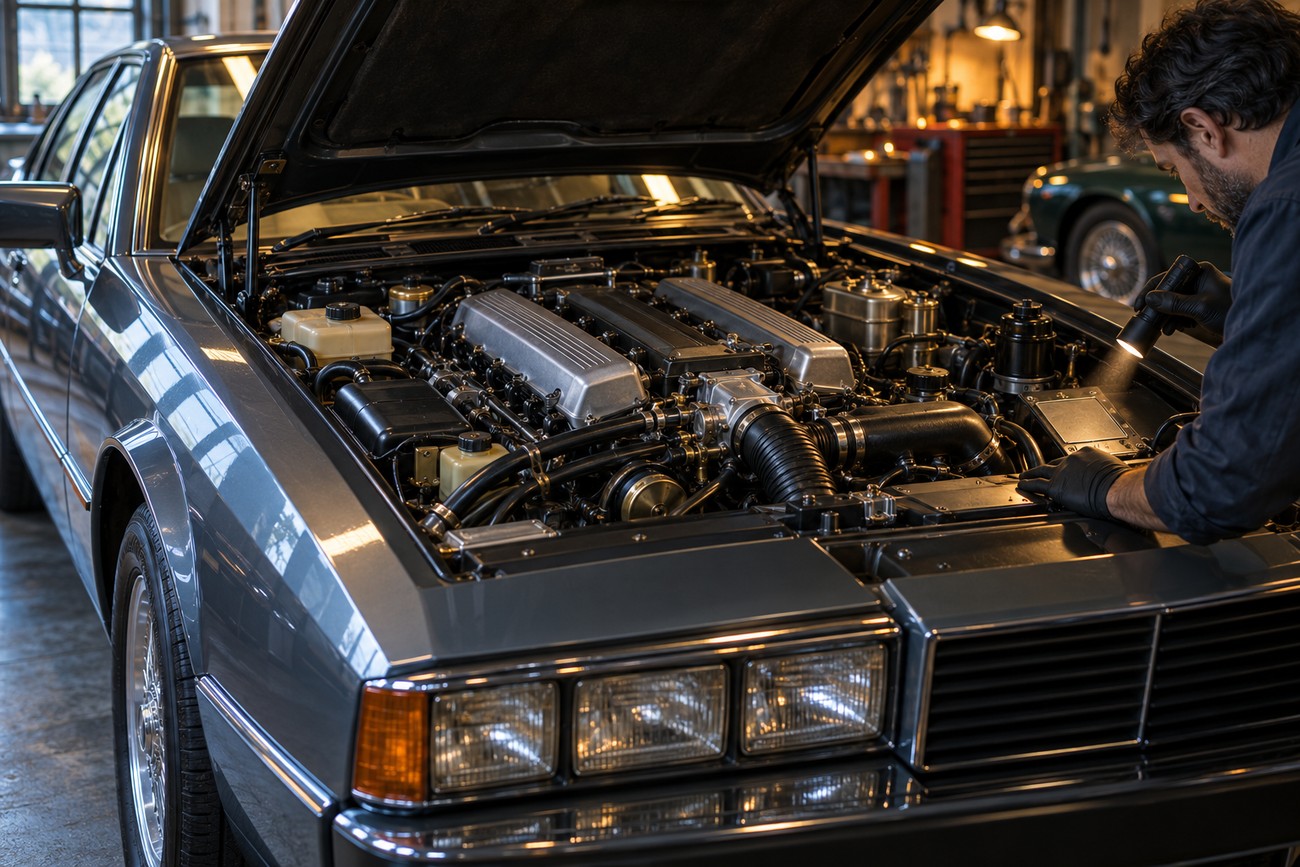
Aston Martin’s stated specification for the relevant car uses a 5,340 cc V8 DOHC engine producing 280 bhp and 360 lb-ft. The transmission is a three-speed automatic. For that stated factory specification, the published acceleration is 0–60 mph in 7.9 seconds, with a top speed of 148 mph.
Those figures provide a useful reference because they identify a specific factory specification rather than an undifferentiated model range. Advertisements and enthusiast publications sometimes cite 300–320 hp or 6.2 seconds to 60 mph. Such claims may mix years, markets, engine configurations, induction systems, and test methods.
That variation matters during a purchase. A performance number without a series, market, engine configuration, and test method cannot reliably describe the car in front of you. It can also distort expectations about the automatic transmission, which has only three forward speeds and contributes to the car’s period character.
Late or modified examples may deliver a different driving impression from an earlier car, particularly where fueling or emissions-related equipment changed. The sensible approach is to record the exact specification and treat the 280 bhp, 7.9-second, and 148 mph figures as the canonical reference for the stated factory version rather than as universal figures for every Lagonda.
A Lagonda Digital Dashboard Was Not One Technology
“Digital dashboard” describes a family of systems rather than one interchangeable unit. Early systems used red LED indicators with membrane touch switches, a striking solution that placed electronic interfaces at the center of the cabin. These components were innovative, but their service requirements have become increasingly important with age.
Early LEDs could be difficult to read in direct sunlight, which led to the use of VFD displays to improve visibility in those conditions. Better legibility did not remove the underlying risks of aging power supplies, connectors, switches, and electronic components. A display that is easy to read can still be unreliable.
CRT displays appeared in Series 3 examples and are regarded as especially difficult and expensive to service. The exact LED-to-VFD-to-CRT transition sequence should be confirmed against factory diagrams or specialist archival sources rather than treated as an unquestionable year-by-year rule.
Display technology also affects parts strategy. LED, VFD, and CRT systems should not be assumed to share modules or repair procedures, and a replacement panel may require specialist adaptation rather than a simple swap. The individual car’s series, equipment, and documented modifications are more useful than the generic phrase “original digital interior.”
LED, VFD and CRT: Which Lagonda Display System Is It?
The comparison below is a buying aid, not a definitive parts-compatibility guide. The chronology is qualified because the precise transition between technologies requires confirmation from factory documentation or specialist archives.
| System | Reported application | Visibility issue | Service complexity | Buyer implication |
|---|---|---|---|---|
| Red LED | Associated with early digital panels and membrane touch switches | Can be difficult to read in direct sunlight | Age-related faults may involve the display, power supply, connectors, or components | Test every segment and switch in bright conditions, during startup, and after the car warms up |
| VFD | Used to improve visibility where early LEDs performed poorly | Generally better suited to difficult lighting conditions than early LEDs | Still vulnerable to aging electronic components and intermittent faults | Improved readability does not establish reliability; demand repair documentation |
| CRT | Appeared in Series 3 examples | Screen behavior depends on an older display system rather than a modern flat panel | Especially difficult and expensive to repair | Identify the unit before purchase and confirm access to suitable specialist support |
Why a Working Screen Does Not Prove Healthy Electronics
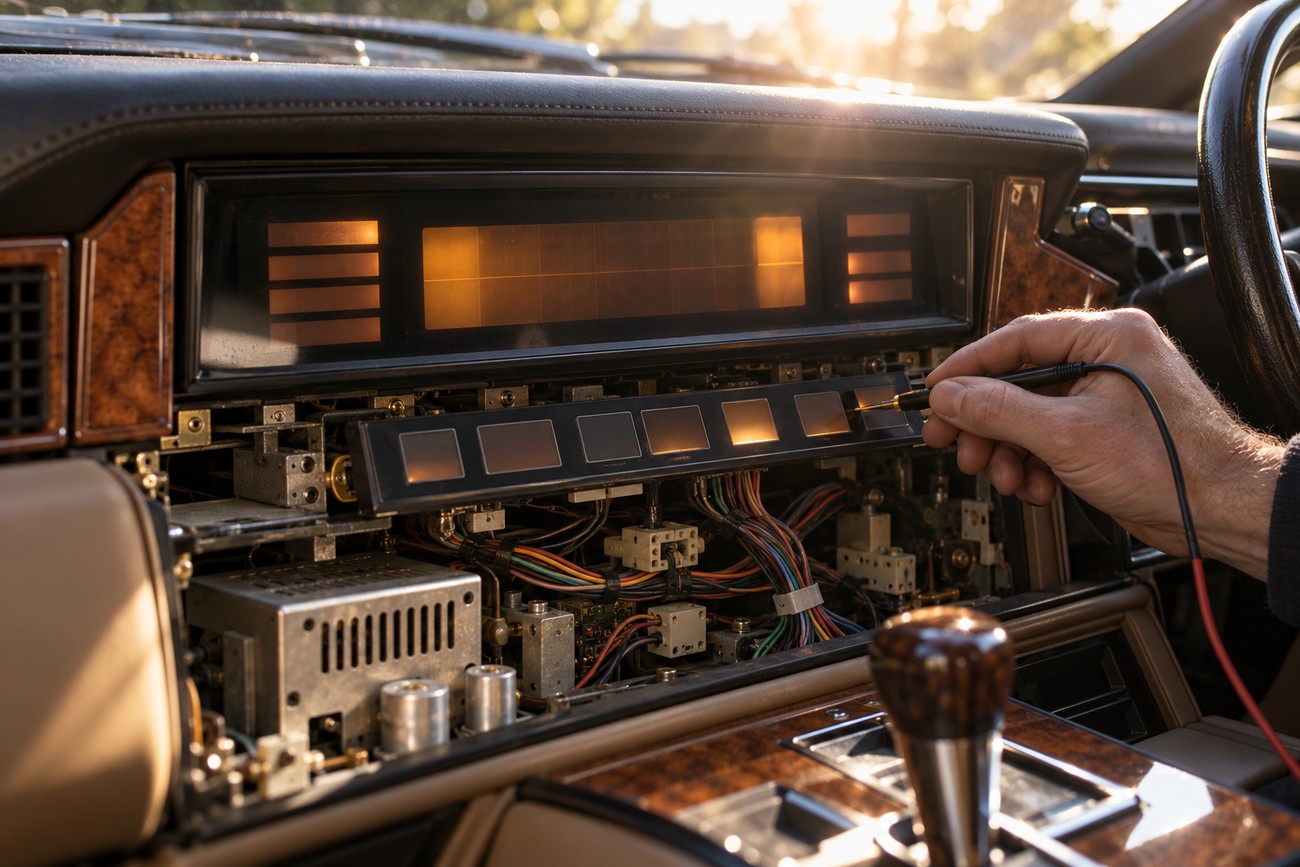
Owners report instrument failures that can appear spontaneous, including cases where a dashboard has already been upgraded. Membrane touch switches may respond inconsistently or fail to register a press. Early LED displays can also remain technically active while becoming difficult to read in direct sunlight.
Intermittent behavior is particularly deceptive. A panel may operate after a restart, begin working once the car warms up, or recover after an interruption in power. Those symptoms can point to the power supply, connectors, or aged components rather than proving that the display module itself is defective.
Technicians test power-supply behavior, connectors, and repeated operation across cold, warm, and restarted conditions before condemning the display module. Temporary recovery is evidence of a fault pattern, not evidence of a repair.
CRT systems add a separate level of risk because their service requirements are especially demanding and expensive. Original electronic modules and donor parts are limited, while specialists familiar with these systems are scarce. A visually excellent car can therefore require substantial diagnostic work before the true fault is known.
The practical consequence is that electronics should be valued as a documented system. A receipt for a specific repair, a clear description of the fitted technology, and evidence of repeated reliable operation are more meaningful than a seller’s statement that the panel “works.”
The Inspection Mistakes That Turn a Wedge into a Liability
Begin with a complete functional test rather than a quick engine start. Check every display, warning indication, membrane switch, and related cabin function. Repeat the test with the car cold, while it is running, after it has warmed up, and following a restart.
Record any symptom that changes with temperature, time, or power cycling. A screen that returns after the ignition is switched off and on should be treated as an intermittent fault, even if it remains functional during the rest of the appointment. Ask for the repair history of the dashboard, power supply, connectors, and any upgrades.
Identify the series and the actual display technology fitted to the car. Do not assume that a wedge-shaped Lagonda has the same panel as another wedge-shaped Lagonda, or that an apparently original system is complete and compatible with available replacement parts. Specialist confirmation may be necessary before a purchase decision.
Performance claims also need documentation. Confirm the market, series, carbureted or injected configuration, engine specification, and transmission before comparing an advertised horsepower or acceleration figure with factory data. The stated three-speed automatic, mass of more than two tons, and full-size dimensions should shape expectations about how the car will drive.
A conventional auto electrician may be able to diagnose parts of the vehicle, but restoring an original Lagonda electronic system can require model-specific knowledge, scarce modules, donor components, or specialist repair. Budget and inspection time should reflect that distinction before money changes hands.
Myths About the Lagonda’s Digital Dashboard and Speed
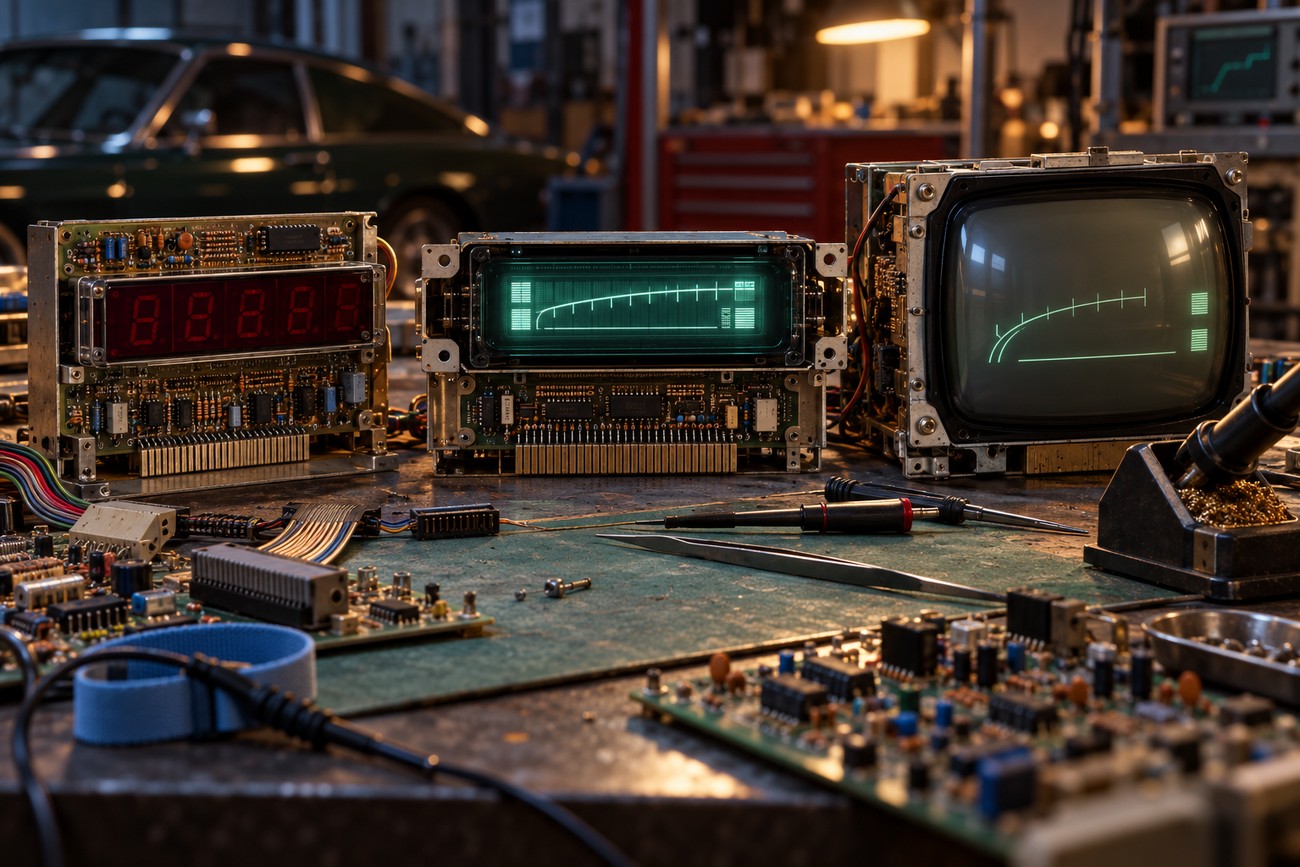
The claim that the Lagonda was the first production car with a digital dashboard requires a precise definition of “first,” “production,” and “digital.” Aston Martin’s dashboard was innovative, but the claim should be used cautiously unless the comparison identifies the relevant type of display and production status.
There was no single universal LED panel across all Lagondas. Early LED systems, VFD systems, and CRT displays associated with Series 3 examples represent different technical solutions. Their visibility, parts requirements, and repair difficulty should be assessed separately.
Nor is 6.2 seconds to 60 mph a universal Lagonda figure. The stated factory specification is 280 bhp, 360 lb-ft, 0–60 mph in 7.9 seconds, and 148 mph. Published claims of 300–320 hp or 6.2 seconds may describe different years, markets, configurations, or test methods and should be labeled accordingly.
Electronic unreliability cannot be blamed on the digital concept alone. Faults may originate in power behavior, connections, aged components, poor sunlight readability, scarce donor parts, or a lack of specialists. Diagnosis must identify the failing part and operating condition instead of treating every problem as proof that digital instrumentation was inherently unsound.
Frequently asked questions
The key questions concern identification, intermittent faults, and conflicting performance claims. Each requires documentation for the individual car rather than reliance on generic model descriptions. A specialist inspection can help connect the dashboard technology and advertised specification with the car’s actual history.
How can a buyer identify which Lagonda display system is fitted?
Start with the car’s series and build documentation, then inspect the display behavior and physical equipment. Red LED indicators and membrane touch switches point toward an early system, while VFD or CRT behavior should be confirmed against the car’s records rather than inferred from appearance alone.
Ask a specialist to match the dashboard to factory information, prior repair invoices, and any upgrade history. This sequence can reveal a replacement or modified unit and helps establish which parts, test procedures, and repair options actually apply.
Why can a Lagonda dashboard work again after the car is restarted?
Temporary recovery commonly indicates an intermittent issue involving power supply behavior, a connector, or an aging electronic component. It may also expose a temperature-sensitive fault that appears only during cold operation or after the cabin and electronics warm up.
Record the exact conditions under which the panel recovered, including whether the ignition was cycled or the car was restarted. Treat that recovery as a diagnostic symptom, not an accepted repair, and have the system tested repeatedly before purchase.
How should conflicting Lagonda horsepower and acceleration claims be written in a sales listing?
A listing should identify the series, market, induction setup, transmission, and test method before quoting performance figures. It should distinguish the stated factory specification of 280 bhp and 7.9 seconds to 60 mph from an unattributed claim of 300–320 hp or 6.2 seconds.
If the supporting documentation is missing, the seller should label the figure as unverified rather than presenting it as universal. That wording protects the buyer from comparing different configurations as though they were identical.







