
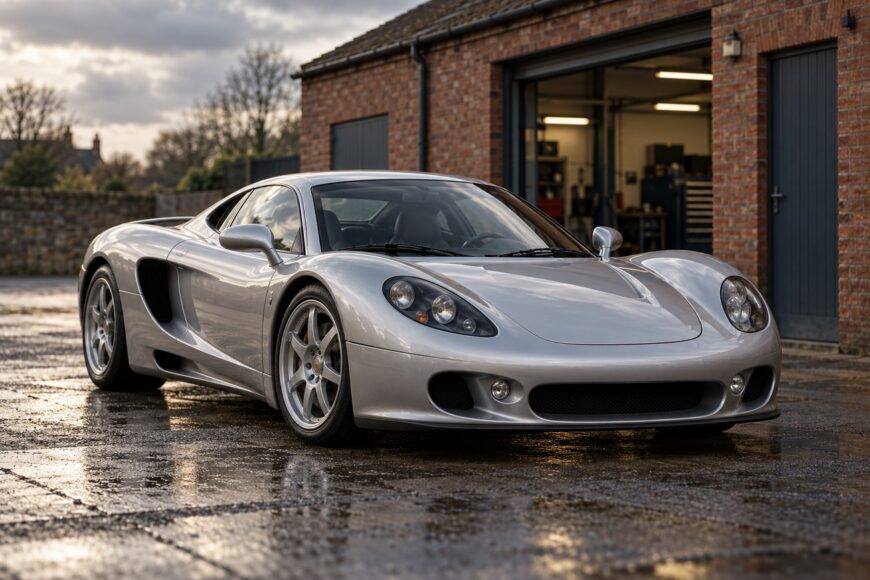
The Ascari KZ1 could run with the supercars of its era, yet it remains obscure. Built in Banbury, England, it put a BMW V8 behind the driver and sent its power to the rear wheels. The familiar engine name offers little reassurance to an owner, though: the KZ1 never came with the parts supply or service network of a mainstream BMW.
That tension makes it an unusually difficult car to judge. It has the layout and performance of a serious driver’s machine, while conflicting published specifications complicate even a basic comparison. The track-oriented KZ1-R adds another source of confusion. For a buyer, the decisive issue may be less how quickly a KZ1 accelerates than how long it could sit waiting for the right repair.
- Banbury, BMW Power, and the KZ1 Idea
- How the KZ1 Was Engineered
- KZ1 vs KZ1-R: The Numbers That Change the Car
- What the Performance Figures Really Mean
- The Hidden Cost of Owning a Rare British Supercar
- Buying a KZ1: Errors to Avoid
- Frequently asked questions
- Why did Ascari go out of business?
- Was the Ascari KZ1 a “poor man’s supercar”?
- What documents should a prospective KZ1 buyer request before viewing the car?
Banbury, BMW Power, and the KZ1 Idea
The Ascari KZ1 appeared in 2003, with production planned to begin that year. It belonged to a small group of early-2000s British supercar projects that sought established mechanical components without adopting the character of the cars that supplied them. Its Banbury origin matters because this was a limited-production car assembled outside a large manufacturer’s industrial and support system.
The KZ1’s engine sits behind the occupants in a mid-engine, rear-wheel-drive layout. Its 5.0-liter BMW S62 V8 has variable valve timing and dry-sump lubrication. BMW provenance provides a useful starting point for identifying the engine family; it does not make the complete car a familiar BMW in a different body.
Packaging, lubrication, and the manual transmission point toward a road-going racing-car character rather than a comfortable grand tourer. That distinction is useful when reading period praise. A responsive car on a clear road may ask much more of its driver in traffic or on a long journey.
The KZ1 was extremely rare, but its production total deserves careful wording. Some catalogs claim 50 examples; independent sources do not consistently confirm that figure. Rarity is certain enough to shape the ownership decision, even if a precise total is harder to establish.
How the KZ1 Was Engineered
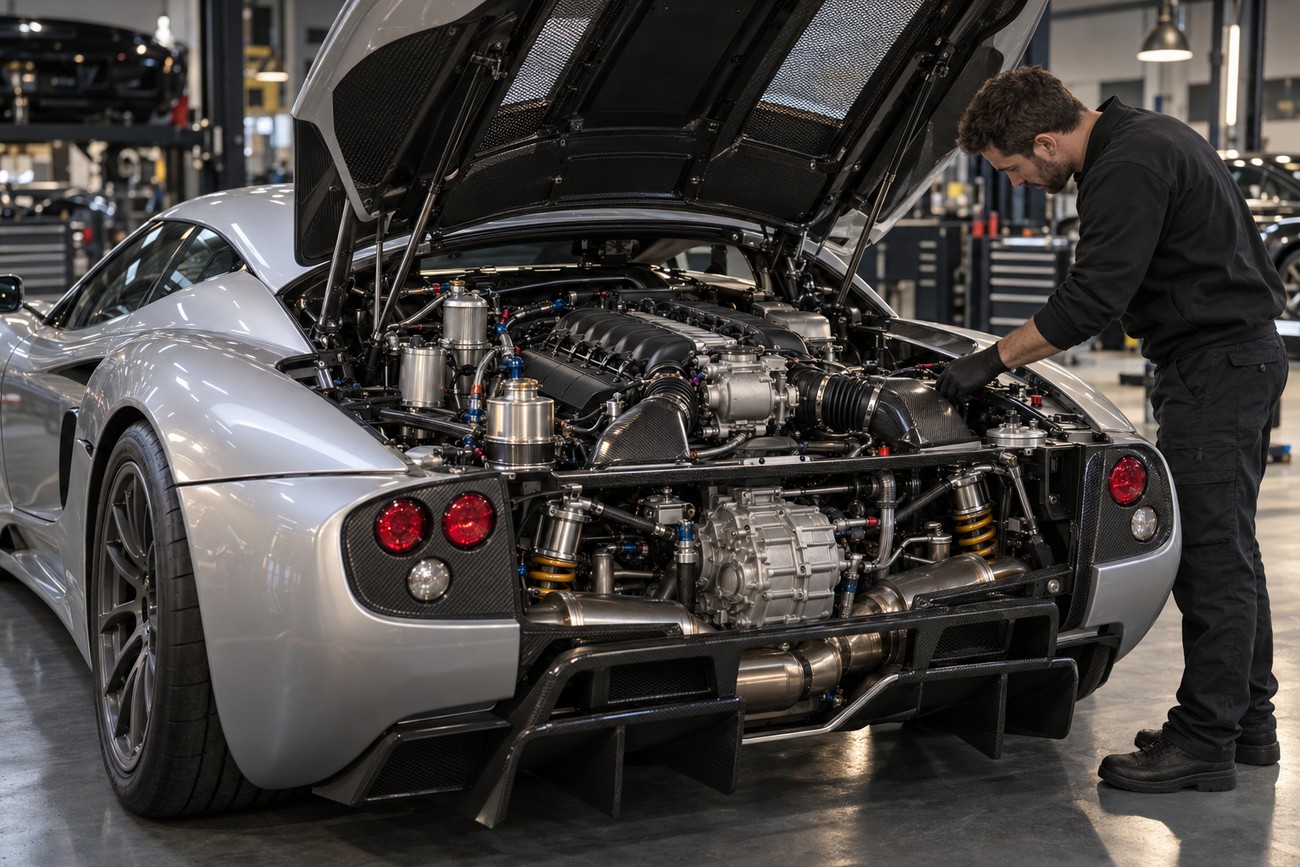
A six-speed manual gearbox gives the driver direct control over the V8, with power delivered to the rear wheels. On a circuit, choosing gears is part of the appeal: the driver can hold an engine speed through a corner and prepare for the exit. In slow traffic, repeated clutch and shift work can make the same arrangement tiring.
The KZ1 measures approximately 4,300 × 1,852 × 1,138 mm, with a 2,636 mm wheelbase. Those figures describe a low, compact supercar, but they cannot by themselves predict its behavior over a rough road or at the limit. Tire condition, alignment, and the state of the suspension matter far more to the way an individual example drives.
Dry-sump lubrication helps control the oil supply under high lateral loads, when sustained cornering can challenge a conventional arrangement. It is a meaningful feature for a car expected to see track use. It also makes the lubrication system and its maintenance history important parts of an inspection, rather than incidental engine details.
A quoted 0–100 km/h time captures only one launch. For repeated hard driving, mass, cooling, brakes, and chassis setup affect whether the car remains consistent after several laps. A short test drive may reveal the engine’s thrust while leaving those longer-duration demands unanswered.
KZ1 vs KZ1-R: The Numbers That Change the Car
Published figures vary, so this comparison uses commonly cited specifications rather than treating either version as a single, immutable factory configuration. Note that the acceleration claims use different speed benchmarks.
| Specification | KZ1 | KZ1-R |
|---|---|---|
| Power | 500–507 hp | Approximately 520 hp |
| Torque | 550 Nm | 550 Nm |
| Mass | 1,275–1,350 kg, depending on source and specification | Approximately 1,250 kg |
| Acceleration | 0–100 km/h in approximately 3.7–3.8 seconds | 0–60 mph in about 3.4 seconds |
| Top speed | Approximately 320–323 km/h | Near 322 km/h |
| Intended use | Road-going supercar | Track-oriented specification |
The KZ1-R should not be treated as a KZ1 with a software upgrade. Its quoted mass and track-oriented purpose are as important to its identity as the higher power figure. Nor are the two acceleration claims directly interchangeable: 60 mph is below 100 km/h, and published test conditions may differ.
What the Performance Figures Really Mean
Most published KZ1 top-speed claims fall around 320–323 km/h. That narrow spread makes the car’s intended performance clear, but it does not verify the maximum speed of a particular example. Condition, configuration, and the origin of a quoted figure still matter.
The commonly listed 500–507 hp range calls for similar restraint. Sources may round or convert a power claim differently, while the KZ1-R is separately listed at approximately 520 hp. A seller’s use of the larger number is therefore a reason to check the car’s exact specification, rather than assume it describes every KZ1.
Mass is the more consequential catalog disagreement: published KZ1 figures run from 1,275 to 1,350 kg, depending on source and specification. That difference can affect how a reader interprets braking, cornering, and power-to-weight claims. Without a documented measurement and an explanation of what was included, a precise-looking weight is only a claim.
Top Gear featured the KZ1 in November 2005, and a quoted lap time was 1:20.7. It is valuable period evidence that the car could deliver serious pace in a contemporary test. It is not a guarantee that every surviving KZ1, on different tires and in a different state of maintenance, will perform identically.
The Hidden Cost of Owning a Rare British Supercar
The KZ1’s principal ownership burden is logistics. A suitable place to store it, access to a specialist, parts delivery, and the possibility of prolonged downtime all affect whether it can actually be used. Headline engine output tells a prospective owner little about any of those constraints.
The S62 connection may help a workshop understand the engine family, but the KZ1’s installation and dry-sump system require specific knowledge. Maintenance records should show more than occasional oil changes, particularly if the car has seen circuit use. A workshop willing to service an ordinary BMW V8 may still be the wrong choice for this application.
Assess a dry-sump service as a check of the complete system: oil level procedure, leaks, tank, lines, cooling, and evidence of correct maintenance. An invoice describing only a routine BMW oil change leaves important questions open.
Unique bodywork, trim, and lighting components present a different problem. Even modest collision damage may need difficult-to-source parts, making the repair disproportionate to the visible impact. Before committing to a car with repaired damage, establish what was replaced, what was fabricated, and whether the finished work can be inspected.
Ordinary roads expose the other side of its track-focused character. Noise, heat, a stiff setup, and the effort of a manual gearbox can make frequent urban use demanding. The practical purchase decision is therefore about the journeys you intend to make, as well as the performance you hope to enjoy.
Buying a KZ1: Errors to Avoid
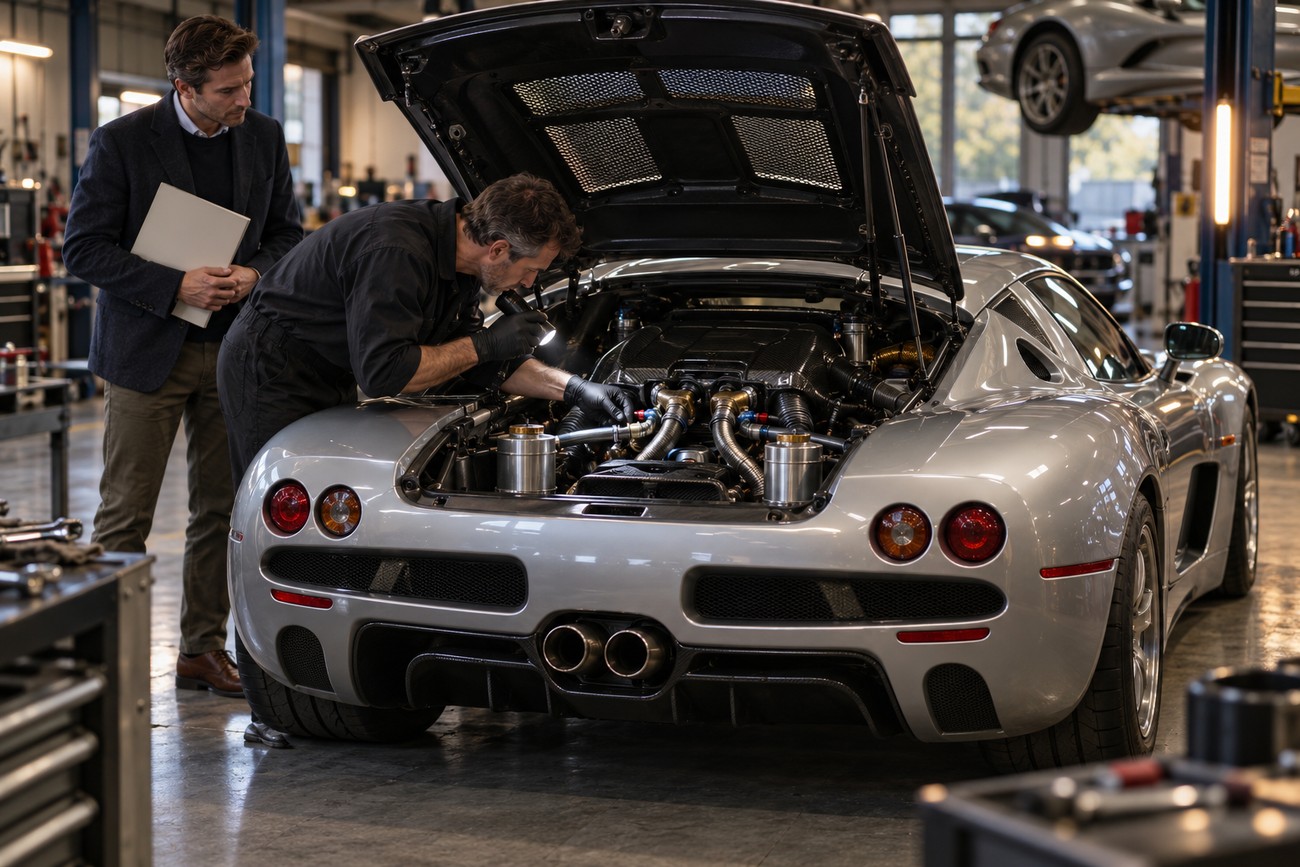
Start with the identity of the individual car. Confirm whether it is a KZ1 or a KZ1-R, and check its actual equipment and configuration against its history. A catalog entry cannot settle discrepancies in published mass or performance figures, and a track-oriented badge should never substitute for chassis-specific evidence.
Trace ownership, maintenance, modifications, and any competition or track use as far as the records allow. Ask who performed work on the engine and dry-sump system, and whether later tuning or component changes were documented. An apparently healthy short drive cannot establish how the car has been maintained over time.
Examine accident history with particular care. Repairs to scarce panels or lighting may have required unusual solutions, so photographs, parts receipts, and an inspection of the finished work are more useful than a broad assurance that the damage was minor. If records are thin, allow for both the cost of further investigation and the risk of future downtime.
Finally, identify a qualified service route before agreeing to buy. BMW-sourced engine hardware does not remove the complications of a rare chassis, a dry-sump installation, or model-specific parts. A KZ1 makes the strongest case as a driver’s car when its provenance and support arrangements are as convincing as its performance claims.
Frequently asked questions
Ascari’s history is often compressed into a story about the KZ1’s pace or rarity. Those details alone cannot explain a business outcome or determine what a surviving car is worth. The following distinctions are especially useful when assessing the marque and an individual example.
Why did Ascari go out of business?
There is no single, consistently documented cause that should be presented as a definitive explanation for Ascari’s disappearance. Building a limited-production supercar and sustaining the commercial scale and support network behind it are different challenges; the KZ1’s engineering appeal does not establish that the business could support ongoing production.
Was the Ascari KZ1 a “poor man’s supercar”?
“Poor man’s supercar” is an informal value comparison, not an official class of car. Applied to the KZ1, it can obscure the costs that matter after purchase: rarity, specialist servicing, scarce parts, and uncertain downtime. It is a misleading shortcut for anyone setting an ownership budget.
What documents should a prospective KZ1 buyer request before viewing the car?
Request chassis-specific ownership provenance, maintenance invoices, inspection records, parts receipts, and evidence of any accident repairs before traveling to see it. Ask for documentation of modifications and specialist work, including work on the lubrication system. This allows you to identify gaps early and arrange an inspection around the particular car’s history rather than a generic KZ1 specification.







