
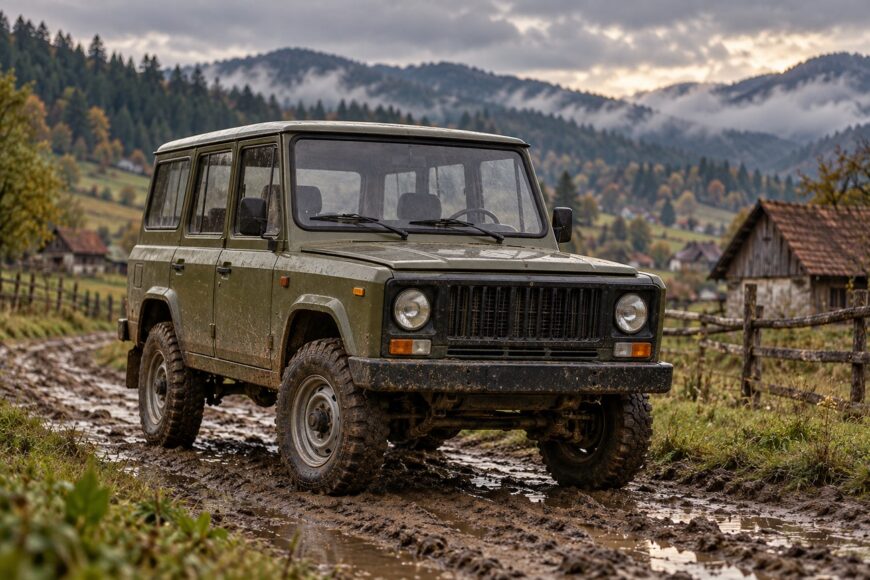
The ARO 24 has the appeal of a working tool: a Romanian, body-on-frame off-roader built for rough roads, loads, and service use rather than polished urban travel. Its simple appearance, upright body, and old-school four-wheel-drive hardware make it attractive to buyers who want character with genuine utility.
The complication is that an ARO 24 listing can hide a substantially different vehicle from the one you expect. The family includes several body indices, petrol and diesel engines, different four-wheel-drive arrangements, and export-market specifications. A generic photograph or a claimed power figure is therefore only a starting point.
- Why the ARO 24 mattered beyond Romania
- One badge, several bodies and purposes
- ARO 24 specifications: family range versus a 2.5 example
- Engines and four-wheel drive: verify the vehicle, not the badge
- What tough-as-nails means on the road and trail
- Buying an ARO 24 without inheriting the wrong project
- Frequently asked questions
- What was the ARO car brand?
- What is the most popular car in Romania?
- Which car is made in Romania?
Why the ARO 24 mattered beyond Romania
ARO 24 was a Romanian body-on-frame utility-vehicle family produced from 1972 to 2006. ARO was the marque, while “24” covered a broad group of work-oriented vehicles rather than one fixed specification. That distinction explains why catalog figures and owner descriptions can vary so widely.
The family had practical appeal in regions where roads were poor, loads mattered, and repairability counted more than refinement. Its frame, utility bodies, and mechanical layout suited agricultural, forestry, military, and service duties. Simplicity shaped the driving experience, although it does not mean every component is easy to source or repair today.
By the end of 1985, more than 125,000 ARO 24-family vehicles had been produced, with more than 93,000 exported. That export reach gave the vehicle a life beyond Romania and also created a modern identification problem: surviving examples may follow specifications associated with another market or period.
The ARO 24’s importance lies in its role as an affordable working 4×4, rather than as a luxury or performance vehicle. Its reputation for toughness comes from the underlying purpose of the design. Decades later, condition determines whether that toughness remains useful or has become an expensive restoration story.
One badge, several bodies and purposes
The family includes the 240, 241, 242, 243, and 244 indices, as well as open-body vehicles, pickups, and enclosed utility wagons. These forms serve different jobs, so a photograph that appears to show a short-wheelbase vehicle, a canvas-topped vehicle, and a closed wagon should not be treated as interchangeable examples.
An open version may appeal to a collector or farm user who values simple access and load flexibility. A pickup can make more sense for equipment, while an enclosed wagon offers greater protection for passengers and cargo. The practical differences affect seating, weather protection, payload expectations, and the amount of work required to make the vehicle usable.
Body identity should be checked on the vehicle itself. Look for the stamped identity, chassis and body details, engine markings, registration documents, and any period plate or data label. An advertisement title may use “ARO 24” as a convenient family description even when the individual vehicle belongs to a specific index with different equipment.
Past conversions add another layer of uncertainty. An open body may have been replaced, a diesel may have been installed in place of a petrol engine, or a work vehicle may have received non-original trim. Generic online photographs are useful for orientation, yet they cannot establish the specification of the vehicle you are considering.
ARO 24 specifications: family range versus a 2.5 example
The figures below separate broad family references from one cataloged version. This matters because the ARO 24 name covers different engines, bodies, weights, and markets.
| Item | Scope | Figure |
|---|---|---|
| Engine | Family range across listed variants | Four-cylinder petrol and diesel engines, approximately 2.1–3.1 liters and 59–147 hp |
| Gearbox | Commonly listed family equipment | Four- and five-speed manual gearboxes; no regular automatic version established in mass-market catalogs |
| Top speed | One cataloged 2.5-liter, 86 hp version | Approximately 120 km/h |
| Curb weight | One cataloged 2.5-liter, 86 hp version | Approximately 1,815 kg |
| Fuel tank | One cataloged 2.5-liter, 86 hp version | 95 liters |
| Payload | Period or typical-family reference | Approximately 700 kg; not a guarantee for every body or variant |
| Fuel consumption | Period or typical-family reference | Approximately 13.8 L/100 km; real use depends on engine, load, and condition |
| Climbable gradient | Period or typical-family reference | Up to 35°; actual capability depends on configuration, tires, surface, and condition |
Engines and four-wheel drive: verify the vehicle, not the badge
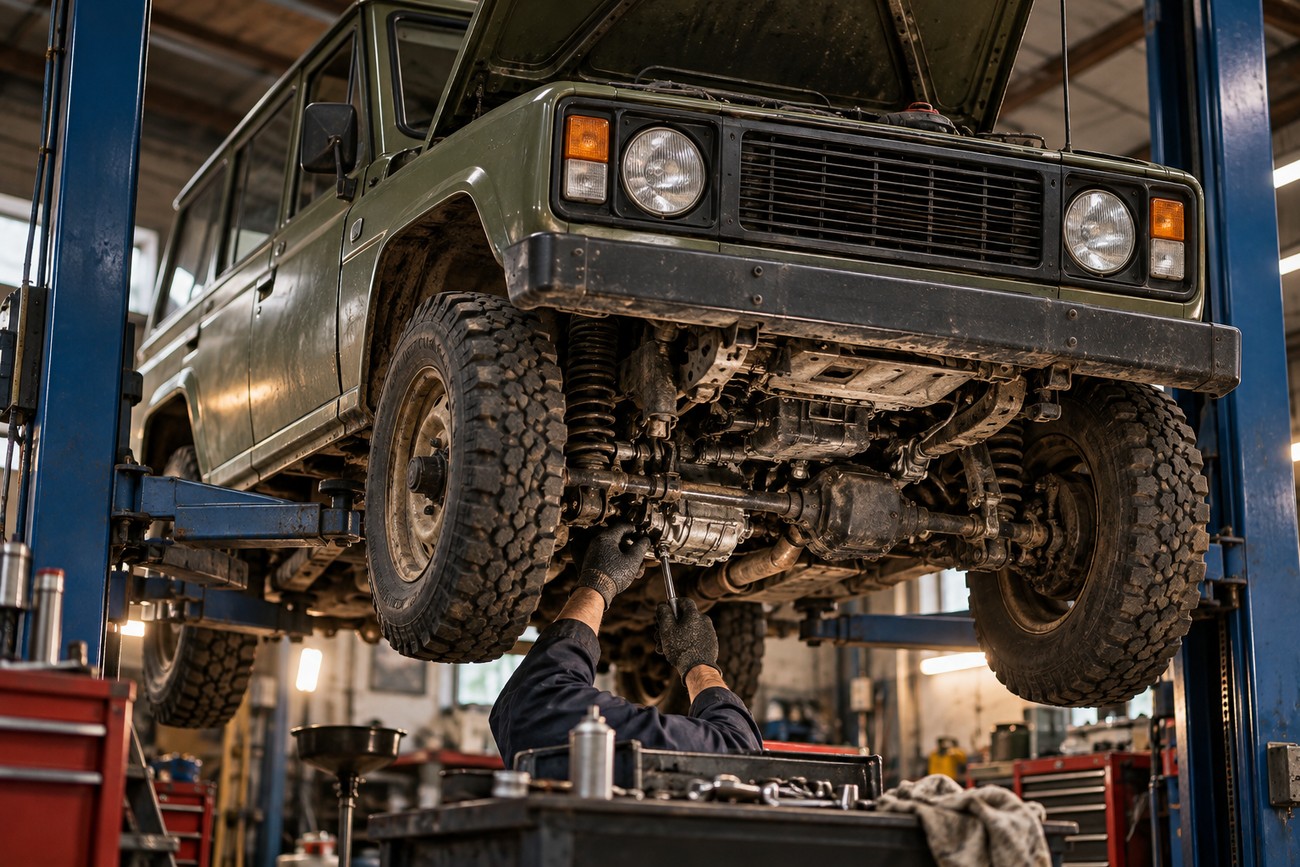
Across the family, listed four-cylinder petrol and diesel engines span approximately 2.1–3.1 liters and 59–147 hp. That range is too broad for a single reputation to describe every ARO 24. A 2.5-liter, 86 hp example belongs to one cataloged configuration, not to the entire family.
Engine swaps make advertised figures even less reliable. Before accepting a seller’s description, compare the engine identification with the paperwork, the registration record, and the vehicle’s stamped identity. Inspect the drivetrain as well to see whether the gearbox and ancillary systems belong to the installed engine or were adapted from another vehicle.
Four- and five-speed manual gearboxes are commonly listed, while mass-market catalogs do not establish a regular automatic version. Four-wheel-drive arrangements differ by modification: some vehicles are reported with selectable four-wheel drive, while others use a full-time arrangement. The transfer case, controls, and operating instructions fitted to the individual vehicle matter more than a bare “4×4” label.
Export history can complicate research because a vehicle sold in one market may carry a different engine or equipment package from a similarly named example elsewhere. Ask for photographs of the identification plate, engine markings, gearbox controls, and underside before traveling to inspect it. These details often settle a specification dispute faster than an old brochure.
What tough-as-nails means on the road and trail
The ARO 24’s frame and utility bodies give it the right basic character for farm tracks, forest roads, construction access, and slow work over broken ground. Period or typical-family references cite a payload of approximately 700 kg and a climbable gradient of up to 35°. Those figures describe the intended working role, while real results depend on tires, surface, load, gearing, and mechanical condition.
Its road manners require realistic expectations. Reports for typical versions commonly place top speed around 110–120 km/h, and one cataloged 2.5-liter, 86 hp version is listed at approximately 120 km/h. A top-speed figure does not establish a comfortable sustained cruising speed, especially in a vehicle with substantial noise, vibration, basic trim, and age-related wear.
Fuel use can also challenge modern expectations. Period or typical-family references cite approximately 13.8 L/100 km, although the result varies with engine type, load, tires, drivetrain condition, and driving conditions. Petrol versions may be particularly difficult to reconcile with a daily commute if the vehicle also needs frequent age-related repairs.
The most convincing ARO 24 is a sound, correctly configured working vehicle used for the tasks its design suits. It is much less convincing as a substitute for a modern SUV. Slow travel, cabin noise, limited refinement, and uncertain parts support are part of the ownership decision rather than minor details to discover afterward.
Buying an ARO 24 without inheriting the wrong project
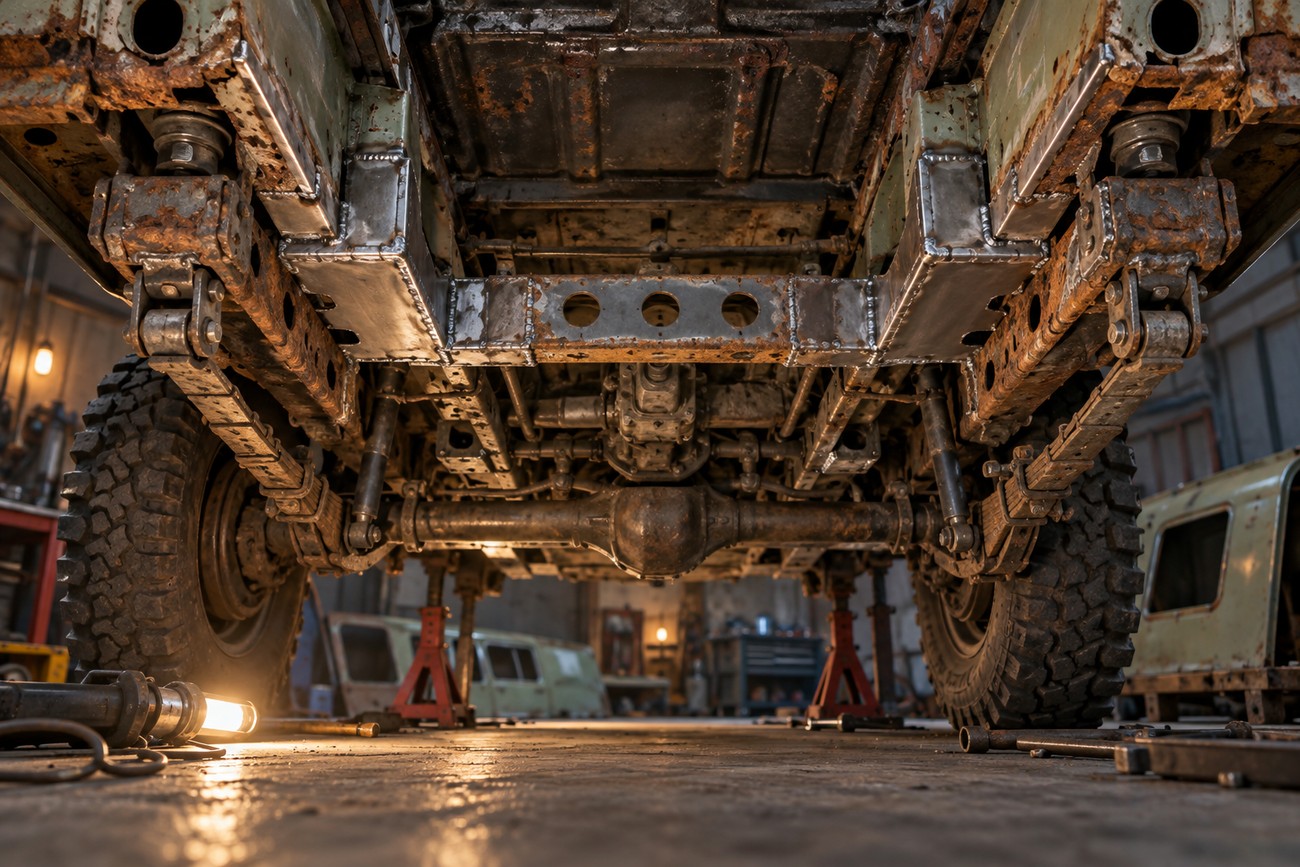
Start with identity. Confirm the 240, 241, 242, 243, or 244 index, identify the fitted engine, and compare both with the registration documents and stamped numbers. Record the body style and four-wheel-drive controls as well. This prevents a common mistake: buying a vehicle based on the family name and discovering that its actual configuration has different space, performance, or parts requirements.
Inspect the frame before becoming interested in paint or accessories. Check rails, crossmembers, suspension mounting areas, body mounts, and the structure around repaired sections for corrosion or poorly executed welding. Examine the body separately, since a tidy exterior can conceal structural work underneath, while an untidy body may still sit on a serviceable frame.
Test the transmission and four-wheel-drive system under safe conditions. Look for difficult engagement, abnormal noises, leaks, and evidence that controls or linkage have been improvised. A vehicle that moves under its own power can still require major work in the gearbox, transfer case, axles, or associated controls.
Non-original repairs deserve careful attention rather than automatic rejection. A sound conversion may be workable, while an undocumented engine swap or mixed drivetrain can make future maintenance difficult. Ask which parts have already been replaced, whether the vehicle has been used for heavy work, and whether the seller can show invoices, old components, or technical documentation.
Parts availability depends heavily on the exact variant. Common mechanical items may be easier to locate than uncommon body, trim, or drivetrain components, and export-market differences can limit compatibility. A hobby vehicle can tolerate research time and occasional downtime; a dependable daily driver usually needs a more predictable supply of parts and a much stronger inspection result.
Frequently asked questions
The ARO name, the 24 family designation, and an individual vehicle’s specification answer different questions. Production history gives context, but it cannot identify the engine, body, or drivetrain on a vehicle for sale. The answers below keep those distinctions in view.
What was the ARO car brand?
ARO was the Romanian vehicle marque, while ARO 24 was a family of utility vehicles sold under that marque. The 24 designation covered several body indices, engines, and market specifications, so it does not identify one exact model in the way a single modern trim name might.
For a particular vehicle, the useful evidence is its stamped identity, engine, body, paperwork, and drivetrain controls. Those details are more reliable than a seller’s use of “ARO” or “ARO 24” as a broad advertising label.
What is the most popular car in Romania?
There is no single timeless answer because popularity changes with the year, whether the measure is new registrations or the whole vehicle fleet, and whether commercial vehicles are included. The ARO 24 should not be described as Romania’s most popular car on the basis of its historical importance.
Its significance is narrower and more practical: it became a recognizable Romanian utility-vehicle family with substantial export reach. That historical role does not make every surviving example common, easy to maintain, or suitable for ordinary daily transport.
Which car is made in Romania?
Romania has produced many vehicle types, including ARO vehicles and the ARO 24 family. A car’s country of manufacture should be checked from its identification plate, production records, and market documentation, since a Romanian marque, an assembly location, and an export specification are separate facts.
For an ARO 24, registration requirements, trailer limits, and parts compatibility cannot be established from the family name alone. Confirm those points for the individual vehicle and your local jurisdiction before purchase or modification.







